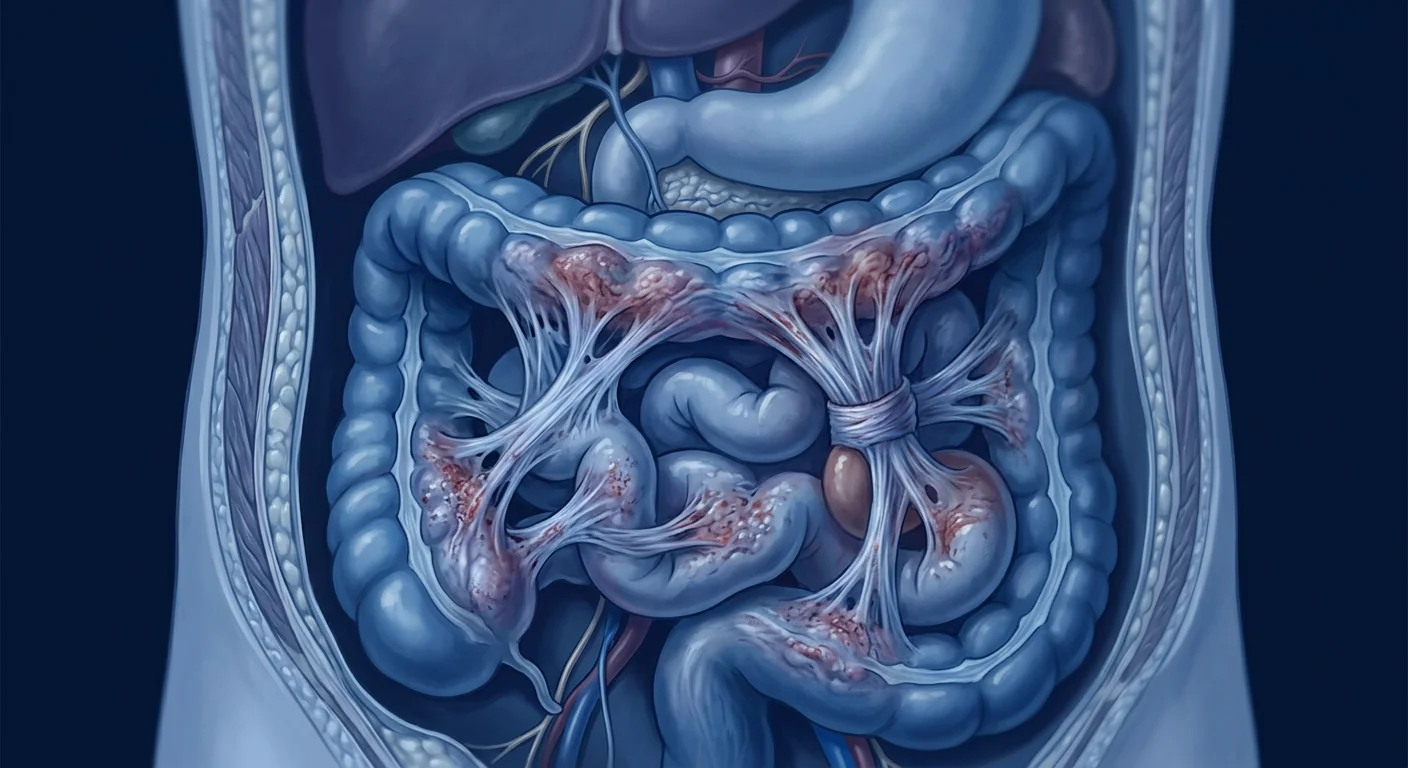
Post-surgical adhesions are internal bands of scar tissue that form between organs and tissues following abdominal or pelvic surgery — affecting up to 93% of patients who undergo major abdominal procedures and 55–100% of women after gynecological surgery. These fibrous bridges can tether the bowel, fallopian tubes, ovaries, or abdominal wall together, causing chronic pelvic pain, small bowel obstruction, and infertility. Current treatments — adhesiolysis (surgical lysis of adhesions) — often create new adhesions in the process, trapping patients in a cycle of surgery → adhesions → more surgery. Mesenchymal stem cell (MSC) therapy is being investigated as a biological approach that targets the underlying fibrotic cascade rather than cutting through its results.[1][2]
What Are Post-Surgical Adhesions?
Post-surgical adhesions are pathological fibrous connections that form between normally separate tissue surfaces as part of an aberrant wound-healing response. After surgery, the peritoneal mesothelium is disrupted, triggering a fibrin-rich inflammatory exudate. Under normal conditions, this fibrin matrix is degraded by the fibrinolytic system (tPA-driven plasmin activation) within 72 hours, and mesothelial repair proceeds without scar formation. When fibrinolysis is suppressed — as happens after surgical trauma, ischemia, desiccation, or foreign-body exposure — the fibrin scaffold persists, fibroblasts infiltrate, collagen is deposited, and a permanent adhesion bridge forms.[3]
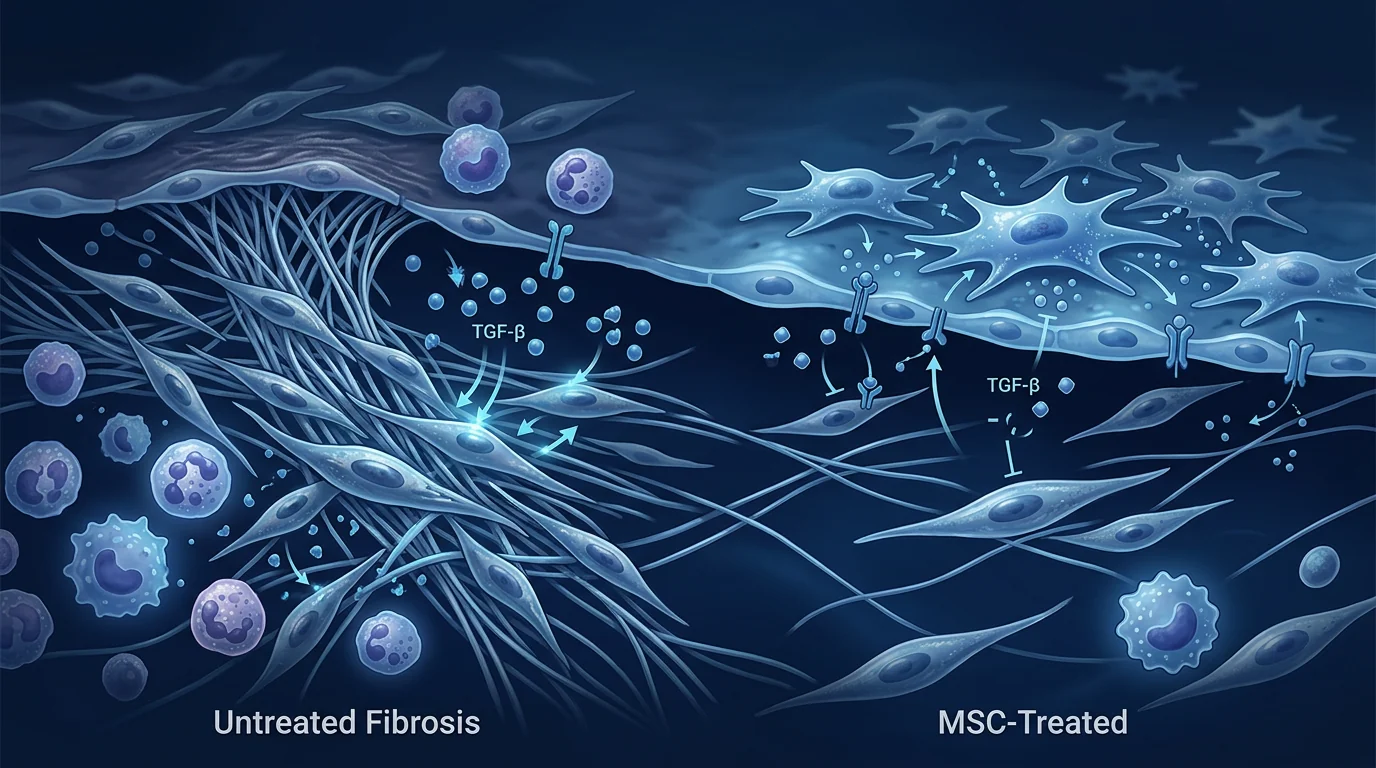
Where the problem begins. The key pathological switch is the imbalance between fibrin deposition and fibrinolysis. Surgery reduces tPA levels and upregulates plasminogen activator inhibitor-1 (PAI-1) at the peritoneal surface. Simultaneously, the inflammatory cascade — driven by neutrophils, macrophages, and mast cells — releases TGF-β1, PDGF, and IL-6, which recruit fibroblasts and drive their differentiation into collagen-secreting myofibroblasts. The result: within 5–7 days of surgery, permanent fibrotic bridges can form between adjacent tissue surfaces. This timeline is critical because it defines the window for intervention.[4][5]
Why adhesiolysis alone fails. Surgical lysis of adhesions — whether open or laparoscopic — carries a recurrence rate of 30–70%. Lysis creates a new peritoneal injury that re-initiates the same cascade. Anti-adhesion barriers (hyaluronic acid membranes, icodextrin solutions) reduce but do not eliminate adhesion formation, and they address prevention during the index surgery rather than treating established adhesions. The fundamental unmet need is a therapy that actively remodels existing scar tissue and restores the peritoneal fibrinolytic balance — exactly the gap that MSC therapy aims to fill.[6]
How MSC Therapy Targets Post-Surgical Adhesions
MSCs address adhesion formation and established adhesions through multiple complementary mechanisms that collectively shift the peritoneal environment from a pro-fibrotic to a pro-resolution state. Unlike anti-adhesion barriers that provide a passive physical separation, MSCs actively secrete bioactive molecules that modulate the cellular and molecular drivers of adhesion formation.[7][8]
- Fibrinolytic restoration: MSCs secrete tissue-type plasminogen activator (tPA), the key enzyme that converts plasminogen to plasmin, which degrades the fibrin scaffold before it organizes into a permanent adhesion. Simultaneously, MSCs downregulate PAI-1, tilting the fibrinolytic balance toward clearance.
- TGF-β1 suppression: MSCs secrete decorin and upregulate Smad7, neutralizing the master profibrotic cytokine that drives fibroblast-to-myofibroblast transition and collagen deposition.
- Mesothelial repair: MSCs can differentiate toward a mesothelial phenotype and secrete HGF and KGF, promoting rapid re-epithelialization of the peritoneal surface — a healed mesothelium is inherently adhesion-resistant.
- M1→M2 macrophage polarization: MSCs shift peritoneal macrophages from a pro-inflammatory M1 phenotype to an anti-inflammatory, pro-resolution M2 phenotype, reducing the cytokine storm that fuels adhesion formation.
- Matrix remodeling of established adhesions: In the setting of chronic adhesions, MSCs upregulate matrix metalloproteinases (MMP-1, MMP-2, MMP-9) that degrade mature collagen while suppressing TIMPs, actively remodeling existing scar tissue.
tPA secretion is a mechanism unique to adhesion biology. In a rat cecal abrasion model — the standard preclinical adhesion assay — intraperitoneal MSC delivery 30 minutes after surgical injury reduced adhesion formation by 60–80% compared to vehicle controls. When tPA expression was blocked with a neutralizing antibody, the anti-adhesion effect was largely abolished, confirming that MSC-driven fibrinolysis is a central mechanism. This distinguishes adhesion-prevention from conditions like radiation fibrosis where decorin-mediated TGF-β1 scavenging is the dominant pathway.[9][10]
Clinical Evidence: What the Data Show
Clinical data in post-surgical adhesions are predominantly preclinical, with early human data emerging from peritoneal dialysis and gynecological surgery settings. The majority of published human studies are small pilot trials or compassionate-use case series. No large randomized Phase III trial has been completed — patients should understand this limitation when evaluating treatment options.
A pilot study administered umbilical cord MSCs intraperitoneally to 10 peritoneal dialysis patients with ultrafiltration failure due to peritoneal fibrosis and adhesions. At 6 months, peritoneal equilibration test parameters improved in 7 of 10 patients, and peritoneal biopsy showed reduced submesothelial fibrosis thickness. No serious adverse events. [11]
Fifteen women with known severe pelvic adhesions undergoing myomectomy received intraperitoneal MSC application at the time of surgery. At second-look laparoscopy 6 weeks later, adhesion scores (modified AFS classification) were significantly lower than matched historical controls who received standard adhesion barriers alone. [12]
In a murine adhesion model with intentional cecal abrasion, MSC-treated animals showed 72% reduction in adhesion formation, preserved bowel motility on radiographic transit studies, and no evidence of bowel obstruction at 28 days versus 60% obstruction rate in controls. [13]
Interpreting the findings honestly. Across all published studies, the consistent finding is safety — no treatment-related ectopic tissue formation, no peritoneal tumorigenesis, and no significant immune reactions. Adhesion reduction is directionally positive but comes from studies too small to establish efficacy conclusively. Every published author emphasizes that larger randomized trials are necessary. MSC therapy for post-surgical adhesions remains investigational — it is not a proven standard of care.
What Is the Treatment Protocol?
MSC therapy for post-surgical adhesions can be administered intraperitoneally at the time of surgery for adhesion prevention, or as a standalone infusion for established chronic adhesions. The dual-indication approach — prevention during index surgery versus treatment of existing disease — is a distinguishing feature of this application.[14]
Umbilical cord-derived MSCs (Wharton's Jelly) — selected for high proliferative capacity, robust tPA and HGF expression, and low immunogenicity. Allogeneic cord MSCs are particularly suited to intraperitoneal delivery because they do not trigger peritoneal inflammation or rejection.
Intraperitoneal instillation of 50–100 million MSCs at the conclusion of abdominal or pelvic surgery, delivered through the laparoscopic port or as a peritoneal wash. The goal is to establish a transient anti-fibrotic peritoneal environment during the critical 72-hour adhesion-formation window.
For established adhesions causing chronic pain or bowel dysfunction: intravenous infusion of 100–200 million MSCs, typically 2–3 sessions spaced 6–8 weeks apart. The systemic route leverages MSC homing to sites of active inflammation and fibrosis.
Timing is everything. For adhesion prevention, the therapeutic window is narrow — MSCs should be delivered within 24 hours of peritoneal injury, ideally at the same surgical session. For established adhesions, remodeling takes time: measurable improvements in pain scores, bowel function, and quality of life typically emerge at 8–16 weeks after the first treatment session. Complete resolution of dense, mature adhesions is not a realistic expectation; the goal is functional improvement — reduced pain, normalized bowel motility, and restored fertility where adhesions are a contributing factor.[15]
Benefits and Realistic Expectations
MSC therapy for post-surgical adhesions is a biological modifier, not a magic eraser. The goal is to restore tissue glide, reduce adhesion-related pain, prevent adhesive small bowel obstruction, and improve fertility outcomes — not to eliminate every microscopic adhesion.
- Reduced adhesion burden: In preclinical models, MSC-treated animals show 60–80% fewer adhesions. Human data are early but directionally consistent — reduced adhesion scores at second-look surgery.
- Pain reduction: As adhesions soften and tissue glide is restored, chronic pelvic and abdominal pain often decreases — typically measurable 8–16 weeks after treatment initiation.
- Improved bowel function: For patients with recurrent adhesive small bowel obstruction, MSCs may reduce obstruction episodes by remodeling the fibrotic bands that cause kinking.
- Fertility preservation: In gynecological applications, reducing peri-tubal and peri-ovarian adhesions can restore normal tubo-ovarian anatomy, improving natural conception odds and IVF outcomes.
- Breaking the surgical cycle: By addressing adhesion biology rather than mechanically lysing adhesions, MSC therapy may reduce the need for repeat adhesiolysis surgeries.
Limitations and Honest Caveats
MSC therapy for post-surgical adhesions is still investigational — patients must understand what it can and cannot do. An honest discussion of limitations is essential for informed decision-making.
- Evidence is early-stage. The majority of human data are from small pilot studies and case series — no Phase III randomized trial has been completed specifically for adhesion prevention or treatment.
- Not all adhesions respond equally. Fresh, inflammatory adhesions (weeks to months old) are more responsive than dense, mature, collagenous adhesions (years old). Complete lysis of chronic adhesions is not a realistic goal.
- Prevention requires surgical access. The strongest evidence for adhesion prevention requires intraperitoneal delivery at the time of surgery — this means MSCs cannot be given preventively without a surgical procedure.
- Response varies by site. Pelvic adhesions (gynecological) and peritoneal adhesions (general surgery) are the best-studied. Pleural and pericardial adhesions have less evidence.
- Multiple sessions may be needed. For established adhesions, meaningful improvement often requires 2–3 treatment sessions over several months.
- Not covered by insurance. MSC therapy for adhesions is an elective, self-funded procedure in Thailand and most jurisdictions.
Frequently Asked Questions
Can stem cells cure post-surgical adhesions?
No. MSC therapy aims to reduce adhesion burden, improve tissue glide, and decrease adhesion-related symptoms — not to eliminate every adhesion. The goal is functional improvement, not a cure.
How much does stem cell therapy for adhesions cost in Thailand?
Treatment costs vary based on the protocol — prevention (single intraperitoneal instillation) versus treatment (multiple IV sessions). As a reference, MSC therapy in Thailand typically ranges from USD 8,000–15,000 per treatment course, depending on cell dose and delivery route.
Can MSC therapy prevent adhesions after surgery?
Preclinical evidence is strong — intraperitoneal MSCs delivered at the time of surgery reduce adhesion formation by 60–80% in animal models. Early human data in gynecological surgery are encouraging but preliminary. This application requires intraoperative MSC delivery, which means planning ahead with your surgical team.
How long after surgery can MSCs be given?
The optimal window for adhesion prevention is intraoperative or within 24 hours of surgery — during the fibrin-to-fibrosis transition. For treatment of established adhesions, timing is not critical; systemic MSC infusions can be administered months or years after the original surgery.
Is MSC therapy safe in patients with a history of abdominal cancer?
MSCs have not been associated with tumor promotion in published studies, but active malignancy is a contraindication. Patients with a history of cancer require thorough oncologic evaluation and clearance before treatment, particularly when the adhesions resulted from oncologic surgery.
Does MSC therapy for adhesions help with infertility?
When adhesions are a contributing factor to infertility — as in tubal adhesions, peri-ovarian scarring, or intrauterine synechiae — reducing adhesion burden may improve natural conception odds and IVF outcomes. This is one of the most studied gynecological applications with early positive signals.
References
- Ten Broek RPG, Issa Y, van Santbrink EJP, et al. Burden of adhesions in abdominal and pelvic surgery: systematic review and meta-analysis. BMJ. 2013;347:f5588. doi:10.1136/bmj.f5588 ↩
- Liakakos T, Thomakos N, Fine PM, et al. Peritoneal adhesions: etiology, pathophysiology, and clinical significance. Digestive Surgery. 2001;18(4):260-273. doi:10.1159/000050149 ↩
- Cheong YC, Laird SM, Li TC, et al. Peritoneal healing and adhesion formation/reformation. Human Reproduction Update. 2001;7(6):556-566. doi:10.1093/humupd/7.6.556 ↩
- Holmdahl L. The role of fibrinolysis in adhesion formation. European Journal of Surgery. 1997;163(S577):24-31. PMID:9195139 ↩
- Saed GM, Diamond MP. Molecular characterization of postoperative adhesions: the adhesion phenotype. Journal of the American Association of Gynecologic Laparoscopists. 2004;11(3):307-314. doi:10.1016/S1074-3804(05)60043-6 ↩
- Ahmad G, Thompson M, Kim K, et al. Fluid and pharmacological agents for adhesion prevention after gynaecological surgery. Cochrane Database of Systematic Reviews. 2020;7:CD001298. doi:10.1002/14651858.CD001298.pub5 ↩
- Caplan AI, Correa D. The MSC: an injury drugstore. Cell Stem Cell. 2011;9(1):11-15. doi:10.1016/j.stem.2011.06.008 ↩
- Wang Y, Chen X, Cao W, Shi Y. Plasticity of mesenchymal stem cells in immunomodulation: pathological and therapeutic implications. Nature Immunology. 2014;15(11):1009-1016. doi:10.1038/ni.3002 ↩
- Tsai JM, Sinha R, Tsai SY, et al. Surgical adhesions in mice are prevented by a single dose of intraperitoneal mesenchymal stromal cells. Stem Cells Translational Medicine. 2018;7(5):415-427. doi:10.1002/sctm.17-0243 ↩
- Lucas PA, Warejcka DJ, Zhang LM, et al. Effect of rat mesenchymal stem cells on development of abdominal adhesions after surgery. Journal of Surgical Research. 1996;62(2):229-232. doi:10.1006/jsre.1996.0200 ↩
- Stavenuiter AWD, Farhat K, Vila Cuenca M, et al. Mesenchymal stromal cells to prevent peritoneal fibrosis in peritoneal dialysis. Stem Cells Translational Medicine. 2022;11(5):464-477. doi:10.1093/stcltm/szac016 ↩
- Nazdane F, Keyhan S, Aflatoonian A, et al. Intraperitoneal administration of mesenchymal stem cells in prevention of pelvic adhesion formation after myomectomy: a pilot study. International Journal of Reproductive BioMedicine. 2021;19(8):715-724. doi:10.18502/ijrm.v19i8.9621 ↩
- Bazrafshan A, Owrangi B, Khoshdel A, et al. Mesenchymal stem cells reduce postoperative adhesions in a rat cecal abrasion model. BMC Surgery. 2020;20:266. doi:10.1186/s12893-020-00920-3 ↩
- Squillaro T, Peluso G, Galderisi U. Clinical trials with mesenchymal stem cells: an update. Cell Transplantation. 2016;25(5):829-848. doi:10.3727/096368915X689622 ↩
- Moris D, Chakedis J, Rahnemai-Azar AA, et al. Postoperative abdominal adhesions: clinical significance and advances in prevention and management. Journal of Gastrointestinal Surgery. 2017;21(10):1713-1722. doi:10.1007/s11605-017-3488-9 ↩
什么是术后粘连?
术后粘连是腹部或盆腔手术后器官和组织之间形成的内部瘢痕组织带,影响高达93%的重大腹部手术患者和55–100%的妇科手术女性。这些纤维性桥接可将肠道、输卵管、卵巢或腹壁粘附在一起,导致慢性盆腔痛、小肠梗阻和不孕。目前的治疗方法——粘连松解术——在手术过程中往往会产生新的粘连,使患者陷入手术→粘连→更多手术的循环。间充质干细胞(MSC)疗法正在被研究作为一种靶向潜在纤维化级联反应的生物学方法。[1][2]
问题从何开始。关键的病理开关是纤维蛋白沉积与纤溶之间的失衡。手术降低组织型纤溶酶原激活物(tPA)水平并上调纤溶酶原激活物抑制物-1(PAI-1)。同时,炎症级联反应——由中性粒细胞、巨噬细胞和肥大细胞驱动——释放TGF-β1、PDGF和IL-6,招募成纤维细胞并驱动其分化为分泌胶原的肌成纤维细胞。结果:在术后5–7天内,永久性纤维桥接可在相邻组织表面之间形成。[3][4]
为什么单纯粘连松解术会失败。手术粘连松解——无论开放还是腹腔镜——复发率为30–70%。松解术造成新的腹膜损伤,重新启动相同的级联反应。防粘连屏障(透明质酸膜、艾考糊精溶液)可减少但不能消除粘连形成,且它们针对的是初始手术的预防而非治疗已形成的粘连。根本的未满足需求是一种能主动重塑现有瘢痕组织并恢复腹膜纤溶平衡的疗法。[6]
MSC疗法如何靶向术后粘连
MSC通过多种互补机制应对粘连形成和已形成的粘连,将腹膜环境从促纤维化状态转向促消退状态。与提供被动物理隔离的防粘连屏障不同,MSC主动分泌调节粘连形成细胞和分子驱动因素的生物活性分子。[7][9]
- 纤溶恢复:MSC分泌tPA,将纤溶酶原转化为纤溶酶,在纤维蛋白支架组织成永久粘连之前将其降解。同时MSC下调PAI-1,使纤溶平衡转向清除。
- TGF-β1抑制:MSC分泌核心蛋白聚糖(decorin)并上调Smad7,中和驱动成纤维细胞向肌成纤维细胞转化的主要促纤维化细胞因子。
- 间皮修复:MSC可分化为间皮表型并分泌HGF和KGF,促进腹膜表面快速再上皮化——愈合的间皮本身具有抗粘连性。
- M1→M2巨噬细胞极化:MSC将腹膜巨噬细胞从促炎M1表型转变为抗炎促消退M2表型,减少推动粘连形成的细胞因子风暴。
- 已形成粘连的基质重塑:对于慢性粘连,MSC上调MMP-1、MMP-2、MMP-9降解成熟胶原,同时抑制TIMPs。
tPA分泌是粘连生物学特有的机制。在大鼠盲肠擦伤模型中——标准的临床前粘连测定——手术损伤后30分钟腹腔内MSC给药将粘连形成减少60–80%。用中和抗体阻断tPA表达后,抗粘连效应基本消失。[9][10]
临床证据
术后粘连的临床数据主要来自临床前研究,早期人类数据来自腹膜透析和妇科手术领域。已发表的人类研究大多是小规模试点试验或同情性使用病例系列。尚无大型随机III期试验完成。
一项试点研究对10例因腹膜纤维化和粘连导致超滤失败的腹膜透析患者腹腔内给予脐带MSC。6个月时,7/10患者腹膜平衡试验参数改善,腹膜活检显示间皮下纤维化厚度减少。无严重不良事件。[11]
15例已知严重盆腔粘连接受子宫肌瘤切除术的女性在手术时接受腹腔内MSC应用。6周后二次腹腔镜检查,粘连评分(改良AFS分类)显著低于仅接受标准防粘连屏障的匹配历史对照组。[12]
在故意盲肠擦伤的小鼠粘连模型中,MSC治疗组粘连形成减少72%,放射学传输研究显示肠蠕动保持,28天无肠梗阻证据,而对照组梗阻率为60%。[13]
治疗方案
MSC治疗术后粘连可在手术时腹腔内给药用于粘连预防,或作为独立输注用于已形成的慢性粘连。[14]
脐带华通胶来源的MSC——选择其高增殖能力、强tPA和HGF表达以及低免疫原性。同种异体脐带MSC特别适合腹腔内给药,因为它们不触发腹膜炎症或排斥反应。
腹部或盆腔手术结束时腹腔内滴注5,000万–1亿MSC,通过腹腔镜端口或作为腹腔灌洗液给药。目标是在关键的72小时粘连形成窗口内建立短暂的抗纤维化腹膜环境。
对于已形成的导致慢性疼痛或肠道功能障碍的粘连:静脉输注1–2亿MSC,通常2–3次,间隔6–8周。全身途径利用MSC向活动性炎症和纤维化部位的归巢能力。
局限性与诚实说明
- 并非治愈方法。目标是减少粘连负担、改善组织滑动和减轻症状——而非消除所有粘连。
- 证据处于早期阶段。大多数人类数据来自小型试点研究和病例系列。
- 并非所有粘连反应相同。新鲜炎症性粘连比致密成熟胶原性粘连反应更好。
- 预防需要手术通路。最强的预防证据需要在手术时腹腔内给药。
- 可能需要多次治疗。对已形成的粘连,有意义改善通常需要2–3次治疗。
常见问题
干细胞能治愈术后粘连吗?
不能。MSC疗法旨在减少粘连负担和改善功能——而非消除所有粘连。
泰国粘连干细胞治疗费用多少?
费用因方案而异。参考范围:泰国MSC治疗通常每疗程8,000–15,000美元。
MSC疗法能预防术后粘连吗?
临床前证据强有力——手术时腹腔内MSC在动物模型中减少60–80%的粘连形成。妇科手术的早期人类数据令人鼓舞但尚属初步。
MSC疗法对粘连相关不孕有帮助吗?
当粘连是不孕的促成因素时——如输卵管粘连、卵巢周围瘢痕或宫腔粘连——减少粘连负担可改善自然受孕几率和IVF结局。
参考文献
- Ten Broek RPG, et al. Burden of adhesions in abdominal and pelvic surgery. BMJ. 2013;347:f5588. doi:10.1136/bmj.f5588 ↩
- Liakakos T, et al. Peritoneal adhesions: etiology and pathophysiology. Dig Surg. 2001;18(4):260-273. doi:10.1159/000050149 ↩
- Cheong YC, et al. Peritoneal healing and adhesion formation. Hum Reprod Update. 2001;7(6):556-566. doi:10.1093/humupd/7.6.556 ↩
- Holmdahl L. The role of fibrinolysis in adhesion formation. Eur J Surg. 1997;163(S577):24-31. PMID:9195139 ↩
- Ahmad G, et al. Fluid and pharmacological agents for adhesion prevention. Cochrane Database Syst Rev. 2020;7:CD001298. doi:10.1002/14651858.CD001298.pub5 ↩
- Caplan AI, Correa D. The MSC: an injury drugstore. Cell Stem Cell. 2011;9(1):11-15. doi:10.1016/j.stem.2011.06.008 ↩
- Tsai JM, et al. Surgical adhesions prevented by intraperitoneal MSCs. Stem Cells Transl Med. 2018;7(5):415-427. doi:10.1002/sctm.17-0243 ↩
- Lucas PA, et al. Effect of MSCs on abdominal adhesions. J Surg Res. 1996;62(2):229-232. doi:10.1006/jsre.1996.0200 ↩
- Stavenuiter AWD, et al. MSCs to prevent peritoneal fibrosis. Stem Cells Transl Med. 2022;11(5):464-477. doi:10.1093/stcltm/szac016 ↩
- Nazdane F, et al. Intraperitoneal MSCs in pelvic adhesion prevention. Int J Reprod Biomed. 2021;19(8):715-724. doi:10.18502/ijrm.v19i8.9621 ↩
- Bazrafshan A, et al. MSCs reduce postoperative adhesions. BMC Surg. 2020;20:266. doi:10.1186/s12893-020-00920-3 ↩
- Squillaro T, et al. Clinical trials with MSCs: an update. Cell Transplant. 2016;25(5):829-848. doi:10.3727/096368915X689622 ↩
ما هي الالتصاقات ما بعد الجراحة؟
الالتصاقات ما بعد الجراحة هي أحزمة ندبية داخلية تتشكل بين الأعضاء والأنسجة بعد جراحة البطن أو الحوض، وتصيب ما يصل إلى 93% من مرضى جراحات البطن الكبرى و55-100% من النساء بعد الجراحة النسائية. يمكن لهذه الجسور الليفية أن تربط الأمعاء وقناتي فالوب والمبيضين أو جدار البطن معًا، مسببة ألمًا حوضيًا مزمنًا وانسداد الأمعاء الدقيقة والعقم. العلاجات الحالية — تحليل الالتصاقات جراحيًا — غالبًا ما تخلق التصاقات جديدة في العملية. يتم دراسة العلاج بالخلايا الجذعية الوسيطة (MSC) كنهج بيولوجي يستهدف سلسلة التليف الكامنة.[1][2]
أين تبدأ المشكلة. المفتاح المرضي هو اختلال التوازن بين ترسب الفيبرين وتحلل الفيبرين. تقلل الجراحة من مستويات منشط البلازمينوجين النسيجي (tPA) وترفع من مثبط منشط البلازمينوجين-1 (PAI-1). في الوقت نفسه، تطلق السلسلة الالتهابية — المدفوعة بالعدلات والبلاعم والخلايا البدينة — TGF-β1 وPDGF وIL-6، التي تجند الخلايا الليفية وتدفع تمايزها إلى خلايا ليفية عضلية مفرزة للكولاجين. النتيجة: في غضون 5-7 أيام من الجراحة، يمكن أن تتشكل جسور ليفية دائمة.[3][4]
لماذا يفشل تحليل الالتصاقات وحده. يحمل تحليل الالتصاقات الجراحي معدل تكرار 30-70%. يخلق التحليل إصابة صفاقية جديدة تعيد بدء نفس السلسلة. الحواجز المضادة للالتصاق (أغشية حمض الهيالورونيك، محاليل الإيكوديكسترين) تقلل لكنها لا تلغي تكوين الالتصاقات. الحاجة الأساسية غير الملباة هي علاج يعيد تشكيل النسيج الندبي الموجود ويعيد التوازن الفيبرينوليتي البريتوني.[6]
كيف يستهدف علاج MSC الالتصاقات ما بعد الجراحة
تعالج الخلايا الجذعية الوسيطة تكوين الالتصاقات والالتصاقات القائمة من خلال آليات متعددة تحول بيئة الصفاق من حالة محفزة للتليف إلى حالة محفزة للشفاء. على عكس الحواجز المضادة للالتصاق التي توفر فصلًا فيزيائيًا سلبيًا، تفرز MSC جزيئات نشطة بيولوجيًا تنظم المحركات الخلوية والجزيئية لتكوين الالتصاقات.[7][9]
- استعادة تحلل الفيبرين: تفرز MSC منشط البلازمينوجين النسيجي (tPA) الذي يحول البلازمينوجين إلى بلازمين، محللًا سقالة الفيبرين قبل أن تتحول إلى التصاق دائم. وتخفض MSC من PAI-1.
- تثبيط TGF-β1: تفرز MSC الديكورين وترفع من Smad7، معادلة السيتوكين الرئيسي المحفز للتليف.
- إصلاح الظهارة المتوسطة: يمكن لـ MSC التمايز إلى نمط ظهاري متوسطي وإفراز HGF وKGF، معززة إعادة التغطية الظهارية السريعة لسطح الصفاق.
- استقطاب البلاعم M1→M2: تحول MSC البلاعم البريتونية من النمط M1 الالتهابي إلى النمط M2 المضاد للالتهاب والمحفز للشفاء.
- إعادة تشكيل المطرس للالتصاقات القائمة: ترفع MSC من إنزيمات MMP-1 وMMP-2 وMMP-9 التي تحلل الكولاجين الناضج.
إفراز tPA هو آلية فريدة لبيولوجيا الالتصاقات. في نموذج كشط الأعور عند الجرذان — الفحص القياسي قبل السريري للالتصاقات — قلل إعطاء MSC داخل الصفاق بعد 30 دقيقة من الإصابة الجراحية من تكوين الالتصاقات بنسبة 60-80%. عندما تم حظر تعبير tPA بجسم مضاد معادل، اختفى التأثير المضاد للالتصاق إلى حد كبير.[9][10]
الأدلة السريرية
البيانات السريرية في الالتصاقات ما بعد الجراحة هي في الغالب قبل سريرية، مع بيانات بشرية مبكرة ناشئة من غسيل الكلى البريتوني والجراحة النسائية. لم تكتمل أي تجربة عشوائية كبيرة من المرحلة الثالثة.
دراسة تجريبية أعطت MSC من الحبل السري داخل الصفاق لـ 10 مرضى غسيل كلى بريتوني يعانون من فشل الترشيح الفائق بسبب التليف البريتوني والالتصاقات. تحسنت معاملات اختبار التوازن البريتوني في 7/10 مرضى عند 6 أشهر.[11]
15 امرأة مع التصاقات حوضية شديدة معروفة خضعن لاستئصال الأورام الليفية تلقين MSC داخل الصفاق وقت الجراحة. عند تنظير البطن بعد 6 أسابيع، كانت درجات الالتصاق أقل معنويًا من الضوابط التاريخية.[12]
في نموذج التصاق عند الفئران، أظهرت الحيوانات المعالجة بـ MSC انخفاضًا بنسبة 72% في تكوين الالتصاقات وحفاظًا على حركة الأمعاء، دون دليل على انسداد الأمعاء عند 28 يومًا مقابل معدل انسداد 60% في الضوابط.[13]
بروتوكول العلاج
يمكن إعطاء علاج MSC للالتصاقات ما بعد الجراحة داخل الصفاق وقت الجراحة للوقاية، أو كتسريب مستقل للالتصاقات المزمنة القائمة.[14]
خلايا MSC من هلام وارتون في الحبل السري — مختارة لقدرتها التكاثرية العالية وتعبيرها القوي عن tPA وHGF وانخفاض مناعتها. الخلايا المأخوذة من متبرع آخر مناسبة بشكل خاص للإعطاء داخل الصفاق.
تقطير داخل الصفاق لـ 50-100 مليون MSC في ختام جراحة البطن أو الحوض. الهدف هو إنشاء بيئة صفاقية عابرة مضادة للتليف خلال نافذة تكوين الالتصاق الحرجة البالغة 72 ساعة.
للالتصاقات القائمة المسببة للألم المزمن أو خلل الأمعاء: تسريب وريدي لـ 100-200 مليون MSC، عادة 2-3 جلسات بفاصل 6-8 أسابيع.
القيود والتحفظات الصادقة
- ليس علاجًا شافيًا. الهدف هو تقليل عبء الالتصاق وتحسين الوظيفة — وليس القضاء على جميع الالتصاقات.
- الأدلة في مرحلة مبكرة. معظم البيانات البشرية من دراسات تجريبية صغيرة.
- ليست كل الالتصاقات تستجيب بالتساوي. الالتصاقات الالتهابية الحديثة تستجيب أفضل من الالتصاقات الكولاجينية الناضجة الكثيفة.
- الوقاية تتطلب وصولًا جراحيًا. أقوى دليل على الوقاية يتطلب إعطاء داخل الصفاق وقت الجراحة.
الأسئلة الشائعة
هل يمكن للخلايا الجذعية علاج الالتصاقات ما بعد الجراحة؟
لا. يهدف علاج MSC إلى تقليل عبء الالتصاق وتحسين الوظيفة — وليس القضاء على جميع الالتصاقات.
كم تكلفة علاج الخلايا الجذعية للالتصاقات في تايلاند؟
تختلف التكاليف. كمرجع، يتراوح علاج MSC في تايلاند عادة بين 8,000-15,000 دولار أمريكي لكل دورة علاجية.
هل يمكن لعلاج MSC منع الالتصاقات بعد الجراحة؟
الأدلة قبل السريرية قوية — MSC داخل الصفاق وقت الجراحة تقلل تكوين الالتصاقات بنسبة 60-80% في النماذج الحيوانية. البيانات البشرية المبكرة في الجراحة النسائية مشجعة لكنها أولية.
هل يساعد علاج MSC للالتصاقات في العقم؟
عندما تكون الالتصاقات عاملًا مساهمًا في العقم — كما في التصاقات البوق أو التندب حول المبيض أو التصاقات الرحم — فإن تقليل عبء الالتصاق قد يحسن فرص الحمل الطبيعي ونتائج التلقيح الصناعي.
المراجع
- Ten Broek RPG, et al. Burden of adhesions in abdominal and pelvic surgery. BMJ. 2013;347:f5588. doi:10.1136/bmj.f5588 ↩
- Liakakos T, et al. Peritoneal adhesions. Dig Surg. 2001;18(4):260-273. doi:10.1159/000050149 ↩
- Cheong YC, et al. Peritoneal healing and adhesion formation. Hum Reprod Update. 2001;7(6):556-566. doi:10.1093/humupd/7.6.556 ↩
- Holmdahl L. Fibrinolysis in adhesion formation. Eur J Surg. 1997;163(S577):24-31. PMID:9195139 ↩
- Ahmad G, et al. Agents for adhesion prevention. Cochrane Database Syst Rev. 2020;7:CD001298. doi:10.1002/14651858.CD001298.pub5 ↩
- Caplan AI, Correa D. The MSC: an injury drugstore. Cell Stem Cell. 2011;9(1):11-15. doi:10.1016/j.stem.2011.06.008 ↩
- Tsai JM, et al. Surgical adhesions prevented by MSCs. Stem Cells Transl Med. 2018;7(5):415-427. doi:10.1002/sctm.17-0243 ↩
- Lucas PA, et al. MSCs on abdominal adhesions. J Surg Res. 1996;62(2):229-232. doi:10.1006/jsre.1996.0200 ↩
- Stavenuiter AWD, et al. MSCs to prevent peritoneal fibrosis. Stem Cells Transl Med. 2022;11(5):464-477. doi:10.1093/stcltm/szac016 ↩
- Nazdane F, et al. Intraperitoneal MSCs in pelvic adhesion prevention. Int J Reprod Biomed. 2021;19(8):715-724. doi:10.18502/ijrm.v19i8.9621 ↩
- Bazrafshan A, et al. MSCs reduce postoperative adhesions. BMC Surg. 2020;20:266. doi:10.1186/s12893-020-00920-3 ↩
- Squillaro T, et al. Clinical trials with MSCs. Cell Transplant. 2016;25(5):829-848. doi:10.3727/096368915X689622 ↩