Traumatic brain injury (TBI) is not a single event — it is a cascade. The initial impact — a fall, a collision, a blast wave — triggers a sequence of molecular and cellular disruptions that can continue for months or years after the acute phase resolves. Globally, an estimated 69 million people sustain a TBI each year, with consequences ranging from persistent headaches and cognitive fog to profound motor and behavioural impairment [1].
Where conventional care stops. Acute TBI management — intracranial pressure monitoring, surgical decompression, neurocritical care — has improved survival dramatically. But after the patient leaves the ICU, the toolbox shrinks. Rehabilitation can retrain function but does not address the underlying neuroinflammatory environment that keeps the injured brain in a state of chronic dysfunction. For many survivors, the plateau is real and frustrating.
The deeper problem is neuroinflammation. After the initial mechanical injury, the brain's immune cells — microglia and astrocytes — enter a prolonged activation state. Pro-inflammatory cytokines (IL-1β, IL-6, TNF-α) remain elevated, blood-brain barrier integrity is compromised, and oxidative stress damages neurons far beyond the original lesion site [2]. This secondary injury cascade, not the initial impact, is what drives long-term disability in TBI.
MSC therapy targets the biology behind the symptoms. Rather than attempting to replace lost neurons — a goal that remains elusive — mesenchymal stem cells intervene in the inflammatory and trophic environment that determines whether surviving neurons thrive or deteriorate. Their action is paracrine: they sense the damaged milieu and release a tailored cocktail of anti-inflammatory cytokines, neurotrophic factors, and angiogenic signals that shift the brain from chronic degeneration toward repair [3].
What happens in the brain after traumatic injury?
The biomechanics of TBI — rapid acceleration-deceleration, rotational forces, direct impact — produce diffuse axonal injury, microvascular damage, and cell membrane disruption. But the pathology that matters most for long-term outcome unfolds in the hours, days, and weeks that follow.
Acute phase (minutes to hours). Mechanical shearing damages axons and blood vessels. Glutamate floods the extracellular space, triggering excitotoxicity. Calcium dysregulation initiates mitochondrial failure and apoptotic cascades. This is the injury emergency medicine is designed to manage.
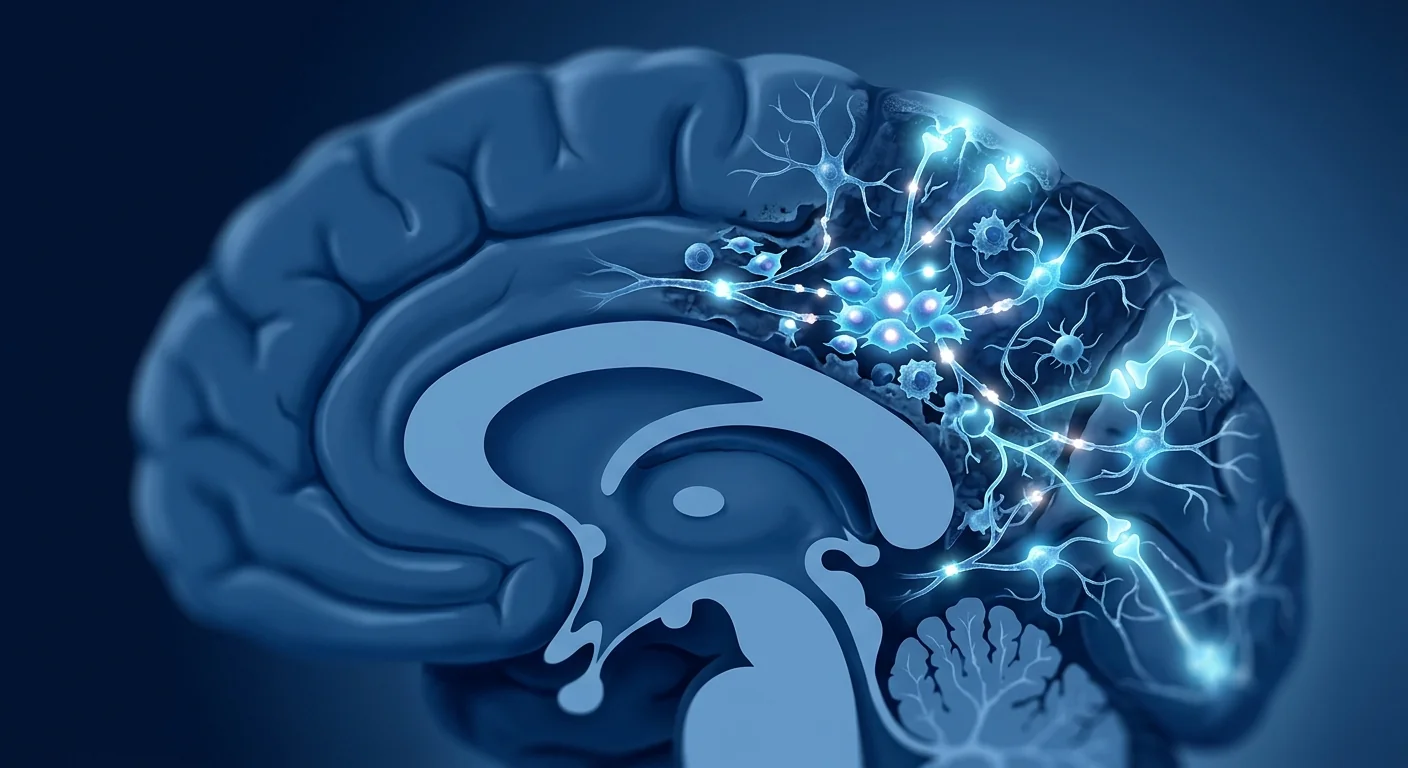
Subacute phase (hours to days). Microglia and peripheral immune cells infiltrate the injury site. The blood-brain barrier becomes permeable. Pro-inflammatory mediators accumulate, and reactive oxygen species drive lipid peroxidation. Cerebral oedema peaks during this window.
Chronic phase (weeks to years). In a subset of patients, microglial activation does not resolve. Neuroinflammation becomes self-sustaining. White matter tracts continue to degenerate. This is the phase where TBI transitions from an acute injury to a chronic neurodegenerative condition — and it is here that MSC therapy has its strongest biological rationale [4].
How MSCs address the TBI injury cascade
MSCs exert their effects through four interconnected mechanisms, each relevant to a different aspect of TBI pathology:
1. Anti-inflammatory immunomodulation
MSCs respond to the elevated cytokine environment of the injured brain by secreting TSG-6, PGE2, IL-10, and IDO — factors that shift microglia from a pro-inflammatory (M1) to a reparative (M2) phenotype. In rodent TBI models, a single intravenous MSC infusion within 24 hours of injury reduced microglial activation by approximately 40% and lowered IL-1β and TNF-α levels in cerebrospinal fluid [5]. The objective is not immune suppression but restoration of neuroimmune homeostasis.
2. Neuroprotection and trophic support
MSCs secrete brain-derived neurotrophic factor (BDNF), nerve growth factor (NGF), glial-derived neurotrophic factor (GDNF), and insulin-like growth factor-1 (IGF-1). These factors promote neuronal survival, reduce apoptosis in the peri-lesional zone, and support synaptic integrity. In controlled cortical impact models, MSC-treated animals showed significantly smaller lesion volumes and higher neuronal density at the injury boundary compared to controls [6].
3. Blood-brain barrier restoration
TBI disrupts tight junction proteins (claudin-5, occludin, ZO-1) that maintain the blood-brain barrier. MSCs release angiopoietin-1 and other barrier-stabilising factors that promote endothelial integrity. Restoring the BBB reduces the influx of peripheral immune cells and serum proteins that fuel secondary neuroinflammation [7].
4. Promotion of endogenous neurogenesis and plasticity
The adult brain retains limited regenerative capacity in the subventricular zone and hippocampal dentate gyrus. MSC-derived factors, particularly BDNF and VEGF, enhance neurogenesis in these niches and promote synaptic plasticity — the brain's ability to rewire around damaged circuits. MSC therapy is best understood as an amplifier of the brain's intrinsic repair programmes, not a replacement for them [8].
What MSC therapy does NOT do for TBI
MSC therapy does not regrow lost brain tissue. It does not replace dead neurons. It does not reverse structural damage that occurred years ago. What it may offer is a more favourable biological environment for the recovery work the brain is already attempting — particularly in the subacute-to-early-chronic window when neuroinflammation remains modifiable and plasticity is most active. Honest clinical teams set this expectation clearly during consultation.
Clinical evidence: what the data show
The clinical evidence base for MSC therapy in TBI is still developing, but the trajectory is encouraging. A 2021 systematic review of 12 preclinical studies and early-phase human trials reported consistent signals across multiple domains [9]:
- Neurological function: Improvements in Glasgow Outcome Scale-Extended (GOS-E) scores observed in multiple open-label series, with the strongest signals in patients treated within 6 months of injury.
- Motor recovery: Gains in Fugl-Meyer and Functional Independence Measure (FIM) scores reported in programmes combining MSC infusion with structured physiotherapy.
- Imaging correlates: Diffusion tensor imaging (DTI) studies have shown preserved white matter integrity in MSC-treated cohorts, suggesting reduced axonal degeneration.
- Safety: Across all published trials, MSC administration — intravenous and intrathecal — has been well tolerated with no serious adverse events attributable to the cells themselves.
A 2023 phase II randomised controlled trial of intravenous umbilical cord-derived MSCs in moderate-to-severe TBI demonstrated statistically significant improvements in lower-extremity motor function and activities of daily living at 6 months, with a favourable safety profile [10].
Important caveat: The field remains early. Most human data come from small, open-label studies. Larger, blinded, randomised trials are underway but results are pending. MSC therapy for TBI is investigational — it is not a standard of care and should not be presented as proven. The evidence supports biological plausibility and early clinical signals; it does not yet support definitive claims of efficacy.
Who is most likely to benefit?
Based on current evidence, the patients most likely to show meaningful response to MSC therapy for TBI include those who are:
- In the subacute-to-early-chronic phase (approximately 1–12 months post-injury), when neuroinflammation is active and modifiable
- Medically stable with no acute intracranial hypertension, uncontrolled seizures, or active infection
- Engaged in structured rehabilitation — MSC effects are synergistic with physiotherapy, occupational therapy, and cognitive rehabilitation, not a substitute for them
- Free of contraindicating conditions including active malignancy, severe coagulopathy, or recent neurosurgery (within 4 weeks)
Patients with severe structural brain loss, prolonged disorders of consciousness exceeding two years, or predominantly neurodegenerative (rather than post-traumatic) pathology are unlikely to derive meaningful benefit. A rigorous pre-treatment assessment is essential to identify appropriate candidates.
What treatment looks like in practice
A TBI-focused MSC programme at VELAR follows a structured, multidisciplinary pathway:
Limitations and honest caveats
MSC therapy for TBI is an investigational approach, and several important limitations must be acknowledged:
- Not a cure. MSC therapy does not reverse structural brain damage or restore pre-injury function entirely. It may support incremental, meaningful recovery — but expectations must be calibrated accordingly.
- Variable response. Outcomes depend on injury severity, time since injury, age, baseline health, and rehabilitation engagement. Not every patient improves.
- Limited trial data. Large-scale, phase III randomised controlled trials have not yet been completed. The evidence base consists primarily of phase I/II studies and systematic reviews.
- Cost and access. MSC therapy is not covered by most insurance plans for TBI. Treatment at a regulated clinical centre in Thailand typically costs significantly less than equivalent protocols in North America or Europe, but remains a self-funded medical expense.
- Regulatory status. MSC therapy for TBI is not FDA-approved or EMA-approved. Treatment is offered in jurisdictions where cell therapy is regulated under medical practice frameworks rather than drug-approval pathways.
Frequently Asked Questions
How soon after a traumatic brain injury can MSC therapy be administered?
Most clinical protocols target the subacute window — approximately 4 to 12 weeks post-injury — when the patient is medically stable, neuroinflammation is active, and the therapeutic window for modulating secondary injury remains open. Earlier administration (within days) is under investigation but requires hospital-based delivery and carries additional safety considerations. Late administration (>2 years post-injury) has a weaker evidence base.
How are the stem cells delivered for TBI treatment?
Intravenous infusion is the most common route — it is minimally invasive, well tolerated, and leverages the homing capacity of MSCs to migrate toward sites of inflammation, including the injured brain. Intrathecal delivery (into the cerebrospinal fluid) bypasses the blood-brain barrier and is used for specific indications, but carries slightly higher procedural risk. The clinical team recommends the appropriate route based on individual assessment.
How much does stem cell therapy for TBI cost in Thailand?
At regulated clinical centres in Bangkok, a complete TBI protocol — including cellular product, medical supervision, and integrated rehabilitation coordination — is typically a fraction of equivalent programmes in the United States or Europe. Exact pricing depends on protocol complexity, cell dose, and session count. A detailed quote is provided after the initial neurological assessment.
Can MSC therapy help with cognitive symptoms like memory loss and brain fog?
Some patients report improvements in processing speed, working memory, and mental clarity following MSC therapy, particularly those treated within the first year of injury. The biological rationale — reduced neuroinflammation, improved synaptic plasticity, and enhanced trophic support — is consistent with cognitive benefit. However, formal neuropsychological outcome data from large trials are not yet available, and cognitive response is among the most variable domains.
Is MSC therapy safe for patients who have had brain surgery?
Patients who have undergone decompressive craniectomy or other neurosurgical procedures are generally eligible once the surgical site has healed (typically 4–6 weeks post-operatively) and there is no active infection. Each case is reviewed individually by the clinical team in coordination with the patient's neurosurgeon.
References
- Dewan MC, Rattani A, Gupta S, et al. Estimating the global incidence of traumatic brain injury. Journal of Neurosurgery. 2019;130(4):1080-1097. doi:10.3171/2017.10.JNS17352 ↩
- Simon DW, McGeachy MJ, Bayır H, Clark RSB, Loane DJ, Kochanek PM. The far-reaching scope of neuroinflammation after traumatic brain injury. Nature Reviews Neurology. 2017;13(3):171-191. doi:10.1038/nrneurol.2017.13 ↩
- Caplan AI, Correa D. The MSC: an injury drugstore. Cell Stem Cell. 2011;9(1):11-15. doi:10.1016/j.stem.2011.06.008 ↩
- Loane DJ, Kumar A. Microglia in the TBI brain: the good, the bad, and the dysregulated. Experimental Neurology. 2016;275(Pt 3):316-327. doi:10.1016/j.expneurol.2015.08.018 ↩
- Zhang Y, Chopp M, Meng Y, et al. Effect of exosomes derived from multipluripotent mesenchymal stromal cells on functional recovery and neurovascular plasticity in rats after traumatic brain injury. Journal of Neurosurgery. 2015;122(4):856-867. doi:10.3171/2014.11.JNS14770 ↩
- Mahmood A, Lu D, Chopp M. Marrow stromal cell transplantation after traumatic brain injury promotes cellular proliferation within the brain. Neurosurgery. 2004;55(5):1185-1193. doi:10.1227/01.NEU.0000141042.14476.3C ↩
- Menge T, Zhao Y, Zhao J, et al. Mesenchymal stem cells regulate blood-brain barrier integrity through TIMP3 release after traumatic brain injury. Science Translational Medicine. 2012;4(161):161ra150. doi:10.1126/scitranslmed.3004660 ↩
- Xiong Y, Mahmood A, Chopp M. Emerging potential of exosomes for treatment of traumatic brain injury. Neural Regeneration Research. 2017;12(1):19-22. doi:10.4103/1673-5374.198966 ↩
- Peng Y, Huang S, Cheng B, et al. Mesenchymal stem cells: A revolution in therapeutic strategies for traumatic brain injury. Frontiers in Neurology. 2021;12:635184. doi:10.3389/fneur.2021.635184 ↩
- Wang S, Cheng H, Dai G, et al. Umbilical cord mesenchymal stem cell transplantation significantly improves neurological function in patients with sequelae of traumatic brain injury. Cell Transplantation. 2023;32:9636897231186552. doi:10.1177/09636897231186552 ↩
- Pischiutta F, Caruso E, Cavaleiro H, Salgado AJ, Loane DJ, Zanier ER. Mesenchymal stromal cell secretome for traumatic brain injury: focus on immunomodulatory molecules. Frontiers in Immunology. 2019;10:1646. doi:10.3389/fimmu.2019.01646 ↩
- Cox CS Jr, Hetz RA, Liao GP, et al. Treatment of severe adult traumatic brain injury using bone marrow mononuclear cells. Stem Cells. 2017;35(4):1065-1070. doi:10.1002/stem.2538 ↩
- Nichols JE, Niles JA, DeWitt D, et al. Neurogenic and neuro-protective potential of a novel stem cell line derived from human adipose tissue. Journal of Neuroscience Research. 2013;91(10):1290-1300. doi:10.1002/jnr.23256 ↩
- Pittenger MF, Discher DE, Peault BM, Phinney DG, Hare JM, Caplan AI. Mesenchymal stem cell perspective: cell biology to clinical progress. NPJ Regenerative Medicine. 2019;4:22. doi:10.1038/s41536-019-0083-6 ↩
创伤性脑损伤(TBI)不是一个单一事件——它是一个级联反应。最初的冲击——摔倒、碰撞、爆炸波——触发了一系列分子和细胞层面的破坏,在急性期过去后可能持续数月甚至数年。全球每年约有6900万人遭受TBI,后果从持续性头痛和认知模糊到严重的运动和行为障碍不等 [1]。
常规治疗的局限性。急性TBI管理——颅内压监测、手术减压、神经重症监护——显著提高了生存率。但患者离开ICU后,治疗手段急剧减少。康复可以重新训练功能,但无法解决使受损大脑处于慢性功能障碍状态的潜在神经炎症环境。对许多幸存者来说,平台期是真实而令人沮丧的。
更深层的问题是神经炎症。在最初的机械性损伤之后,大脑的免疫细胞——小胶质细胞和星形胶质细胞——进入持续激活状态。促炎细胞因子(IL-1β、IL-6、TNF-α)保持升高,血脑屏障完整性受损,氧化应激损伤远超原始病灶范围的神经元 [2]。这种继发性损伤级联反应——而非最初的冲击——才是导致TBI长期残疾的原因。
间充质干细胞疗法针对症状背后的生物学机制。间充质干细胞并非试图替代丢失的神经元——这一目标仍然难以实现——而是干预决定幸存神经元是存活还是退化的炎症和营养环境。其作用方式为旁分泌:它们感知受损环境并释放定制的抗炎细胞因子、神经营养因子和血管生成信号混合物,将大脑从慢性退化转向修复 [3]。
创伤性脑损伤后大脑发生了什么?
TBI的生物力学——快速加速-减速、旋转力、直接冲击——导致弥漫性轴索损伤、微血管损伤和细胞膜破裂。但对长期预后最重要的病理变化在随后的数小时、数天和数周内展开。
急性期(数分钟至数小时)。机械性剪切力损伤轴突和血管。谷氨酸大量释放到细胞外空间,触发兴奋性毒性。钙失调引发线粒体衰竭和凋亡级联反应。这是急诊医学旨在处理的损伤阶段。
亚急性期(数小时至数天)。小胶质细胞和外周免疫细胞浸润损伤部位。血脑屏障变得通透。促炎介质积累,活性氧驱动脂质过氧化。脑水肿在此窗口期达到峰值。
慢性期(数周至数年)。在一部分患者中,小胶质细胞活化不会消退。神经炎症变得自我维持。白质束持续退化。这是TBI从急性损伤转变为慢性神经退行性疾病的阶段——而间充质干细胞疗法在此阶段具有最强的生物学依据 [4]。
间充质干细胞如何应对TBI损伤级联反应
间充质干细胞通过四个相互关联的机制发挥作用,每个机制都针对TBI病理的不同方面:
1. 抗炎免疫调节
间充质干细胞通过分泌TSG-6、PGE2、IL-10和IDO来响应受损大脑中升高的细胞因子环境——这些因子将小胶质细胞从促炎(M1)表型转变为修复性(M2)表型。在啮齿动物TBI模型中,损伤后24小时内单次静脉输注间充质干细胞使小胶质细胞活化减少约40%,并降低脑脊液中IL-1β和TNF-α水平 [5]。目标不是免疫抑制,而是恢复神经免疫稳态。
2. 神经保护和营养支持
间充质干细胞分泌脑源性神经营养因子(BDNF)、神经生长因子(NGF)、胶质源性神经营养因子(GDNF)和胰岛素样生长因子-1(IGF-1)。这些因子促进神经元存活,减少病灶周围区域的凋亡,并支持突触完整性。在受控皮层冲击模型中,与对照组相比,间充质干细胞治疗组显示出显著更小的病灶体积和更高的损伤边界神经元密度 [6]。
3. 血脑屏障修复
TBI破坏维持血脑屏障的紧密连接蛋白(claudin-5、occludin、ZO-1)。间充质干细胞释放血管生成素-1和其他屏障稳定因子,促进内皮完整性。恢复血脑屏障可减少外周免疫细胞和血清蛋白的流入,这些物质会加剧继发性神经炎症 [7]。
4. 促进内源性神经发生和可塑性
成人大脑在脑室下区和海马齿状回保留了有限的再生能力。间充质干细胞衍生因子,特别是BDNF和VEGF,增强这些区域的神经发生并促进突触可塑性——大脑围绕受损回路重新连接的能力。间充质干细胞疗法最好理解为大脑内在修复程序的放大器,而非替代品 [8]。
间充质干细胞疗法对TBI的局限性
间充质干细胞疗法不会让丢失的脑组织再生。它不能替代死亡的神经元。它不能逆转多年前发生的结构性损伤。它可能提供的是一个更有利的生物学环境,以支持大脑已经在尝试的修复工作——特别是在亚急性到早期慢性窗口期,此时神经炎症仍可调节,可塑性最为活跃。诚实的临床团队会在咨询中明确设定这一期望。
临床证据:数据显示了什么
间充质干细胞疗法治疗TBI的临床证据基础仍在发展中,但趋势令人鼓舞。2021年对12项临床前研究和早期人体试验的系统综述报告了在多个领域的持续信号 [9]:
- 神经功能:在多个开放标签系列中观察到格拉斯哥预后量表扩展版(GOS-E)评分的改善,在损伤后6个月内接受治疗的患者中信号最强。
- 运动恢复:在将间充质干细胞输注与结构化物理治疗相结合的项目中,报告了Fugl-Meyer和功能独立性测量(FIM)评分的提升。
- 影像学相关性:弥散张量成像(DTI)研究显示间充质干细胞治疗组白质完整性得到保留,表明轴突变性减少。
- 安全性:在所有已发表的试验中,间充质干细胞给药——静脉和鞘内——耐受性良好,没有归因于细胞本身的严重不良事件。
2023年一项针对中重度TBI的脐带来源间充质干细胞静脉输注的II期随机对照试验显示,6个月时下肢运动功能和日常生活活动有统计学显著改善,且安全性良好 [10]。
重要提示:该领域仍处于早期阶段。大多数人体数据来自小型开放标签研究。更大规模、盲法、随机试验正在进行中,但结果尚未公布。间充质干细胞疗法治疗TBI是研究性的——它不是标准治疗,不应被表述为已证实的疗法。现有证据支持生物学合理性和早期临床信号;尚不支持明确的疗效主张。
谁最有可能受益?
根据现有证据,最有可能对间充质干细胞疗法治疗TBI表现出有意义反应的患者包括:
- 处于亚急性到早期慢性阶段(约损伤后1-12个月),此时神经炎症活跃且可调节
- 医学稳定,无急性颅内高压、未控制的癫痫或活动性感染
- 参与结构化康复——间充质干细胞的效果与物理治疗、作业治疗和认知康复协同作用,而非替代它们
- 无禁忌症,包括活动性恶性肿瘤、严重凝血障碍或近期神经外科手术(4周内)
具有严重结构性脑损失、超过两年的长期意识障碍、或以神经退行性(而非创伤后)病理为主的患者不太可能获得有意义的益处。严格的治疗前评估对于确定合适的候选人至关重要。
治疗实践
VELAR的TBI间充质干细胞治疗方案遵循结构化、多学科的路径:
局限性与诚实说明
间充质干细胞疗法治疗TBI是一种研究性方法,必须承认几个重要局限:
- 不是治愈方法。间充质干细胞疗法不能逆转结构性脑损伤或完全恢复损伤前功能。它可能支持渐进的、有意义的恢复——但期望必须相应校准。
- 反应因人而异。结果取决于损伤严重程度、损伤后时间、年龄、基线健康状况和康复参与度。并非每位患者都会改善。
- 有限的试验数据。大规模III期随机对照试验尚未完成。证据基础主要由I/II期研究和系统综述组成。
- 费用和可及性。大多数保险计划不覆盖TBI的间充质干细胞疗法。在泰国受监管的临床中心进行治疗通常比北美或欧洲的等效方案费用显著更低,但仍是一项自费的医疗支出。
- 监管状态。间充质干细胞疗法治疗TBI未获FDA或EMA批准。治疗在细胞疗法受医疗实践框架而非药物审批途径监管的司法管辖区提供。
常见问题
创伤性脑损伤后多久可以进行间充质干细胞治疗?
大多数临床方案针对亚急性窗口期——约损伤后4至12周——此时患者医学稳定,神经炎症活跃,调节继发性损伤的治疗窗口仍然开放。更早给药(数天内)正在研究中,但需要住院给药并涉及额外的安全考虑。晚期给药(损伤后>2年)的证据基础较弱。
TBI治疗的干细胞如何给药?
静脉输注是最常见的途径——微创、耐受性好,并利用间充质干细胞向炎症部位(包括受损大脑)迁移的归巢能力。鞘内给药(进入脑脊液)绕过血脑屏障,用于特定适应症,但程序风险略高。临床团队根据个体评估推荐适当的途径。
在泰国治疗TBI的干细胞疗法费用是多少?
在曼谷受监管的临床中心,完整的TBI方案——包括细胞产品、医疗监督和综合康复协调——通常仅为美国或欧洲等效方案费用的一小部分。确切价格取决于方案复杂性、细胞剂量和疗程次数。详细报价在初次神经学评估后提供。
间充质干细胞疗法能帮助改善记忆丧失和脑雾等认知症状吗?
一些患者报告在间充质干细胞治疗后处理速度、工作记忆和思维清晰度有所改善,特别是在损伤后第一年内接受治疗的患者。生物学依据——减少神经炎症、改善突触可塑性和增强营养支持——与认知获益一致。然而,大规模试验的正式神经心理学结果数据尚未出炉,认知反应是最具变异性的领域之一。
间充质干细胞疗法对接受过脑部手术的患者安全吗?
接受过去骨瓣减压术或其他神经外科手术的患者通常在手术部位愈合后(通常术后4-6周)且无活动性感染时符合条件。每个病例由临床团队与患者的神经外科医生协调进行个体化审查。
参考文献
- Dewan MC, Rattani A, Gupta S, et al. Estimating the global incidence of traumatic brain injury. Journal of Neurosurgery. 2019;130(4):1080-1097. doi:10.3171/2017.10.JNS17352 ↩
- Simon DW, McGeachy MJ, Bayır H, Clark RSB, Loane DJ, Kochanek PM. The far-reaching scope of neuroinflammation after traumatic brain injury. Nature Reviews Neurology. 2017;13(3):171-191. doi:10.1038/nrneurol.2017.13 ↩
- Caplan AI, Correa D. The MSC: an injury drugstore. Cell Stem Cell. 2011;9(1):11-15. doi:10.1016/j.stem.2011.06.008 ↩
- Loane DJ, Kumar A. Microglia in the TBI brain: the good, the bad, and the dysregulated. Experimental Neurology. 2016;275(Pt 3):316-327. doi:10.1016/j.expneurol.2015.08.018 ↩
- Zhang Y, Chopp M, Meng Y, et al. Effect of exosomes derived from multipluripotent mesenchymal stromal cells on functional recovery and neurovascular plasticity in rats after traumatic brain injury. Journal of Neurosurgery. 2015;122(4):856-867. doi:10.3171/2014.11.JNS14770 ↩
- Mahmood A, Lu D, Chopp M. Marrow stromal cell transplantation after traumatic brain injury promotes cellular proliferation within the brain. Neurosurgery. 2004;55(5):1185-1193. doi:10.1227/01.NEU.0000141042.14476.3C ↩
- Menge T, Zhao Y, Zhao J, et al. Mesenchymal stem cells regulate blood-brain barrier integrity through TIMP3 release after traumatic brain injury. Science Translational Medicine. 2012;4(161):161ra150. doi:10.1126/scitranslmed.3004660 ↩
- Xiong Y, Mahmood A, Chopp M. Emerging potential of exosomes for treatment of traumatic brain injury. Neural Regeneration Research. 2017;12(1):19-22. doi:10.4103/1673-5374.198966 ↩
- Peng Y, Huang S, Cheng B, et al. Mesenchymal stem cells: A revolution in therapeutic strategies for traumatic brain injury. Frontiers in Neurology. 2021;12:635184. doi:10.3389/fneur.2021.635184 ↩
- Wang S, Cheng H, Dai G, et al. Umbilical cord mesenchymal stem cell transplantation significantly improves neurological function in patients with sequelae of traumatic brain injury. Cell Transplantation. 2023;32:9636897231186552. doi:10.1177/09636897231186552 ↩
- Pischiutta F, Caruso E, Cavaleiro H, Salgado AJ, Loane DJ, Zanier ER. Mesenchymal stromal cell secretome for traumatic brain injury: focus on immunomodulatory molecules. Frontiers in Immunology. 2019;10:1646. doi:10.3389/fimmu.2019.01646 ↩
- Cox CS Jr, Hetz RA, Liao GP, et al. Treatment of severe adult traumatic brain injury using bone marrow mononuclear cells. Stem Cells. 2017;35(4):1065-1070. doi:10.1002/stem.2538 ↩
- Nichols JE, Niles JA, DeWitt D, et al. Neurogenic and neuro-protective potential of a novel stem cell line derived from human adipose tissue. Journal of Neuroscience Research. 2013;91(10):1290-1300. doi:10.1002/jnr.23256 ↩
- Pittenger MF, Discher DE, Peault BM, Phinney DG, Hare JM, Caplan AI. Mesenchymal stem cell perspective: cell biology to clinical progress. NPJ Regenerative Medicine. 2019;4:22. doi:10.1038/s41536-019-0083-6 ↩
إصابة الدماغ الرضية (TBI) ليست حدثاً واحداً — إنها سلسلة متوالية. الصدمة الأولية — سقوط، اصطدام، موجة انفجار — تطلق سلسلة من الاضطرابات الجزيئية والخلوية التي قد تستمر لأشهر أو سنوات بعد انتهاء المرحلة الحادة. على مستوى العالم، يعاني ما يقدر بـ 69 مليون شخص من إصابة دماغية رضية كل عام، مع عواقب تتراوح من الصداع المستمر والضبابية الإدراكية إلى الإعاقة الحركية والسلوكية العميقة [1].
حدود الرعاية التقليدية. حسّنت إدارة إصابة الدماغ الرضية الحادة — مراقبة الضغط داخل الجمجمة، تخفيف الضغط الجراحي، الرعاية العصبية الحرجة — من معدلات البقاء على قيد الحياة بشكل كبير. لكن بعد مغادرة المريض لوحدة العناية المركزة، تتقلص الأدوات المتاحة. يمكن لإعادة التأهيل إعادة تدريب الوظائف لكنها لا تعالج البيئة الالتهابية العصبية الكامنة التي تبقي الدماغ المصاب في حالة خلل وظيفي مزمن. بالنسبة للعديد من الناجين، مرحلة الثبات حقيقية ومحبطة.
المشكلة الأعمق هي الالتهاب العصبي. بعد الإصابة الميكانيكية الأولية، تدخل الخلايا المناعية للدماغ — الخلايا الدبقية الصغيرة والخلايا النجمية — في حالة تنشيط مطولة. تبقى السيتوكينات المؤيدة للالتهاب (IL-1β، IL-6، TNF-α) مرتفعة، وتتعرض سلامة الحاجز الدموي الدماغي للخطر، ويدمر الإجهاد التأكسدي الخلايا العصبية بعيداً عن موقع الآفة الأصلي [2]. سلسلة الإصابة الثانوية هذه — وليس الصدمة الأولية — هي ما يسبب الإعاقة طويلة المدى في إصابة الدماغ الرضية.
يستهدف العلاج بالخلايا الجذعية الوسيطة البيولوجيا الكامنة وراء الأعراض. بدلاً من محاولة استبدال الخلايا العصبية المفقودة — وهو هدف لا يزال بعيد المنال — تتدخل الخلايا الجذعية الوسيطة في البيئة الالتهابية والتغذوية التي تحدد ما إذا كانت الخلايا العصبية الباقية ستزدهر أم ستتدهور. عملها نظير صماوي: تستشعر البيئة التالفة وتطلق مزيجاً مخصصاً من السيتوكينات المضادة للالتهاب والعوامل العصبية التغذوية وإشارات تكوين الأوعية الدموية التي تحول الدماغ من التدهور المزمن نحو الإصلاح [3].
ماذا يحدث في الدماغ بعد الإصابة الرضية؟
تنتج الميكانيكا الحيوية لإصابة الدماغ الرضية — التسارع والتباطؤ السريع، القوى الدورانية، الصدمة المباشرة — عن إصابة محوارية منتشرة، وتلف الأوعية الدقيقة، وتمزق غشاء الخلية. لكن التغيرات المرضية الأكثر أهمية للنتائج طويلة المدى تتكشف في الساعات والأيام والأسابيع التالية.
المرحلة الحادة (دقائق إلى ساعات). القص الميكانيكي يدمر المحاور والأوعية الدموية. يفيض الجلوتامات في الفضاء خارج الخلية، مسبباً السمية الاستثارية. يؤدي اضطراب الكالسيوم إلى فشل الميتوكوندريا وسلاسل موت الخلايا المبرمج. هذه هي مرحلة الإصابة التي صُممت طب الطوارئ للتعامل معها.
المرحلة تحت الحادة (ساعات إلى أيام). تتسلل الخلايا الدبقية الصغيرة والخلايا المناعية الطرفية إلى موقع الإصابة. يصبح الحاجز الدموي الدماغي نافذاً. تتراكم الوسائط المؤيدة للالتهاب، وتدفع أنواع الأكسجين التفاعلية بيروكسدة الدهون. تبلغ الوذمة الدماغية ذروتها خلال هذه الفترة.
المرحلة المزمنة (أسابيع إلى سنوات). في مجموعة فرعية من المرضى، لا يتراجع تنشيط الخلايا الدبقية الصغيرة. يصبح الالتهاب العصبي مكتفياً ذاتياً. تستمر مسالك المادة البيضاء في التدهور. هذه هي المرحلة التي تتحول فيها إصابة الدماغ الرضية من إصابة حادة إلى حالة تنكسية عصبية مزمنة — وهنا يكون للعلاج بالخلايا الجذعية الوسيطة أقوى مبرر بيولوجي [4].
كيف تعالج الخلايا الجذعية الوسيطة سلسلة إصابة الدماغ الرضية
تمارس الخلايا الجذعية الوسيطة تأثيراتها من خلال أربع آليات مترابطة، كل منها ذو صلة بجانب مختلف من أمراض إصابة الدماغ الرضية:
١. التعديل المناعي المضاد للالتهاب
تستجيب الخلايا الجذعية الوسيطة لبيئة السيتوكين المرتفعة في الدماغ المصاب عن طريق إفراز TSG-6 وPGE2 وIL-10 وIDO — وهي عوامل تحول الخلايا الدبقية الصغيرة من النمط الظاهري المؤيد للالتهاب (M1) إلى النمط الإصلاحي (M2). في نماذج القوارض لإصابة الدماغ الرضية، قلل تسريب وريدي واحد للخلايا الجذعية الوسيطة خلال 24 ساعة من الإصابة من تنشيط الخلايا الدبقية الصغيرة بنسبة 40% تقريباً وخفض مستويات IL-1β وTNF-α في السائل الدماغي الشوكي [5]. الهدف ليس تثبيط المناعة بل استعادة التوازن المناعي العصبي.
٢. الحماية العصبية والدعم التغذوي
تفرز الخلايا الجذعية الوسيطة عامل التغذية العصبية المشتق من الدماغ (BDNF)، وعامل نمو الأعصاب (NGF)، وعامل التغذية العصبية المشتق من الخلايا الدبقية (GDNF)، وعامل النمو شبيه الأنسولين-1 (IGF-1). تعزز هذه العوامل بقاء الخلايا العصبية، وتقلل من موت الخلايا المبرمج في المنطقة المحيطة بالآفة، وتدعم سلامة المشابك العصبية. في نماذج الصدمة القشرية المسيطر عليها، أظهرت الحيوانات المعالجة بالخلايا الجذعية الوسيطة أحجام آفات أصغر بشكل ملحوظ وكثافة عصبية أعلى عند حدود الإصابة مقارنة بالضوابط [6].
٣. استعادة الحاجز الدموي الدماغي
تعطل إصابة الدماغ الرضية بروتينات الوصلات الضيقة (claudin-5، occludin، ZO-1) التي تحافظ على الحاجز الدموي الدماغي. تطلق الخلايا الجذعية الوسيطة أنجيوبويتين-1 وعوامل استقرار حاجزية أخرى تعزز سلامة البطانة. تقلل استعادة الحاجز الدموي الدماغي من تدفق الخلايا المناعية الطرفية وبروتينات المصل التي تغذي الالتهاب العصبي الثانوي [7].
٤. تعزيز تكوين الخلايا العصبية الذاتية واللدونة
يحتفظ الدماغ البالغ بقدرة تجديدية محدودة في المنطقة تحت البطينية والتلفيف المسنن للحصين. تعزز العوامل المشتقة من الخلايا الجذعية الوسيطة، وخاصة BDNF وVEGF، تكوين الخلايا العصبية في هذه المناطق وتعزز اللدونة المشبكية — قدرة الدماغ على إعادة التوصيل حول الدوائر التالفة. يُفهم العلاج بالخلايا الجذعية الوسيطة بشكل أفضل كمضخم لبرامج الإصلاح الذاتية للدماغ، وليس بديلاً عنها [8].
ما لا يفعله العلاج بالخلايا الجذعية الوسيطة لإصابة الدماغ الرضية
العلاج بالخلايا الجذعية الوسيطة لا يعيد نمو أنسجة الدماغ المفقودة. إنه لا يستبدل الخلايا العصبية الميتة. إنه لا يعكس الضرر الهيكلي الذي حدث قبل سنوات. ما قد يقدمه هو بيئة بيولوجية أكثر ملاءمة لعمل الإصلاح الذي يحاول الدماغ القيام به بالفعل — خاصة في الفترة تحت الحادة إلى المزمنة المبكرة عندما يظل الالتهاب العصبي قابلاً للتعديل وتكون اللدونة في أوج نشاطها. تحدد الفرق السريرية الصادقة هذا التوقع بوضوح أثناء الاستشارة.
الأدلة السريرية: ما تظهره البيانات
لا تزال قاعدة الأدلة السريرية للعلاج بالخلايا الجذعية الوسيطة في إصابة الدماغ الرضية قيد التطوير، لكن المسار مشجع. أبلغت مراجعة منهجية عام 2021 لـ 12 دراسة قبل سريرية وتجارب بشرية مبكرة عن إشارات متسقة عبر مجالات متعددة [9]:
- الوظيفة العصبية: تحسن في درجات مقياس غلاسكو الموسع للنتائج (GOS-E) لوحظ في سلاسل متعددة مفتوحة التسمية، مع أقوى الإشارات لدى المرضى الذين عولجوا خلال 6 أشهر من الإصابة.
- التعافي الحركي: تم الإبلاغ عن مكاسب في درجات Fugl-Meyer ومقياس الاستقلال الوظيفي (FIM) في البرامج التي تجمع بين تسريب الخلايا الجذعية الوسيطة والعلاج الطبيعي المنظم.
- الارتباطات التصويرية: أظهرت دراسات تصوير الانتشار الموتر (DTI) الحفاظ على سلامة المادة البيضاء لدى المجموعات المعالجة بالخلايا الجذعية الوسيطة، مما يشير إلى تقليل التنكس المحواري.
- السلامة: عبر جميع التجارب المنشورة، كان إعطاء الخلايا الجذعية الوسيطة — وريدياً وداخل القراب — جيد التحمل دون أحداث ضائرة خطيرة تُنسب إلى الخلايا نفسها.
أظهرت تجربة عشوائية محكومة من المرحلة الثانية عام 2023 للخلايا الجذعية الوسيطة المشتقة من الحبل السري عن طريق الوريد في إصابة الدماغ الرضية المتوسطة إلى الشديدة تحسينات ذات دلالة إحصائية في الوظيفة الحركية للأطراف السفلية وأنشطة الحياة اليومية عند 6 أشهر، مع ملف سلامة مناسب [10].
تنبيه مهم: لا يزال المجال في مرحلة مبكرة. معظم البيانات البشرية تأتي من دراسات صغيرة مفتوحة التسمية. التجارب العشوائية المعماة الأكبر جارية لكن النتائج معلقة. العلاج بالخلايا الجذعية الوسيطة لإصابة الدماغ الرضية استقصائي — إنه ليس معيار رعاية ولا ينبغي تقديمه كعلاج مثبت. تدعم الأدلة المعقولية البيولوجية والإشارات السريرية المبكرة؛ لكنها لا تدعم بعد ادعاءات قاطعة بالفعالية.
من هم الأكثر احتمالاً للاستفادة؟
بناءً على الأدلة الحالية، المرضى الأكثر احتمالاً لإظهار استجابة ذات مغزى للعلاج بالخلايا الجذعية الوسيطة لإصابة الدماغ الرضية يشملون أولئك الذين:
- في المرحلة تحت الحادة إلى المزمنة المبكرة (حوالي 1-12 شهراً بعد الإصابة)، عندما يكون الالتهاب العصبي نشطاً وقابلاً للتعديل
- مستقرون طبياً دون ارتفاع حاد في الضغط داخل الجمجمة، أو نوبات غير مسيطر عليها، أو عدوى نشطة
- منخرطون في إعادة تأهيل منظم — تأثيرات الخلايا الجذعية الوسيطة تتآزر مع العلاج الطبيعي والعلاج الوظيفي وإعادة التأهيل الإدراكي، وليست بديلاً عنها
- خالون من موانع الاستعمال بما في ذلك الورم الخبيث النشط، أو اعتلال التخثر الشديد، أو جراحة الأعصاب الحديثة (خلال 4 أسابيع)
المرضى الذين يعانون من فقدان هيكلي شديد للدماغ، أو اضطرابات الوعي المطولة التي تتجاوز عامين، أو الأمراض التنكسية العصبية في الغالب (وليس ما بعد الصدمة) من غير المرجح أن يستفيدوا بشكل ذي مغزى. التقييم الدقيق قبل العلاج ضروري لتحديد المرشحين المناسبين.
كيف يبدو العلاج في الممارسة العملية
يتبع برنامج الخلايا الجذعية الوسيطة المركّز على إصابة الدماغ الرضية في فيلار مساراً منظماً متعدد التخصصات:
القيود والتحفظات الصادقة
العلاج بالخلايا الجذعية الوسيطة لإصابة الدماغ الرضية هو نهج استقصائي، ويجب الاعتراف بعدة قيود مهمة:
- ليس علاجاً شافياً. العلاج بالخلايا الجذعية الوسيطة لا يعكس الضرر الهيكلي للدماغ أو يستعيد وظيفة ما قبل الإصابة بالكامل. قد يدعم تعافياً تدريجياً ذا مغزى — لكن يجب معايرة التوقعات وفقاً لذلك.
- استجابة متغيرة. تعتمد النتائج على شدة الإصابة، والوقت منذ الإصابة، والعمر، والصحة الأساسية، والمشاركة في إعادة التأهيل. ليس كل مريض يتحسن.
- بيانات تجارب محدودة. لم تكتمل بعد التجارب العشوائية المحكومة واسعة النطاق من المرحلة الثالثة. تتكون قاعدة الأدلة بشكل أساسي من دراسات المرحلة الأولى/الثانية ومراجعات منهجية.
- التكلفة والوصول. لا يغطي معظم خطط التأمين العلاج بالخلايا الجذعية الوسيطة لإصابة الدماغ الرضية. العلاج في مركز سريري منظم في تايلاند يكلف عادة أقل بكثير من البروتوكولات المكافئة في أمريكا الشمالية أو أوروبا، لكنه يظل نفقة طبية ممولة ذاتياً.
- الوضع التنظيمي. العلاج بالخلايا الجذعية الوسيطة لإصابة الدماغ الرضية غير معتمد من FDA أو EMA. يُقدم العلاج في ولايات قضائية حيث يُنظم العلاج الخلوي تحت أطر الممارسة الطبية وليس مسارات الموافقة على الأدوية.
الأسئلة الشائعة
متى يمكن إعطاء العلاج بالخلايا الجذعية الوسيطة بعد إصابة الدماغ الرضية؟
تستهدف معظم البروتوكولات السريرية الفترة تحت الحادة — حوالي 4 إلى 12 أسبوعاً بعد الإصابة — عندما يكون المريض مستقراً طبياً، والالتهاب العصبي نشطاً، ولا تزال النافذة العلاجية لتعديل الإصابة الثانوية مفتوحة. الإعطاء المبكر (خلال أيام) قيد التحقيق لكنه يتطلب توصيلاً داخل المستشفى وينطوي على اعتبارات سلامة إضافية. الإعطاء المتأخر (أكثر من سنتين بعد الإصابة) له قاعدة أدلة أضعف.
كيف يتم توصيل الخلايا الجذعية لعلاج إصابة الدماغ الرضية؟
التسريب الوريدي هو المسار الأكثر شيوعاً — وهو أقل توغلاً، جيد التحمل، ويستفيد من قدرة الخلايا الجذعية الوسيطة على التوجه نحو مواقع الالتهاب، بما في ذلك الدماغ المصاب. التوصيل داخل القراب (في السائل الدماغي الشوكي) يتجاوز الحاجز الدموي الدماغي ويستخدم لمؤشرات محددة، لكنه ينطوي على مخاطر إجرائية أعلى قليلاً. يوصي الفريق السريري بالمسار المناسب بناءً على التقييم الفردي.
كم تكلفة العلاج بالخلايا الجذعية لإصابة الدماغ الرضية في تايلاند؟
في المراكز السريرية المنظمة في بانكوك، يكون بروتوكول إصابة الدماغ الرضية الكامل — بما في ذلك المنتج الخلوي، والإشراف الطبي، وتنسيق إعادة التأهيل المتكامل — عادة جزءاً بسيطاً من البرامج المكافئة في الولايات المتحدة أو أوروبا. يعتمد التسعير الدقيق على تعقيد البروتوكول، وجرعة الخلايا، وعدد الجلسات. يُقدم عرض سعر مفصل بعد التقييم العصبي الأولي.
هل يمكن للعلاج بالخلايا الجذعية الوسيطة المساعدة في الأعراض الإدراكية مثل فقدان الذاكرة والضبابية الدماغية؟
يبلغ بعض المرضى عن تحسنات في سرعة المعالجة، والذاكرة العاملة، والصفاء الذهني بعد العلاج بالخلايا الجذعية الوسيطة، خاصة أولئك الذين عولجوا خلال السنة الأولى من الإصابة. الأساس البيولوجي — تقليل الالتهاب العصبي، وتحسين اللدونة المشبكية، وتعزيز الدعم التغذوي — متسق مع الفائدة الإدراكية. ومع ذلك، فإن بيانات النتائج النفسية العصبية الرسمية من التجارب الكبيرة ليست متاحة بعد، والاستجابة الإدراكية هي من بين أكثر المجالات تبايناً.
هل العلاج بالخلايا الجذعية الوسيطة آمن للمرضى الذين خضعوا لجراحة الدماغ؟
المرضى الذين خضعوا لاستئصال القحف المخفف للضغط أو غيرها من الإجراءات الجراحية العصبية يكونون مؤهلين عموماً بمجرد شفاء موقع الجراحة (عادة 4-6 أسابيع بعد العملية) وعدم وجود عدوى نشطة. تتم مراجعة كل حالة بشكل فردي من قبل الفريق السريري بالتنسيق مع جراح الأعصاب الخاص بالمريض.
المراجع
- Dewan MC, Rattani A, Gupta S, et al. Estimating the global incidence of traumatic brain injury. Journal of Neurosurgery. 2019;130(4):1080-1097. doi:10.3171/2017.10.JNS17352 ↩
- Simon DW, McGeachy MJ, Bayır H, Clark RSB, Loane DJ, Kochanek PM. The far-reaching scope of neuroinflammation after traumatic brain injury. Nature Reviews Neurology. 2017;13(3):171-191. doi:10.1038/nrneurol.2017.13 ↩
- Caplan AI, Correa D. The MSC: an injury drugstore. Cell Stem Cell. 2011;9(1):11-15. doi:10.1016/j.stem.2011.06.008 ↩
- Loane DJ, Kumar A. Microglia in the TBI brain: the good, the bad, and the dysregulated. Experimental Neurology. 2016;275(Pt 3):316-327. doi:10.1016/j.expneurol.2015.08.018 ↩
- Zhang Y, Chopp M, Meng Y, et al. Effect of exosomes derived from multipluripotent mesenchymal stromal cells on functional recovery and neurovascular plasticity in rats after traumatic brain injury. Journal of Neurosurgery. 2015;122(4):856-867. doi:10.3171/2014.11.JNS14770 ↩
- Mahmood A, Lu D, Chopp M. Marrow stromal cell transplantation after traumatic brain injury promotes cellular proliferation within the brain. Neurosurgery. 2004;55(5):1185-1193. doi:10.1227/01.NEU.0000141042.14476.3C ↩
- Menge T, Zhao Y, Zhao J, et al. Mesenchymal stem cells regulate blood-brain barrier integrity through TIMP3 release after traumatic brain injury. Science Translational Medicine. 2012;4(161):161ra150. doi:10.1126/scitranslmed.3004660 ↩
- Xiong Y, Mahmood A, Chopp M. Emerging potential of exosomes for treatment of traumatic brain injury. Neural Regeneration Research. 2017;12(1):19-22. doi:10.4103/1673-5374.198966 ↩
- Peng Y, Huang S, Cheng B, et al. Mesenchymal stem cells: A revolution in therapeutic strategies for traumatic brain injury. Frontiers in Neurology. 2021;12:635184. doi:10.3389/fneur.2021.635184 ↩
- Wang S, Cheng H, Dai G, et al. Umbilical cord mesenchymal stem cell transplantation significantly improves neurological function in patients with sequelae of traumatic brain injury. Cell Transplantation. 2023;32:9636897231186552. doi:10.1177/09636897231186552 ↩
- Pischiutta F, Caruso E, Cavaleiro H, Salgado AJ, Loane DJ, Zanier ER. Mesenchymal stromal cell secretome for traumatic brain injury: focus on immunomodulatory molecules. Frontiers in Immunology. 2019;10:1646. doi:10.3389/fimmu.2019.01646 ↩
- Cox CS Jr, Hetz RA, Liao GP, et al. Treatment of severe adult traumatic brain injury using bone marrow mononuclear cells. Stem Cells. 2017;35(4):1065-1070. doi:10.1002/stem.2538 ↩
- Nichols JE, Niles JA, DeWitt D, et al. Neurogenic and neuro-protective potential of a novel stem cell line derived from human adipose tissue. Journal of Neuroscience Research. 2013;91(10):1290-1300. doi:10.1002/jnr.23256 ↩
- Pittenger MF, Discher DE, Peault BM, Phinney DG, Hare JM, Caplan AI. Mesenchymal stem cell perspective: cell biology to clinical progress. NPJ Regenerative Medicine. 2019;4:22. doi:10.1038/s41536-019-0083-6 ↩