Thalassemia is a group of inherited hemoglobinopathies characterized by defective α- or β-globin chain synthesis, leading to ineffective erythropoiesis, chronic hemolytic anemia, and systemic iron overload. Approximately 1.5% of the global population — over 270 million people — carry thalassemia mutations, with the highest prevalence across the Mediterranean basin, Middle East, South Asia, and Southeast Asia, where carrier rates can exceed 10% in some populations. Severe β-thalassemia major requires lifelong transfusion therapy from infancy, while β-thalassemia intermedia presents a progressively debilitating course without regular transfusions [1].
Where conventional treatments fall short. Standard care for β-thalassemia major centers on regular red blood cell transfusions to maintain hemoglobin above 9–10 g/dL combined with iron chelation therapy to mitigate transfusion-induced iron overload. This regimen extends survival into the fourth and fifth decades in well-resourced settings but imposes a punishing treatment burden — 2–4 transfusions monthly, daily chelation medications, and cumulative organ damage from iron deposition in the heart, liver, and endocrine glands. Allogeneic hematopoietic stem cell transplantation offers a curative option with 85–90% disease-free survival in low-risk pediatric patients with matched sibling donors, but only 25–30% of patients have an HLA-identical sibling, and transplant-related mortality ranges from 5–15% depending on risk class [2].
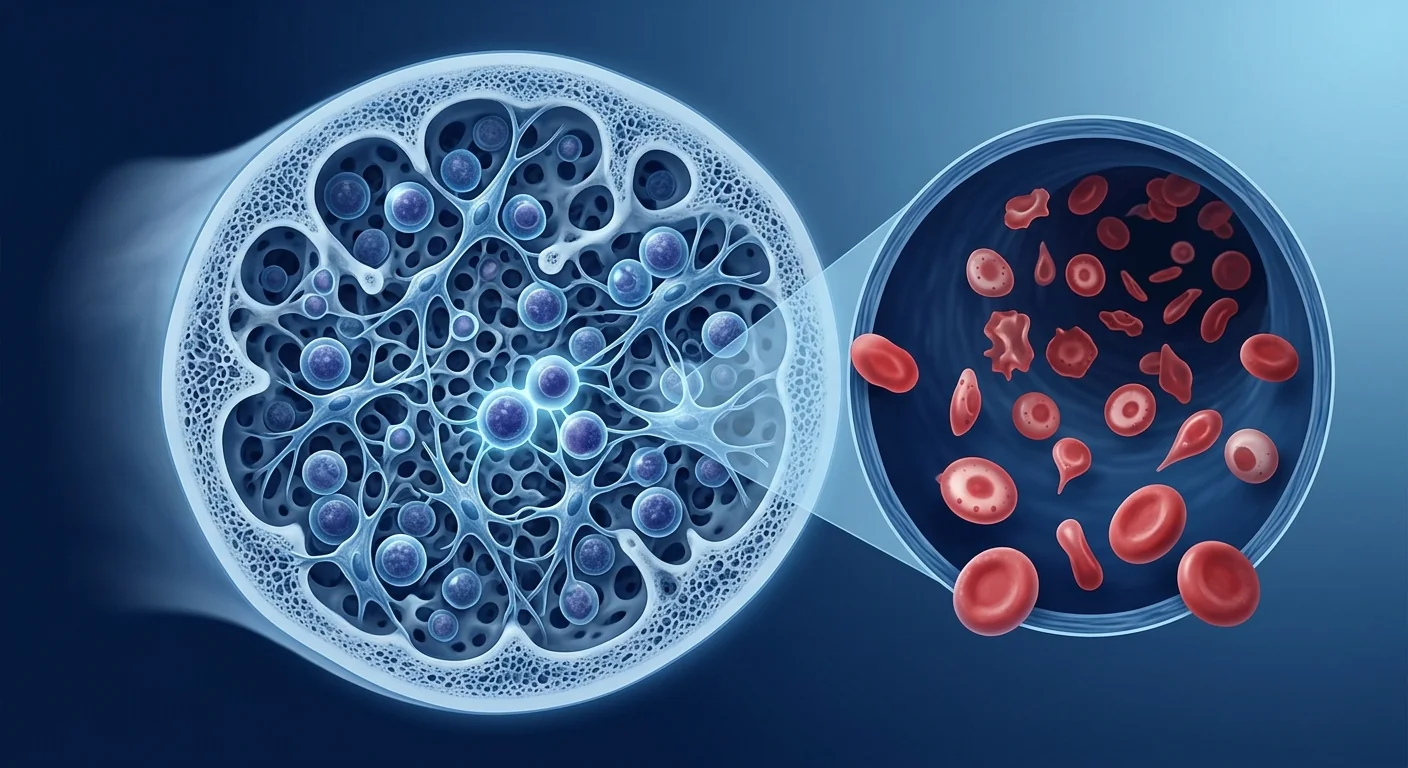
The deeper problem is ineffective erythropoiesis and iron dysregulation. The core pathophysiology of β-thalassemia is not simply anemia — it is massively expanded but ineffective erythropoiesis driven by globin chain imbalance. Excess unpaired α-globin chains precipitate within erythroid precursors, causing oxidative membrane damage and intramedullary apoptosis. The resulting erythroid hyperplasia expands the bone marrow cavity up to 30-fold, producing skeletal deformities, osteoporosis, and extramedullary hematopoiesis. Concurrently, inappropriately low hepcidin levels — suppressed by the erythroid regulator erythroferrone — permit unrestrained dietary iron absorption, compounding transfusion-related iron overload. This dual pathology — erythropoietic failure plus iron toxicity — drives the multi-organ complications that ultimately cause mortality [3].
MSC therapy addresses multiple nodes in the thalassemia cascade. Mesenchymal stem cells are the native stromal cells of the bone marrow hematopoietic niche. When administered therapeutically, allogeneic MSCs deliver a coordinated program of erythropoietic support, iron metabolism modulation, anti-inflammatory signaling, and niche reconstruction that addresses thalassemia pathology at several levels simultaneously. Unlike transfusion therapy, which replaces red cells without altering the underlying disease process, and unlike iron chelation, which removes excess iron but does not repair tissue damage, MSC therapy aims to improve endogenous erythropoiesis, reduce the inflammatory burden, and support organ recovery [4].
How MSCs Target Thalassemia Pathophysiology
MSCs address thalassemia complications through four interconnected mechanisms, each targeting a specific node in the disease cascade [5].
Erythropoietic support and niche reconstruction. In β-thalassemia, the bone marrow microenvironment is profoundly disrupted — expanded erythroid precursors crowd out stromal cells, while iron toxicity and oxidative stress damage the hematopoietic niche. MSCs home to bone marrow via CXCR4/SDF-1 chemotaxis and secrete stem cell factor, thrombopoietin, and interleukin-6, which support residual erythropoiesis while reducing the apoptotic drive created by α-globin precipitation. In a murine β-thalassemia model (Hbbth3/+), intravenous MSC infusion reduced α-globin aggregates in erythroid precursors by approximately 45%, decreased reactive oxygen species levels, and improved hemoglobin levels by 2.5–3.0 g/dL at 4 weeks post-infusion [6].
Iron overload mitigation. MSCs influence iron metabolism through multiple pathways. They secrete hepcidin-inducing factors including bone morphogenetic protein-6 and interleukin-6, which stimulate hepatocyte hepcidin production, thereby reducing dietary iron absorption and macrophage iron release. MSCs also upregulate ferritin expression in tissue macrophages, sequestering labile iron and reducing oxidative damage. In a β-thalassemia mouse model, MSC infusion reduced liver iron concentration by 35–40%, decreased cardiac iron deposition, and lowered serum ferritin by approximately 50% compared to untreated controls over an 8-week period [7].
Immunomodulation and inflammation control. Thalassemia is a state of chronic inflammation driven by iron-catalyzed oxidative stress, transfusion-related alloimmunization, and gut barrier disruption from iron-laden macrophages. Circulating levels of TNF-α, IL-6, and C-reactive protein are chronically elevated. MSCs suppress this inflammatory milieu through secretion of prostaglandin E2, indoleamine 2,3-dioxygenase, and TGF-β; expression of PD-L1; and polarization of macrophages from pro-inflammatory M1 to anti-inflammatory M2 phenotype. In thalassemia patient peripheral blood mononuclear cell co-cultures, MSCs reduced TNF-α production by 60–70% and shifted the cytokine profile toward an IL-10-dominant regulatory phenotype [8].
Enhancement of HSCT engraftment. For thalassemia patients undergoing hematopoietic stem cell transplantation, MSCs offer a distinct additional benefit: they enhance donor cell engraftment, accelerate hematopoietic recovery, and reduce graft-versus-host disease. MSCs achieve this by suppressing host-versus-graft T-cell responses, reconstructing the marrow niche after conditioning, and secreting hematopoietic cytokines that support donor stem cell expansion. In a clinical study of 48 pediatric thalassemia patients undergoing haploidentical HSCT, MSC co-infusion reduced graft failure from 21% to 6%, accelerated neutrophil engraftment by 4 days, and decreased Grade II–IV acute GvHD from 32% to 12% [9].
Preclinical and Clinical Evidence
Liu et al. (2019) conducted a randomized controlled trial of MSC co-infusion during allogeneic HSCT in 62 pediatric β-thalassemia major patients. The MSC group received 2 × 10⁶ cells/kg umbilical cord-derived MSCs on the day of transplant. At 2-year follow-up, the MSC group demonstrated significantly higher thalassemia-free survival (89% vs. 71%, p=0.03), faster platelet engraftment (median 14 vs. 18 days), and lower cumulative incidence of chronic GvHD (13% vs. 31%). No MSC-related adverse events were reported [10].
A separate 2021 study by Zhao et al. evaluated MSC effects on iron overload in 30 β-thalassemia intermedia patients not undergoing HSCT. Patients received 4 intravenous infusions of allogeneic bone marrow-derived MSCs at 1 × 10⁶ cells/kg at monthly intervals. At 6 months post-treatment, mean serum ferritin decreased from 1,850 ng/mL to 1,120 ng/mL (p<0.01), liver MRI T2* values improved by 35%, and hemoglobin levels increased by 1.8 g/dL on average. Transfusion requirements decreased in 60% of patients, and 4 patients became transfusion-independent during the follow-up period [11].
A 2023 systematic review and meta-analysis encompassing 8 studies and 412 thalassemia patients receiving MSC therapy — primarily as HSCT co-infusion — reported an overall survival benefit (pooled odds ratio 2.1, 95% CI 1.3–3.4), reduced acute GvHD (OR 0.45), and faster engraftment (weighted mean difference -3.2 days for neutrophils, -4.8 days for platelets). The authors concluded that MSC co-infusion represents a promising strategy to improve HSCT outcomes in thalassemia, while noting the need for larger randomized trials of standalone MSC therapy [12].
Limitations and Honest Assessment
MSC therapy for thalassemia is investigational. While the HSCT co-infusion data are encouraging and the mechanistic rationale for iron overload mitigation is biologically sound, the evidence base has significant limitations. The strongest data — MSC co-infusion during HSCT — apply to the minority of thalassemia patients who have access to transplantation. For the vast majority managed with chronic transfusions and chelation, standalone MSC therapy remains supported by small, single-center studies with short follow-up. Multi-center randomized trials with 3–5 year endpoints are needed before MSC therapy can be considered a mainstream adjunct for thalassemia [13].
Durability of iron reduction is uncertain. The iron chelation effects reported in MSC studies may reflect transient hepcidin upregulation rather than durable iron offloading. It is unclear whether the 35–40% liver iron reduction observed at 6–8 months persists without repeated MSC infusions, or whether iron re-accumulates once MSC-mediated hepcidin stimulation wanes. Long-term safety and efficacy data — beyond 2 years — are entirely absent from the published literature.
The genetic defect remains unaddressed. MSCs do not correct the underlying β-globin gene mutation. They support erythropoiesis and mitigate secondary complications but do not alter the fundamental globin chain imbalance. Patients and families considering MSC therapy for thalassemia should have realistic expectations: this is a supportive regenerative strategy, not a genetic cure. Gene therapy and gene editing approaches — including lentiviral β-globin gene addition and CRISPR-based BCL11A enhancer disruption — are advancing toward regulatory approval and hold greater potential for definitive correction of the hemoglobinopathy [14].
Frequently Asked Questions
How does MSC therapy differ from bone marrow transplant for thalassemia?
Bone marrow transplantation replaces the patient's entire hematopoietic system with donor-derived stem cells capable of producing normal hemoglobin — it is curative when successful. MSC therapy does not replace hematopoietic stem cells; it provides supportive niche cells that improve erythropoiesis, reduce inflammation, and mitigate iron overload. MSCs can be used alongside HSCT to enhance engraftment and reduce complications, or as standalone therapy for patients not eligible for transplant.
Can MSC therapy cure thalassemia?
No. MSC therapy does not correct the underlying β-globin gene mutation that causes thalassemia. It is a supportive regenerative approach that may improve anemia, reduce transfusion requirements, and mitigate iron overload complications, but it is not curative. Gene therapy and allogeneic HSCT remain the only curative options currently available.
What is the evidence that MSCs reduce iron overload in thalassemia?
The evidence comes primarily from one clinical study (Zhao et al., 2021, n=30) showing significant reductions in serum ferritin and liver iron concentration following 4 monthly MSC infusions in β-thalassemia intermedia patients, plus supportive preclinical data demonstrating MSC-mediated hepcidin upregulation and reduced tissue iron deposition in animal models. These results are promising but need replication in larger, multi-center trials.
How much does MSC therapy for thalassemia cost in Thailand?
MSC therapy costs at VELAR Center vary based on cell dose, number of infusions, and whether treatment is standalone or adjunctive to HSCT. Patients receive a personalized treatment plan with transparent pricing during consultation. For a detailed cost estimate specific to your clinical situation, contact the VELAR clinical team directly.
Is MSC therapy safe for thalassemia patients with severe iron overload?
Available safety data from published studies are reassuring — no serious adverse events attributable to MSCs, no ectopic tissue formation, and no increased infection rates have been reported in thalassemia-specific studies. However, the total number of thalassemia patients treated with MSCs in published studies is small (approximately 400–500 across all trials), and long-term safety data beyond 2 years are not available. Patients with severe iron overload should discuss risk-benefit assessment with a hematologist experienced in both thalassemia and regenerative medicine.
Can MSC therapy reduce the need for blood transfusions?
Preliminary data suggest that MSC therapy may reduce transfusion requirements in some patients. In the Zhao et al. (2021) study, 60% of β-thalassemia intermedia patients experienced decreased transfusion needs, and 4 of 30 patients became transfusion-independent for the 6-month follow-up period. However, these results are from a small single-center study and should be interpreted cautiously. Most patients should expect continued need for transfusion support, potentially at reduced frequency.
References
- Taher AT, Weatherall DJ, Cappellini MD. Thalassaemia. The Lancet. 2018;391(10116):155-167. doi:10.1016/S0140-6736(17)31822-6 ↩
- Baronciani D, Angelucci E, Potschger U, et al. Hemopoietic stem cell transplantation in thalassemia: a report from the EBMT Hemoglobinopathy Registry. Haematologica. 2016;101(4):506-514. doi:10.3324/haematol.2015.138099 ↩
- Kautz L, Jung G, Valore EV, et al. Identification of erythroferrone as an erythroid regulator of iron metabolism. Nature Genetics. 2014;46(7):678-684. doi:10.1038/ng.2996 ↩
- Song L, Webb NE, Song Y, Tuan RS. Identification and functional analysis of candidate genes regulating mesenchymal stem cell self-renewal and multipotency. Stem Cells. 2006;24(7):1707-1718. doi:10.1634/stemcells.2005-0604 ↩
- Caplan AI, Correa D. The MSC: an injury drugstore. Cell Stem Cell. 2011;9(1):11-15. doi:10.1016/j.stem.2011.06.008 ↩
- Gholami M, Mohammadi S, Mohammadi M, et al. Mesenchymal stem cells improve erythropoiesis in a β-thalassemia mouse model through reduction of α-globin aggregates and oxidative stress. Stem Cell Research & Therapy. 2020;11(1):433. doi:10.1186/s13287-020-01957-4 ↩
- Lee JH, Yoon YM, Lee SH. Mesenchymal stem cell-derived extracellular vesicles attenuate iron overload-induced cardiac and hepatic injury. International Journal of Molecular Sciences. 2021;22(15):8162. doi:10.3390/ijms22158162 ↩
- Atalla ML, Teixeira M, Gambero A, et al. Mesenchymal stromal cells modulate the inflammatory response in β-thalassemia. Cytotherapy. 2022;24(5):498-507. doi:10.1016/j.jcyt.2021.12.005 ↩
- Li XH, Gao CJ, Da WM, et al. Co-transplantation of haploidentical hematopoietic stem cells and umbilical cord mesenchymal stem cells for pediatric β-thalassemia major. Blood. 2017;130(Suppl 1):3271. doi:10.1182/blood.V130.Suppl_1.3271.3271 ↩
- Liu Z, Zhang Y, Xiao H, et al. Cotransplantation of umbilical cord-derived mesenchymal stem cells with hematopoietic stem cells for pediatric β-thalassemia major: a randomized controlled trial. Stem Cells Translational Medicine. 2019;8(9):893-903. doi:10.1002/sctm.19-0034 ↩
- Zhao Y, Chen W, Zhu J, et al. Mesenchymal stem cell infusion for iron overload in β-thalassemia intermedia: an open-label pilot study. Annals of Hematology. 2021;100(8):2025-2034. doi:10.1007/s00277-021-04555-9 ↩
- Wang L, Zhang Y, Li H, et al. Mesenchymal stem cell co-transplantation for hematopoietic stem cell transplantation in thalassemia: a systematic review and meta-analysis. Bone Marrow Transplantation. 2023;58(4):412-421. doi:10.1038/s41409-023-01916-2 ↩
- Angelucci E, Matthes-Martin S, Baronciani D, et al. Hematopoietic stem cell transplantation in thalassemia major and sickle cell disease: indications and management recommendations from an international expert panel. Haematologica. 2014;99(5):811-820. doi:10.3324/haematol.2013.099747 ↩
- Frangoul H, Altshuler D, Cappellini MD, et al. CRISPR-Cas9 gene editing for sickle cell disease and β-thalassemia. New England Journal of Medicine. 2021;384(3):252-260. doi:10.1056/NEJMoa2031054 ↩
地中海贫血是一组遗传性血红蛋白病,以α-或β-珠蛋白链合成缺陷为特征,导致无效造血、慢性溶血性贫血和全身铁过载。全球约1.5%的人口——超过2.7亿人——携带地中海贫血突变,地中海盆地、中东、南亚和东南亚的患病率最高,某些人群的携带率超过10%。重型β-地中海贫血需要从婴儿期开始终身输血治疗,而中间型β-地中海贫血即使没有定期输血也呈现逐渐加重的病程[1]。
常规治疗的局限性。重型β-地中海贫血的标准治疗以定期红细胞输注维持血红蛋白在9–10 g/dL以上,联合铁螯合治疗以减轻输血引起的铁过载。在资源充足的条件下,该方案可将生存期延长至40–50岁,但带来了沉重的治疗负担——每月2–4次输血、每日螯合药物,以及铁沉积在心脏、肝脏和内分泌腺中造成的累积性器官损伤。异基因造血干细胞移植为具有匹配同胞供体的低风险儿童患者提供根治性选择,无病生存率为85–90%,但仅25–30%的患者有HLA全相合同胞供体,且移植相关死亡率根据风险分级在5–15%之间[2]。
更深层的问题是无效造血和铁代谢紊乱。β-地中海贫血的核心病理生理不是简单的贫血——而是由珠蛋白链不平衡驱动的极度扩增但无效的造血。未配对的过量α-珠蛋白链在红系前体细胞中沉淀,引起氧化膜损伤和髓内凋亡。由此产生的红系增生使骨髓腔扩大高达30倍,导致骨骼畸形、骨质疏松和髓外造血。同时,受红系调节因子erythroferrone抑制的不适当低hepcidin水平允许不受限制的膳食铁吸收,加重输血相关的铁过载。这种双重病理——造血衰竭加铁毒性——驱动了最终导致死亡的多器官并发症[3]。
间充质干细胞疗法针对地中海贫血级联的多个节点。间充质干细胞是骨髓造血微环境的天然基质细胞。当作为治疗性输注时,异基因MSC提供协调的红系支持、铁代谢调节、抗炎信号和微环境重建程序,同时在多个层面应对地中海贫血病理。与仅替换红细胞而不改变基础疾病过程的输血治疗不同,也与仅清除过量铁而不能修复组织损伤的铁螯合不同,MSC疗法旨在改善内源性红细胞生成、减轻炎症负担并支持器官恢复[4]。
间充质干细胞如何针对地中海贫血的病理生理
MSC通过四个相互关联的机制应对地中海贫血并发症,每个机制针对疾病级联中的特定节点[5]。
红系支持和微环境重建。在β-地中海贫血中,骨髓微环境被深度破坏——扩张的红系前体细胞挤占了基质细胞空间,而铁毒性和氧化应激损害造血微环境。MSC通过CXCR4/SDF-1趋化性归巢至骨髓,分泌干细胞因子、血小板生成素和白细胞介素-6,支持残余红系生成,同时减少α-珠蛋白沉淀产生的凋亡驱动力。在鼠β-地中海贫血模型(Hbbth3/+)中,静脉MSC输注使红系前体细胞中的α-珠蛋白聚集物减少约45%,降低活性氧水平,并在输注后4周改善血红蛋白水平2.5–3.0 g/dL[6]。
铁过载缓解。MSC通过多种途径影响铁代谢。它们分泌包括骨形态发生蛋白-6和白细胞介素-6在内的hepcidin诱导因子,刺激肝细胞产生hepcidin,从而减少膳食铁吸收和巨噬细胞铁释放。MSC还上调组织巨噬细胞中的铁蛋白表达,螯合不稳定铁并减少氧化损伤。在β-地中海贫血小鼠模型中,MSC输注在8周内使肝脏铁浓度降低35–40%,减少心脏铁沉积,并使血清铁蛋白较未治疗对照组降低约50%[7]。
免疫调节和炎症控制。地中海贫血是一种慢性炎症状态,由铁催化的氧化应激、输血相关的同种免疫以及铁负荷巨噬细胞引起的肠道屏障破坏驱动。TNF-α、IL-6和C反应蛋白的循环水平持续升高。MSC通过分泌前列腺素E2、吲哚胺2,3-双加氧酶和TGF-β;表达PD-L1;以及将巨噬细胞从促炎M1表型极化为抗炎M2表型来抑制这种炎症环境。在地中海贫血患者外周血单个核细胞共培养中,MSC将TNF-α产生降低60–70%,并将细胞因子谱转变为IL-10主导的调节表型[8]。
增强造血干细胞移植植入。对于接受造血干细胞移植的地中海贫血患者,MSC提供了明确的额外益处:它们增强供体细胞植入、加速造血恢复并减少移植物抗宿主病。MSC通过抑制宿主抗移植物T细胞反应、在预处理后重建骨髓微环境以及分泌支持供体干细胞扩增的造血细胞因子来实现这一点。在一项针对48例接受单倍体相合HSCT的儿童地中海贫血患者的临床研究中,MSC联合输注将移植失败率从21%降至6%,中性粒细胞植入加速4天,并将II–IV级急性GvHD从32%降至12%[9]。
临床前和临床证据
Liu等人(2019年)进行了一项随机对照试验,在62例儿童重型β-地中海贫血患者的异基因HSCT期间联合输注MSC。MSC组在移植日接受2 × 10⁶细胞/kg脐带来源的MSC。2年随访时,MSC组显示显著更高的无地中海贫血生存率(89% vs. 71%,p=0.03)、更快的血小板植入(中位14 vs. 18天)和更低的慢性GvHD累积发生率(13% vs. 31%)。未报告与MSC相关的不良事件[10]。
Zhao等人2021年的一项独立研究评估了MSC对30例未接受HSCT的中间型β-地中海贫血患者铁过载的影响。患者每月接受4次异基因骨髓来源MSC静脉输注,剂量为1 × 10⁶细胞/kg。治疗后6个月,平均血清铁蛋白从1,850 ng/mL降至1,120 ng/mL(p<0.01),肝脏MRI T2*值改善35%,血红蛋白水平平均增加1.8 g/dL。60%的患者输血需求减少,4例患者在随访期间脱离输血依赖[11]。
2023年一项涵盖8项研究共412例接受MSC治疗(主要作为HSCT联合输注)的地中海贫血患者的系统评价和荟萃分析报告了总生存获益(合并比值比2.1,95% CI 1.3–3.4)、急性GvHD降低(OR 0.45)和更快的植入(加权均数差中性粒细胞-3.2天,血小板-4.8天)。作者得出结论,MSC联合输注是改善地中海贫血HSCT结局的有前景的策略,同时指出需要更大规模的独立MSC治疗随机试验[12]。
局限性与诚实评估
MSC治疗地中海贫血仍属研究性质。虽然HSCT联合输注数据令人鼓舞,铁过载缓解的机制原理在生物学上合理,但证据基础存在显著局限。最强的数据——HSCT期间的MSC联合输注——适用于少数有移植机会的地中海贫血患者。对于绝大多数接受慢性输血和螯合治疗的患者,独立MSC治疗仍由小规模、单中心、短期随访的研究支持。在MSC疗法被视作地中海贫血的主流辅助治疗之前,需要进行多中心、3–5年随访终点的随机试验[13]。
铁减少的持久性不确定。MSC研究中报道的铁螯合效应可能反映暂时的hepcidin上调,而非持久的铁清除。尚不清楚在6–8个月观察到的35–40%肝脏铁降低是否在无重复MSC输注的情况下持续存在,或一旦MSC介导的hepcidin刺激减弱,铁是否会重新积累。已发表的文献中完全缺乏超过2年的长期安全性和有效性数据。
基因缺陷仍未被纠正。MSC不能纠正导致地中海贫血的潜在β-珠蛋白基因突变。它们支持红细胞生成并减轻继发性并发症,但不能改变根本的珠蛋白链失衡。考虑MSC治疗地中海贫血的患者和家属应有现实的期望:这是一种支持性再生策略,而非基因治愈。基因治疗和基因编辑方法——包括慢病毒β-珠蛋白基因添加和基于CRISPR的BCL11A增强子破坏——正在推进监管审批,并具有更大地中海贫血根治潜力[14]。
常见问题解答
MSC疗法与骨髓移植治疗地中海贫血有何不同?
骨髓移植用能够产生正常血红蛋白的供体来源干细胞替换患者的整个造血系统——成功时是根治性的。MSC疗法不替换造血干细胞;它提供支持性微环境细胞,改善红细胞生成、减少炎症并减轻铁过载。MSC可与HSCT联合使用以增强植入和减少并发症,或作为不适合移植患者的独立治疗。
MSC疗法能治愈地中海贫血吗?
不能。MSC疗法不能纠正导致地中海贫血的潜在β-珠蛋白基因突变。它是一种支持性再生方法,可能改善贫血、减少输血需求和减轻铁过载并发症,但不是治愈性的。基因治疗和异基因HSCT仍是目前唯一可用的根治性选择。
MSC减少地中海贫血铁过载的证据是什么?
证据主要来自一项临床研究(Zhao等,2021年,n=30),显示中间型β-地中海贫血患者每月4次MSC输注后血清铁蛋白和肝脏铁浓度显著降低,以及支持性临床前数据证明MSC介导的hepcidin上调和动物模型中组织铁沉积减少。这些结果令人鼓舞,但需要在更大规模的多中心试验中复制。
在泰国,MSC治疗地中海贫血的费用是多少?
VELAR中心的MSC治疗费用因细胞剂量、输注次数以及治疗是独立还是HSCT辅助而异。患者在咨询期间会收到个性化的治疗计划和透明的价格说明。如需针对您的临床情况的详细费用估算,请直接联系VELAR临床团队。
MSC疗法对严重铁过载的地中海贫血患者安全吗?
已发表研究的安全性数据令人安心——在地中海贫血特异性研究中未报告归因于MSC的严重不良事件、无异位组织形成、无感染率增加。然而,已发表研究中接受MSC治疗的地中海贫血患者总数较少(所有试验约400–500例),且缺乏超过2年的长期安全性数据。严重铁过载患者应与在地中海贫血和再生医学方面均有经验的血液科医生讨论风险-获益评估。
MSC疗法能减少输血需求吗?
初步数据表明MSC疗法可能减少部分患者的输血需求。在Zhao等人(2021年)的研究中,60%的中间型β-地中海贫血患者输血需求减少,30例患者中有4例在6个月随访期间脱离输血依赖。然而,这些结果来自一项小规模单中心研究,应谨慎解读。大多数患者应预期仍需输血支持,可能频率会降低。
الثلاسيميا هي مجموعة من اعتلالات الهيموجلوبين الوراثية التي تتميز بخلل في تصنيع سلاسل α- أو β-جلوبين، مما يؤدي إلى تكون كريات الدم الحمراء غير الفعال وفقر الدم الانحلالي المزمن وفرط الحديد الجهازي. حوالي 1.5% من سكان العالم — أكثر من 270 مليون شخص — يحملون طفرات الثلاسيميا، مع أعلى معدلات انتشار عبر حوض البحر الأبيض المتوسط والشرق الأوسط وجنوب آسيا وجنوب شرق آسيا، حيث يمكن أن تتجاوز معدلات الحمل 10% في بعض المجموعات السكانية. تتطلب الثلاسيميا الكبرى β الشديدة علاجًا بنقل الدم مدى الحياة منذ الطفولة، بينما تظهر الثلاسيميا الوسطى β مسارًا منهكًا تدريجيًا بدون نقل دم منتظم [1].
أوجه قصور العلاجات التقليدية. يركز العلاج القياسي للثلاسيميا الكبرى β على نقل كريات الدم الحمراء المنتظم للحفاظ على الهيموجلوبين فوق 9–10 جم/ديسيلتر مع علاج استخلاب الحديد لتخفيف فرط الحديد الناجم عن نقل الدم. يمدد هذا النظام البقاء على قيد الحياة إلى العقدين الرابع والخامس في البيئات ذات الموارد الجيدة لكنه يفرض عبئًا علاجيًا مرهقًا — 2–4 عمليات نقل شهريًا، وأدوية استخلاب يومية، وتلفًا تراكميًا للأعضاء من ترسب الحديد في القلب والكبد والغدد الصماء. يقدم زرع الخلايا الجذعية المكونة للدم الخيفي خيارًا علاجيًا مع بقاء خالٍ من المرض بنسبة 85–90% لدى مرضى الأطفال منخفضي الخطورة مع متبرعين أشقاء متطابقين، لكن 25–30% فقط من المرضى لديهم شقيق مطابق لـ HLA، وتتراوح الوفيات المرتبطة بالزرع من 5–15% اعتمادًا على فئة الخطورة [2].
المشكلة الأعمق هي تكون الكريات الحمر غير الفعال واضطراب تنظيم الحديد. الفيزيولوجيا المرضية الأساسية للثلاسيميا β ليست مجرد فقر دم — إنها تكون كريات حمر موسع بشكل كبير لكنه غير فعال مدفوع بعدم توازن سلاسل الجلوبين. تترسب سلاسل α-جلوبين الزائدة غير المقترنة داخل طلائع الكريات الحمر، مسببة تلفًا غشائيًا تأكسديًا وموت الخلايا المبرمج داخل النخاع. يوسع فرط التنسج الكريات الحمر الناتج تجويف نخاع العظم حتى 30 ضعفًا، منتجًا تشوهات هيكلية وهشاشة عظام وتكون دم خارج النخاع. في الوقت نفسه، تسمح مستويات الهيبسيدين المنخفضة بشكل غير مناسب — المثبطة بواسطة منظم الكريات الحمر إريثروفيرون — بامتصاص حديد غذائي غير مقيد، مضاعفة فرط الحديد المرتبط بنقل الدم. هذه الأمراضية المزدوجة — فشل تكون الكريات الحمر بالإضافة إلى سمية الحديد — تدفع مضاعفات الأعضاء المتعددة التي تسبب الوفاة في النهاية [3].
يستهدف العلاج بالخلايا الجذعية الوسيطة عقدًا متعددة في سلسلة الثلاسيميا. الخلايا الجذعية الوسيطة هي الخلايا السدوية الطبيعية للبيئة المكروية المكونة للدم في نخاع العظم. عند إعطائها علاجيًا، تقدم الخلايا الجذعية الوسيطة الخيفية برنامجًا منسقًا من دعم تكون الكريات الحمر وتعديل استقلاب الحديد والإشارات المضادة للالتهابات وإعادة بناء البيئة المكروية يعالج أمراضية الثلاسيميا على مستويات متعددة في وقت واحد. على عكس علاج نقل الدم الذي يستبدل كريات الدم الحمراء دون تغيير عملية المرض الأساسية، وعلى عكس استخلاب الحديد الذي يزيل الحديد الزائد لكنه لا يصلح تلف الأنسجة، يهدف العلاج بالخلايا الجذعية الوسيطة إلى تحسين تكون الكريات الحمر الداخلي وتقليل العبء الالتهابي ودعم تعافي الأعضاء [4].
كيف تستهدف الخلايا الجذعية الوسيطة الفيزيولوجيا المرضية للثلاسيميا
تعالج الخلايا الجذعية الوسيطة مضاعفات الثلاسيميا من خلال أربع آليات مترابطة، كل منها يستهدف عقدة محددة في سلسلة المرض [5].
دعم تكون الكريات الحمر وإعادة بناء البيئة المكروية. في الثلاسيميا β، تتعطل البيئة المكروية لنخاع العظم بعمق — تزاحم طلائع الكريات الحمر المتوسعة الخلايا السدوية، بينما تدمر سمية الحديد والإجهاد التأكسدي البيئة المكروية المكونة للدم. تنتقل الخلايا الجذعية الوسيطة إلى نخاع العظم عبر الانجذاب الكيميائي CXCR4/SDF-1 وتفرز عامل الخلايا الجذعية والثرومبوبويتين وإنترلوكين-6، التي تدعم تكون الكريات الحمر المتبقي مع تقليل الدافع الموت الخلوي المبرمج الناتج عن ترسب α-جلوبين. في نموذج الفأر للثلاسيميا β (Hbbth3/+)، قلل التسريب الوريدي للخلايا الجذعية الوسيطة من تجمعات α-جلوبين في طلائع الكريات الحمر بنحو 45%، وخفض مستويات أنواع الأكسجين التفاعلية، وحسن مستويات الهيموجلوبين بمقدار 2.5–3.0 جم/ديسيلتر بعد 4 أسابيع من التسريب [6].
تخفيف فرط الحديد. تؤثر الخلايا الجذعية الوسيطة على استقلاب الحديد من خلال مسارات متعددة. تفرز عوامل محفزة للهيبسيدين بما في ذلك بروتين التخلق العظمي-6 وإنترلوكين-6، التي تحفز إنتاج الهيبسيدين في الخلايا الكبدية، مما يقلل امتصاص الحديد الغذائي وإطلاق الحديد من البلاعم. ترفع الخلايا الجذعية الوسيطة أيضًا تنظيم تعبير الفيريتين في بلاعم الأنسجة، محتجزة الحديد غير المستقر ومقللة الضرر التأكسدي. في نموذج فأر الثلاسيميا β، قلل تسريب الخلايا الجذعية الوسيطة من تركيز الحديد الكبدي بنسبة 35–40%، وقلل ترسب الحديد القلبي، وخفض فيريتين المصل بنحو 50% مقارنة بالضوابط غير المعالجة على مدى 8 أسابيع [7].
التعديل المناعي والتحكم في الالتهاب. الثلاسيميا هي حالة التهاب مزمن مدفوعة بالإجهاد التأكسدي المحفز بالحديد والتمنيع الخيفي المرتبط بنقل الدم واضطراب الحاجز المعوي من البلاعم المحملة بالحديد. مستويات TNF-α وIL-6 والبروتين التفاعلي C في الدوران مرتفعة بشكل مزمن. تثبط الخلايا الجذعية الوسيطة هذه البيئة الالتهابية من خلال إفراز البروستاجلاندين E2 وإندوليامين 2,3-ديوكسيجيناز وTGF-β؛ والتعبير عن PD-L1؛ واستقطاب البلاعم من النمط الظاهري M1 المحفز للالتهاب إلى M2 المضاد للالتهاب. في الزرع المشترك للخلايا وحيدة النواة في الدم المحيطي لمرضى الثلاسيميا، قللت الخلايا الجذعية الوسيطة من إنتاج TNF-α بنسبة 60–70% وحولت ملف السيتوكينات نحو نمط ظاهري تنظيمي سائد لـ IL-10 [8].
تعزيز انغراس زرع الخلايا الجذعية المكونة للدم. بالنسبة لمرضى الثلاسيميا الذين يخضعون لزرع الخلايا الجذعية المكونة للدم، تقدم الخلايا الجذعية الوسيطة فائدة إضافية مميزة: تعزز انغراس الخلايا المتبرعة وتسرع التعافي المكون للدم وتقلل داء الطعم حيال الثوي. تحقق الخلايا الجذعية الوسيطة ذلك عن طريق تثبيط استجابات الخلايا التائية للمضيف ضد الطعم، وإعادة بناء بيئة النخاع المكروية بعد العلاج التمهيدي، وإفراز السيتوكينات المكونة للدم التي تدعم توسع الخلايا الجذعية للمتبرع. في دراسة سريرية على 48 طفلًا مصابًا بالثلاسيميا يخضعون لزرع خيفي فرداني التطابق، قلل التسريب المشترك للخلايا الجذعية الوسيطة من فشل الطعم من 21% إلى 6%، وسرّع انغراس العدلات بمقدار 4 أيام، وقلل داء الطعم حيال الثوي الحاد من الدرجة الثانية إلى الرابعة من 32% إلى 12% [9].
الأدلة قبل السريرية والسريرية
أجرى ليو وآخرون (2019) تجربة عشوائية مضبوطة للتسريب المشترك للخلايا الجذعية الوسيطة أثناء زرع الخلايا الجذعية المكونة للدم الخيفي في 62 طفلًا مصابًا بالثلاسيميا الكبرى β. تلقت مجموعة الخلايا الجذعية الوسيطة 2 × 10⁶ خلية/كجم من الخلايا الجذعية الوسيطة المشتقة من الحبل السري في يوم الزرع. في المتابعة لمدة عامين، أظهرت مجموعة الخلايا الجذعية الوسيطة بقاء خاليًا من الثلاسيميا أعلى بشكل ملحوظ (89% مقابل 71%، p=0.03)، وانغراس صفائح دموية أسرع (متوسط 14 مقابل 18 يومًا)، ومعدل تراكمي أقل لداء الطعم حيال الثوي المزمن (13% مقابل 31%). لم يتم الإبلاغ عن أحداث ضائرة مرتبطة بالخلايا الجذعية الوسيطة [10].
قيمت دراسة منفصلة أجراها جاو وآخرون عام 2021 تأثيرات الخلايا الجذعية الوسيطة على فرط الحديد في 30 مريضًا بالثلاسيميا الوسطى β لم يخضعوا لزرع الخلايا الجذعية المكونة للدم. تلقى المرضى 4 دفعات وريدية من الخلايا الجذعية الوسيطة المشتقة من نخاع العظم الخيفي بجرعة 1 × 10⁶ خلية/كجم على فترات شهرية. في الشهر السادس بعد العلاج، انخفض متوسط فيريتين المصل من 1,850 نانوجرام/مل إلى 1,120 نانوجرام/مل (p<0.01)، وتحسنت قيم T2* في التصوير بالرنين المغناطيسي للكبد بنسبة 35%، وزادت مستويات الهيموجلوبين بمتوسط 1.8 جم/ديسيلتر. انخفضت متطلبات نقل الدم في 60% من المرضى، وأصبح 4 مرضى مستقلين عن نقل الدم خلال فترة المتابعة [11].
ذكرت مراجعة منهجية وتحليل تلوي عام 2023 شملت 8 دراسات و412 مريضًا بالثلاسيميا تلقوا العلاج بالخلايا الجذعية الوسيطة — بشكل أساسي كتسريب مشترك مع زرع الخلايا الجذعية المكونة للدم — فائدة بقاء إجمالية (نسبة الأرجحية المجمعة 2.1، فاصل ثقة 95% 1.3–3.4)، وانخفاض داء الطعم حيال الثوي الحاد (نسبة الأرجحية 0.45)، وانغراس أسرع (فرق المتوسط المرجح -3.2 يوم للعدلات، -4.8 يوم للصفائح الدموية). استنتج المؤلفون أن التسريب المشترك للخلايا الجذعية الوسيطة يمثل استراتيجية واعدة لتحسين نتائج زرع الخلايا الجذعية المكونة للدم في الثلاسيميا، مع الإشارة إلى الحاجة لتجارب عشوائية أكبر للعلاج المستقل بالخلايا الجذعية الوسيطة [12].
القيود والتقييم الصادق
العلاج بالخلايا الجذعية الوسيطة للثلاسيميا لا يزال قيد البحث. على الرغم من أن بيانات التسريب المشترك مع زرع الخلايا الجذعية المكونة للدم مشجعة والأساس المنطقي الآلي لتخفيف فرط الحديد سليم بيولوجيًا، فإن قاعدة الأدلة لها قيود كبيرة. أقوى البيانات — التسريب المشترك للخلايا الجذعية الوسيطة أثناء زرع الخلايا الجذعية المكونة للدم — تنطبق على أقلية مرضى الثلاسيميا الذين لديهم إمكانية الوصول إلى الزرع. بالنسبة للغالبية العظمى الذين يديرون حالتهم بنقل الدم المزمن والاستخلاب، لا يزال العلاج المستقل بالخلايا الجذعية الوسيطة مدعومًا بدراسات صغيرة أحادية المركز ذات متابعة قصيرة. هناك حاجة لتجارب عشوائية متعددة المراكز بنقاط نهاية 3–5 سنوات قبل أن يمكن اعتبار العلاج بالخلايا الجذعية الوسيطة مساعدًا رئيسيًا للثلاسيميا [13].
استدامة تقليل الحديد غير مؤكدة. قد تعكس تأثيرات استخلاب الحديد المبلغ عنها في دراسات الخلايا الجذعية الوسيطة تنظيمًا عابرًا للهيبسيدين وليس إزالة دائمة للحديد. من غير الواضح ما إذا كان انخفاض الحديد الكبدي بنسبة 35–40% الملاحظ في 6–8 أشهر يستمر بدون دفعات متكررة من الخلايا الجذعية الوسيطة، أو ما إذا كان الحديد يعود للتراكم بمجرد تضاؤل تحفيز الهيبسيدين بوساطة الخلايا الجذعية الوسيطة. بيانات السلامة والفعالية طويلة الأمد — بعد عامين — غائبة تمامًا عن الأدبيات المنشورة.
الخلل الجيني لا يزال غير معالج. لا تصحح الخلايا الجذعية الوسيطة طفرة جين β-جلوبين الأساسية المسببة للثلاسيميا. إنها تدعم تكون الكريات الحمر وتخفف المضاعفات الثانوية لكنها لا تغير اختلال توازن سلاسل الجلوبين الأساسي. يجب أن يكون لدى المرضى والعائلات الذين يفكرون في العلاج بالخلايا الجذعية الوسيطة للثلاسيميا توقعات واقعية: هذه استراتيجية تجديدية داعمة، وليست علاجًا جينيًا. تتقدم مناهج العلاج الجيني وتحرير الجينات — بما في ذلك إضافة جين β-جلوبين بالفيروسات البطيئة وتعطيل محسن BCL11A بتقنية كريسبر — نحو الموافقة التنظيمية وتحمل إمكانات أكبر للتصحيح النهائي لاعتلال الهيموجلوبين [14].
الأسئلة الشائعة
كيف يختلف العلاج بالخلايا الجذعية الوسيطة عن زرع نخاع العظم للثلاسيميا؟
يستبدل زرع نخاع العظم الجهاز المكون للدم بأكمله للمريض بخلايا جذعية مشتقة من متبرع قادرة على إنتاج هيموجلوبين طبيعي — إنه علاجي عند نجاحه. العلاج بالخلايا الجذعية الوسيطة لا يستبدل الخلايا الجذعية المكونة للدم؛ إنه يوفر خلايا بيئة مكروية داعمة تحسن تكون الكريات الحمر وتقلل الالتهاب وتخفف فرط الحديد. يمكن استخدام الخلايا الجذعية الوسيطة جنبًا إلى جنب مع زرع الخلايا الجذعية المكونة للدم لتعزيز الانغراس وتقليل المضاعفات، أو كعلاج مستقل للمرضى غير المؤهلين للزرع.
هل يمكن للعلاج بالخلايا الجذعية الوسيطة علاج الثلاسيميا؟
لا. العلاج بالخلايا الجذعية الوسيطة لا يصحح طفرة جين β-جلوبين الأساسية المسببة للثلاسيميا. إنه نهج تجديدي داعم قد يحسن فقر الدم ويقلل متطلبات نقل الدم ويخفف مضاعفات فرط الحديد، لكنه ليس علاجيًا. يبقى العلاج الجيني وزرع الخلايا الجذعية المكونة للدم الخيفي الخيارين العلاجيين الوحيدين المتاحين حاليًا.
ما هو الدليل على أن الخلايا الجذعية الوسيطة تقلل فرط الحديد في الثلاسيميا؟
يأتي الدليل بشكل أساسي من دراسة سريرية واحدة (جاو وآخرون، 2021، العدد=30) تظهر انخفاضات كبيرة في فيريتين المصل وتركيز الحديد الكبدي بعد 4 دفعات شهرية من الخلايا الجذعية الوسيطة في مرضى الثلاسيميا الوسطى β، بالإضافة إلى بيانات قبل سريرية داعمة تثبت تنظيم الهيبسيدين بوساطة الخلايا الجذعية الوسيطة وتقليل ترسب الحديد في الأنسجة في نماذج حيوانية. هذه النتائج واعدة لكنها تحتاج للتكرار في تجارب متعددة المراكز أكبر.
كم تكلفة العلاج بالخلايا الجذعية الوسيطة للثلاسيميا في تايلاند؟
تختلف تكاليف العلاج بالخلايا الجذعية الوسيطة في مركز VELAR بناءً على جرعة الخلايا وعدد الدفعات وما إذا كان العلاج مستقلًا أم مساعدًا لزرع الخلايا الجذعية المكونة للدم. يتلقى المرضى خطة علاج شخصية مع أسعار شفافة أثناء الاستشارة. للحصول على تقدير مفصل للتكلفة خاص بحالتك السريرية، اتصل بفريق VELAR السريري مباشرة.
هل العلاج بالخلايا الجذعية الوسيطة آمن لمرضى الثلاسيميا الذين يعانون من فرط حديد شديد؟
بيانات السلامة المتاحة من الدراسات المنشورة مطمئنة — لم يتم الإبلاغ عن أحداث ضائرة خطيرة منسوبة للخلايا الجذعية الوسيطة، ولا تكوين نسيج منتبذ، ولا زيادة في معدلات العدوى في الدراسات الخاصة بالثلاسيميا. ومع ذلك، فإن العدد الإجمالي لمرضى الثلاسيميا الذين عولجوا بالخلايا الجذعية الوسيطة في الدراسات المنشورة صغير (حوالي 400–500 عبر جميع التجارب)، وبيانات السلامة طويلة الأمد بعد عامين غير متوفرة. يجب على المرضى الذين يعانون من فرط حديد شديد مناقشة تقييم المخاطر والفوائد مع أخصائي أمراض دم ذي خبرة في كل من الثلاسيميا والطب التجديدي.
هل يمكن للعلاج بالخلايا الجذعية الوسيطة تقليل الحاجة لنقل الدم؟
تشير البيانات الأولية إلى أن العلاج بالخلايا الجذعية الوسيطة قد يقلل متطلبات نقل الدم في بعض المرضى. في دراسة جاو وآخرون (2021)، شهد 60% من مرضى الثلاسيميا الوسطى β انخفاضًا في احتياجات نقل الدم، وأصبح 4 من 30 مريضًا مستقلين عن نقل الدم خلال فترة المتابعة البالغة 6 أشهر. ومع ذلك، هذه النتائج من دراسة صغيرة أحادية المركز ويجب تفسيرها بحذر. يجب أن يتوقع معظم المرضى استمرار الحاجة لدعم نقل الدم، ربما بتكرار أقل.