The liver is one of the few organs in the human body capable of regenerating itself — remove a portion and, in health, it can grow back. Cirrhosis is what happens when that capacity is finally overwhelmed. Years of chronic injury — from hepatitis B or C, alcohol, or metabolic (fatty) liver disease — replace working liver tissue with scar, until the organ can no longer keep up. Current care manages complications and, in advanced cases, points toward transplantation, which remains the only definitive cure. It is precisely this gap that stem cell research hopes to narrow. Understanding what is realistic, however, means separating genuine science from the marketing that too often surrounds it.
What goes wrong in the cirrhotic liver
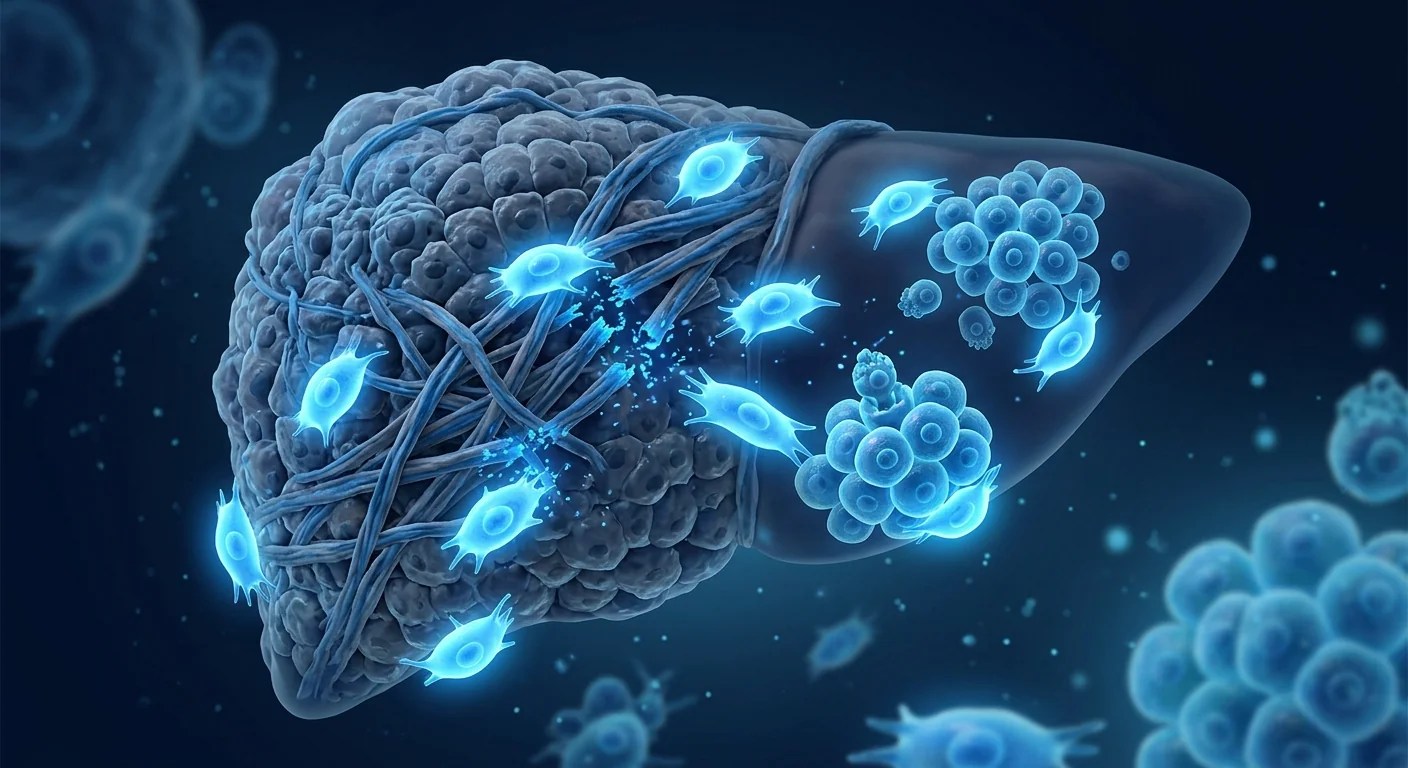
Cirrhosis is the end stage of chronic liver injury. Whatever the initial cause, the common pathway is fibrosis — the progressive deposition of scar tissue. Normally quiescent cells in the liver called hepatic stellate cells become activated by ongoing inflammation and injury, transforming into collagen-producing myofibroblasts. They lay down dense bands of scar that distort the liver's delicate architecture, choke off blood flow, and raise pressure in the portal vein. The result is portal hypertension and, over time, liver failure — with fluid accumulation, jaundice, bleeding varices and confusion among its consequences.[1][2][3][4]
The cruel irony is that the liver's famous regenerative power is not switched off in cirrhosis; it is simply outmatched. Scar formation outpaces the survival and renewal of functioning liver cells (hepatocytes). Once the scaffolding of the organ is remodelled into nodules and fibrous septa, healthy regeneration cannot organise itself normally. That is what makes cirrhosis so difficult — and why a therapy that could dampen scarring and support hepatocyte survival is such an attractive, if still unproven, idea.
Why mesenchymal stem cells are the main candidate
The cells most studied in cirrhosis are mesenchymal stem cells (MSCs), typically sourced from bone marrow or umbilical cord. They are favoured for two reasons: a reassuring safety record across many trials, and a biological profile that fits the problem. Importantly, MSCs are not expected to regrow a whole liver or replace large numbers of hepatocytes. Their proposed value is paracrine, anti-fibrotic and immunomodulatory — they sense an injured, inflamed environment and respond by secreting signalling molecules that recalibrate it.
In laboratory and animal studies, MSCs have been shown to reduce the activation of hepatic stellate cells — the engine of fibrosis — and even encourage the breakdown of existing scar by shifting the balance of matrix-remodelling enzymes. They dampen inflammation and secrete growth factors implicated in liver repair, most notably hepatocyte growth factor (HGF), which can support the survival and function of remaining hepatocytes. In pre-clinical cirrhosis models, these effects have translated into reduced fibrosis and improved liver function markers. Whether the same holds durably in humans is precisely the open question.
What the human trials actually show
Most clinical experience comes from early-phase studies in patients with decompensated cirrhosis and acute-on-chronic liver failure (ACLF) — settings of severe, advanced disease with few options. Across a number of small trials, umbilical-cord and bone-marrow MSCs delivered by intravenous or hepatic-artery infusion have generally been reported as safe and well tolerated. Some studies have described transient improvements in liver-function measures — a falling MELD score, rising serum albumin, improving bilirubin — over weeks to a few months.
That is the encouraging part. The sobering part is that these signals are often short-lived, and results across trials are mixed and inconsistent. Many studies are small, of variable design, and short in follow-up. The measures that matter most to patients — long-term survival and transplant-free survival — have not been reliably shown to improve. In short: promising early safety and short-term biochemical signals, but no established durable benefit.
The honest headline
As of today, no stem cell therapy is an approved, proven treatment that reverses cirrhosis or replaces the need for standard hepatology care and, where indicated, liver transplantation. The credible work is happening in early-phase clinical trials that have mainly established safety and glimpsed short-term biochemical improvements. Any clinic presenting cirrhosis stem cell treatment as a reliable cure is going well beyond the evidence.
How liver outcomes are actually measured
Optimistic stories rarely mention how rigorously benefit must be demonstrated in liver disease. Researchers rely on objective, standardised measures. The MELD score (Model for End-stage Liver Disease) combines bilirubin, creatinine and clotting to gauge severity and prioritise transplantation. The Child–Pugh score grades cirrhosis using albumin, bilirubin, clotting, fluid retention and mental status. Individual markers such as serum albumin (which the liver makes) and bilirubin (which it clears) track function directly. But the ultimate test is survival — whether patients live longer, or avoid transplant, in a controlled comparison. So far, cell therapy has not consistently moved that endpoint.
What the evidence supports — and what it doesn't
The fair summary is nuanced. Across multiple early-phase studies, MSC therapy for cirrhosis has generally appeared safe and well tolerated, which is a real and necessary first step, and there are biologically plausible anti-fibrotic mechanisms with occasional short-term improvements in liver-function markers. What is missing is the harder evidence: large, randomised, controlled trials showing that a specific cell product produces a consistent, reproducible and durable improvement in liver function and survival. Until that exists, the responsible description is investigational.
- Benefits so far are often transient. Improvements in MELD or albumin reported in some trials have tended to fade over months, and it remains unclear how to sustain any early effect.
- Results are mixed and hard to compare. Cell source, dose, route of delivery and patient selection vary widely between studies, and small, uncontrolled trials cannot separate a genuine effect from the natural fluctuation of liver disease.
- It does not replace standard care. Treating the underlying cause — antiviral therapy, alcohol cessation, metabolic management — and timely transplant assessment remain the foundation; cell therapy is being studied as a possible adjunct, not a substitute.
Cirrhosis is exactly the kind of serious, advanced condition where false hope does real harm. The most respectful thing we can offer is the truth about where the science stands — and the patience to let rigorous trials answer the questions that anecdotes cannot.
— VELAR Clinical Team
How to evaluate any offer responsibly
If you or someone you love is considering stem cell options for cirrhosis, the diligence is the same that protects against any over-promised treatment. Ask whether the approach is part of a registered clinical trial with ethical oversight. Ask what cell type and source are used, how outcomes such as MELD, Child–Pugh, albumin and survival are measured, and on what published evidence the claims rest. Be deeply sceptical of guaranteed results, success-rate percentages without a cited source, or any framing that positions an experimental therapy as a routine cure or an alternative to transplant evaluation. A trustworthy provider will describe cirrhosis cell therapy as emerging research — and will never let hope outrun the data.
The VELAR perspective
At VELAR Center, our regenerative work is grounded in conditions where the evidence is more established, and we follow hepatology cell-therapy research closely without overstating it. Cirrhosis remains one of the hardest problems in the field, and we believe the only honest way to discuss it is plainly: the anti-fibrotic rationale is sound, the early-phase safety data are reassuring, short-term biochemical signals are encouraging, durable outcome benefit is unproven, and it is still investigational — never a replacement for standard hepatology care or transplantation. As the controlled evidence matures, we will let that evidence — not enthusiasm — shape anything we ever say about it. If you want an honest conversation about what regenerative medicine can and cannot do today, that is exactly where a responsible consultation begins.
References
- Uccelli A, Moretta L, Pistoia V. Mesenchymal stem cells in health and disease. Nature Reviews Immunology. 2008;8(9):726-736. doi:10.1038/nri2395 ↩
- Shi Y, Wang Y, Li Q, et al. Immunoregulatory mechanisms of mesenchymal stem and stromal cells in inflammatory diseases. Nature Reviews Nephrology. 2018;14(8):493-507. doi:10.1038/s41581-018-0023-5 ↩
- Spees JL, Lee RH, Gregory CA. Mechanisms of mesenchymal stem/stromal cell function. Stem Cell Research & Therapy. 2016;7(1):125. doi:10.1186/s13287-016-0363-7 ↩
- Galipeau J, Sensébé L. Mesenchymal stromal cells: clinical challenges and therapeutic opportunities. Cell Stem Cell. 2018;22(6):824-833. doi:10.1016/j.stem.2018.05.004 ↩
- Pittenger MF, Discher DE, Péault BM, Phinney DG, Hare JM, Caplan AI. Mesenchymal stem cell perspective: cell biology to clinical progress. NPJ Regenerative Medicine. 2019;4:22. doi:10.1038/s41536-019-0083-6 ↩
- Caplan AI. Mesenchymal stem cells: time to change the name! Stem Cells Translational Medicine. 2017;6(6):1445-1451. doi:10.1002/sctm.17-0051 ↩
- Dominici M, Le Blanc K, Mueller I, et al. Minimal criteria for defining multipotent mesenchymal stromal cells. Cytotherapy. 2006;8(4):315-317. doi:10.1080/14653240600855905 ↩
- Lalu MM, McIntyre L, Pugliese C, et al. Safety of cell therapy with mesenchymal stromal cells (SafeCell). PLoS One. 2012;7(10):e47559. doi:10.1371/journal.pone.0047559 ↩
- Naji A, Eitoku M, Favier B, Deschaseaux F, Rouas-Freiss N, Suganuma N. Biological functions of mesenchymal stem cells. Cellular and Molecular Life Sciences. 2019;76(17):3323-3348. doi:10.1007/s00018-019-03125-1 ↩
- Bronckaers A, Hilkens P, Martens W, et al. Mesenchymal stem/stromal cells as a pharmacological approach to accelerate angiogenesis. Pharmacology & Therapeutics. 2014;143(2):181-196. doi:10.1016/j.pharmthera.2014.02.013 ↩
- Wang Y, Chen X, Cao W, Shi Y. Plasticity of mesenchymal stem cells in immunomodulation. Nature Immunology. 2014;15(11):1009-1016. doi:10.1038/ni.3002 ↩
- Weiss DJ, Bertoncello I, Borok Z, et al. Stem cells and cell therapies in lung biology and lung diseases. Proceedings of the American Thoracic Society. 2011;8(3):223-272. doi:10.1513/pats.201012-071DW ↩
参考文献
- Uccelli A, Moretta L, Pistoia V. Mesenchymal stem cells in health and disease. Nature Reviews Immunology. 2008;8(9):726-736. doi:10.1038/nri2395 ↩
- Shi Y, Wang Y, Li Q, et al. Immunoregulatory mechanisms of mesenchymal stem and stromal cells in inflammatory diseases. Nature Reviews Nephrology. 2018;14(8):493-507. doi:10.1038/s41581-018-0023-5 ↩
- Spees JL, Lee RH, Gregory CA. Mechanisms of mesenchymal stem/stromal cell function. Stem Cell Research & Therapy. 2016;7(1):125. doi:10.1186/s13287-016-0363-7 ↩
- Galipeau J, Sensébé L. Mesenchymal stromal cells: clinical challenges and therapeutic opportunities. Cell Stem Cell. 2018;22(6):824-833. doi:10.1016/j.stem.2018.05.004 ↩
- Pittenger MF, Discher DE, Péault BM, Phinney DG, Hare JM, Caplan AI. Mesenchymal stem cell perspective: cell biology to clinical progress. NPJ Regenerative Medicine. 2019;4:22. doi:10.1038/s41536-019-0083-6 ↩
- Caplan AI. Mesenchymal stem cells: time to change the name! Stem Cells Translational Medicine. 2017;6(6):1445-1451. doi:10.1002/sctm.17-0051 ↩
- Dominici M, Le Blanc K, Mueller I, et al. Minimal criteria for defining multipotent mesenchymal stromal cells. Cytotherapy. 2006;8(4):315-317. doi:10.1080/14653240600855905 ↩
- Lalu MM, McIntyre L, Pugliese C, et al. Safety of cell therapy with mesenchymal stromal cells (SafeCell). PLoS One. 2012;7(10):e47559. doi:10.1371/journal.pone.0047559 ↩
- Naji A, Eitoku M, Favier B, Deschaseaux F, Rouas-Freiss N, Suganuma N. Biological functions of mesenchymal stem cells. Cellular and Molecular Life Sciences. 2019;76(17):3323-3348. doi:10.1007/s00018-019-03125-1 ↩
- Bronckaers A, Hilkens P, Martens W, et al. Mesenchymal stem/stromal cells as a pharmacological approach to accelerate angiogenesis. Pharmacology & Therapeutics. 2014;143(2):181-196. doi:10.1016/j.pharmthera.2014.02.013 ↩
- Wang Y, Chen X, Cao W, Shi Y. Plasticity of mesenchymal stem cells in immunomodulation. Nature Immunology. 2014;15(11):1009-1016. doi:10.1038/ni.3002 ↩
- Weiss DJ, Bertoncello I, Borok Z, et al. Stem cells and cell therapies in lung biology and lung diseases. Proceedings of the American Thoracic Society. 2011;8(3):223-272. doi:10.1513/pats.201012-071DW ↩
肝脏是人体少数能够自我再生的器官之一——在健康状态下,切除一部分它仍可再度长回。而肝硬化,正是这一能力最终被压垮之时。多年的慢性损伤——来自乙型或丙型肝炎、酒精,或代谢性(脂肪)肝病——用瘢痕取代了有功能的肝组织,直到器官再也无法跟上。现有治疗管理并发症,并在晚期指向肝移植,而移植仍是唯一的根治手段。正是这一缺口,干细胞研究希望去缩小。然而,要理解什么是现实的,就必须把真正的科学与常常环绕其周围的营销区分开来。
肝硬化的肝出了什么问题
肝硬化是慢性肝损伤的终末阶段。无论最初病因为何,其共同通路都是纤维化——瘢痕组织的逐渐沉积。肝内通常静止的肝星状细胞在持续的炎症与损伤下被激活,转变为产生胶原的肌成纤维细胞。它们铺下致密的瘢痕带,扭曲肝脏精细的结构,阻断血流,并升高门静脉的压力。其结果是门静脉高压,并随时间演进为肝功能衰竭——腹水、黄疸、静脉曲张出血与意识混乱皆是其后果。
残酷的讽刺在于,肝脏著名的再生能力在肝硬化中并未被关闭;它只是寡不敌众。瘢痕的形成超过了有功能肝细胞(肝细胞)的存活与更新。一旦器官的支架被重塑为结节与纤维间隔,健康的再生便无法正常地组织起来。这正是肝硬化如此棘手的原因——也是一种能抑制瘢痕并支持肝细胞存活的疗法,何以成为如此诱人却仍未证实的设想。
为何间充质干细胞是主要候选
在肝硬化中研究最多的细胞是间充质干细胞(MSC),通常取自骨髓或脐带。它们受青睐有两个原因:在众多试验中令人放心的安全记录,以及契合该问题的生物学特性。重要的是,人们并不期望 MSC 重新长出整个肝脏或替代大量肝细胞。其被提出的价值在于旁分泌、抗纤维化与免疫调节——它们感知受损、发炎的环境,并以分泌信号分子来重新校准它作为回应。
在实验室与动物研究中,MSC 已被证明能减少肝星状细胞——纤维化的引擎——的激活,甚至通过改变基质重塑酶的平衡来促进现有瘢痕的分解。它们抑制炎症,并分泌与肝脏修复相关的生长因子,尤以肝细胞生长因子(HGF)为著,可支持剩余肝细胞的存活与功能。在临床前肝硬化模型中,这些效应转化为纤维化减轻与肝功能指标改善。这是否在人体中持久成立,正是悬而未决的问题。
人体试验究竟显示了什么
大多数临床经验来自针对失代偿期肝硬化与慢加急性肝功能衰竭(ACLF)患者的早期研究——这些都是病情严重、晚期、选择甚少的情形。在若干小型试验中,通过静脉或肝动脉输注的脐带与骨髓 MSC,总体上被报告为安全且耐受良好。一些研究描述了肝功能指标在数周至数月内出现短暂改善——MELD 评分下降、血清白蛋白上升、胆红素好转。
这是令人鼓舞的部分。而清醒的部分在于,这些信号往往短暂,且各试验间的结果不一且不一致。许多研究规模小、设计各异、随访短。对患者最重要的指标——长期生存与无移植生存——尚未被可靠地证明有所改善。简言之:早期安全性与短期生化信号令人鼓舞,但尚无确立的持久获益。
诚实的标题
截至今日,没有任何干细胞疗法是已获批准、经证实能够逆转肝硬化,或替代标准肝病治疗以及在有指征时替代肝移植的治疗。可信的工作正在早期临床试验中进行,这些试验主要确立了安全性,并瞥见了短期的生化改善。任何将肝硬化干细胞治疗呈现为可靠治愈的诊所,都已远远超出了证据。
肝脏结果究竟如何衡量
乐观的故事很少提及在肝病中必须多么严格地证明获益。研究人员依赖客观、标准化的衡量指标。MELD 评分(终末期肝病模型)结合胆红素、肌酐与凝血功能,用以评估严重程度并排定移植优先顺序。Child–Pugh 评分以白蛋白、胆红素、凝血、腹水与精神状态来分级肝硬化。诸如血清白蛋白(由肝脏制造)与胆红素(由肝脏清除)等单项指标直接反映功能。但终极的检验是生存——在对照比较中,患者是否活得更久,或是否避免了移植。迄今为止,细胞疗法尚未一致地改变这一终点。
证据支持什么——又不支持什么
公允的总结是细致入微的。在多项早期研究中,肝硬化的 MSC 疗法总体上显得安全且耐受良好,这是真实且必要的第一步,并且存在生物学上合理的抗纤维化机制,偶有肝功能指标的短期改善。所缺失的是更有力的证据:大型、随机、有对照的试验,证明某种特定细胞产品能在肝功能与生存方面产生一致、可重复且持久的改善。在此之前,负责任的描述是研究性的。
- 迄今获益往往是短暂的。一些试验中报告的 MELD 或白蛋白改善,往往在数月内消退,如何维持任何早期效应仍不清楚。
- 结果不一且难以比较。各研究间的细胞来源、剂量、递送途径与患者选择差异甚大,小型、无对照的试验无法将真实效应与肝病的自然波动区分开来。
- 它并不替代标准治疗。治疗根本病因——抗病毒治疗、戒酒、代谢管理——以及及时的移植评估仍是基础;细胞疗法正被作为可能的辅助手段研究,而非替代品。
肝硬化恰恰是那种虚假希望会造成真实伤害的严重晚期疾病。我们能给予的最尊重的态度,是关于科学现状的真相——以及让严谨试验回答轶事无法回答之问题的耐心。
— VELAR 临床团队
如何负责任地评估任何提议
如果您或您所爱之人正在考虑肝硬化的干细胞选择,所需的审慎与防范任何被过度承诺之治疗的审慎相同。询问该方法是否属于受伦理监督的注册临床试验。询问使用何种细胞类型与来源、如何衡量 MELD、Child–Pugh、白蛋白与生存等结果,以及这些声称建立在何种已发表证据之上。对保证的结果、没有引用来源的成功率百分比,或任何将实验性疗法定位为常规治愈或移植评估之替代的表述,都要深度怀疑。值得信赖的提供者会将肝硬化细胞疗法描述为新兴研究——且绝不会让希望超越数据。
VELAR 的观点
在 VELAR 中心,我们的再生工作立足于证据更为确立的适应症,我们密切关注肝病细胞疗法研究而不夸大其词。肝硬化仍是该领域最棘手的难题之一,我们相信讨论它唯一诚实的方式就是直白:抗纤维化的理据充分,早期安全数据令人放心,短期生化信号令人鼓舞,持久的结果获益尚未证实,而它仍处于研究阶段——绝不替代标准肝病治疗或肝移植。随着对照证据的成熟,我们将让证据——而非热情——塑造我们对它所说的一切。如果您想就再生医学今天能做什么、不能做什么进行一次诚实的对话,那正是负责任咨询的起点。
المراجع
- Uccelli A, Moretta L, Pistoia V. Mesenchymal stem cells in health and disease. Nature Reviews Immunology. 2008;8(9):726-736. doi:10.1038/nri2395 ↩
- Shi Y, Wang Y, Li Q, et al. Immunoregulatory mechanisms of mesenchymal stem and stromal cells in inflammatory diseases. Nature Reviews Nephrology. 2018;14(8):493-507. doi:10.1038/s41581-018-0023-5 ↩
- Spees JL, Lee RH, Gregory CA. Mechanisms of mesenchymal stem/stromal cell function. Stem Cell Research & Therapy. 2016;7(1):125. doi:10.1186/s13287-016-0363-7 ↩
- Galipeau J, Sensébé L. Mesenchymal stromal cells: clinical challenges and therapeutic opportunities. Cell Stem Cell. 2018;22(6):824-833. doi:10.1016/j.stem.2018.05.004 ↩
- Pittenger MF, Discher DE, Péault BM, Phinney DG, Hare JM, Caplan AI. Mesenchymal stem cell perspective: cell biology to clinical progress. NPJ Regenerative Medicine. 2019;4:22. doi:10.1038/s41536-019-0083-6 ↩
- Caplan AI. Mesenchymal stem cells: time to change the name! Stem Cells Translational Medicine. 2017;6(6):1445-1451. doi:10.1002/sctm.17-0051 ↩
- Dominici M, Le Blanc K, Mueller I, et al. Minimal criteria for defining multipotent mesenchymal stromal cells. Cytotherapy. 2006;8(4):315-317. doi:10.1080/14653240600855905 ↩
- Lalu MM, McIntyre L, Pugliese C, et al. Safety of cell therapy with mesenchymal stromal cells (SafeCell). PLoS One. 2012;7(10):e47559. doi:10.1371/journal.pone.0047559 ↩
- Naji A, Eitoku M, Favier B, Deschaseaux F, Rouas-Freiss N, Suganuma N. Biological functions of mesenchymal stem cells. Cellular and Molecular Life Sciences. 2019;76(17):3323-3348. doi:10.1007/s00018-019-03125-1 ↩
- Bronckaers A, Hilkens P, Martens W, et al. Mesenchymal stem/stromal cells as a pharmacological approach to accelerate angiogenesis. Pharmacology & Therapeutics. 2014;143(2):181-196. doi:10.1016/j.pharmthera.2014.02.013 ↩
- Wang Y, Chen X, Cao W, Shi Y. Plasticity of mesenchymal stem cells in immunomodulation. Nature Immunology. 2014;15(11):1009-1016. doi:10.1038/ni.3002 ↩
- Weiss DJ, Bertoncello I, Borok Z, et al. Stem cells and cell therapies in lung biology and lung diseases. Proceedings of the American Thoracic Society. 2011;8(3):223-272. doi:10.1513/pats.201012-071DW ↩
الكبد من الأعضاء القليلة في جسم الإنسان القادرة على تجديد نفسها — إذ يمكنه، في حال الصحة، أن ينمو من جديد بعد استئصال جزء منه. وتليّف الكبد (التشمّع) هو ما يحدث حين تُغلَب هذه القدرة أخيراً. فسنوات من الأذى المزمن — من التهاب الكبد B أو C، أو الكحول، أو مرض الكبد الاستقلابي (الدهني) — تستبدل بالنسيج الكبدي العامل نسيجاً ندبياً، إلى أن يعجز العضو عن مواكبة ذلك. وتدير الرعاية الحالية المضاعفات، وتشير في الحالات المتقدمة إلى زراعة الكبد التي تبقى العلاج الشافي الوحيد. وهذه الفجوة بالذات هي ما تأمل أبحاث الخلايا الجذعية في تضييقه. لكن فهم ما هو واقعي يتطلب فصل العلم الحقيقي عن التسويق الذي كثيراً ما يحيط به.
ما الخلل الذي يصيب الكبد المتليّف
تشمّع الكبد هو المرحلة النهائية للأذى الكبدي المزمن. ومهما كان السبب الأولي، فالمسار المشترك هو التليّف — الترسّب المتدرّج للنسيج الندبي. فالخلايا الساكنة عادةً في الكبد والمسماة الخلايا النجمية الكبدية تُنشَّط بفعل الالتهاب والأذى المستمرين، فتتحول إلى خلايا ليفية عضلية منتجة للكولاجين. وتضع أشرطة كثيفة من الندبة تشوّه بنية الكبد الدقيقة، وتخنق تدفق الدم، وترفع الضغط في الوريد البابي. والنتيجة هي فرط ضغط الدم البابي، ومع الوقت فشل الكبد — ومن عواقبه تراكم السوائل واليرقان ونزف الدوالي والتشوّش الذهني.
والمفارقة القاسية أن قدرة الكبد التجديدية الشهيرة لا تُطفأ في التشمّع؛ بل يُتغلَّب عليها فحسب. إذ يسبق تكوّن الندبة بقاءَ وتجدّدَ خلايا الكبد العاملة (الخلايا الكبدية). ومتى أُعيدت هيكلة سقالة العضو إلى عُقيدات وحواجز ليفية، تعذّر على التجدّد السليم أن ينتظم على نحو طبيعي. وهذا ما يجعل التشمّع عسيراً جداً — ولماذا يكون علاج قادر على تهدئة التندّب ودعم بقاء الخلايا الكبدية فكرة جذّابة جداً وإن ظلت غير مثبتة.
لماذا الخلايا الجذعية الوسيطة هي المرشّح الرئيسي
أكثر الخلايا دراسةً في التشمّع هي الخلايا الجذعية الوسيطة (MSCs)، التي تُؤخذ عادةً من نخاع العظم أو الحبل السري. وتُفضَّل لسببين: سجل أمان مطمئن عبر تجارب كثيرة، وملمح بيولوجي يناسب المشكلة. والمهم أنه لا يُتوقع من هذه الخلايا أن تُنبت كبداً كاملاً أو تحل محل أعداد كبيرة من الخلايا الكبدية. فقيمتها المقترحة شبه صمّاوية ومضادة للتليّف ومناعية تعديلية — إذ تستشعر البيئة المتضررة الملتهبة وتستجيب بإفراز جزيئات إشارية تعيد ضبطها.
في الدراسات المختبرية والحيوانية، تبيّن أن MSCs تقلّل تنشيط الخلايا النجمية الكبدية — محرّك التليّف — بل وتشجّع تفكيك الندبة القائمة بتحويل توازن أنزيمات إعادة تشكيل المطرس. كما تخفّف الالتهاب وتفرز عوامل نمو متورطة في إصلاح الكبد، وأبرزها عامل نمو الخلايا الكبدية (HGF)، الذي يمكن أن يدعم بقاء الخلايا الكبدية المتبقية ووظيفتها. وفي نماذج التشمّع قبل السريرية، ترجمت هذه التأثيرات إلى تليّف أقل وتحسّن في مؤشرات وظائف الكبد. وهل يصمد ذلك نفسه على المدى في البشر؟ هذا تحديداً هو السؤال المفتوح.
ماذا تُظهر التجارب البشرية فعلياً
معظم الخبرة السريرية تأتي من دراسات مبكرة الطور في مرضى التشمّع اللا معاوَض والفشل الكبدي المزمن الحاد الاشتداد (ACLF) — وهي حالات مرض شديد ومتقدّم بخيارات قليلة. وعبر عدد من التجارب الصغيرة، أُبلغ عموماً أن خلايا MSC من الحبل السري ونخاع العظم، المُوصلة بالحقن الوريدي أو عبر الشريان الكبدي، آمنة وجيدة التحمّل. ووصفت بعض الدراسات تحسّنات عابرة في مقاييس وظائف الكبد — انخفاض درجة MELD، وارتفاع ألبومين المصل، وتحسّن البيليروبين — على مدى أسابيع إلى بضعة أشهر.
هذا هو الجانب المشجّع. أما الجانب الرصين فهو أن هذه الإشارات كثيراً ما تكون قصيرة الأمد، وأن النتائج بين التجارب متباينة وغير متسقة. فكثير من الدراسات صغيرة، متفاوتة التصميم، قصيرة المتابعة. والمقاييس الأهم للمرضى — البقاء طويل الأمد والبقاء دون زراعة — لم يثبُت تحسّنها على نحو موثوق. باختصار: أمان مبكر وإشارات كيميائية حيوية قصيرة الأمد مشجّعة، لكن دون فائدة دائمة راسخة.
العنوان الصادق
حتى اليوم، لا يوجد علاج بالخلايا الجذعية معتمد ومُثبت يعكس التشمّع أو يُغني عن رعاية الكبد المعيارية، وعن زراعة الكبد عند وجود دواعيها. العمل الموثوق يجري في تجارب سريرية مبكرة الطور أثبتت الأمان أساساً ولمحت تحسّنات كيميائية حيوية قصيرة الأمد. وأي عيادة تقدّم علاج التشمّع بالخلايا الجذعية كشفاء موثوق تتجاوز الأدلة بكثير.
كيف تُقاس نتائج الكبد فعلياً
نادراً ما تذكر القصص المتفائلة مدى الصرامة المطلوبة لإثبات الفائدة في مرض الكبد. ويعتمد الباحثون على مقاييس موضوعية وموحّدة. فدرجة MELD (نموذج مرض الكبد في مرحلته النهائية) تجمع البيليروبين والكرياتينين والتخثّر لتقدير الشدّة وترتيب أولوية الزراعة. وتصنّف درجة Child–Pugh التشمّع باستخدام الألبومين والبيليروبين والتخثّر واحتباس السوائل والحالة الذهنية. وتتتبّع مؤشرات مفردة مثل ألبومين المصل (الذي يصنعه الكبد) والبيليروبين (الذي يطرحه) الوظيفة مباشرةً. لكن الاختبار الأسمى هو البقاء — هل يعيش المرضى أطول، أو يتجنّبون الزراعة، في مقارنة مضبوطة. وحتى الآن لم يحرّك العلاج الخلوي هذه النهاية على نحو متسق.
ما تدعمه الأدلة — وما لا تدعمه
الخلاصة المنصفة دقيقة. عبر دراسات متعددة مبكرة الطور، بدا علاج MSC في التشمّع بوجه عام آمناً وجيد التحمّل، وهي خطوة أولى حقيقية وضرورية، وثمة آليات مضادة للتليّف معقولة بيولوجياً مع تحسّنات قصيرة الأمد أحياناً في مؤشرات وظائف الكبد. والمفقود هو الدليل الأقوى: تجارب كبيرة وعشوائية ومضبوطة تثبت أن منتجاً خلوياً محدداً يحقق تحسناً متسقاً وقابلاً للتكرار ودائماً في وظائف الكبد والبقاء. وإلى أن يتوفر ذلك، فالوصف المسؤول هو بحثي تجريبي.
- الفوائد حتى الآن كثيراً ما تكون عابرة. التحسّنات في MELD أو الألبومين المُبلَّغ عنها في بعض التجارب مالت إلى الاضمحلال خلال أشهر، ويبقى غامضاً كيف يُدام أي أثر مبكر.
- النتائج متباينة ويصعب مقارنتها. يتفاوت مصدر الخلايا والجرعة وطريق الإيصال واختيار المرضى تفاوتاً واسعاً بين الدراسات، ولا تستطيع التجارب الصغيرة غير المضبوطة الفصل بين أثر حقيقي والتذبذب الطبيعي لمرض الكبد.
- لا يحل محل الرعاية المعيارية. يظل علاج السبب الكامن — العلاج المضاد للفيروسات، والإقلاع عن الكحول، والإدارة الاستقلابية — وتقييم الزراعة في الوقت المناسب أساساً؛ ويُدرَس العلاج الخلوي بوصفه مُكمّلاً محتملاً لا بديلاً.
التشمّع هو بالضبط نوع الحالات الخطيرة المتقدّمة التي يسبب فيها الأمل الزائف ضرراً حقيقياً. وأكثر ما يمكننا تقديمه احتراماً هو الحقيقة عن موضع العلم — والصبر لندع التجارب الصارمة تجيب عن الأسئلة التي لا تستطيع الروايات الإجابة عنها.
— الفريق السريري في VELAR
كيف تقيّم أي عرض بمسؤولية
إذا كنت أنت أو شخص تحبه يفكر في خيارات الخلايا الجذعية للتشمّع، فالعناية المطلوبة هي نفسها التي تحمي من أي علاج مبالغ في الوعد به. اسأل عما إذا كان النهج جزءاً من تجربة سريرية مسجّلة تخضع لإشراف أخلاقي. اسأل عن نوع الخلايا المستخدم ومصدرها، وكيف تُقاس نتائج مثل MELD وChild–Pugh والألبومين والبقاء، وعلى أي دليل منشور تستند الادعاءات. وكن شديد الشك تجاه النتائج المضمونة، أو نسب نجاح بلا مصدر مذكور، أو أي صياغة تضع علاجاً تجريبياً في موضع الشفاء الروتيني أو بديلاً عن تقييم الزراعة. سيصف المزوّد الموثوق العلاج الخلوي للتشمّع بوصفه بحثاً ناشئاً — ولن يدع الأمل يتجاوز البيانات أبداً.
منظور VELAR
في مركز VELAR، يرتكز عملنا التجديدي على حالات تكون فيها الأدلة أكثر رسوخاً، ونتابع عن كثب أبحاث العلاج الخلوي في أمراض الكبد من دون المبالغة فيها. يظل التشمّع من أصعب المشكلات في المجال، ونؤمن بأن الطريقة الصادقة الوحيدة لمناقشته هي الصراحة: الأساس المضاد للتليّف سليم، وبيانات الأمان المبكرة مطمئنة، والإشارات الكيميائية الحيوية قصيرة الأمد مشجّعة، والفائدة الدائمة في النتائج غير مثبتة، وهو لا يزال بحثياً تجريبياً — وليس بديلاً أبداً عن رعاية الكبد المعيارية أو الزراعة. ومع نضوج الأدلة المضبوطة، سندع تلك الأدلة — لا الحماس — تشكّل أي شيء نقوله عنه يوماً. وإذا أردت حواراً صادقاً عما يستطيع الطب التجديدي وما لا يستطيع فعله اليوم، فهذا تحديداً حيث تبدأ الاستشارة المسؤولة.