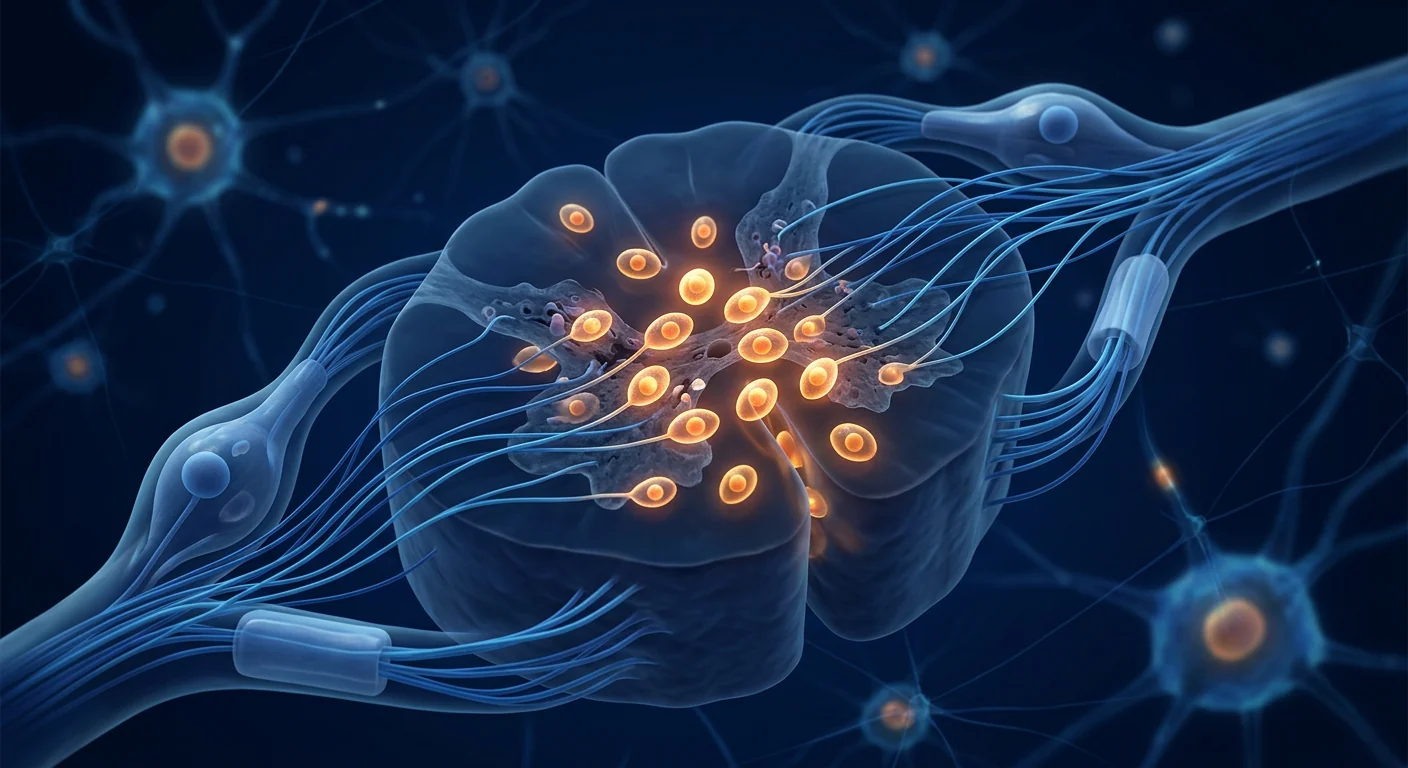
A spinal cord injury (SCI) is one of the most consequential events in medicine. When the dense bundle of nerve fibres running through the spine is damaged, the messages between brain and body are interrupted — and because the adult central nervous system regenerates poorly, that loss has historically been considered permanent [1]. It is precisely this wall of permanence that stem cell research hopes to push against. But understanding what is realistic requires separating the genuine science from the marketing that too often surrounds it.
Why the spinal cord does not heal on its own
The damage in SCI happens in two phases. The primary injury is the mechanical trauma itself. The secondary injury unfolds over hours to weeks: inflammation, swelling, cell death, and the breakdown of the myelin insulation that lets nerve signals travel. The body then forms a dense glial scar around the site. That scar stabilises the tissue but also creates a physical and chemical barrier that blocks severed nerve fibres (axons) from regrowing across the gap. The result is a region where surviving neurons cannot reconnect, oligodendrocytes that once insulated them are lost, and the local environment actively discourages repair.
Any cell-based strategy has to contend with all of this at once: replacing lost cells, remyelinating bare axons, calming inflammation, and somehow making the scarred environment more permissive to regrowth. No single approach does all of it, which is why researchers are testing several distinct cell types.
The cell types under investigation
Mesenchymal stem cells (MSCs)
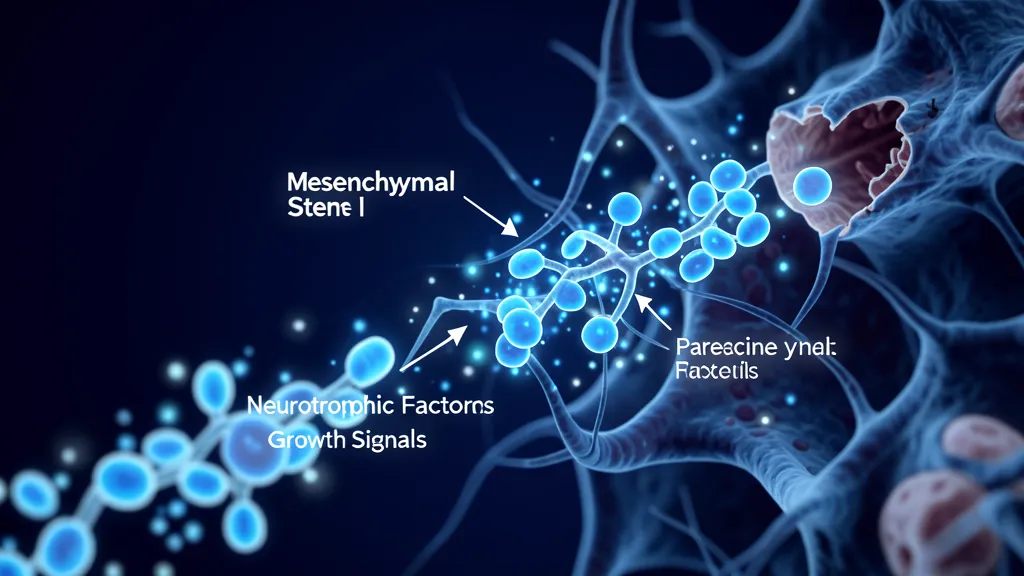
MSCs — often sourced from bone marrow, adipose tissue or umbilical cord — are the most widely studied cells in SCI trials, largely because they are accessible and have a reassuring safety profile [2]. Importantly, MSCs are not expected to turn into new neurons. Their proposed value is paracrine: they secrete neurotrophic factors, dampen inflammation, and support the survival of cells that the injury has put at risk. In other words, MSCs are studied mostly as a protective and modulating influence on the injured environment, not as a structural replacement for lost cord tissue [3].
Neural stem and progenitor cells (NSCs)
Neural stem cells can give rise to neurons, astrocytes and oligodendrocytes — the actual cell types of the central nervous system. The hope is that, transplanted into or near the lesion, they might form new relay circuits or replace lost cells. Pre-clinical models have shown transplanted NSCs extending processes and, in some studies, contributing to functional recovery. Translating this into humans is far harder, and remains at an early investigational stage.
Oligodendrocyte progenitor cells (OPCs)
Oligodendrocytes make the myelin that insulates axons; when they die, otherwise intact axons can no longer conduct signals. OPCs are designed to remyelinate those bare axons. This was the basis of one of the most closely watched programmes in the field — the Asterias Biotherapeutics SCiStar trial, which delivered an embryonic-stem-cell-derived OPC product (AST-OPC1) to patients with cervical SCI. The early-phase results were reported as encouraging on safety, with some participants showing motor-level improvement, but it was a small, uncontrolled study — promising signal-finding, not proof of efficacy.
Schwann cells
Schwann cells are the myelinating cells of the peripheral nervous system and, unusually, support axon regrowth. Because they can be harvested from a patient's own peripheral nerve, autologous Schwann-cell transplantation has been tested in early human studies — notably at the Miami Project to Cure Paralysis — primarily to establish safety and feasibility.
How outcomes are actually measured
The standard tool is the ASIA Impairment Scale (AIS), which grades injury severity from A (complete) to E (normal) based on motor and sensory testing [4]. A genuine improvement — say, a one-grade conversion from AIS A to AIS B — is clinically meaningful and hard to fake. But spontaneous recovery also occurs in the months after injury, especially in incomplete injuries, which is exactly why controlled trials matter: without a comparison group, it is impossible to know whether an observed change came from the cells or from natural recovery.
The honest headline
As of today, no stem cell therapy is an approved, proven treatment that restores function after spinal cord injury. The credible work is happening in early-phase clinical trials that are still establishing safety and looking for preliminary signals of benefit. Any clinic presenting SCI stem cell treatment as a reliable cure is going well beyond the evidence.
What the evidence supports — and what it doesn't
Across multiple early-phase studies, cell transplantation for SCI has generally appeared safe and feasible, which is a real and necessary first step [5]. Some trials have reported individual participants with sensory or motor improvements [6]. What is missing is the harder evidence: large, randomised, controlled trials demonstrating that a specific cell product produces a consistent, reproducible functional benefit beyond natural recovery. Until that exists, the responsible description is investigational — a field with biological plausibility and encouraging early signals, but not yet established efficacy.
- Chronic versus acute injury matters. The injured environment changes dramatically over time, and a therapy that helps in the acute phase may behave very differently in a years-old, fully scarred injury.
- Delivery is unsolved. Getting cells to survive, stay where they are placed, and integrate safely is a major technical challenge in its own right.
- Combination approaches are likely. Most researchers expect that cells alone will not be enough — biomaterial scaffolds, rehabilitation, and scar-modifying drugs may all be needed together.
Spinal cord injury is exactly the kind of condition where false hope does real harm. The most respectful thing we can offer is the truth about where the science stands — and the patience to let rigorous trials answer the questions that anecdotes cannot.
— VELAR Clinical Team
How to evaluate any offer responsibly
If you or someone you love is considering stem cell options for SCI, the diligence is the same that protects against any over-promised treatment. Ask whether the approach is part of a registered clinical trial with ethical oversight. Ask what cell type is used, how outcomes are measured, and on what published evidence the claims rest. Be deeply sceptical of guaranteed results, success-rate percentages without a cited source, or any framing that positions an experimental therapy as a routine cure. A trustworthy provider will describe SCI cell therapy as emerging research — and will never let hope outrun the data.
The VELAR perspective
At VELAR Center, our regenerative work is grounded in conditions where the evidence is more established, and we follow neurological cell-therapy research closely without overstating it. Spinal cord injury remains one of the hardest problems in the field, and we believe the only honest way to discuss it is plainly: the science is genuinely advancing, the early-phase trials are worth watching, and it is still investigational. As the controlled evidence matures, we will let that evidence — not enthusiasm — shape anything we ever say about it. If you want an honest conversation about what regenerative medicine can and cannot do today, that is exactly where a responsible consultation begins.
References
- Ahuja CS, Wilson JR, Nori S, et al. Traumatic spinal cord injury. Nature Reviews Disease Primers. 2017;3:17018. doi:10.1038/nrdp.2017.18 ↩
- Shkap M, Namestnikova D, Cherkashova E, et al. Clinical Insights into Mesenchymal Stem Cell Applications for Spinal Cord Injury. International Journal of Molecular Sciences. 2025;26(24):12139. doi:10.3390/ijms262412139 ↩
- Fan Y, Wong ST, Goh ELK, et al. Cell therapy for stroke and spinal cord injury in clinical trials. Stem Cells Translational Medicine. 2026;15(1):szaf082. doi:10.1093/stcltm/szaf082 ↩
- Kirshblum SC, Burns SP, Biering-Sorensen F, et al. International standards for neurological classification of spinal cord injury (revised 2011). Journal of Spinal Cord Medicine. 2011;34(6):535-546. doi:10.1179/204577211X13207446293695 ↩
- Bydon M, Qu W, Moinuddin FM, et al. Intrathecal delivery of adipose-derived mesenchymal stem cells in traumatic spinal cord injury: Phase I trial. Nature Communications. 2024;15:2786. doi:10.1038/s41467-024-46259-y ↩
- Kaplan N, Kabatas S, Civelek E, et al. Multiroute administration of Wharton's jelly mesenchymal stem cells in chronic complete spinal cord injury: A phase I safety study. World Journal of Stem Cells. 2025;17(5):101675. doi:10.4252/wjsc.v17.i5.101675 ↩
- Bach DH, Van Giang B, Nguyen TL. Cell Therapy for Spinal Cord Injury: Mechanistic Insights and Translational Challenges. Cellular and Molecular Neurobiology. 2026;46(3):117. doi:10.1007/s10571-026-01720-y ↩
- Awidi A, Al Shudifat A, El Adwan N, et al. Safety and potential efficacy of expanded mesenchymal stromal cells of bone marrow and umbilical cord origins in patients with chronic spinal cord injury. Cytotherapy. 2024;26(8):878-887. doi:10.1016/j.jcyt.2024.03.480 ↩
- Macêdo CT, de Freitas Souza BS, Villarreal CF, et al. Transplantation of autologous mesenchymal stromal cells in complete cervical spinal cord injury: a pilot study. Frontiers in Medicine. 2024;11:1451297. doi:10.3389/fmed.2024.1451297 ↩
- Akhlaghpasand M, Tavanaei R, Hosseinpoor M, et al. Safety and potential effects of intrathecal injection of allogeneic human umbilical cord mesenchymal stem cell-derived exosomes in chronic spinal cord injury. Stem Cell Research & Therapy. 2024;15:268. doi:10.1186/s13287-024-03868-0 ↩
- Wang X, Wang Q, Xia Z, et al. Mesenchymal stromal cell therapies for traumatic neurological injuries. Journal of Translational Medicine. 2024;22:1044. doi:10.1186/s12967-024-05725-3 ↩
- Hoang DM, Pham PT, Bach TQ, et al. Stem cell-based therapy for human diseases. Signal Transduction and Targeted Therapy. 2022;7:272. doi:10.1038/s41392-022-01134-4 ↩
- Jafar H, Jamali F, Al-Hattab D, et al. Functional improvements correlate with enhanced quality of life following mesenchymal stromal cell therapy in chronic spinal cord injury. Scientific Reports. 2025;15:23142. doi:10.1038/s41598-025-23142-4 ↩
- Akhlaghpasand M, Tavanaei R, Hosseinpoor M, et al. Effects of Combined Intrathecal Mesenchymal Stem Cells and Schwann Cells Transplantation on Neuropathic Pain in Complete Spinal Cord Injury. Cell Transplantation. 2025;34:9636897241298128. doi:10.1177/09636897241298128 ↩
脊髓损伤(SCI)是医学中后果最严重的事件之一。当贯穿脊柱的密集神经纤维束受损时,大脑与身体之间的信息传递就被中断——而由于成人中枢神经系统再生能力很差,这种损失在历史上一直被视为永久性的。正是这堵「永久」之墙,干细胞研究希望去撼动。但要理解什么是现实的,就必须把真正的科学与常常环绕其周围的营销区分开来。
为什么脊髓无法自行愈合
SCI 的损伤分两个阶段发生。原发性损伤是机械创伤本身。继发性损伤则在数小时至数周内展开:炎症、肿胀、细胞死亡,以及让神经信号得以传递的髓鞘绝缘层的崩解。随后,身体在损伤部位形成致密的胶质瘢痕。该瘢痕稳定了组织,但也制造了物理与化学屏障,阻止断裂的神经纤维(轴突)跨越缺口重新生长。结果就是:存活的神经元无法重新连接,曾为其提供绝缘的少突胶质细胞丧失,而局部环境也主动阻碍修复。
任何基于细胞的策略都必须同时应对这一切:替换丧失的细胞、为裸露的轴突重新髓鞘化、平息炎症,并设法让瘢痕化的环境对再生更为友好。没有任何单一方法能做到全部,这正是研究人员测试多种不同细胞类型的原因。
正在研究的细胞类型
间充质干细胞(MSC)
MSC——常取自骨髓、脂肪组织或脐带——是 SCI 试验中研究最广泛的细胞,主要因为它们易于获取且安全性令人放心。重要的是,人们并不期望 MSC 转变为新的神经元。其被提出的价值在于旁分泌:它们分泌神经营养因子、抑制炎症,并支持因损伤而处于危险中的细胞存活。换言之,MSC 主要作为对受损环境的保护与调节影响来研究,而非作为丧失脊髓组织的结构性替代。
神经干细胞与祖细胞(NSC)
神经干细胞可分化为神经元、星形胶质细胞与少突胶质细胞——即中枢神经系统真正的细胞类型。人们希望,将其移植到病灶内或附近,或许能形成新的中继回路或替换丧失的细胞。临床前模型显示移植的 NSC 会延伸突起,且在一些研究中促进了功能恢复。将其转化到人体要困难得多,仍处于早期研究阶段。
少突胶质祖细胞(OPC)
少突胶质细胞制造为轴突绝缘的髓鞘;当它们死亡时,原本完好的轴突便无法再传导信号。OPC 旨在为这些裸露的轴突重新髓鞘化。这正是该领域最受关注的项目之一的基础——Asterias Biotherapeutics 的 SCiStar 试验,它向颈段 SCI 患者递送了一种源自胚胎干细胞的 OPC 产品(AST-OPC1)。早期结果在安全性上被报告为令人鼓舞,部分受试者显示出运动平面的改善,但这是一项小型、无对照的研究——是有前景的信号发现,而非疗效证明。
雪旺细胞
雪旺细胞是周围神经系统的髓鞘形成细胞,并且不同寻常地支持轴突再生。由于它们可从患者自身的周围神经中获取,自体雪旺细胞移植已在早期人体研究中被测试——尤其是在迈阿密治愈瘫痪项目中——主要用于确立安全性与可行性。
结果究竟如何衡量
乐观的故事很少提及恢复必须被多么严格地衡量。标准工具是 ASIA 损伤量表(AIS),它基于运动与感觉测试,将损伤严重程度从 A(完全)分级到 E(正常)。真正的改善——例如从 AIS A 到 AIS B 的一级转变——具有临床意义且难以伪造。但损伤后数月内也会发生自发恢复,尤其在不完全损伤中,这正是对照试验之所以重要的原因:没有对照组,就无法知道观察到的变化究竟来自细胞还是来自自然恢复。
诚实的标题
截至今日,没有任何干细胞疗法是已获批准、经证实能够恢复脊髓损伤后功能的治疗。可信的工作正在早期临床试验中进行,这些试验仍在确立安全性并寻找初步的获益信号。任何将 SCI 干细胞治疗呈现为可靠治愈的诊所,都已远远超出了证据。
证据支持什么——又不支持什么
公允的总结是细致入微的。在多项早期研究中,SCI 的细胞移植总体上显得安全且可行,这是真实且必要的第一步。一些试验报告了个别受试者出现感觉或运动改善。所缺失的是更有力的证据:大型、随机、有对照的试验,证明某种特定细胞产品能产生超越自然恢复的一致、可重复的功能获益。在此之前,负责任的描述是研究性的——一个具有生物学合理性与令人鼓舞的早期信号、但尚未确立疗效的领域。
- 慢性与急性损伤有别。受损环境随时间剧烈变化,在急性期有帮助的疗法,在多年陈旧、完全瘢痕化的损伤中可能表现迥异。
- 递送尚未解决。让细胞存活、停留在放置之处并安全整合,本身就是一项重大的技术挑战。
- 联合方法可能是必需的。多数研究人员预期单靠细胞并不足够——生物材料支架、康复训练与瘢痕修饰药物或许都需要协同使用。
脊髓损伤恰恰是那种虚假希望会造成真实伤害的疾病。我们能给予的最尊重的态度,是关于科学现状的真相——以及让严谨试验回答轶事无法回答之问题的耐心。
— VELAR 临床团队
如何负责任地评估任何提议
如果您或您所爱之人正在考虑 SCI 的干细胞选择,所需的审慎与防范任何被过度承诺之治疗的审慎相同。询问该方法是否属于受伦理监督的注册临床试验。询问使用何种细胞类型、如何衡量结果,以及这些声称建立在何种已发表证据之上。对保证的结果、没有引用来源的成功率百分比,或任何将实验性疗法定位为常规治愈的表述,都要深度怀疑。值得信赖的提供者会将 SCI 细胞疗法描述为新兴研究——且绝不会让希望超越数据。
VELAR 的观点
在 VELAR 中心,我们的再生工作立足于证据更为确立的适应症,我们密切关注神经细胞疗法研究而不夸大其词。脊髓损伤仍是该领域最棘手的难题之一,我们相信讨论它唯一诚实的方式就是直白:科学确实在进步,早期试验值得关注,而它仍处于研究阶段。随着对照证据的成熟,我们将让证据——而非热情——塑造我们对它所说的一切。如果您想就再生医学今天能做什么、不能做什么进行一次诚实的对话,那正是负责任咨询的起点。
إصابة الحبل الشوكي (SCI) من أشد الأحداث خطورةً في الطب. فعندما تتضرر الحزمة الكثيفة من الألياف العصبية الممتدة عبر العمود الفقري، تنقطع الرسائل بين الدماغ والجسم — ولأن الجهاز العصبي المركزي لدى البالغين يتجدد بصعوبة، فقد اعتُبرت هذه الخسارة تاريخياً دائمة. وهذا الجدار من الديمومة بالذات هو ما تأمل أبحاث الخلايا الجذعية في دفعه. لكن فهم ما هو واقعي يتطلب فصل العلم الحقيقي عن التسويق الذي كثيراً ما يحيط به.
لماذا لا يلتئم الحبل الشوكي من تلقاء نفسه
يحدث الضرر في إصابة الحبل الشوكي على مرحلتين. الإصابة الأولية هي الرضح الميكانيكي نفسه. أما الإصابة الثانوية فتتكشف على مدى ساعات إلى أسابيع: التهاب وتورم وموت خلوي وتفكك غمد الميالين العازل الذي يسمح بانتقال الإشارات العصبية. ثم يكوّن الجسم ندبة دبقية كثيفة حول الموقع. تثبّت هذه الندبة النسيج لكنها تخلق أيضاً حاجزاً فيزيائياً وكيميائياً يمنع الألياف العصبية المقطوعة (المحاور) من إعادة النمو عبر الفجوة. والنتيجة منطقة لا تستطيع فيها العصبونات الناجية إعادة الاتصال، وتُفقد فيها الخلايا قليلة التغصن التي كانت تعزلها، وتثبّط فيها البيئة المحلية الإصلاح بنشاط.
أي استراتيجية قائمة على الخلايا عليها أن تواجه هذا كله دفعة واحدة: استبدال الخلايا المفقودة، وإعادة تكوين الميالين للمحاور العارية، وتهدئة الالتهاب، وجعل البيئة المتندبة أكثر تسامحاً مع إعادة النمو بطريقة ما. ولا يحقق أي نهج منفرد ذلك كله، ولهذا يختبر الباحثون عدة أنواع خلوية متمايزة.
أنواع الخلايا قيد البحث
الخلايا الجذعية الوسيطة (MSCs)
الخلايا الجذعية الوسيطة — التي تُؤخذ غالباً من نخاع العظم أو النسيج الدهني أو الحبل السري — هي أكثر الخلايا دراسةً في تجارب إصابة الحبل الشوكي، أساساً لأنها متاحة ولها سجل أمان مطمئن. والمهم أنه لا يُتوقع من هذه الخلايا أن تتحول إلى عصبونات جديدة. فقيمتها المقترحة شبه صمّاوية: إذ تفرز عوامل غذائية عصبية، وتخفف الالتهاب، وتدعم بقاء الخلايا التي عرّضتها الإصابة للخطر. بعبارة أخرى، تُدرس هذه الخلايا غالباً كمؤثر حامٍ ومعدِّل على البيئة المصابة، لا كبديل بنيوي لنسيج الحبل المفقود.
الخلايا الجذعية والسليفة العصبية (NSCs)
يمكن للخلايا الجذعية العصبية أن تنشئ عصبونات وخلايا نجمية وخلايا قليلة التغصن — وهي الأنواع الخلوية الفعلية للجهاز العصبي المركزي. والأمل أنها، إذا زُرعت داخل الآفة أو قربها، قد تكوّن دارات ترحيل جديدة أو تستبدل الخلايا المفقودة. وقد أظهرت النماذج قبل السريرية امتداد استطالات من هذه الخلايا المزروعة، وفي بعض الدراسات مساهمةً في التعافي الوظيفي. لكن ترجمة ذلك إلى البشر أصعب بكثير ولا تزال في مرحلة بحثية مبكرة.
الخلايا السليفة قليلة التغصن (OPCs)
تصنع الخلايا قليلة التغصن الميالين الذي يعزل المحاور؛ وعند موتها لا تعود المحاور السليمة قادرة على توصيل الإشارات. صُممت هذه السليفات لإعادة تكوين الميالين لتلك المحاور العارية. وكان هذا أساس أحد أكثر البرامج متابعةً في المجال — تجربة SCiStar من شركة Asterias Biotherapeutics، التي أوصلت منتج OPC مشتقاً من خلايا جذعية جنينية (AST-OPC1) إلى مرضى إصابة عنقية في الحبل الشوكي. وأُبلغ عن نتائج المرحلة المبكرة بأنها مشجعة من حيث الأمان، مع إظهار بعض المشاركين تحسناً في المستوى الحركي، لكنها كانت دراسة صغيرة وغير مضبوطة — استكشافٌ واعد للإشارة، لا إثبات للفاعلية.
خلايا شوان
خلايا شوان هي الخلايا المكوّنة للميالين في الجهاز العصبي المحيطي، وهي على نحوٍ غير معتاد تدعم إعادة نمو المحاور. ولأنه يمكن حصادها من عصب محيطي للمريض نفسه، فقد اختُبر زرع خلايا شوان الذاتية في دراسات بشرية مبكرة — لا سيما في مشروع ميامي لشفاء الشلل — أساساً لإثبات الأمان والجدوى.
كيف تُقاس النتائج فعلياً
نادراً ما تذكر القصص المتفائلة مدى الصرامة المطلوبة في قياس التعافي. والأداة المعيارية هي مقياس آسيا للإعاقة (AIS)، الذي يصنّف شدة الإصابة من A (كاملة) إلى E (طبيعية) استناداً إلى اختبارات حركية وحسية. والتحسن الحقيقي — كتحوّل بدرجة واحدة من AIS A إلى AIS B — ذو دلالة سريرية ويصعب تزييفه. لكن التعافي التلقائي يحدث أيضاً في الأشهر التالية للإصابة، خصوصاً في الإصابات غير الكاملة، وهذا تحديداً سبب أهمية التجارب المضبوطة: فبدون مجموعة مقارنة، يستحيل معرفة ما إذا كان التغير المُلاحَظ ناتجاً عن الخلايا أم عن التعافي الطبيعي.
العنوان الصادق
حتى اليوم، لا يوجد علاج بالخلايا الجذعية معتمد ومُثبت يستعيد الوظيفة بعد إصابة الحبل الشوكي. العمل الموثوق يجري في تجارب سريرية مبكرة الطور لا تزال تثبت الأمان وتبحث عن إشارات أولية للفائدة. وأي عيادة تقدّم علاج إصابة الحبل الشوكي بالخلايا الجذعية كشفاء موثوق تتجاوز الأدلة بكثير.
ما تدعمه الأدلة — وما لا تدعمه
الخلاصة المنصفة دقيقة. عبر دراسات متعددة مبكرة الطور، بدا زرع الخلايا في إصابة الحبل الشوكي بوجه عام آمناً وقابلاً للتطبيق، وهي خطوة أولى حقيقية وضرورية. وأبلغت بعض التجارب عن مشاركين أفراد ظهر لديهم تحسن حسي أو حركي. والمفقود هو الدليل الأقوى: تجارب كبيرة وعشوائية ومضبوطة تثبت أن منتجاً خلوياً محدداً يحقق فائدة وظيفية متسقة وقابلة للتكرار تتجاوز التعافي الطبيعي. وإلى أن يتوفر ذلك، فالوصف المسؤول هو بحثي تجريبي — مجال ذو معقولية بيولوجية وإشارات مبكرة مشجعة، لكن من دون فاعلية راسخة بعد.
- الإصابة المزمنة تختلف عن الحادة. تتغير البيئة المصابة تغيراً جذرياً مع الوقت، وقد يتصرف علاج يفيد في الطور الحاد على نحوٍ مختلف تماماً في إصابة قديمة بسنوات ومتندبة بالكامل.
- الإيصال لم يُحل. جعل الخلايا تبقى حية وتستقر في موضعها وتندمج بأمان تحدٍّ تقني كبير بحد ذاته.
- المناهج التوليفية مرجّحة. يتوقع معظم الباحثين أن الخلايا وحدها لن تكفي — فقد تلزم سقالات المواد الحيوية وإعادة التأهيل وأدوية تعديل الندبة معاً.
إصابة الحبل الشوكي هي بالضبط نوع الحالات التي يسبب فيها الأمل الزائف ضرراً حقيقياً. وأكثر ما يمكننا تقديمه احتراماً هو الحقيقة عن موضع العلم — والصبر لندع التجارب الصارمة تجيب عن الأسئلة التي لا تستطيع الروايات الإجابة عنها.
— الفريق السريري في VELAR
كيف تقيّم أي عرض بمسؤولية
إذا كنت أنت أو شخص تحبه يفكر في خيارات الخلايا الجذعية لإصابة الحبل الشوكي، فالعناية المطلوبة هي نفسها التي تحمي من أي علاج مبالغ في الوعد به. اسأل عما إذا كان النهج جزءاً من تجربة سريرية مسجّلة تخضع لإشراف أخلاقي. اسأل عن نوع الخلايا المستخدم، وكيف تُقاس النتائج، وعلى أي دليل منشور تستند الادعاءات. وكن شديد الشك تجاه النتائج المضمونة، أو نسب نجاح بلا مصدر مذكور، أو أي صياغة تضع علاجاً تجريبياً في موضع الشفاء الروتيني. سيصف المزوّد الموثوق العلاج الخلوي لإصابة الحبل الشوكي بوصفه بحثاً ناشئاً — ولن يدع الأمل يتجاوز البيانات أبداً.
منظور VELAR
في مركز VELAR، يرتكز عملنا التجديدي على حالات تكون فيها الأدلة أكثر رسوخاً، ونتابع عن كثب أبحاث العلاج الخلوي العصبي من دون المبالغة فيها. تظل إصابة الحبل الشوكي من أصعب المشكلات في المجال، ونؤمن بأن الطريقة الصادقة الوحيدة لمناقشتها هي الصراحة: العلم يتقدم فعلاً، والتجارب المبكرة جديرة بالمتابعة، وهي لا تزال بحثية تجريبية. ومع نضوج الأدلة المضبوطة، سندع تلك الأدلة — لا الحماس — تشكّل أي شيء نقوله عنها يوماً. وإذا أردت حواراً صادقاً عما يستطيع الطب التجديدي وما لا يستطيع فعله اليوم، فهذا تحديداً حيث تبدأ الاستشارة المسؤولة.