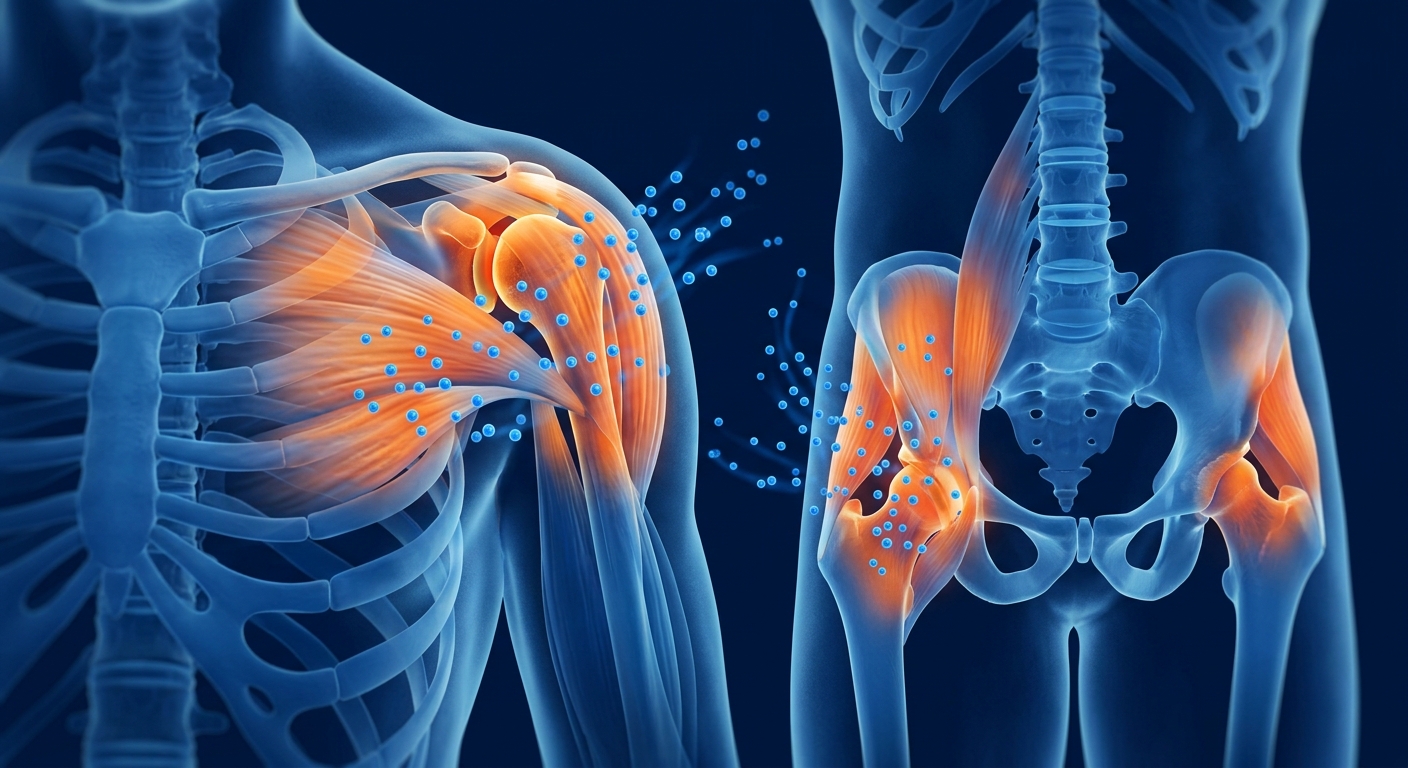
Polymyalgia rheumatica (PMR) is an inflammatory rheumatic condition that causes severe stiffness and aching in the shoulders, neck, and hip girdle — turning everyday movements like raising an arm or rising from a chair into genuine hardship. It affects adults almost exclusively over age 50 and is closely linked to giant cell arteritis, a potentially sight-threatening vasculitis. The cornerstone of treatment is corticosteroids, which often work dramatically within days. But for the substantial minority of patients who cannot taper below a threshold dose without relapse, or who suffer intolerable steroid side effects, the medical toolbox has been frustratingly limited. Mesenchymal stem cell therapy is now being studied as a way to address the underlying immune dysregulation rather than simply suppress it.[1][2]
What goes wrong in polymyalgia rheumatica
Polymyalgia rheumatica is an autoinflammatory condition centered on the proximal joints — shoulders and hips — driven by a dysregulated innate immune response. Unlike rheumatoid arthritis, PMR does not primarily involve joint erosion or autoantibodies. Instead, the pathology revolves around IL-6, a master cytokine that orchestrates the systemic inflammation, morning stiffness, and acute-phase response characteristic of the disease.[3]
The IL-6 cascade. Activated dendritic cells and macrophages in the synovium and bursae release IL-6, which stimulates the liver to produce C-reactive protein (CRP) and drives the constitutional symptoms — fatigue, low-grade fever, weight loss — that often accompany PMR. IL-6 also promotes differentiation of Th17 cells and suppresses regulatory T-cell function, tilting the immune balance toward sustained inflammation.[4]
The corticosteroid trap. Prednisolone at 15–20 mg/day typically produces a dramatic response within 48–72 hours — so reliable that a rapid response is itself a diagnostic criterion. The problem is what comes next. Many patients require treatment for 1–3 years, and a significant proportion — estimates range from 30% to 60% — cannot taper below 5–7.5 mg/day without experiencing recurrent symptoms. Prolonged corticosteroid exposure brings its own burden: osteoporosis, diabetes, hypertension, cataracts, and increased infection risk. This is the clinical gap that MSC research aims to fill.[5]
Why mesenchymal stem cells are a candidate for PMR
The therapeutic rationale for MSCs in polymyalgia rheumatica rests on a remarkably close fit between MSC biology and PMR pathology. MSCs are the body's most potent endogenous immunomodulators — they sense inflammatory signals and respond with a coordinated anti-inflammatory program that targets the very pathways driving PMR.[6][7]
Direct IL-6 suppression. MSCs secrete soluble factors including TSG-6, PGE2, and IDO that directly downregulate IL-6 production by activated macrophages and dendritic cells. In pre-clinical models, MSC infusion reduces systemic IL-6 levels within hours — a mechanism that maps directly onto the IL-6-driven pathology of PMR.
Treg expansion and Th17 restraint. MSCs promote the expansion of regulatory T-cells (Tregs) while suppressing Th17 differentiation, rebalancing the immune system toward tolerance. This is the same mechanism that has shown early promise in other inflammatory rheumatic conditions such as rheumatoid arthritis and lupus, where Treg–Th17 imbalance is central to disease persistence.[8]
Macrophage polarization. MSCs shift macrophages from the pro-inflammatory M1 phenotype to the anti-inflammatory, tissue-repair M2 phenotype — reducing the local production of TNF-α and IL-1β while promoting resolution of inflammation. In the context of PMR, where bursal and synovial macrophage activation is a core feature, this mechanism is particularly relevant.[9]
What the research shows — and what it doesn't
The evidence for MSC therapy in PMR is at an earlier stage than for some other rheumatic conditions. No dedicated PMR-specific MSC trial has yet been completed. However, the research landscape is populated by studies in closely related inflammatory conditions that share the same IL-6-driven pathophysiology — giant cell arteritis, rheumatoid arthritis, and other autoinflammatory syndromes — and by a growing body of mechanistic data that supports the biological rationale.
Relevant clinical signals. In small trials of MSC therapy for rheumatoid arthritis and systemic lupus erythematosus, infusion of umbilical-cord-derived MSCs produced measurable reductions in inflammatory markers including CRP and ESR, alongside improvements in disease-activity scores. Some studies have reported sustained reductions in IL-6 levels for weeks to months post-infusion. While these are not PMR trials, the shared IL-6-driven inflammatory axis makes the findings relevant to the PMR question.[10]
The corticosteroid-sparing potential. Perhaps the most clinically relevant question for PMR patients is whether MSC therapy could reduce the required corticosteroid dose — or enable tapering in patients who are steroid-dependent. In animal models of inflammatory disease, MSC infusion has been shown to maintain disease control while allowing corticosteroid dose reduction. This has not yet been specifically tested in a PMR cohort, but it represents the most compelling translational rationale for the field.
The honest headline
As of today, MSC therapy has not been proven to treat polymyalgia rheumatica in a dedicated clinical trial. The biological rationale — IL-6 suppression, Treg expansion, and macrophage reprogramming — is strong and maps directly onto PMR pathology. The relevant research in adjacent inflammatory conditions has produced encouraging safety data and preliminary signals of immunomodulatory benefit. But no PMR-specific efficacy data exist, and anyone presenting MSC therapy as a proven treatment for PMR is going beyond what the evidence supports.
How PMR outcomes are measured — and what MSC therapy would need to show
For MSC therapy to be taken seriously in PMR, it would need to demonstrate benefit using the same rigorous measures that rheumatologists apply to existing treatments. The PMR-AS (Polymyalgia Rheumatica Activity Score) combines morning stiffness duration, the ability to elevate the upper limbs, physician global assessment, and CRP into a validated composite score. Cumulative corticosteroid dose over 12–24 months is arguably the most meaningful outcome — a therapy that reduces total steroid exposure by even 30% would represent clinically significant progress. Relapse-free survival during steroid tapering is another critical endpoint, since the defining problem in PMR is the inability to discontinue corticosteroids without disease recurrence.
How to evaluate any offer responsibly
If you are considering stem cell options for PMR, the same principles of due diligence apply as for any investigational therapy. Ask whether the treatment is part of a registered clinical trial with ethical oversight and published protocols. Ask what cell source and dose are being used, and on what published evidence — not anecdotes or testimonials — the claims rest. Be deeply sceptical of guaranteed results, success-rate statistics without a citation, or any suggestion to discontinue prescribed corticosteroids without medical supervision. Abrupt corticosteroid withdrawal can trigger an adrenal crisis — a potentially life-threatening event that no legitimate provider would risk.
A responsible clinic will describe MSC therapy for PMR as an emerging area of research with a plausible biological rationale but no completed efficacy trials — and will never let hope outpace the data.
Polymyalgia rheumatica is exactly the kind of condition where false hope causes real harm — because the standard treatment works, but its long-term burden is heavy. The most respectful thing we can offer patients is the truth about where the science stands, and the patience to let rigorous investigation answer the questions that testimonials cannot.
— VELAR Clinical Team
The VELAR perspective
At VELAR Center, our clinical work is grounded in conditions where the regenerative evidence base is more mature. We follow the MSC research in autoinflammatory disease closely because the IL-6-centered biology of PMR makes it a compelling target for immunomodulatory cell therapy — but we believe the only honest way to discuss it is with plain language: the rationale is sound, the relevant research in adjacent conditions is encouraging, the corticosteroid-sparing potential is the most exciting translational question, and it remains investigational. As the evidence matures, we will let that evidence — not enthusiasm — shape anything we say about it. If you are living with PMR and want an honest, evidence-based conversation about what regenerative medicine can and cannot do today, that is exactly where a responsible consultation begins.
Frequently Asked Questions
Can stem cell therapy cure polymyalgia rheumatica?
No stem cell therapy has been proven to cure PMR. MSC therapy is being researched for its potential to modulate the IL-6-driven inflammation that causes PMR, with the goal of reducing disease activity and corticosteroid dependence — not as a cure. The research is at an early, investigational stage with no completed PMR-specific efficacy trials.
How much does stem cell therapy for PMR cost in Thailand?
MSC therapy costs in Thailand vary widely depending on cell source, dose, and clinic. As PMR-specific treatment remains investigational with no standardized protocol, pricing is not standardized. For a transparent discussion of costs and what regenerative options may be appropriate, a consultation with the VELAR clinical team is the recommended starting point.
Could MSC therapy help me reduce my prednisolone dose?
Corticosteroid sparing is theoretically the most compelling potential application of MSC therapy in PMR. In animal models and small human studies in related inflammatory conditions, MSCs have demonstrated the ability to maintain disease control while allowing corticosteroid dose reduction. However, this has not been specifically tested in a PMR patient population, and no clinical recommendation can yet be made.
Is MSC therapy safe for older adults with PMR?
The safety data from MSC trials across multiple conditions — including studies in older adults — have been generally reassuring. No serious short-term safety signals attributable to the cells themselves have been consistently reported. However, the safety of MSC therapy has not been specifically studied in a PMR cohort, and each patient's individual risk profile — including cardiovascular status and concurrent medications — must be assessed by a qualified clinician.
What is the difference between PMR and rheumatoid arthritis?
While both are inflammatory rheumatic conditions, PMR primarily affects the proximal muscles and joints (shoulders, hips, neck) with severe stiffness rather than joint destruction. RA involves synovial inflammation leading to cartilage and bone erosion, is associated with autoantibodies (RF, anti-CCP), and typically affects smaller joints (hands, wrists, feet) symmetrically. Both involve IL-6-driven inflammation, which is why MSC immunomodulation is relevant to both conditions — but they are distinct diseases with different treatment paradigms.
References
- Salvarani C, Cantini F, Hunder GG. Polymyalgia rheumatica and giant-cell arteritis. The Lancet. 2008;372(9634):234-245. doi:10.1016/S0140-6736(08)61077-6 ↩
- Dasgupta B, Cimmino MA, Maradit-Kremers H, et al. 2012 provisional classification criteria for polymyalgia rheumatica. Annals of the Rheumatic Diseases. 2012;71(4):484-492. doi:10.1136/annrheumdis-2011-200329 ↩
- Roche NE, Fulbright JW, Wagner AD, Hunder GG, Goronzy JJ, Weyand CM. Correlation of interleukin-6 production and disease activity in polymyalgia rheumatica. Arthritis & Rheumatism. 1993;36(9):1286-1294. doi:10.1002/art.1780360913 ↩
- Weyand CM, Goronzy JJ. Immune mechanisms in medium and large-vessel vasculitis. Nature Reviews Rheumatology. 2013;9(12):731-740. doi:10.1038/nrrheum.2013.161 ↩
- Mackie SL, Mallen CD. Polymyalgia rheumatica. BMJ. 2013;347:f6937. doi:10.1136/bmj.f6937 ↩
- Uccelli A, Moretta L, Pistoia V. Mesenchymal stem cells in health and disease. Nature Reviews Immunology. 2008;8(9):726-736. doi:10.1038/nri2395 ↩
- Shi Y, Wang Y, Li Q, et al. Immunoregulatory mechanisms of mesenchymal stem and stromal cells in inflammatory diseases. Nature Reviews Nephrology. 2018;14(8):493-507. doi:10.1038/s41581-018-0023-5 ↩
- Wang Y, Chen X, Cao W, Shi Y. Plasticity of mesenchymal stem cells in immunomodulation. Nature Immunology. 2014;15(11):1009-1016. doi:10.1038/ni.3002 ↩
- Németh K, Leelahavanichkul A, Yuen PST, et al. Bone marrow stromal cells attenuate sepsis via prostaglandin E2-dependent reprogramming of host macrophages. Nature Medicine. 2009;15(1):42-49. doi:10.1038/nm.1905 ↩
- Galipeau J, Sensébé L. Mesenchymal stromal cells: clinical challenges and therapeutic opportunities. Cell Stem Cell. 2018;22(6):824-833. doi:10.1016/j.stem.2018.05.004 ↩
- Pittenger MF, Discher DE, Péault BM, Phinney DG, Hare JM, Caplan AI. Mesenchymal stem cell perspective: cell biology to clinical progress. NPJ Regenerative Medicine. 2019;4:22. doi:10.1038/s41536-019-0083-6 ↩
- Lalu MM, McIntyre L, Pugliese C, et al. Safety of cell therapy with mesenchymal stromal cells (SafeCell). PLoS One. 2012;7(10):e47559. doi:10.1371/journal.pone.0047559 ↩
风湿性多肌痛(PMR)是一种炎症性风湿病,导致肩部、颈部和髋部周围严重僵硬和疼痛——使抬手或从椅子上站起等日常动作变得真正困难。它几乎只影响50岁以上的成年人,并与巨细胞动脉炎(一种可能威胁视力的血管炎)密切相关。治疗的基石是皮质类固醇,通常在数天内即可显著起效。但对于相当一部分无法将剂量降至阈值以下而不复发、或无法耐受类固醇副作用的患者而言,治疗选择一直令人沮丧地有限。间充质干细胞疗法正在被研究作为一种解决潜在免疫失调、而非仅仅将其抑制的手段。
风湿性多肌痛的病理机制
风湿性多肌痛是一种以肩部和髋部近端关节为中心的自体炎症性疾病,由失调的先天免疫反应驱动。与类风湿关节炎不同,PMR 并不主要涉及关节侵蚀或自身抗体。其病理围绕着IL-6——一种协调该病特征性全身炎症、晨僵和急性期反应的主要细胞因子。
IL-6 级联反应。滑膜和滑囊中被激活的树突状细胞和巨噬细胞释放 IL-6,刺激肝脏产生 C 反应蛋白(CRP),并驱动常伴随 PMR 的全身症状——疲劳、低热、体重减轻。IL-6 还促进 Th17 细胞分化并抑制调节性 T 细胞功能,使免疫平衡向持续炎症倾斜。
皮质类固醇困境。泼尼松龙 15–20 mg/天通常在 48–72 小时内产生显著反应——如此可靠以至快速反应本身就是一个诊断标准。问题在于后续。许多患者需要治疗 1–3 年,且相当比例——估计在 30% 至 60% 之间——无法将剂量降至 5–7.5 mg/天以下而不出现症状复发。长期皮质类固醇暴露带来自身负担:骨质疏松、糖尿病、高血压、白内障和感染风险增加。这正是 MSC 研究旨在填补的临床空白。
为何间充质干细胞是 PMR 的候选
MSC 治疗 PMR 的理据在于 MSC 生物学与 PMR 病理之间极其紧密的匹配。MSC 是人体最有效的内源性免疫调节剂——它们感知炎症信号,并以协调的抗炎程序作出反应,靶向驱动 PMR 的通路。
直接抑制 IL-6。MSC 分泌包括 TSG-6、PGE2 和 IDO 在内的可溶性因子,直接下调活化巨噬细胞和树突状细胞产生 IL-6。在临床前模型中,MSC 输注可在数小时内降低全身 IL-6 水平——这一机制直接映射到 PMR 的 IL-6 驱动病理。
Treg 扩增与 Th17 抑制。MSC 促进调节性 T 细胞(Treg)扩增同时抑制 Th17 分化,将免疫系统重新平衡至耐受。这一机制已在类风湿关节炎和狼疮等其他炎症性风湿病中显示出早期前景,这些疾病中 Treg–Th17 失衡也是疾病持续的核心。
巨噬细胞极化。MSC 将巨噬细胞从促炎的 M1 表型转变为抗炎、组织修复的 M2 表型——减少 TNF-α 和 IL-1β 的局部产生,同时促进炎症消退。在 PMR 中,滑囊和滑膜巨噬细胞活化是一个核心特征,这一机制尤为相关。
研究显示了什么——以及未显示什么
MSC 疗法在 PMR 中的证据比一些其他风湿病处于更早期阶段。尚无专门针对 PMR 的 MSC 试验完成。然而,研究领域包括具有相同 IL-6 驱动病理生理的密切相关炎症性疾病的研究——巨细胞动脉炎、类风湿关节炎和其他自体炎症综合征——以及不断增长的机制数据支持这一生物学理据。
相关临床信号。在针对类风湿关节炎和系统性红斑狼疮的 MSC 疗法小型试验中,脐带来源 MSC 的输注产生了可测量的炎症标志物下降,包括 CRP 和 ESR,以及疾病活动评分的改善。一些研究报告 IL-6 水平在输注后持续降低数周至数月。虽非 PMR 试验,但共同的 IL-6 驱动炎症轴使这些发现与 PMR 问题相关。
皮质类固醇节约潜力。对于 PMR 患者而言,最具临床相关性的问题或许是 MSC 疗法能否减少所需皮质类固醇剂量——或使类固醇依赖患者能够减量。在炎症性疾病的动物模型中,MSC 输注已被证明可在维持疾病控制的同时允许皮质类固醇减量。这尚未在 PMR 队列中专门测试,但它代表了该领域最引人注目的转化理据。
诚实的标题
截至今日,MSC 疗法尚未在专门的临床试验中被证明可以治疗风湿性多肌痛。生物学理据——IL-6 抑制、Treg 扩增和巨噬细胞重编程——有充分依据,且直接映射到 PMR 病理。邻近炎症性疾病的相关研究已产生令人鼓舞的安全数据和免疫调节获益的初步信号。但尚无 PMR 特异性疗效数据,任何将 MSC 疗法呈现为 PMR 已证实治疗的人都在超越证据支持。
PMR 的结果如何衡量——MSC 疗法需要证明什么
要使 MSC 疗法在 PMR 中被认真对待,它需要使用风湿科医生应用于现有治疗的同样严格指标来证明获益。PMR-AS(风湿性多肌痛活动评分)将晨僵持续时间、上肢抬举能力、医师总体评估和 CRP 结合为一个经验证的复合评分。12–24 个月的累积皮质类固醇剂量可能是最有意义的结果——一种能将总类固醇暴露减少哪怕 30% 的疗法都将代表具有临床意义的进展。类固醇减量期间的无复发生存是另一个关键终点,因为 PMR 的根本问题是无法在不复发的情况下停用皮质类固醇。
如何负责任地评估任何提议
如果您正在考虑 PMR 的干细胞选择,同样的审慎原则适用于任何研究性疗法。询问该治疗是否属于具有伦理监督和已发表方案的注册临床试验。询问所使用的细胞来源和剂量,以及这些声称建立在何种已发表证据——而非轶事或证言——之上。对保证的结果、无引用的成功率统计数据、或任何建议在无医疗监督下停用处方的皮质类固醇的说法,要深度怀疑。突然停用皮质类固醇可引发肾上腺危象——一种可能危及生命的事件,任何合法提供者都不会冒此风险。
负责任的诊所会将 PMR 的 MSC 疗法描述为一个新兴研究领域,具有合理的生物学理据但尚无完成的疗效试验——且绝不会让希望超越数据。
风湿性多肌痛正是那种虚假希望会造成真实伤害的疾病——因为标准治疗有效,但其长期负担沉重。我们能给予患者的最尊重的态度,是关于科学现状的真相,以及让严谨研究回答证言无法回答之问题的耐心。
— VELAR 临床团队
VELAR 的观点
在 VELAR 中心,我们的临床工作立足于再生证据基础更为成熟的疾病。我们密切关注自体炎症性疾病中的 MSC 研究,因为 PMR 以 IL-6 为中心的生物学使其成为免疫调节细胞疗法的一个引人注目的靶点——但我们相信唯一诚实的讨论方式是直言不讳:理据充分,邻近疾病的相关研究令人鼓舞,皮质类固醇节约潜力是最令人兴奋的转化问题,而它仍处于研究阶段。随着证据的成熟,我们将让证据——而非热情——塑造我们对它所说的一切。如果您患有 PMR,想就再生医学今天能做什么、不能做什么进行一次诚实、基于证据的对话,那正是负责任咨询的起点。
常见问题
干细胞疗法能治愈风湿性多肌痛吗?
尚无干细胞疗法被证明能治愈 PMR。MSC 疗法正在研究其调节驱动 PMR 的 IL-6 介导炎症的潜力,目标是降低疾病活动度和皮质类固醇依赖——而非作为治愈手段。该研究处于早期研究阶段,尚无针对 PMR 的专门疗效试验完成。
在泰国,PMR 的干细胞疗法费用是多少?
泰国的 MSC 疗法费用因细胞来源、剂量和诊所而异很大。由于 PMR 特异性治疗仍处于研究阶段且无标准化方案,价格也不统一。如需对费用及哪些再生方案可能适合进行透明讨论,建议从 VELAR 临床团队的咨询开始。
MSC 疗法能帮助我减少泼尼松龙剂量吗?
皮质类固醇节约在理论上是 MSC 疗法在 PMR 中最引人注目的潜在应用。在动物模型和相关炎症性疾病的小型人体研究中,MSC 已展示出在维持疾病控制的同时允许皮质类固醇减量的能力。然而,这尚未在 PMR 患者群体中专门测试,目前尚无法做出临床推荐。
MSC 疗法对患有 PMR 的老年人安全吗?
来自多种疾病 MSC 试验的安全性数据——包括在老年人群中的研究——总体上是令人放心的。未有持续报告归因于细胞本身的严重短期安全信号。然而,MSC 疗法的安全性尚未在 PMR 队列中专门研究,每位患者的个体风险特征——包括心血管状况和合并用药——必须由合格临床医生评估。
PMR 和类风湿关节炎有什么区别?
虽然两者都是炎症性风湿病,但 PMR 主要影响近端肌肉和关节(肩部、髋部、颈部),以严重僵硬而非关节破坏为特征。RA 涉及导致软骨和骨侵蚀的滑膜炎症,与自身抗体(RF、抗 CCP)相关,通常对称性地影响较小关节(手、腕、足)。两者都涉及 IL-6 驱动的炎症,这是 MSC 免疫调节与两种疾病相关的原因——但它们是具有不同治疗范式的不同疾病。
参考文献
- Salvarani C, Cantini F, Hunder GG. Polymyalgia rheumatica and giant-cell arteritis. The Lancet. 2008;372(9634):234-245. doi:10.1016/S0140-6736(08)61077-6 ↩
- Dasgupta B, Cimmino MA, Maradit-Kremers H, et al. 2012 provisional classification criteria for polymyalgia rheumatica. Annals of the Rheumatic Diseases. 2012;71(4):484-492. doi:10.1136/annrheumdis-2011-200329 ↩
- Roche NE, Fulbright JW, Wagner AD, Hunder GG, Goronzy JJ, Weyand CM. Correlation of interleukin-6 production and disease activity in polymyalgia rheumatica. Arthritis & Rheumatism. 1993;36(9):1286-1294. doi:10.1002/art.1780360913 ↩
- Weyand CM, Goronzy JJ. Immune mechanisms in medium and large-vessel vasculitis. Nature Reviews Rheumatology. 2013;9(12):731-740. doi:10.1038/nrrheum.2013.161 ↩
- Mackie SL, Mallen CD. Polymyalgia rheumatica. BMJ. 2013;347:f6937. doi:10.1136/bmj.f6937 ↩
- Uccelli A, Moretta L, Pistoia V. Mesenchymal stem cells in health and disease. Nature Reviews Immunology. 2008;8(9):726-736. doi:10.1038/nri2395 ↩
- Shi Y, Wang Y, Li Q, et al. Immunoregulatory mechanisms of mesenchymal stem and stromal cells in inflammatory diseases. Nature Reviews Nephrology. 2018;14(8):493-507. doi:10.1038/s41581-018-0023-5 ↩
- Wang Y, Chen X, Cao W, Shi Y. Plasticity of mesenchymal stem cells in immunomodulation. Nature Immunology. 2014;15(11):1009-1016. doi:10.1038/ni.3002 ↩
- Németh K, Leelahavanichkul A, Yuen PST, et al. Bone marrow stromal cells attenuate sepsis via prostaglandin E2-dependent reprogramming of host macrophages. Nature Medicine. 2009;15(1):42-49. doi:10.1038/nm.1905 ↩
- Galipeau J, Sensébé L. Mesenchymal stromal cells: clinical challenges and therapeutic opportunities. Cell Stem Cell. 2018;22(6):824-833. doi:10.1016/j.stem.2018.05.004 ↩
- Pittenger MF, Discher DE, Péault BM, Phinney DG, Hare JM, Caplan AI. Mesenchymal stem cell perspective: cell biology to clinical progress. NPJ Regenerative Medicine. 2019;4:22. doi:10.1038/s41536-019-0083-6 ↩
- Lalu MM, McIntyre L, Pugliese C, et al. Safety of cell therapy with mesenchymal stromal cells (SafeCell). PLoS One. 2012;7(10):e47559. doi:10.1371/journal.pone.0047559 ↩
ألم العضلات الروماتيزمي (PMR) هو حالة التهابية روماتيزمية تسبب تيبساً وألماً شديدين في الكتفين والرقبة وحزام الورك — مما يجعل الحركات اليومية مثل رفع الذراع أو النهوض من الكرسي صعوبة حقيقية. يصيب البالغين تقريباً حصراً فوق سن الخمسين ويرتبط ارتباطاً وثيقاً بالتهاب الشريان ذي الخلايا العملاقة، وهو التهاب وعائي قد يهدد البصر. حجر الزاوية في العلاج هو الكورتيكوستيرويدات، التي غالباً ما تعمل بشكل كبير في غضون أيام. لكن بالنسبة للأقلية الكبيرة من المرضى الذين لا يستطيعون تخفيض الجرعة دون حد threshold معين دون انتكاس، أو الذين يعانون من آثار جانبية غير محتملة للستيرويدات، كانت الخيارات العلاجية محدودة بشكل محبط. العلاج بالخلايا الجذعية الوسيطة يُدرس الآن كوسيلة لمعالجة الخلل المناعي الأساسي بدلاً من مجرد كبته.
ما الخلل في ألم العضلات الروماتيزمي
ألم العضلات الروماتيزمي هو حالة التهابية ذاتية تتمحور حول المفاصل القريبة — الكتفين والوركين — مدفوعة باستجابة مناعية فطرية مضطربة. وعلى عكس التهاب المفاصل الروماتويدي، لا يشمل PMR تآكل المفاصل أو الأجسام المضادة الذاتية بشكل أساسي. بل تدور الآلية المرضية حول IL-6، وهو سيتوكين رئيسي ينسق الالتهاب الجهازي والتيبس الصباحي واستجابة المرحلة الحادة المميزة للمرض.
سلسلة IL-6. تطلق الخلايا المتغصنة والبلاعم المنشطة في الغشاء الزليلي والجرابات IL-6، الذي يحفز الكبد على إنتاج البروتين التفاعلي C (CRP) ويدفع الأعراض البنيوية — الإرهاق والحمى المنخفضة وفقدان الوزن — التي ترافق PMR غالباً. كما يعزز IL-6 تمايز خلايا Th17 ويكبت وظيفة الخلايا التائية التنظيمية، مما يميل التوازن المناعي نحو التهاب مستدام.
مأزق الكورتيكوستيرويد. ينتج بريدنيزولون بجرعة 15–20 ملغ/يوم عادةً استجابة كبيرة خلال 48–72 ساعة — بموثوقية تجعل الاستجابة السريعة بحد ذاتها معياراً تشخيصياً. المشكلة هي ما يأتي لاحقاً. يحتاج كثير من المرضى للعلاج لمدة 1–3 سنوات، ولا تستطيع نسبة كبيرة — تتراوح التقديرات بين 30% و60% — تخفيض الجرعة دون 5–7.5 ملغ/يوم دون ظهور أعراض متكررة. ويجلب التعرض المطول للكورتيكوستيرويدات أعباءه الخاصة: هشاشة العظام والسكري وارتفاع ضغط الدم والمياه البيضاء وزيادة خطر العدوى. هذه هي الفجوة السريرية التي يهدف بحث MSC إلى سدها.
لماذا الخلايا الجذعية الوسيطة مرشحة لـ PMR
يرتكز الأساس المنطقي العلاجي لـ MSCs في ألم العضلات الروماتيزمي على تطابق وثيق بشكل ملحوظ بين بيولوجيا MSC وآلية PMR.MSCs هي أقوى المعدِّلات المناعية الذاتية في الجسم — تستشعر الإشارات الالتهابية وتستجيب ببرنامج مضاد للالتهاب منسق يستهدف المسارات ذاتها التي تحرك PMR.
الكبت المباشر لـ IL-6. تفرز MSCs عوامل ذائبة تشمل TSG-6 وPGE2 وIDO تكبح مباشرة إنتاج IL-6 من البلاعم والخلايا المتغصنة المنشطة. في النماذج قبل السريرية، يخفض حقن MSC مستويات IL-6 الجهازية في غضون ساعات — وهي آلية تنطبق مباشرة على الآلية المرضية لـ PMR المدفوعة بـ IL-6.
توسيع Treg وكبح Th17. تعزز MSCs توسع الخلايا التائية التنظيمية (Tregs) مع كبت تمايز Th17، معيدة توازن الجهاز المناعي نحو التحمل. هذه هي الآلية نفسها التي أظهرت وعوداً مبكرة في حالات روماتيزمية التهابية أخرى مثل التهاب المفاصل الروماتويدي والذئبة، حيث يكون اختلال Treg–Th17 محورياً في استمرار المرض.
استقطاب البلاعم. تحول MSCs البلاعم من النمط الظاهري M1 المحرض للالتهاب إلى النمط M2 المضاد للالتهاب والمصلح للنسيج — مما يقلل الإنتاج الموضعي لـ TNF-α وIL-1β مع تعزيز حل الالتهاب. في سياق PMR، حيث يكون تنشيط البلاعم الجرابية والزليلية سمة أساسية، تكون هذه الآلية ذات صلة خاصة.
ما تظهره الأبحاث — وما لا تظهره
الأدلة على علاج MSC في PMR في مرحلة أبكر مما هي لبعض الحالات الروماتيزمية الأخرى. لم تُستكمل بعد أي تجربة MSC مخصصة لـ PMR. غير أن مشهد البحث مليء بدراسات في حالات التهابية وثيقة الصلة تشترك في الفيزيولوجيا المرضية نفسها المدفوعة بـ IL-6 — التهاب الشريان ذي الخلايا العملاقة والتهاب المفاصل الروماتويدي ومتلازمات الالتهاب الذاتي الأخرى — وبجسم متنامٍ من البيانات الآلية التي تدعم الأساس المنطقي البيولوجي.
الإشارات السريرية ذات الصلة. في تجارب صغيرة لعلاج MSC لالتهاب المفاصل الروماتويدي والذئبة الحمامية الجهازية، أنتج حقن MSCs المشتقة من الحبل السري انخفاضات قابلة للقياس في مؤشرات الالتهاب بما فيها CRP وESR، إلى جانب تحسنات في درجات نشاط المرض. وأبلغت بعض الدراسات عن انخفاضات مستدامة في مستويات IL-6 لأسابيع إلى أشهر بعد الحقن. ورغم أنها ليست تجارب PMR، فإن محور الالتهاب المشترك المدفوع بـ IL-6 يجعل هذه النتائج ذات صلة بمسألة PMR.
الإمكانية الموفِّرة للكورتيكوستيرويد. ربما كان السؤال الأكثر صلة سريرياً لمرضى PMR هو ما إذا كان علاج MSC يمكن أن يقلل جرعة الكورتيكوستيرويد المطلوبة — أو يمكّن من التخفيض التدريجي لدى المرضى المعتمدين على الستيرويد. في النماذج الحيوانية للأمراض الالتهابية، ثبت أن حقن MSC يحافظ على السيطرة على المرض مع السماح بتخفيض جرعة الكورتيكوستيرويد. لم يُختبر هذا بعد تحديداً في مجموعة PMR، لكنه يمثل الأساس المنطقي الانتقالي الأكثر إقناعاً للمجال.
العنوان الصادق
حتى اليوم، لم يثبت علاج MSC في علاج ألم العضلات الروماتيزمي في تجربة سريرية مخصصة. الأساس المنطقي البيولوجي — كبت IL-6 وتوسيع Treg وإعادة برمجة البلاعم — قوي وينطبق مباشرة على آلية PMR. أنتجت البحوث ذات الصلة في الحالات الالتهابية المجاورة بيانات أمان مشجعة وإشارات أولية لفائدة تعديل المناعة. لكن لا توجد بيانات فعالية مخصصة لـ PMR، وأي شخص يقدم علاج MSC كعلاج مثبت لـ PMR يتجاوز ما تدعمه الأدلة.
كيف تُقاس نتائج PMR — وما يحتاج علاج MSC لإثباته
ليؤخذ علاج MSC على محمل الجد في PMR، سيحتاج لإثبات الفائدة باستخدام المقاييس الصارمة نفسها التي يطبقها أطباء الروماتيزم على العلاجات القائمة. PMR-AS (درجة نشاط ألم العضلات الروماتيزمي) تجمع مدة التيبس الصباحي والقدرة على رفع الطرفين العلويين والتقييم العام للطبيب وCRP في درجة مركبة معتمدة. جرعة الكورتيكوستيرويد التراكمية على 12–24 شهراً هي النتيجة الأكثر معنى على الأرجح — علاج يقلل التعرض الكلي للستيرويد حتى بنسبة 30% سيمثل تقدماً ذا مغزى سريري. البقاء خالياً من الانتكاس أثناء تخفيض الستيرويد هو نقطة نهائية حرجة أخرى، لأن المشكلة المحددة في PMR هي عدم القدرة على إيقاف الكورتيكوستيرويدات دون عودة المرض.
كيف تقيّم أي عرض بمسؤولية
إذا كنت تفكر في خيارات الخلايا الجذعية لـ PMR، تنطبق مبادئ العناية الواجبة نفسها كما في أي علاج تجريبي. اسأل عما إذا كان العلاج جزءاً من تجربة سريرية مسجلة بإشراف أخلاقي وبروتوكولات منشورة. اسأل عن مصدر الخلايا والجرعة المستخدمة، وعلى أي دليل منشور — لا روايات أو شهادات — تستند الادعاءات. كن شديد الشك تجاه النتائج المضمونة أو إحصائيات نسب النجاح دون مصدر، أو أي اقتراح بإيقاف الكورتيكوستيرويدات الموصوفة دون إشراف طبي. يمكن أن يؤدي الإيقاف المفاجئ للكورتيكوستيرويدات إلى أزمة كظرية — حدث قد يهدد الحياة لا يخاطر به أي مقدم رعاية شرعي.
ستصف العيادة المسؤولة علاج MSC لـ PMR كمجال بحثي ناشئ له أساس منطقي بيولوجي معقول لكن دون تجارب فعالية مكتملة — ولن تدع الأمل يتجاوز البيانات أبداً.
ألم العضلات الروماتيزمي هو بالضبط نوع الحالات التي يسبب فيها الأمل الزائف ضرراً حقيقياً — لأن العلاج القياسي يعمل، لكن عبئه طويل الأمد ثقيل. أكثر ما يمكننا تقديمه احتراماً للمرضى هو الحقيقة عن موضع العلم، والصبر لندع البحث الدقيق يجيب عن الأسئلة التي لا تستطيع الشهادات الإجابة عنها.
— الفريق السريري في VELAR
منظور VELAR
في مركز VELAR، يرتكز عملنا السريري على حالات تكون فيها قاعدة الأدلة التجديدية أكثر نضجاً. نتابع أبحاث MSC في الأمراض الالتهابية الذاتية عن كثب لأن بيولوجيا PMR المتمحورة حول IL-6 تجعله هدفاً مقنعاً للعلاج الخلوي المعدِّل للمناعة — لكننا نؤمن بأن الطريقة الصادقة الوحيدة لمناقشته هي بلغة واضحة: الأساس المنطقي سليم، والبحوث ذات الصلة في الحالات المجاورة مشجعة، والإمكانية الموفِّرة للكورتيكوستيرويد هي السؤال الانتقالي الأكثر إثارة، وهو يظل بحثياً تجريبياً. ومع نضوج الأدلة، سندع تلك الأدلة — لا الحماس — تشكل أي شيء نقوله عنه. إذا كنت تعيش مع PMR وتريد حواراً صادقاً قائماً على الأدلة حول ما يستطيع الطب التجديدي وما لا يستطيع فعله اليوم، فهذا تحديداً حيث تبدأ الاستشارة المسؤولة.
أسئلة شائعة
هل يمكن للعلاج بالخلايا الجذعية أن يشفي ألم العضلات الروماتيزمي؟
لم يثبت أي علاج بالخلايا الجذعية قدرته على شفاء PMR. يُبحث علاج MSC لقدرته المحتملة على تعديل الالتهاب المدفوع بـ IL-6 والمسبب لـ PMR، بهدف تقليل نشاط المرض والاعتماد على الكورتيكوستيرويد — وليس كعلاج شافٍ. البحث في مرحلة مبكرة تجريبية دون اكتمال تجارب فعالية مخصصة لـ PMR.
كم تكلفة علاج PMR بالخلايا الجذعية في تايلاند؟
تتفاوت تكاليف علاج MSC في تايلاند بشكل كبير حسب مصدر الخلايا والجرعة والعيادة. وبما أن علاج PMR تحديداً لا يزال بحثياً تجريبياً دون بروتوكول معياري، فإن التسعير غير موحد. لمناقشة شفافة للتكاليف والخيارات التجديدية التي قد تكون مناسبة، تُعد استشارة الفريق السريري لـ VELAR نقطة الانطلاق الموصى بها.
هل يمكن لعلاج MSC مساعدتي في تقليل جرعة بريدنيزولون؟
توفير الكورتيكوستيرويد هو نظرياً أكثر التطبيقات المحتملة إقناعاً لعلاج MSC في PMR. في النماذج الحيوانية والدراسات البشرية الصغيرة في حالات التهابية ذات صلة، أظهرت MSCs القدرة على الحفاظ على السيطرة على المرض مع السماح بتخفيض جرعة الكورتيكوستيرويد. غير أن هذا لم يُختبر تحديداً في مجموعة مرضى PMR، ولا يمكن بعد تقديم توصية سريرية.
هل علاج MSC آمن لكبار السن المصابين بـ PMR؟
بيانات السلامة من تجارب MSC عبر حالات متعددة — بما فيها دراسات في كبار السن — كانت مطمئنة عموماً. لم تُبلغ باستمرار أي إشارات أمان خطيرة قصيرة المدى تُعزى للخلايا نفسها. غير أن سلامة علاج MSC لم تُدرس تحديداً في مجموعة PMR، ويجب تقييم الملف الشخصي للمخاطر لكل مريض — بما في ذلك الحالة القلبية الوعائية والأدوية المتزامنة — من قبل طبيب مؤهل.
ما الفرق بين PMR والتهاب المفاصل الروماتويدي؟
رغم أن كلاهما حالتان روماتيزميتان التهابيتان، فإن PMR يصيب بشكل رئيسي العضلات والمفاصل القريبة (الكتفين والوركين والرقبة) بتيبس شديد بدلاً من تدمير المفاصل. يشمل RA التهاباً زليلياً يؤدي إلى تآكل الغضروف والعظم، ويرتبط بأجسام مضادة ذاتية (RF، anti-CCP)، ويصيب عادة المفاصل الأصغر (اليدين والرسغين والقدمين) بشكل متناظر. كلاهما يشمل التهاباً مدفوعاً بـ IL-6، ولهذا يكون تعديل المناعة بـ MSC ذا صلة بكلا الحالتين — لكنهما مرضان مختلفان بنماذج علاجية مختلفة.
المراجع
- Salvarani C, Cantini F, Hunder GG. Polymyalgia rheumatica and giant-cell arteritis. The Lancet. 2008;372(9634):234-245. doi:10.1016/S0140-6736(08)61077-6 ↩
- Dasgupta B, Cimmino MA, Maradit-Kremers H, et al. 2012 provisional classification criteria for polymyalgia rheumatica. Annals of the Rheumatic Diseases. 2012;71(4):484-492. doi:10.1136/annrheumdis-2011-200329 ↩
- Roche NE, Fulbright JW, Wagner AD, Hunder GG, Goronzy JJ, Weyand CM. Correlation of interleukin-6 production and disease activity in polymyalgia rheumatica. Arthritis & Rheumatism. 1993;36(9):1286-1294. doi:10.1002/art.1780360913 ↩
- Weyand CM, Goronzy JJ. Immune mechanisms in medium and large-vessel vasculitis. Nature Reviews Rheumatology. 2013;9(12):731-740. doi:10.1038/nrrheum.2013.161 ↩
- Mackie SL, Mallen CD. Polymyalgia rheumatica. BMJ. 2013;347:f6937. doi:10.1136/bmj.f6937 ↩
- Uccelli A, Moretta L, Pistoia V. Mesenchymal stem cells in health and disease. Nature Reviews Immunology. 2008;8(9):726-736. doi:10.1038/nri2395 ↩
- Shi Y, Wang Y, Li Q, et al. Immunoregulatory mechanisms of mesenchymal stem and stromal cells in inflammatory diseases. Nature Reviews Nephrology. 2018;14(8):493-507. doi:10.1038/s41581-018-0023-5 ↩
- Wang Y, Chen X, Cao W, Shi Y. Plasticity of mesenchymal stem cells in immunomodulation. Nature Immunology. 2014;15(11):1009-1016. doi:10.1038/ni.3002 ↩
- Németh K, Leelahavanichkul A, Yuen PST, et al. Bone marrow stromal cells attenuate sepsis via prostaglandin E2-dependent reprogramming of host macrophages. Nature Medicine. 2009;15(1):42-49. doi:10.1038/nm.1905 ↩
- Galipeau J, Sensébé L. Mesenchymal stromal cells: clinical challenges and therapeutic opportunities. Cell Stem Cell. 2018;22(6):824-833. doi:10.1016/j.stem.2018.05.004 ↩
- Pittenger MF, Discher DE, Péault BM, Phinney DG, Hare JM, Caplan AI. Mesenchymal stem cell perspective: cell biology to clinical progress. NPJ Regenerative Medicine. 2019;4:22. doi:10.1038/s41536-019-0083-6 ↩
- Lalu MM, McIntyre L, Pugliese C, et al. Safety of cell therapy with mesenchymal stromal cells (SafeCell). PLoS One. 2012;7(10):e47559. doi:10.1371/journal.pone.0047559 ↩