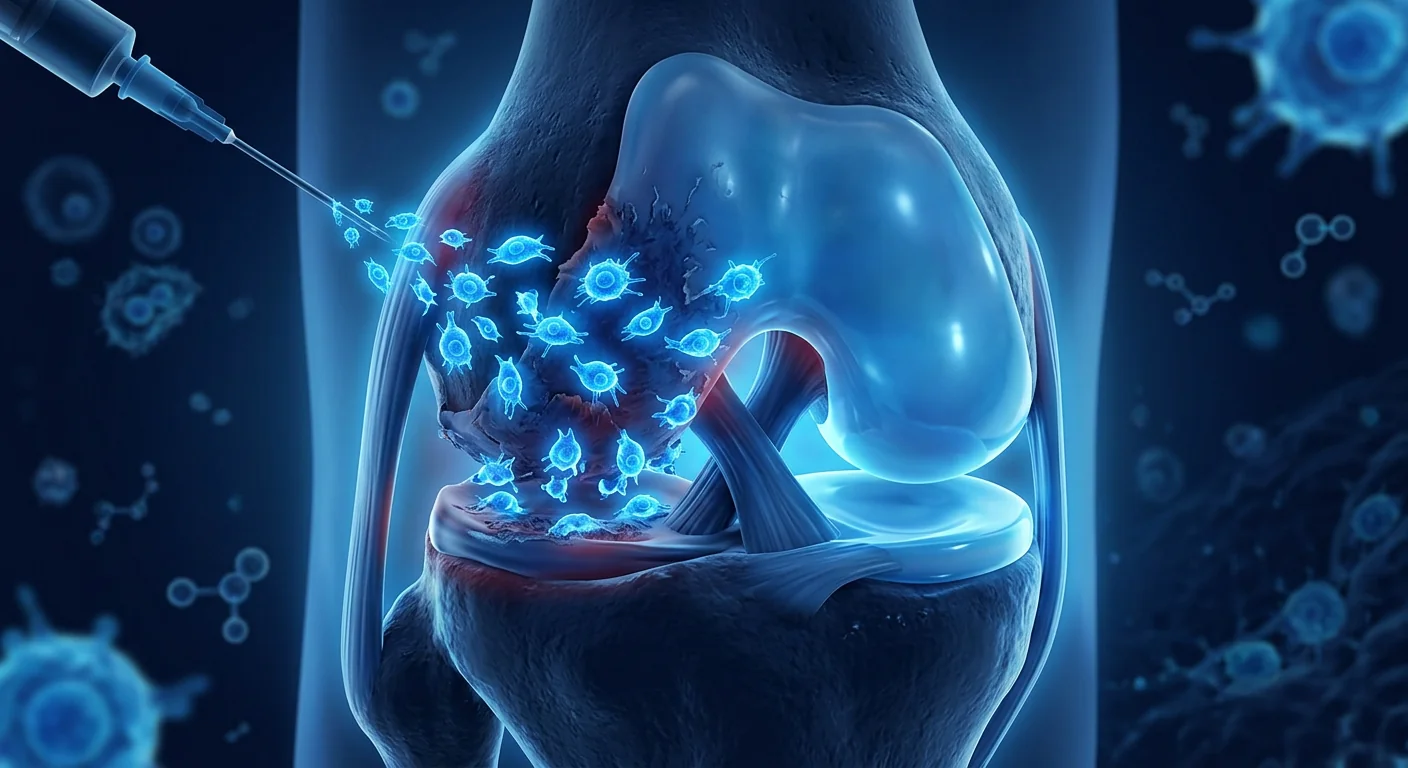
Joint pain is one of the most common — and most underestimated — health burdens of modern adulthood. Osteoarthritis alone affects more than 500 million people globally, eroding mobility, sleep, and quality of life long before it ever becomes a candidate for joint replacement surgery [1]. For decades, the conventional pathway has been linear and limited: anti-inflammatory medication, intra-articular steroid injections, physical therapy, and eventually arthroplasty. Mesenchymal Stem Cell therapy offers a fundamentally different approach — one focused not on managing pain, but on supporting the joint's own regenerative biology [2].
Understanding what is actually happening in your joint
Healthy joints rely on a thin layer of articular cartilage that cushions bone-on-bone contact, combined with synovial fluid, ligaments, and surrounding tissue. Osteoarthritis is the progressive breakdown of this system — driven not just by mechanical wear, but by chronic low-grade inflammation within the joint capsule. Inflammatory cytokines such as IL-1β, IL-6, and TNF-α are produced by stressed joint tissue, accelerate cartilage breakdown, and create the cycle of pain, stiffness, and swelling familiar to anyone with arthritis [3].
This matters because traditional treatments target the symptom (pain) without affecting the process (cartilage degradation and inflammation). MSC therapy, by contrast, intervenes at the inflammatory and regenerative level — addressing both the pain experience and the underlying joint biology.
How MSC therapy works in the joint
When clinical-grade Mesenchymal Stem Cells are delivered to an arthritic joint — either via precision intra-articular injection or systemic infusion — they engage the inflammatory environment in several coordinated ways:
1. They quiet the inflammation
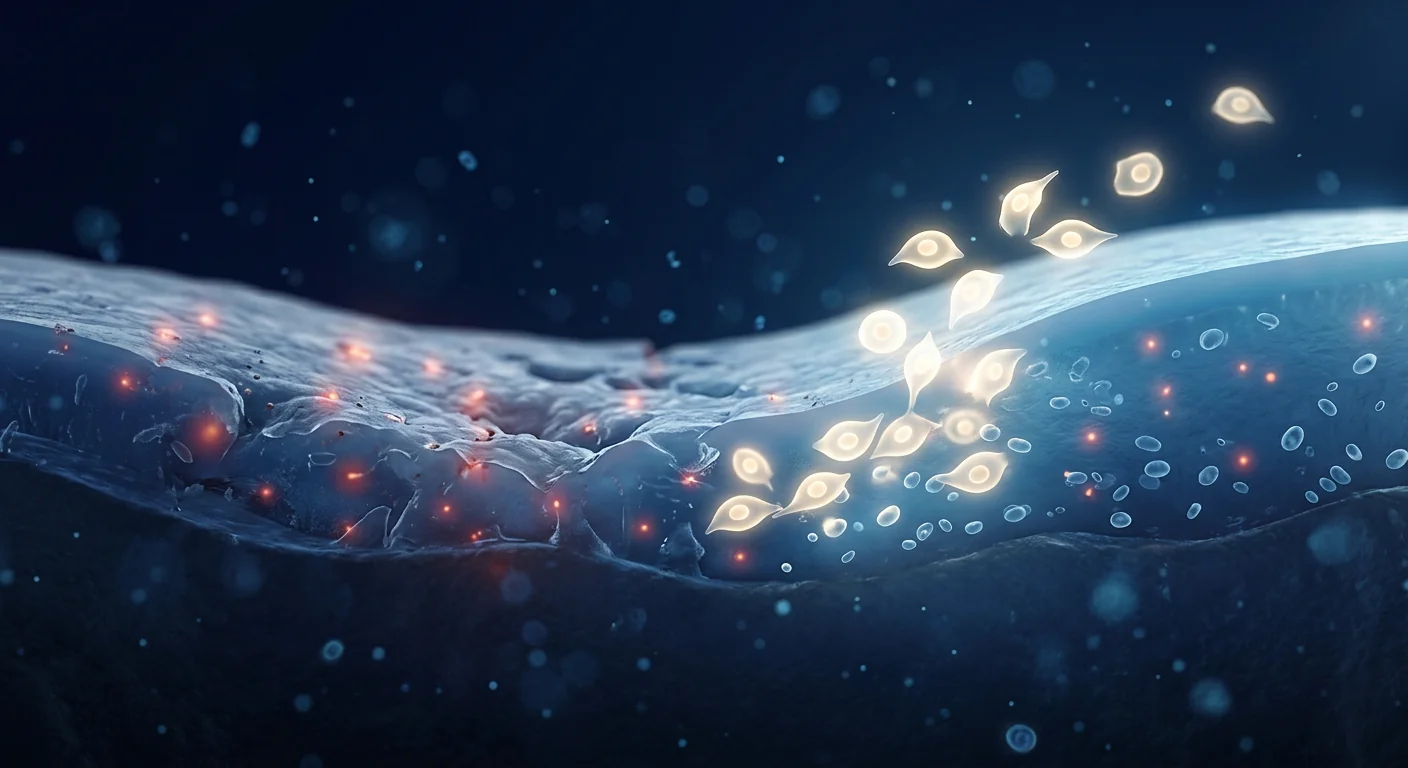
MSCs respond to the high cytokine environment by releasing anti-inflammatory mediators (TSG-6, PGE2, IDO) that interrupt the cascade. Within the joint capsule, this can begin reducing pain and swelling in the early weeks after treatment [4].
2. They support cartilage protection and repair
MSCs secrete growth factors (TGF-β, IGF-1, BMP-7) that signal local chondrocytes (cartilage cells) to maintain matrix integrity, and may stimulate the body's resident progenitor cells to support cartilage repair [5].
3. They modulate the joint immune environment
Beyond cytokines, MSCs influence local macrophage populations — encouraging a shift from the pro-inflammatory M1 phenotype to the regenerative M2 phenotype, which is critical for tissue healing [6].
4. They support the surrounding soft tissue
Tendons, ligaments, and the synovial membrane all benefit from MSC paracrine signalling — relevant in patients whose joint pain stems from a combination of cartilage and soft-tissue dysfunction.
What MSC therapy does NOT do
It is important to set honest expectations. MSC therapy does not regrow a destroyed joint. It does not reverse end-stage bone-on-bone osteoarthritis to a youthful state. What it does is reduce inflammation, support remaining cartilage, ease pain, and may delay or potentially avoid the need for joint replacement in candidates with mild-to-moderate disease.
Who is a good candidate?
The strongest results from MSC therapy for joint pain come from patients with mild to moderate osteoarthritis — typically Kellgren-Lawrence grades I, II, and early III. These are patients who:
- Have measurable cartilage remaining on imaging
- Are experiencing pain, stiffness, or reduced mobility but are not yet bone-on-bone
- Have not responded adequately to conservative treatment
- Want to delay or avoid joint replacement surgery
- Are looking for a regenerative rather than purely symptomatic approach
Patients with end-stage osteoarthritis (severe grade III, grade IV) — where cartilage is largely absent — are typically less suitable for regenerative therapy alone, and are better served by surgical consultation. A reputable clinic will tell you this honestly. The role of the consultation is to determine candidacy through imaging, functional assessment, and bio-marker review.
What the treatment process looks like
At a clinical-grade centre, a typical journey for joint-focused MSC therapy follows a structured path:
Step 1: Consultation and assessment
Medical history review, joint imaging (typically MRI), inflammatory bio-markers, and a physical assessment. The goal is to confirm candidacy and identify the optimal protocol.
Step 2: Protocol design
The clinical team determines: dose, route (intra-articular injection alone, IV infusion, or combined), frequency (single session vs. series), and adjunct therapies (physical therapy, lifestyle adjustments).
Step 3: Treatment delivery
Intra-articular injections are typically performed under ultrasound or fluoroscopy guidance for precision placement. Sessions are outpatient, generally 60–90 minutes including preparation. Patients walk out the same day.
Step 4: Recovery period
Light activity restrictions for 48–72 hours, then a graduated return to normal mobility. Many clinics recommend a structured physical therapy programme alongside the cellular therapy to maximize the rebuilt joint mechanics.
Step 5: Outcome monitoring
Follow-up at 4, 12, and 24 weeks tracks pain (using validated scales like WOMAC and VAS), function, range of motion, and where appropriate, repeat imaging.
Realistic timelines: what to expect when
Cellular therapy is not a pharmaceutical — it does not deliver an instant effect. Most patients experience the response in three identifiable phases:
Outcomes vary by patient, severity of disease, MSC source quality, dosing, and the structure of the surrounding rehabilitation programme. A reputable clinic will be transparent about typical response rates and the proportion of patients who experience strong vs. moderate vs. limited benefit.
Safety and what every patient should know
When delivered with clinical-grade cells, image-guided injection technique, and appropriate clinical oversight, MSC therapy for joint pain has an excellent safety profile. The most common side-effects are local: temporary post-injection soreness, mild swelling, or stiffness for 24–72 hours. Serious adverse events are rare in published literature [7][8].
The biggest preventable risk in this field is not the therapy itself — it is unregulated providers using non-clinical-grade cells with unverified sterility, identity, or potency. This is why patients should always confirm: source of the cells, laboratory certifications, and access to a Certificate of Analysis for the dose being administered.
For the right patient — with mild to moderate joint disease and a goal of preserving function — MSC therapy can be a meaningful alternative to a future of escalating medication and eventual surgery.
— VELAR Clinical Team
The VELAR approach to joint regeneration
Joint-focused protocols at VELAR Center begin with comprehensive imaging and bio-marker assessment to confirm candidacy and tailor dosing. Each patient's protocol uses clinical-grade Wharton's jelly–derived MSCs (≥95% MSC marker expression, >95% viability at delivery), delivered via image-guided intra-articular injection, IV infusion, or combined protocol depending on the indication. Every session is led by an experienced clinician, paired with structured rehabilitation, and monitored across the 1, 3, and 6-month milestones.
If you are considering regenerative therapy for joint pain, the most important first step is an honest assessment of your specific candidacy — and a clear understanding of what realistic outcomes look like for your stage of disease.
References
- Hunter DJ, Bierma-Zeinstra S. Osteoarthritis. The Lancet. 2019;393(10182):1745-1759. doi:10.1016/S0140-6736(19)30417-9 ↩
- Cao M, Ou Z, Sheng R, et al. Efficacy and safety of mesenchymal stem cells in knee osteoarthritis: a systematic review and meta-analysis of randomized controlled trials. Stem Cell Research & Therapy. 2025;16:112. doi:10.1186/s13287-025-04252-2 ↩
- Kapoor M, Martel-Pelletier J, Lajeunesse D, et al. Role of proinflammatory cytokines in the pathophysiology of osteoarthritis. Nature Reviews Rheumatology. 2011;7(1):33-42. doi:10.1038/nrrheum.2010.196 ↩
- Uccelli A, Moretta L, Pistoia V. Mesenchymal stem cells in health and disease. Nature Reviews Immunology. 2008;8(9):726-736. doi:10.1038/nri2395 ↩
- Chen MF, Hsu YH, Lin YC, et al. Timing of intra-articular injection of adipose-derived mesenchymal stem cells affects cartilage integrity. International Immunopharmacology. 2026;146:115964. doi:10.1016/j.intimp.2025.115964 ↩
- Harrell CR, Markovic BS, Fellabaum C, et al. Mesenchymal stem cell-based therapy of osteoarthritis: Current knowledge and future perspectives. Biomedicine & Pharmacotherapy. 2019;109:2318-2326. doi:10.1016/j.biopha.2018.11.099 ↩
- Tong W, Shi Y, Wu D, et al. Intra-articular injection of umbilical cord-derived mesenchymal stem cells is safe and effective for moderate to severe knee osteoarthritis. BMC Musculoskeletal Disorders. 2025;26:1186. doi:10.1186/s12891-025-09440-y ↩
- Lalu MM, McIntyre L, Pugliese C, et al. Safety of cell therapy with mesenchymal stromal cells (SafeCell): a systematic review and meta-analysis of clinical trials. PLoS One. 2012;7(10):e47559. doi:10.1371/journal.pone.0047559 ↩
- Awad G, Saad JP, Hamyeh A, et al. Efficacy and safety of intra-articular mesenchymal stem cell-based therapies in knee osteoarthritis: A systematic review and meta-analysis. Clinical Rheumatology. 2026;45(5):1783-1795. doi:10.1007/s10067-026-08042-w ↩
- Deng L, Zhao C, Zhou L, et al. Efficacy and safety of single versus repeated injections of mesenchymal stem cells for the treatment of knee osteoarthritis: a systematic review and meta-analysis. Stem Cell Research & Therapy. 2025;16:391. doi:10.1186/s13287-025-04638-2 ↩
- Khodadoust E, Zarrabi M, Afzal E, et al. Three intra-articular injections of allogeneic umbilical cord-derived mesenchymal stromal cells in knee osteoarthritis: a phase-I safety and efficacy study. Regenerative Medicine. 2026;21(1):37-48. doi:10.1080/17460751.2026.2636683 ↩
- Jafar H, Samara O, Shahin D, et al. Intra-articular allogeneic adipose-derived mesenchymal stromal cell injections for stage III knee osteoarthritis: a double-blind placebo-controlled trial. Stem Cells Translational Medicine. 2026;15(4):sza018. doi:10.1093/stcltm/szag018 ↩
- Park JB, Jang GY, Cho KY, et al. Factors affecting outcomes of intra-articular injection of autologous, culture-expanded, adipose-derived mesenchymal stem cells in knee osteoarthritis. Stem Cells Translational Medicine. 2026;15(5):sza027. doi:10.1093/stcltm/szag027 ↩
- Johnson S, Boettcher BJ, Korpershoek JV, et al. Allogeneic mesenchymal stromal cell injections for knee osteoarthritis: a review of clinical outcomes. Regenerative Medicine. 2025;20(10):545-558. doi:10.1080/17460751.2025.2572202 ↩
关节疼痛是现代成人最常见——也最被低估——的健康负担之一。仅骨关节炎就影响全球超过 5 亿人,在它成为关节置换手术的候选之前很久,就已侵蚀活动能力、睡眠与生活质量。数十年来,传统路径线性而有限:抗炎药物、关节内类固醇注射、物理治疗,最终是关节置换手术。间充质干细胞疗法提供了一种根本不同的方法——其重点不是管理疼痛,而是支持关节自身的再生生物学。
了解您的关节中实际正在发生什么
健康的关节依赖一层薄薄的关节软骨来缓冲骨与骨之间的接触,结合滑液、韧带与周围组织。骨关节炎是这一系统的渐进性破坏——不仅由机械磨损驱动,还由关节囊内的慢性低度炎症驱动。受压关节组织产生的炎症细胞因子(如 IL-1β、IL-6 与 TNF-α)会加速软骨破坏,并造成任何关节炎患者都熟悉的疼痛、僵硬与肿胀的循环。
这一点很重要,因为传统治疗针对症状(疼痛),却不影响过程(软骨退化与炎症)。相比之下,MSC 疗法在炎症与再生层面进行干预——同时解决疼痛体验与潜在的关节生物学。
MSC 疗法在关节中如何运作
当临床级间充质干细胞被递送到关节炎的关节中——通过精确的关节内注射或全身输注——它们以若干协调的方式与炎症环境互动:
1. 它们抑制炎症
MSC 通过释放抗炎介质(TSG-6、PGE2、IDO)来响应高细胞因子环境,打断级联反应。在关节囊内,这可在治疗后的早期数周开始减轻疼痛与肿胀。
2. 它们支持软骨保护与修复
MSC 分泌生长因子(TGF-β、IGF-1、BMP-7),向局部软骨细胞发出信号以维持基质完整性,并可能刺激身体的常驻祖细胞以支持软骨修复。
3. 它们调节关节免疫环境
除细胞因子外,MSC 还影响局部巨噬细胞群体——鼓励从促炎 M1 表型转向再生 M2 表型,这对组织愈合至关重要。
4. 它们支持周围软组织
肌腱、韧带与滑膜均受益于 MSC 的旁分泌信号传导——对关节疼痛源于软骨与软组织功能障碍组合的患者尤为相关。
MSC 疗法所不能做的事
设定诚实的预期至关重要。MSC 疗法无法重建已被破坏的关节。它无法将晚期骨与骨之间的骨关节炎逆转回年轻状态。它能做的是减少炎症、支持剩余软骨、缓解疼痛,并可能在轻度至中度疾病的候选者中延迟或潜在避免关节置换的需要。
谁是合适的候选者?
对关节疼痛的 MSC 疗法效果最强的来自轻度至中度骨关节炎患者——通常 Kellgren-Lawrence 分级 I、II 与早期 III。这些患者:
- 影像学上可见可量测的剩余软骨
- 体验疼痛、僵硬或活动减少,但尚未骨与骨之间
- 对保守治疗反应不佳
- 希望延迟或避免关节置换手术
- 寻找再生而非纯症状性的方法
晚期骨关节炎(重度 III 级、IV 级)患者——其软骨大多缺失——通常不太适合单独的再生疗法,而更适合外科咨询。信誉良好的诊所会诚实地告诉您这一点。咨询的作用是通过影像学、功能评估与生物标志物审查来确定候选资格。
治疗过程是什么样子
在临床级中心,专注关节的 MSC 疗法的典型旅程遵循结构化路径:
第一步:咨询与评估
病史回顾、关节影像(通常 MRI)、炎症生物标志物以及体格评估。目标是确认候选资格并确定最佳方案。
第二步:方案设计
临床团队确定:剂量、途径(仅关节内注射、IV 输注或联合)、频率(单次会话与系列)以及辅助疗法(物理治疗、生活方式调整)。
第三步:治疗递送
关节内注射通常在超声或荧光透视引导下进行以精确放置。会话为门诊,通常含准备 60–90 分钟。患者当天即可走出。
第四步:恢复期
48–72 小时轻度活动限制,然后逐渐恢复正常活动。许多诊所建议在细胞治疗的同时进行结构化的物理治疗方案,以最大化重建的关节力学。
第五步:疗效监测
在 4、12 与 24 周的随访追踪疼痛(使用经验证的量表如 WOMAC 与 VAS)、功能、活动范围,并在适当情况下重复影像学检查。
实际时间表:何时期待什么
细胞治疗不是药物——它不会立即产生效果。大多数患者经历的反应分为三个可识别阶段:
疗效因患者、疾病严重程度、MSC 来源质量、剂量以及周围康复方案的结构而异。信誉良好的诊所会透明地说明典型的反应率以及强、中、有限受益患者的比例。
安全性与每位患者应知道的
当以临床级细胞、影像引导的注射技术与适当的临床监督递送时,关节疼痛的 MSC 疗法具有出色的安全性概况。最常见的副作用是局部的:注射后 24–72 小时的暂时酸痛、轻度肿胀或僵硬。在已发表的文献中,严重不良事件少见。
该领域最大的可预防风险并非疗法本身——而是未受监管的提供者使用未经验证无菌性、身份或效力的非临床级细胞。这就是为什么患者应始终确认:细胞来源、实验室认证,以及所给予剂量的分析证书的获取。
对合适的患者——具有轻度至中度关节疾病并以保留功能为目标——MSC 疗法可以是不断升级的药物治疗与最终手术之未来的有意义替代。
——VELAR 临床团队
VELAR 的关节再生方法
VELAR Center 专注关节的方案从全面的影像学与生物标志物评估开始,以确认候选资格并定制剂量。每位患者的方案使用临床级华通氏胶来源 MSC(MSC 标志物表达 ≥95%、交付时活性 >95%),通过影像引导的关节内注射、IV 输注或联合方案递送,视适应症而定。每次会话由经验丰富的临床医师主导,搭配结构化康复,并在 1、3 与 6 个月里程碑进行监测。
如果您正在考虑关节疼痛的再生疗法,最重要的第一步是对您具体候选资格的诚实评估——以及对您疾病阶段的实际疗效的清晰理解。
آلام المفاصل من أكثر — وأقل تقديراً — الأعباء الصحية شيوعاً للبالغين المعاصرين. يصيب التهاب المفاصل وحده أكثر من 500 مليون شخص حول العالم، مُؤكَّلاً الحركة والنوم وجودة الحياة قبل أن يصبح مرشحاً لجراحة استبدال المفصل بوقت طويل. لعقود، كان المسار التقليدي خطياً ومحدوداً: أدوية مضادة للالتهاب، حقن الستيرويد داخل المفصل، العلاج الطبيعي، وأخيراً تقويم المفصل. يقدم علاج الخلايا الجذعية الوسيطة منهجاً مختلفاً جذرياً — يركز ليس على إدارة الألم، بل على دعم البيولوجيا التجديدية للمفصل ذاته.
فهم ما يحدث فعلياً في مفصلك
تعتمد المفاصل الصحية على طبقة رقيقة من الغضروف المفصلي الذي يبطن التلامس بين العظام، إلى جانب السائل الزليلي والأربطة والأنسجة المحيطة. التهاب المفاصل هو الانهيار التدريجي لهذا النظام — مدفوعاً ليس فقط بالاهتراء الميكانيكي، بل بـالالتهاب منخفض الدرجة المزمن داخل كبسولة المفصل. تنتج الأنسجة المفصلية المُجهَدة سيتوكينات التهابية مثل IL-1β وIL-6 وTNF-α، تُسرع انهيار الغضروف، وتخلق دورة الألم والتيبس والتورم المألوفة لأي شخص مصاب بالتهاب المفاصل.
هذا مهم لأن العلاجات التقليدية تستهدف العَرَض (الألم) دون التأثير على العملية (تدهور الغضروف والالتهاب). علاج MSC، على النقيض، يتدخل على مستوى الالتهاب والتجدد — معالجاً تجربة الألم وكذلك بيولوجيا المفصل الكامنة.
كيف يعمل علاج MSC في المفصل
عندما تُسلَّم الخلايا الجذعية الوسيطة ذات الجودة السريرية إلى مفصل مصاب بالتهاب المفاصل — إما عبر الحقن الدقيق داخل المفصل أو التسريب الجهازي — فإنها تتفاعل مع البيئة الالتهابية بعدة طرق منسقة:
1. تُهدِّئ الالتهاب
تستجيب MSC لبيئة السيتوكينات العالية بإطلاق وسطاء مضادين للالتهاب (TSG-6 وPGE2 وIDO) يقطعون السلسلة. داخل كبسولة المفصل، يمكن أن يبدأ هذا في تقليل الألم والتورم في الأسابيع الأولى بعد العلاج.
2. تدعم حماية الغضروف وإصلاحه
تفرز MSC عوامل نمو (TGF-β وIGF-1 وBMP-7) تُشير إلى الخلايا الغضروفية المحلية للحفاظ على سلامة المصفوفة، وقد تحفز خلايا السلف المقيمة للجسم لدعم إصلاح الغضروف.
3. تُعدِّل البيئة المناعية للمفصل
إلى جانب السيتوكينات، تؤثر MSC على مجموعات الخلايا الكبيرة المحلية — مشجعةً الانتقال من النمط الالتهابي M1 إلى النمط التجديدي M2، وهو حاسم لشفاء الأنسجة.
4. تدعم الأنسجة الرخوة المحيطة
تستفيد الأوتار والأربطة والغشاء الزليلي جميعها من إشارات MSC شبه الإفرازية — وهذا مهم لدى المرضى الذين تنبع آلام مفاصلهم من مزيج من خلل الغضروف والأنسجة الرخوة.
ما لا يفعله علاج MSC
من المهم وضع توقعات صادقة. علاج MSC لا يُعيد إنماء مفصل تالف. لا يعكس التهاب المفاصل النهائي عظم على عظم إلى حالة شابة. ما يفعله هو تقليل الالتهاب، دعم الغضروف المتبقي، تخفيف الألم، وقد يؤخر أو يُحتمل أن يتجنب الحاجة إلى استبدال المفصل لدى المرشحين بمرض خفيف إلى معتدل.
من هو المرشح المناسب؟
أقوى نتائج علاج MSC لآلام المفاصل تأتي من المرضى المصابين بالتهاب مفاصل خفيف إلى معتدل — عادة درجات Kellgren-Lawrence I وII وأوائل III. هؤلاء المرضى:
- لديهم غضروف متبقٍ قابل للقياس على التصوير
- يعانون من الألم أو التيبس أو انخفاض الحركة لكن ليسوا بعد عظم على عظم
- لم يستجيبوا بشكل كافٍ للعلاج المحافظ
- يريدون تأخير أو تجنب جراحة استبدال المفصل
- يبحثون عن منهج تجديدي بدلاً من نهج عَرَضي بحت
المرضى الذين يعانون من التهاب مفاصل في مراحل متأخرة (شديد درجة III، درجة IV) — حيث الغضروف غائب إلى حد كبير — عادة ما يكونون أقل ملاءمة للعلاج التجديدي وحده، ويُخدمون بشكل أفضل بالاستشارة الجراحية. ستخبرك العيادة ذات السمعة الجيدة بذلك بصدق. دور الاستشارة هو تحديد الأهلية من خلال التصوير والتقييم الوظيفي ومراجعة المؤشرات الحيوية.
كيف تبدو عملية العلاج
في مركز ذي جودة سريرية، تتبع الرحلة النموذجية لعلاج MSC المتمحور حول المفاصل مساراً منظماً:
الخطوة 1: الاستشارة والتقييم
مراجعة التاريخ الطبي، تصوير المفصل (عادة MRI)، المؤشرات الحيوية الالتهابية، والتقييم البدني. الهدف هو تأكيد الأهلية وتحديد البروتوكول الأمثل.
الخطوة 2: تصميم البروتوكول
يحدد الفريق السريري: الجرعة، الطريقة (حقن داخل المفصل وحده، تسريب وريدي، أو مجتمعة)، التكرار (جلسة واحدة مقابل سلسلة)، والعلاجات المساعدة (العلاج الطبيعي، تعديلات نمط الحياة).
الخطوة 3: تسليم العلاج
تُجرى الحقن داخل المفصل عادة تحت توجيه الموجات فوق الصوتية أو التنظير الفلوري للوضع الدقيق. الجلسات خارجية، عموماً 60–90 دقيقة بما في ذلك التحضير. يخرج المرضى في نفس اليوم.
الخطوة 4: فترة التعافي
قيود نشاط خفيف لمدة 48–72 ساعة، ثم عودة متدرجة إلى الحركة الطبيعية. توصي العديد من العيادات ببرنامج علاج طبيعي منظم إلى جانب العلاج الخلوي لتعظيم ميكانيكا المفصل المُعاد بناؤها.
الخطوة 5: مراقبة النتائج
المتابعة في 4 و12 و24 أسبوعاً تتتبع الألم (باستخدام مقاييس مُعتمَدة مثل WOMAC وVAS)، الوظيفة، نطاق الحركة، وحيث يكون مناسباً، إعادة التصوير.
جداول زمنية واقعية: ماذا تتوقع ومتى
العلاج الخلوي ليس دواء — لا يعطي تأثيراً فورياً. يختبر معظم المرضى الاستجابة في ثلاث مراحل قابلة للتحديد:
تختلف النتائج حسب المريض، شدة المرض، جودة مصدر MSC، الجرعات، وهيكل برنامج إعادة التأهيل المحيط. ستكون العيادة ذات السمعة الجيدة شفافة بشأن معدلات الاستجابة النموذجية ونسبة المرضى الذين يختبرون فائدة قوية مقابل معتدلة مقابل محدودة.
السلامة وما يجب أن يعرفه كل مريض
عند التسليم بخلايا ذات جودة سريرية، تقنية حقن مُوجَّهة بالصورة، وإشراف سريري مناسب، يتمتع علاج MSC لآلام المفاصل بملف أمان ممتاز. الآثار الجانبية الأكثر شيوعاً هي موضعية: ألم مؤقت بعد الحقن، تورم خفيف، أو تيبس لمدة 24–72 ساعة. الأحداث السلبية الخطيرة نادرة في الأدبيات المنشورة.
أكبر خطر يمكن منعه في هذا المجال ليس العلاج نفسه — بل المزودون غير المُنظَّمين الذين يستخدمون خلايا غير سريرية الجودة بعقامة أو هوية أو فعالية غير مُتحقَّق منها. هذا هو السبب في أنه ينبغي للمرضى دائماً تأكيد: مصدر الخلايا، اعتمادات المختبر، والوصول إلى شهادة تحليل للجرعة المُعطاة.
للمريض المناسب — بمرض مفاصل خفيف إلى معتدل وهدف الحفاظ على الوظيفة — يمكن أن يكون علاج MSC بديلاً ذا معنى لمستقبل من الأدوية المتصاعدة والجراحة في النهاية.
— فريق VELAR السريري
منهج VELAR لتجديد المفاصل
تبدأ البروتوكولات المتمحورة حول المفاصل في VELAR Center بتصوير شامل وتقييم المؤشرات الحيوية لتأكيد الأهلية وتخصيص الجرعات. يستخدم بروتوكول كل مريض MSC ذات الجودة السريرية المشتقة من هلام وارتون (تعبير علامات MSC ≥95٪، حيوية عند التسليم >95٪)، تُسلَّم عبر الحقن داخل المفصل المُوجَّه بالصورة، أو التسريب الوريدي، أو بروتوكول مجتمع حسب الدلالة. تُقاد كل جلسة من قبل طبيب ذي خبرة، مقترنةً بإعادة تأهيل منظمة، ومُراقَبة عبر علامات 1 و3 و6 أشهر.
إذا كنت تفكر في العلاج التجديدي لآلام المفاصل، فإن أهم خطوة أولى هي تقييم صادق لأهليتك المحددة — وفهم واضح لكيف تبدو النتائج الواقعية لمرحلة مرضك.