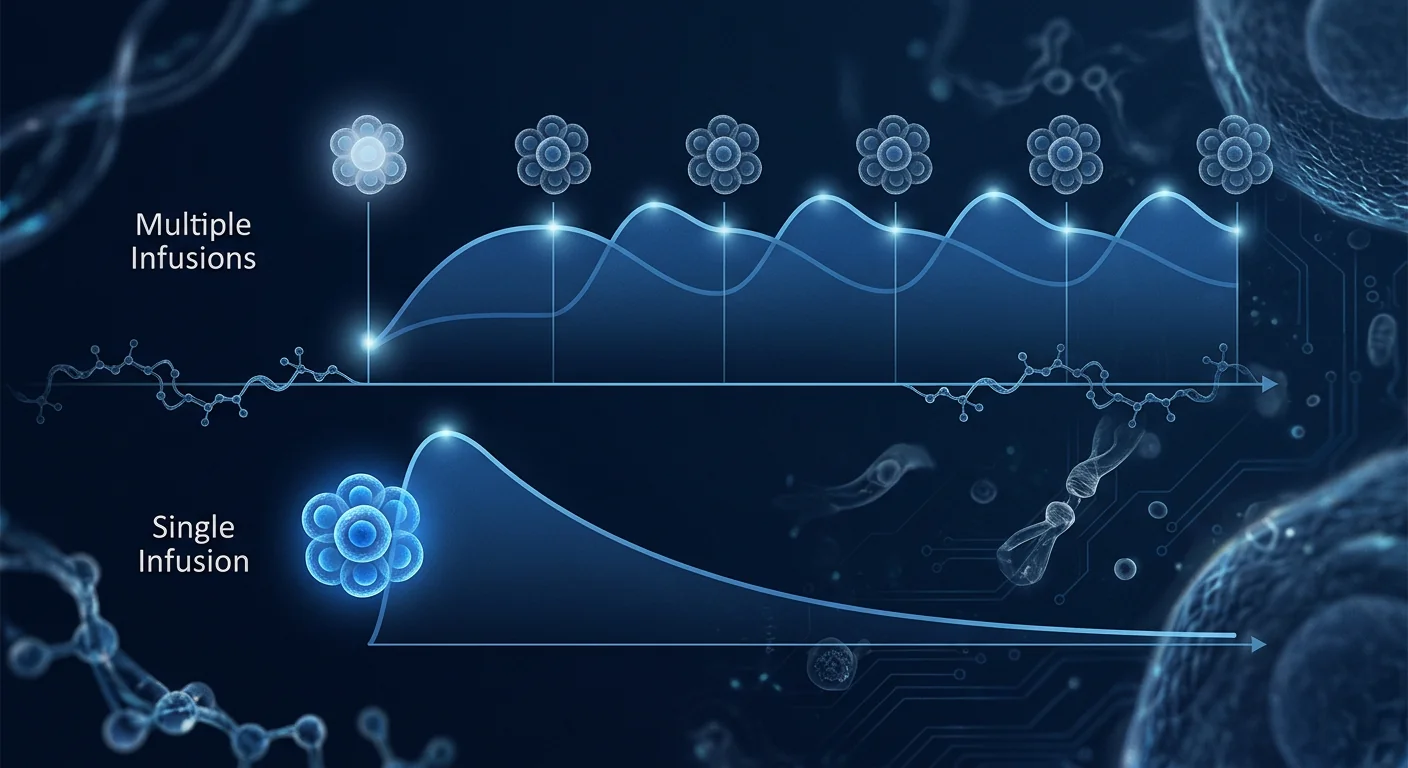
Mesenchymal stem cell therapy is not a one-size-fits-all treatment — and one of the most clinically significant variables is whether a single infusion suffices or whether repeat dosing is required for durable benefit. The answer depends on the condition being treated, the biological half-life of MSC effects, the mechanism of action that matters most, and the patient's treatment goals.
Single infusions work best for acute tissue injury. When MSCs are deployed in the immediate aftermath of an acute event — a myocardial infarction, a stroke, a traumatic spinal cord injury — the primary therapeutic window is the first 72–96 hours of inflammation. A single, well-timed dose can modulate the cytokine storm, reduce neutrophil infiltration, polarize macrophages toward the reparative M2 phenotype, and limit fibrotic scarring before it organizes. [1] The goal is damage containment, not chronic disease management. Once the acute inflammatory cascade is suppressed, the body's endogenous repair machinery often handles the rest.
Chronic degenerative conditions are a fundamentally different equation. In osteoarthritis, neurodegenerative disease, chronic kidney disease, or autoimmune conditions, the pathology is sustained — ongoing low-grade inflammation, cumulative oxidative stress, and progressive tissue loss that does not stop after a single intervention. The therapeutic effects of a single MSC infusion typically peak at 2–4 weeks and wane over 4–12 weeks as the cells are cleared. [2] In chronic conditions, this fading translates to symptom recurrence unless a repeat dosing strategy is employed.
How Long Do MSC Effects Last? The Biological Half-Life Question
MSC therapy does not work the way a pharmaceutical drug works. There is no classic pharmacokinetic half-life because MSCs are living cells that exert their effects primarily through paracrine signaling — secretion of cytokines, growth factors, extracellular vesicles, and immunomodulatory molecules — rather than through direct receptor binding. [3]
However, the functional half-life of MSC effects can be characterized. After intravenous infusion, the majority of MSCs are trapped in the pulmonary microvasculature within minutes and cleared within 24–72 hours. [4] The therapeutic window — the period during which clinically meaningful benefit is observed — depends on the downstream biological cascade the MSCs trigger, not on how long the cells themselves survive.
The duration of effect varies substantially by condition and delivery route:
When Single Infusion Makes Sense
A single MSC infusion is appropriate when the therapeutic goal is a one-time biological intervention rather than ongoing disease suppression. The strongest evidence supports single-infusion protocols in the following scenarios:
Acute tissue injury with a defined inflammatory window. Myocardial infarction, acute ischemic stroke, acute kidney injury, and traumatic spinal cord injury all feature a narrow post-injury window — typically 24–96 hours — during which immunomodulation can meaningfully alter the trajectory of tissue damage. [7] A single infusion during this window has been shown to reduce infarct size, preserve renal function, and improve neurological recovery scores in both preclinical and early clinical studies.
Orthopedic applications with mechanical restoration. When MSCs are used as an adjunct to surgical repair — meniscus repair, rotator cuff reconstruction, ACL reconstruction — the primary role of the cells is to enhance the initial healing response at the surgical site. A single intra-operative or peri-operative dose delivered directly to the tissue is often sufficient. [8]
Cosmetic and dermatological applications. Skin rejuvenation, hair restoration, and scar remodeling typically respond well to a single treatment session because the target tissue (dermis, hair follicle) has relatively high intrinsic regenerative capacity, and MSCs act primarily as a catalyst rather than a sustained therapy. [9]
When Repeat Dosing Adds Value
Repeat MSC dosing becomes clinically important when the underlying pathology is sustained, progressive, or cyclical. The rationale is straightforward: if the disease process outlasts the therapeutic effect, episodic treatment must be renewed.
Chronic neurodegenerative disease. ALS, Parkinson's disease, Alzheimer's disease, and multiple sclerosis involve ongoing neuronal loss, chronic microglial activation, and sustained neuroinflammation that does not resolve. In ALS clinical trials, patients receiving 2–4 intrathecal infusions at 2–3 month intervals showed sustained slowing of disease progression compared to single-infusion cohorts. [6] Each infusion provides a fresh wave of neurotrophins — BDNF, GDNF, CNTF — and anti-inflammatory cytokines that temporarily suppress the degenerative microenvironment.
Autoimmune disease with relapsing-remitting patterns. Lupus, rheumatoid arthritis, Crohn's disease, and psoriasis feature flares interspersed with quiescent periods. A single MSC infusion may induce remission for 3–12 months, but as autoreactive T-cell and B-cell populations re-expand, immunomodulation needs to be reinstated. [10] Repeat dosing at 3–6 month intervals has been shown to extend remission duration and reduce flare severity in several autoimmune cohorts.
Chronic degenerative joint disease. Osteoarthritis involves progressive cartilage loss, synovial inflammation, and subchondral bone remodeling — processes that continue indefinitely. While a single intra-articular MSC injection often provides 6–12 months of pain relief and functional improvement, repeat injections at 12-month intervals sustain the benefit. [11]
Anti-aging and longevity protocols. The rationale for repeat MSC dosing in healthy aging is the gradual accumulation of senescent cells, decline in endogenous stem cell pools, and chronic low-grade inflammation (inflammaging). [12] In this context, periodic MSC infusions — typically every 6–12 months — are studied as a way to periodically reset the inflammatory milieu and support tissue maintenance, rather than to treat any specific disease.
Tachyphylaxis and Diminishing Returns: Does Repeat Dosing Lose Effectiveness?
A common concern with repeat biological therapy is tachyphylaxis — the progressive loss of therapeutic response with repeated doses. Unlike monoclonal antibodies, MSCs are immunoprivileged (they express low levels of MHC Class I and no MHC Class II), and allogeneic MSC therapy does not typically generate neutralizing antibodies. [13]
Clinical data on tachyphylaxis with repeat MSC dosing is limited but generally reassuring. In a systematic review of 36 studies involving repeat MSC infusions (2–10 doses), no evidence of diminishing efficacy was reported in any study; in several, cumulative benefit was observed. [14] The absence of tachyphylaxis is attributed to the paracrine mechanism: MSCs do not occupy a receptor that can be downregulated; they secrete a broad cocktail of factors whose targets are distributed across multiple cell types and pathways.
However, practical limits exist. After 4–6 infusions in some protocols, the incremental benefit per additional infusion may plateau — not because of tachyphylaxis but because the achievable level of tissue repair or immunomodulation has a biological ceiling determined by the extent of pre-existing damage. [15]
Cost-Benefit Analysis: How Many Infusions Are Worth It?
The decision to pursue repeat dosing is ultimately a clinical and economic one. The following framework can guide the discussion:
VELAR's Approach: Personalized Dosing Protocols
At VELAR Center in Bangkok, we do not apply a fixed dosing template to every patient. Our clinical team designs individualized treatment protocols based on the specific condition, its stage of progression, the patient's age and regenerative capacity, and the mechanism of action most relevant to that patient's goals.
For acute conditions — recent stroke, acute spinal injury, acute kidney injury — we typically recommend a single infusion with a follow-up assessment at 3 months to determine whether a second infusion would provide meaningful additional benefit.
For chronic degenerative conditions — osteoarthritis, neurodegenerative disease, chronic autoimmune disease — we typically recommend an initial infusion followed by a planned reassessment at 12 weeks, with the option of a second infusion if biomarkers and clinical scores indicate incomplete response. Many patients on chronic disease protocols receive 2–3 infusions per year.
For healthy aging and longevity optimization — we offer 6-month and 12-month repeat protocols, with each session preceded by a comprehensive biomarker panel to track inflammatory markers (CRP, IL-6, TNF-α), oxidative stress indices, and cellular health metrics.
Limitations and Important Caveats
MSC therapy, whether single or repeat, remains an investigational treatment for most indications. The clinical evidence for repeat dosing protocols is derived primarily from small-to-medium-sized studies, many of which are open-label or single-arm. [14] Large, randomized, placebo-controlled trials specifically comparing single vs repeat dosing strategies are lacking for most conditions.
Additionally, the optimal dosing interval has not been rigorously established. The 3-month, 6-month, and 12-month intervals commonly cited in the literature are pragmatic choices based on observed effect duration rather than pharmacodynamic optimization. As MSC therapy matures, more precise biomarker-driven dosing schedules will likely emerge.
Patients considering repeat MSC dosing should discuss the evidence specific to their condition with a qualified clinician. Not all conditions benefit equally from repeat protocols, and the cost of multiple infusions must be weighed against the expected incremental benefit.
Frequently Asked Questions
How many MSC infusions do I need?
The number of infusions depends on your condition. Acute injuries (stroke, heart attack, acute kidney injury) typically need only one well-timed infusion. Chronic conditions (osteoarthritis, autoimmune disease, neurodegenerative disease) generally benefit from 2–4 infusions per year. A consultation with biomarker assessment can help determine the right protocol for you.
How long does a single MSC infusion last?
The functional duration of a single MSC infusion is typically 6–12 weeks for systemic conditions and 3–12 months for localized joint injections. The cells themselves are cleared within days, but the paracrine effects — immunomodulation, growth factor secretion, macrophage polarization — persist for weeks to months afterward.
Can you have too many stem cell infusions?
MSC therapy has an excellent safety profile, and serious adverse events from repeat infusions are rare. However, after 4–6 infusions, the incremental benefit per additional dose may plateau because achievable tissue repair has a biological ceiling. More is not automatically better — timing and indication matter more than total dose count.
What is the best interval between MSC infusions?
For most chronic conditions, a 3–6 month interval between infusions is supported by current evidence. Shorter intervals (under 4 weeks) have not been shown to provide additional benefit and may be unnecessary since the biological effects of each infusion last at least 6–8 weeks. Your clinician can help determine the optimal interval based on your response to the first infusion.
Is repeat dosing more expensive than single infusion?
Yes, repeat dosing involves higher total costs because each infusion carries its own cell preparation, administration, and monitoring costs. However, for chronic conditions, a well-planned repeat protocol may be more cost-effective than returning for ad-hoc infusions when symptoms recur. At VELAR, we provide transparent pricing for both single-infusion and multi-session treatment plans.
Does the body build resistance to repeat MSC infusions?
No. Unlike pharmaceutical drugs or monoclonal antibodies, MSCs are immunoprivileged and do not trigger neutralizing antibody formation. Clinical evidence to date shows no tachyphylaxis or diminishing efficacy with repeat dosing. The paracrine mechanism — secretion of a broad cocktail of factors — avoids the single-receptor targeting that underlies drug tolerance.
- Lee RH, Pulin AA, Seo MJ, et al. Intravenous hMSCs improve myocardial infarction in mice because cells embolized in lung are activated to secrete the anti-inflammatory protein TSG-6. Cell Stem Cell. 2009;5(1):54-63. doi:10.1016/j.stem.2009.05.003 ↩
- Eggenhofer E, Benseler V, Kroemer A, et al. Mesenchymal stem cells are short-lived and do not migrate beyond the lungs after intravenous infusion. Frontiers in Immunology. 2012;3:297. doi:10.3389/fimmu.2012.00297 ↩
- Caplan AI, Correa D. The MSC: an injury drugstore. Cell Stem Cell. 2011;9(1):11-15. doi:10.1016/j.stem.2011.06.008 ↩
- Fischer UM, Harting MT, Jimenez F, et al. Pulmonary passage is a major obstacle for intravenous stem cell delivery: the pulmonary first-pass effect. Stem Cells and Development. 2009;18(5):683-692. doi:10.1089/scd.2008.0253 ↩
- Vega A, Martin-Ferrero MA, Del Canto F, et al. Treatment of knee osteoarthritis with allogeneic bone marrow mesenchymal stem cells: a randomized controlled trial. Transplantation. 2015;99(8):1681-1690. doi:10.1097/TP.0000000000000678 ↩
- Petrou P, Gothelf Y, Argov Z, et al. Safety and clinical effects of mesenchymal stem cells secreting neurotrophic factor transplantation in patients with amyotrophic lateral sclerosis. JAMA Neurology. 2016;73(3):337-344. doi:10.1001/jamaneurol.2015.4321 ↩
- Gnecchi M, Zhang Z, Ni A, Dzau VJ. Paracrine mechanisms in adult stem cell signaling and therapy. Circulation Research. 2008;103(11):1204-1219. doi:10.1161/CIRCRESAHA.108.176826 ↩
- Hernigou P, Flouzat Lachaniette CH, Delambre J, et al. Biologic augmentation of rotator cuff repair with mesenchymal stem cells during arthroscopy improves healing and prevents further tears. International Orthopaedics. 2014;38(9):1811-1818. doi:10.1007/s00264-014-2391-1 ↩
- Shin H, Ryu HH, Kwon O, Park BS, Jo SJ. Clinical use of conditioned media of adipose tissue-derived stem cells in female pattern hair loss: a retrospective case series study. International Journal of Dermatology. 2015;54(7):730-735. doi:10.1111/ijd.12650 ↩
- Wang D, Zhang H, Liang J, et al. Allogeneic mesenchymal stem cell transplantation in severe and refractory systemic lupus erythematosus: 4 years of experience. Cell Transplantation. 2013;22(12):2267-2277. doi:10.3727/096368911X582769 ↩
- Matas J, Orrego M, Amenabar D, et al. Umbilical cord-derived mesenchymal stromal cells for the treatment of knee osteoarthritis: a double-blind randomized controlled trial with repeated injections. Stem Cells Translational Medicine. 2019;8(3):215-224. doi:10.1002/sctm.18-0053 ↩
- Franceschi C, Garagnani P, Parini P, Giuliani C, Santoro A. Inflammaging: a new immune-metabolic viewpoint for age-related diseases. Nature Reviews Endocrinology. 2018;14(10):576-590. doi:10.1038/s41574-018-0059-4 ↩
- Ankrum JA, Ong JF, Karp JM. Mesenchymal stem cells: immune evasive, not immune privileged. Nature Biotechnology. 2014;32(3):252-260. doi:10.1038/nbt.2816 ↩
- Lalu MM, McIntyre L, Pugliese C, et al. Safety of cell therapy with mesenchymal stromal cells (SafeCell): a systematic review and meta-analysis of clinical trials. PLoS ONE. 2012;7(10):e47559. doi:10.1371/journal.pone.0047559 ↩
- Galipeau J, Sensebe L. Mesenchymal stromal cells: clinical challenges and therapeutic opportunities. Cell Stem Cell. 2018;22(6):824-833. doi:10.1016/j.stem.2018.05.004 ↩
间充质干细胞疗法并非一刀切的治疗方案——其中一个最具临床意义的变量是:单次输注是否足够,还是需要重复给药以获得持久效果。答案取决于所治疗的疾病、MSC效果的生物学半衰期、最重要的作用机制以及患者的治疗目标。
单次输注最适合急性组织损伤。当MSC在急性事件发生后立即使用——心肌梗死、中风、创伤性脊髓损伤——主要的治疗窗口是炎症发生后的前72-96小时。单次、时机恰当的剂量可以调节细胞因子风暴、减少中性粒细胞浸润、将巨噬细胞极化为修复性M2表型,并在纤维化瘢痕形成前加以限制。[1]目标是损伤控制,而非慢性疾病管理。一旦急性炎症级联反应被抑制,身体的内源性修复机制通常能够完成其余工作。
慢性退行性疾病是一个根本不同的方程。在骨关节炎、神经退行性疾病、慢性肾病或自身免疫性疾病中,病理是持续的——持续的低度炎症、累积性氧化应激和进行性组织丧失,这些不会因单次干预而停止。单次MSC输注的治疗效果通常在2-4周达到峰值,并在4-12周内随着细胞被清除而减弱。[2]在慢性疾病中,这种消退意味着症状复发,除非采用重复给药策略。
MSC效果持续多久?生物学半衰期问题
MSC疗法不像药物那样起作用。没有经典的药代动力学半衰期,因为MSC是活细胞,主要通过旁分泌信号传导发挥作用——分泌细胞因子、生长因子、细胞外囊泡和免疫调节分子——而非通过直接受体结合。[3]
然而,MSC效应的功能性半衰期可以被描述。静脉输注后,大多数MSC在几分钟内被困在肺微血管中,并在24-72小时内被清除。[4]治疗窗口——即观察到有临床意义的益处的时期——取决于MSC触发的下游生物级联,而非细胞本身的存活时间。
效果持续时间因疾病和给药途径而有实质性差异:
单次输注何时有意义
当治疗目标是一次性生物干预而非持续疾病抑制时,单次MSC输注是合适的。最有力的证据支持以下场景的单次输注方案:
具有明确炎症窗口的急性组织损伤。心肌梗死、急性缺血性中风、急性肾损伤和创伤性脊髓损伤都有一个狭窄的损伤后窗口——通常为24-96小时——在此期间免疫调节可以有意义地改变组织损伤的轨迹。[7]在此窗口期内单次输注已被证明可以减少梗死面积、保护肾功能并改善临床前和早期临床研究中的神经功能恢复评分。
伴随机械修复的骨科应用。当MSC作为手术修复的辅助手段使用时——半月板修复、肩袖重建、ACL重建——细胞的主要作用是增强手术部位最初的愈合反应。单次术中或围手术期剂量直接递送到组织通常足够。[8]
美容和皮肤科应用。皮肤年轻化、毛发修复和瘢痕重塑通常对单次治疗反应良好,因为目标组织(真皮、毛囊)具有相对较高的内在再生能力,MSC主要作为催化剂而非持续治疗发挥作用。[9]
重复给药何时增加价值
当基础病理是持续的、进行性的或周期性的时,重复MSC给药在临床上变得重要。理由很简单:如果疾病过程超过治疗效果,间歇性治疗必须更新。
慢性神经退行性疾病。ALS、帕金森病、阿尔茨海默病和多发性硬化涉及持续的神经元丧失、慢性小胶质细胞激活和持续的神经炎症,这些不会自行消退。在ALS临床试验中,接受2-4次鞘内输注(间隔2-3个月)的患者与单次输注组相比显示疾病进展的持续减缓。[6]每次输注提供新的神经营养因子——BDNF、GDNF、CNTF——和抗炎细胞因子,暂时抑制退行性微环境。
具有复发-缓解模式的自身免疫性疾病。狼疮、类风湿关节炎、克罗恩病和银屑病表现为发作与静止期交替。单次MSC输注可能诱导3-12个月的缓解,但随着自身反应性T细胞和B细胞群体的重新扩增,免疫调节需要重新建立。[10]每3-6个月重复给药已被证明可以延长缓解持续时间并减少多个自身免疫队列中的发作严重程度。
慢性退行性关节病。骨关节炎涉及进行性软骨丧失、滑膜炎症和软骨下骨重塑——这些过程无限期持续。虽然单次关节内MSC注射通常提供6-12个月的疼痛缓解和功能改善,但每12个月重复注射可维持获益。[11]
快速耐受和收益递减:重复给药会失去效果吗?
重复生物治疗的一个常见担忧是快速耐受——重复给药后治疗反应的进行性丧失。与单克隆抗体不同,MSC具有免疫豁免特性(表达低水平MHC I类分子,不表达MHC II类分子),同种异体MSC疗法通常不产生中和抗体。[13]
关于MSC重复给药中快速耐受的临床数据有限但总体令人放心。在一项涉及36项重复MSC输注研究(2-10次剂量)的系统评价中,没有研究报告疗效减弱的证据;在几项研究中,观察到了累积获益。[14]无快速耐受归因于旁分泌机制:MSC不占据可被下调的受体;它们分泌广泛的因子组合,其靶标分布在多种细胞类型和通路中。
然而,实际限制是存在的。在某些方案中,经过4-6次输注后,每次额外输注的增量获益可能趋于平缓——不是因为快速耐受,而是因为可达到的组织修复或免疫调节水平有一个由预先存在的损伤程度决定的生物学上限。[15]
成本效益分析:多少次输注是值得的?
追求重复给药的决定最终是一个临床和经济问题。以下框架可以指导讨论:
VELAR的方法:个性化给药方案
在曼谷VELAR中心,我们不对每位患者使用固定的给药模板。我们的临床团队根据具体疾病、进展阶段、患者年龄和再生能力以及与患者目标最相关的作用机制设计个体化治疗方案。
对于急性疾病——近期中风、急性脊髓损伤、急性肾损伤——我们通常建议单次输注,并在3个月时进行随访评估,以确定第二次输注是否会提供有意义额外获益。
对于慢性退行性疾病——骨关节炎、神经退行性疾病、慢性自身免疫性疾病——我们通常建议初始输注后进行12周计划性重新评估,如果生物标志物和临床评分显示不完全反应,可选择第二次输注。许多慢性疾病方案的患者每年接受2-3次输注。
对于健康衰老和长寿优化——我们提供6个月和12个月的重复方案,每次治疗前进行全面的生物标志物检测,跟踪炎症标志物(CRP、IL-6、TNF-α)、氧化应激指数和细胞健康指标。
局限性和重要注意事项
MSC疗法,无论单次还是重复,对大多数适应症仍是研究性治疗。重复给药方案的临床证据主要来自中小型研究,其中许多是开放标签或单臂研究。[14]大规模、随机、安慰剂对照试验专门比较单次与重复给药策略在大多数疾病中仍然缺乏。
此外,最佳给药间隔尚未被严格确定。文献中常引用的3个月、6个月和12个月间隔是基于观察到的效果持续时间的务实选择,而非药效学优化。随着MSC疗法的成熟,更精确的生物标志物驱动的给药方案可能会出现。
考虑重复MSC给药的患者应与其合格临床医生讨论针对其疾病的具体证据。并非所有疾病都能同等受益于重复方案,多次输注的成本必须与预期的增量获益权衡。
常见问题
我需要多少次MSC输注?
输注次数取决于您的疾病。急性损伤(中风、心脏病发作、急性肾损伤)通常只需要一次时机恰当的输注。慢性疾病(骨关节炎、自身免疫性疾病、神经退行性疾病)通常每年需要2-4次输注。包含生物标志物评估的咨询可以帮助确定适合您的方案。
单次MSC输注持续多久?
单次MSC输注的功能性持续时间通常为全身性疾病6-12周,局部关节注射3-12个月。细胞本身在数天内被清除,但旁分泌效应——免疫调节、生长因子分泌、巨噬细胞极化——在之后持续数周至数月。
干细胞输注会过多吗?
MSC疗法具有优异的安全性,重复输注的严重不良事件罕见。然而,经过4-6次输注后,每次额外剂量的增量获益可能趋于平缓,因为可达到的组织修复具有生物学上限。更多不自动意味着更好——时机和适应症比总剂量数更重要。
MSC输注之间的最佳间隔是多少?
对于大多数慢性疾病,现有证据支持输注之间3-6个月的间隔。更短的间隔(4周以下)尚未显示出提供额外获益,可能是不必要的,因为每次输注的生物效应至少持续6-8周。您的临床医生可以帮助确定基于您对第一次输注反应的最佳间隔。
重复给药比单次输注更贵吗?
是的,重复给药涉及更高的总成本,因为每次输注都有自己的细胞制备、给药和监测成本。然而,对于慢性疾病,精心计划的重复方案可能比症状复发时进行临时输注更具成本效益。在VELAR,我们为单次输注和多次治疗计划提供透明的定价。
身体会对重复MSC输注产生抵抗吗?
不会。与药物或单克隆抗体不同,MSC具有免疫豁免特性,不触发中和抗体形成。迄今为止的临床证据显示重复给药无快速耐受或疗效减弱。旁分泌机制——广泛因子组合的分泌——避免了构成药物耐受基础的单受体靶向。
- Lee RH, Pulin AA, Seo MJ, et al. Intravenous hMSCs improve myocardial infarction in mice because cells embolized in lung are activated to secrete the anti-inflammatory protein TSG-6. Cell Stem Cell. 2009;5(1):54-63. doi:10.1016/j.stem.2009.05.003 ↩
- Eggenhofer E, Benseler V, Kroemer A, et al. Mesenchymal stem cells are short-lived and do not migrate beyond the lungs after intravenous infusion. Frontiers in Immunology. 2012;3:297. doi:10.3389/fimmu.2012.00297 ↩
- Caplan AI, Correa D. The MSC: an injury drugstore. Cell Stem Cell. 2011;9(1):11-15. doi:10.1016/j.stem.2011.06.008 ↩
- Fischer UM, Harting MT, Jimenez F, et al. Pulmonary passage is a major obstacle for intravenous stem cell delivery: the pulmonary first-pass effect. Stem Cells and Development. 2009;18(5):683-692. doi:10.1089/scd.2008.0253 ↩
- Vega A, Martin-Ferrero MA, Del Canto F, et al. Treatment of knee osteoarthritis with allogeneic bone marrow mesenchymal stem cells: a randomized controlled trial. Transplantation. 2015;99(8):1681-1690. doi:10.1097/TP.0000000000000678 ↩
- Petrou P, Gothelf Y, Argov Z, et al. Safety and clinical effects of mesenchymal stem cells secreting neurotrophic factor transplantation in patients with amyotrophic lateral sclerosis. JAMA Neurology. 2016;73(3):337-344. doi:10.1001/jamaneurol.2015.4321 ↩
- Gnecchi M, Zhang Z, Ni A, Dzau VJ. Paracrine mechanisms in adult stem cell signaling and therapy. Circulation Research. 2008;103(11):1204-1219. doi:10.1161/CIRCRESAHA.108.176826 ↩
- Hernigou P, Flouzat Lachaniette CH, Delambre J, et al. Biologic augmentation of rotator cuff repair with mesenchymal stem cells during arthroscopy improves healing and prevents further tears. International Orthopaedics. 2014;38(9):1811-1818. doi:10.1007/s00264-014-2391-1 ↩
- Shin H, Ryu HH, Kwon O, Park BS, Jo SJ. Clinical use of conditioned media of adipose tissue-derived stem cells in female pattern hair loss: a retrospective case series study. International Journal of Dermatology. 2015;54(7):730-735. doi:10.1111/ijd.12650 ↩
- Wang D, Zhang H, Liang J, et al. Allogeneic mesenchymal stem cell transplantation in severe and refractory systemic lupus erythematosus: 4 years of experience. Cell Transplantation. 2013;22(12):2267-2277. doi:10.3727/096368911X582769 ↩
- Matas J, Orrego M, Amenabar D, et al. Umbilical cord-derived mesenchymal stromal cells for the treatment of knee osteoarthritis: a double-blind randomized controlled trial with repeated injections. Stem Cells Translational Medicine. 2019;8(3):215-224. doi:10.1002/sctm.18-0053 ↩
- Franceschi C, Garagnani P, Parini P, Giuliani C, Santoro A. Inflammaging: a new immune-metabolic viewpoint for age-related diseases. Nature Reviews Endocrinology. 2018;14(10):576-590. doi:10.1038/s41574-018-0059-4 ↩
- Ankrum JA, Ong JF, Karp JM. Mesenchymal stem cells: immune evasive, not immune privileged. Nature Biotechnology. 2014;32(3):252-260. doi:10.1038/nbt.2816 ↩
- Lalu MM, McIntyre L, Pugliese C, et al. Safety of cell therapy with mesenchymal stromal cells (SafeCell): a systematic review and meta-analysis of clinical trials. PLoS ONE. 2012;7(10):e47559. doi:10.1371/journal.pone.0047559 ↩
- Galipeau J, Sensebe L. Mesenchymal stromal cells: clinical challenges and therapeutic opportunities. Cell Stem Cell. 2018;22(6):824-833. doi:10.1016/j.stem.2018.05.004 ↩
علاج الخلايا الجذعية الوسيطة ليس علاجًا واحدًا يناسب الجميع — وأحد أكثر المتغيرات أهمية سريريًا هو ما إذا كان التسريب الواحد كافيًا أم أن الجرعات المتكررة مطلوبة للحصول على فائدة دائمة. تعتمد الإجابة على الحالة المعالجة، ونصف العمر البيولوجي لتأثيرات الخلايا الجذعية الوسيطة، وآلية العمل الأكثر أهمية، وأهداف علاج المريض.
التسريب الواحد يعمل بشكل أفضل للإصابة الحادة للأنسجة. عندما تُنشر الخلايا الجذعية الوسيطة في أعقاب حدث حاد مباشرة — احتشاء عضلة القلب، أو السكتة الدماغية، أو إصابة الحبل الشوكي الرضحية — تكون النافذة العلاجية الرئيسية هي أول 72-96 ساعة من الالتهاب. يمكن لجرعة واحدة موقوتة جيدًا تعديل عاصفة السيتوكين، وتقليل تسلل العدلات، واستقطاب البلاعم نحو النمط الظاهري M2 الإصلاحي، والحد من التندب الليفي قبل أن يتنظم. [1] الهدف هو احتواء الضرر، وليس إدارة المرض المزمن. بمجرد قمع الشلال الالتهابي الحاد، غالبًا ما تتولى آليات الإصلاح الداخلية للجسم الباقي.
الأمراض التنكسية المزمنة معادلة مختلفة جوهريًا. في هشاشة العظام، والأمراض التنكسية العصبية، وأمراض الكلى المزمنة، أو أمراض المناعة الذاتية، يكون المرض مستدامًا — التهاب مستمر منخفض الدرجة، وإجهاد تأكسدي تراكمي، وفقدان تدريجي للأنسجة لا يتوقف بعد تدخل واحد. تبلغ التأثيرات العلاجية للتسريب الواحد للخلايا الجذعية الوسيطة ذروتها عادة في 2-4 أسابيع وتتلاشى خلال 4-12 أسبوعًا مع إزالة الخلايا. [2] في الحالات المزمنة، يترجم هذا التلاشي إلى عودة الأعراض ما لم تُستخدم استراتيجية الجرعات المتكررة.
كم تدوم تأثيرات الخلايا الجذعية الوسيطة؟ مسألة نصف العمر البيولوجي
لا يعمل علاج الخلايا الجذعية الوسيطة بالطريقة التي يعمل بها الدواء الصيدلاني. لا يوجد نصف عمر حركي دوائي كلاسيكي لأن الخلايا الجذعية الوسيطة هي خلايا حية تمارس تأثيراتها بشكل أساسي من خلال الإشارات الباراكرينية — إفراز السيتوكينات، وعوامل النمو، والحويصلات خارج الخلوية، والجزيئات المعدلة للمناعة — بدلاً من الارتباط المباشر بالمستقبلات. [3]
ومع ذلك، يمكن وصف نصف العمر الوظيفي لتأثيرات الخلايا الجذعية الوسيطة. بعد التسريب الوريدي، تُحتجز غالبية الخلايا الجذعية الوسيطة في الأوعية الدقيقة الرئوية خلال دقائق وتُزال خلال 24-72 ساعة. [4] تعتمد النافذة العلاجية — الفترة التي يُلاحظ خلالها فائدة ذات معنى سريري — على الشلال البيولوجي النهائي الذي تحفزه الخلايا الجذعية الوسيطة، وليس على مدة بقاء الخلايا نفسها.
تختلف مدة التأثير بشكل كبير حسب الحالة وطريق الإعطاء:
متى يكون التسريب الواحد منطقيًا
يكون التسريب الواحد للخلايا الجذعية الوسيطة مناسبًا عندما يكون الهدف العلاجي تدخلاً بيولوجيًا لمرة واحدة بدلاً من قمع المرض المستمر. تدعم أقوى الأدلة بروتوكولات التسريب الواحد في السيناريوهات التالية:
إصابة الأنسجة الحادة مع نافذة التهابية محددة. احتشاء عضلة القلب، والسكتة الدماغية الإقفارية الحادة، وإصابة الكلى الحادة، وإصابة الحبل الشوكي الرضحية كلها تتميز بنافذة ضيقة بعد الإصابة — عادة 24-96 ساعة — يمكن خلالها للتعديل المناعي أن يغير بشكل ذي معنى مسار تلف الأنسجة. [7] وقد ثبت أن التسريب الواحد خلال هذه النافذة يقلل من حجم الاحتشاء، ويحافظ على وظائف الكلى، ويحسن درجات التعافي العصبي في كل من الدراسات قبل السريرية والسريرية المبكرة.
تطبيقات العظام مع الترميم الميكانيكي. عندما تُستخدم الخلايا الجذعية الوسيطة كمساعد للإصلاح الجراحي — إصلاح الغضروف الهلالي، وإعادة بناء الكفة المدورة، وإعادة بناء الرباط الصليبي الأمامي — يكون الدور الأساسي للخلايا هو تعزيز استجابة الشفاء الأولية في موقع الجراحة. غالبًا ما تكون جرعة واحدة أثناء الجراحة أو حول الجراحة تُسلم مباشرة إلى النسيج كافية. [8]
التطبيقات التجميلية والأمراض الجلدية. تجديد البشرة، واستعادة الشعر، وإعادة تشكيل الندبات تستجيب عادة بشكل جيد لجلسة علاج واحدة لأن النسيج المستهدف (الأدمة، بصيلات الشعر) لديه قدرة تجديدية داخلية عالية نسبيًا، وتعمل الخلايا الجذعية الوسيطة بشكل أساسي كمحفز بدلاً من علاج مستدام. [9]
متى تضيف الجرعات المتكررة قيمة
تصبح الجرعات المتكررة للخلايا الجذعية الوسيطة مهمة سريريًا عندما يكون المرض الأساسي مستدامًا أو تقدميًا أو دوريًا. المنطق واضح: إذا تجاوزت عملية المرض التأثير العلاجي، يجب تجديد العلاج العرضي.
الأمراض التنكسية العصبية المزمنة. يتضمن التصلب الجانبي الضموري ومرض باركنسون ومرض الزهايمر والتصلب المتعدد فقدانًا عصبيًا مستمرًا وتنشيطًا مزمنًا للخلايا الدبقية الصغيرة والتهابًا عصبيًا مستدامًا لا يتحلل. في تجارب التصلب الجانبي الضموري السريرية، أظهر المرضى الذين تلقوا 2-4 تسريبات داخل القراب على فترات 2-3 أشهر تباطؤًا مستدامًا في تطور المرض مقارنة بمجموعات التسريب الواحد. [6] يوفر كل تسريب موجة جديدة من العوامل التغذوية العصبية — BDNF وGDNF وCNTF — والسيتوكينات المضادة للالتهابات التي تثبط مؤقتًا البيئة الدقيقة التنكسية.
أمراض المناعة الذاتية ذات الأنماط الانتكاسية-التراجعية. الذئبة والتهاب المفاصل الروماتويدي ومرض كرون والصدفية تتميز بنوبات تتخللها فترات هدوء. قد يحفز التسريب الواحد للخلايا الجذعية الوسيطة هدوءًا لمدة 3-12 شهرًا، ولكن مع إعادة تمدد مجموعات الخلايا التائية والبائية ذاتية التفاعل، يحتاج التعديل المناعي إلى إعادة التأسيس. [10] وقد ثبت أن الجرعات المتكررة على فترات 3-6 أشهر تطيل مدة الهدوء وتقلل من شدة النوبات في عدة مجموعات من أمراض المناعة الذاتية.
مرض المفاصل التنكسي المزمن. تتضمن هشاشة العظام فقدانًا تدريجيًا للغضروف والتهابًا زليليًا وإعادة تشكيل العظم تحت الغضروفي — عمليات تستمر إلى أجل غير مسمى. بينما توفر حقنة واحدة داخل المفصل للخلايا الجذعية الوسيطة غالبًا 6-12 شهرًا من تخفيف الألم وتحسين الوظيفة، فإن الحقن المتكرر على فترات 12 شهرًا يحافظ على الفائدة. [11]
الت tachyphylaxis والعوائد المتناقصة: هل تفقد الجرعات المتكررة فعاليتها؟
القلق الشائع مع العلاج البيولوجي المتكرر هو الت tachyphylaxis — الفقدان التدريجي للاستجابة العلاجية مع الجرعات المتكررة. على عكس الأجسام المضادة وحيدة النسيلة، تتمتع الخلايا الجذعية الوسيطة بامتياز مناعي (تعبر عن مستويات منخفضة من MHC Class I ولا تعبر عن MHC Class II)، ولا يولد علاج الخلايا الجذعية الوسيطة الخيفي عادة أجسامًا مضادة معادلة. [13]
البيانات السريرية حول الت tachyphylaxis مع الجرعات المتكررة للخلايا الجذعية الوسيطة محدودة ولكنها مطمئنة بشكل عام. في مراجعة منهجية لـ 36 دراسة شملت تسريبات متكررة للخلايا الجذعية الوسيطة (2-10 جرعات)، لم يُبلغ عن أي دليل على انخفاض الفعالية في أي دراسة؛ وفي عدة دراسات، لوحظت فائدة تراكمية. [14] يُعزى غياب الت tachyphylaxis إلى الآلية الباراكرينية: لا تشغل الخلايا الجذعية الوسيطة مستقبلًا يمكن تقليل تنظيمه؛ بل تفرز مزيجًا واسعًا من العوامل التي تتوزع أهدافها عبر أنواع ومسارات خلوية متعددة.
ومع ذلك، توجد حدود عملية. بعد 4-6 تسريبات في بعض البروتوكولات، قد تستقر الفائدة الإضافية لكل تسريب إضافي — ليس بسبب الت tachyphylaxis ولكن لأن المستوى القابل للتحقيق من إصلاح الأنسجة أو التعديل المناعي له سقف بيولوجي يحدده مدى الضرر الموجود مسبقًا. [15]
تحليل التكلفة والفائدة: كم تسريبًا يستحق العناء؟
قرار متابعة الجرعات المتكررة هو في النهاية قرار سريري واقتصادي. يمكن للإطار التالي توجيه المناقشة:
نهج VELAR: بروتوكولات الجرعات الشخصية
في مركز VELAR في بانكوك، لا نطبق قالب جرعات ثابت على كل مريض. يصمم فريقنا السريري بروتوكولات علاج فردية بناءً على الحالة المحددة ومرحلة تقدمها وعمر المريض وقدرته التجديدية وآلية العمل الأكثر صلة بأهداف ذلك المريض.
للحالات الحادة — السكتة الدماغية الحديثة، إصابة الحبل الشوكي الحادة، إصابة الكلى الحادة — نوصي عادة بتسريب واحد مع تقييم متابعة في 3 أشهر لتحديد ما إذا كان التسريب الثاني سيوفر فائدة إضافية ذات معنى.
للحالات التنكسية المزمنة — هشاشة العظام، الأمراض التنكسية العصبية، أمراض المناعة الذاتية المزمنة — نوصي عادة بتسريب أولي متبوعًا بإعادة تقييم مخططة في 12 أسبوعًا، مع خيار تسريب ثانٍ إذا أشارت المؤشرات الحيوية والدرجات السريرية إلى استجابة غير كاملة. يتلقى العديد من المرضى في بروتوكولات الأمراض المزمنة 2-3 تسريبات سنويًا.
للشيخوخة الصحية وتحسين طول العمر — نقدم بروتوكولات متكررة لمدة 6 أشهر و12 شهرًا، تسبق كل جلسة لوحة مؤشرات حيوية شاملة لتتبع علامات الالتهاب (CRP وIL-6 وTNF-α) ومؤشرات الإجهاد التأكسدي ومقاييس صحة الخلايا.
القيود والتحفظات المهمة
يبقى علاج الخلايا الجذعية الوسيطة، سواء كان مفردًا أو متكررًا، علاجًا استقصائيًا لمعظم المؤشرات. الأدلة السريرية لبروتوكولات الجرعات المتكررة مستمدة بشكل أساسي من دراسات صغيرة إلى متوسطة الحجم، العديد منها مفتوح التسمية أو ذراع واحد. [14] التجارب الكبيرة العشوائية المضبوطة بالعلاج الوهمي التي تقارن على وجه التحديد استراتيجيات الجرعات المفردة مقابل المتكررة غير متوفرة لمعظم الحالات.
بالإضافة إلى ذلك، لم يتم تحديد الفاصل الزمني الأمثل للجرعات بشكل صارم. الفواصل الزمنية 3 أشهر و6 أشهر و12 شهرًا المذكورة بشكل شائع في الأدبيات هي خيارات عملية تستند إلى مدة التأثير الملحوظة بدلاً من التحسين الديناميكي الدوائي. مع نضوج علاج الخلايا الجذعية الوسيطة، من المرجح أن تظهر جداول جرعات أكثر دقة مدفوعة بالمؤشرات الحيوية.
يجب على المرضى الذين يفكرون في الجرعات المتكررة للخلايا الجذعية الوسيطة مناقشة الأدلة الخاصة بحالتهم مع طبيب مؤهل. لا تستفيد جميع الحالات بالتساوي من البروتوكولات المتكررة، ويجب موازنة تكلفة التسريبات المتعددة مقابل الفائدة الإضافية المتوقعة.
الأسئلة الشائعة
كم عدد تسريبات الخلايا الجذعية الوسيطة التي أحتاجها؟
يعتمد عدد التسريبات على حالتك. الإصابات الحادة (السكتة الدماغية، النوبة القلبية، إصابة الكلى الحادة) تحتاج عادة إلى تسريب واحد فقط موقوت جيدًا. الحالات المزمنة (هشاشة العظام، أمراض المناعة الذاتية، الأمراض التنكسية العصبية) تستفيد عمومًا من 2-4 تسريبات سنويًا. يمكن أن تساعد الاستشارة مع تقييم المؤشرات الحيوية في تحديد البروتوكول المناسب لك.
كم يدوم التسريب الواحد للخلايا الجذعية الوسيطة؟
المدة الوظيفية للتسريب الواحد للخلايا الجذعية الوسيطة هي عادة 6-12 أسبوعًا للحالات الجهازية و3-12 شهرًا لحقن المفاصل الموضعية. تُزال الخلايا نفسها خلال أيام، لكن التأثيرات الباراكرينية — التعديل المناعي، وإفراز عوامل النمو، واستقطاب البلاعم — تستمر لأسابيع إلى أشهر بعد ذلك.
هل يمكن أن يكون هناك الكثير من تسريبات الخلايا الجذعية؟
يتمتع علاج الخلايا الجذعية الوسيطة بملف سلامة ممتاز، والأحداث الضائرة الخطيرة من التسريبات المتكررة نادرة. ومع ذلك، بعد 4-6 تسريبات، قد تستقر الفائدة الإضافية لكل جرعة إضافية لأن إصلاح الأنسجة القابل للتحقيق له سقف بيولوجي. المزيد لا يعني تلقائيًا أفضل — التوقيت والمؤشر أهم من عدد الجرعات الإجمالي.
ما هو أفضل فاصل زمني بين تسريبات الخلايا الجذعية الوسيطة؟
بالنسبة لمعظم الحالات المزمنة، فإن فاصل 3-6 أشهر بين التسريبات مدعوم بالأدلة الحالية. لم تظهر الفواصل الأقصر (أقل من 4 أسابيع) أنها توفر فائدة إضافية وقد تكون غير ضرورية لأن التأثيرات البيولوجية لكل تسريب تستمر 6-8 أسابيع على الأقل. يمكن لطبيبك المساعدة في تحديد الفاصل الأمثل بناءً على استجابتك للتسريب الأول.
هل يطور الجسم مقاومة لتسريبات الخلايا الجذعية الوسيطة المتكررة؟
لا. على عكس الأدوية الصيدلانية أو الأجسام المضادة وحيدة النسيلة، تتمتع الخلايا الجذعية الوسيطة بامتياز مناعي ولا تحفز تكوين الأجسام المضادة المعادلة. لا تظهر الأدلة السريرية حتى الآن أي ت tachyphylaxis أو انخفاض في الفعالية مع الجرعات المتكررة. الآلية الباراكرينية — إفراز مزيج واسع من العوامل — تتجنب استهداف المستقبل الواحد الذي يكمن وراء تحمل الأدوية.
- Lee RH, Pulin AA, Seo MJ, et al. Intravenous hMSCs improve myocardial infarction in mice because cells embolized in lung are activated to secrete the anti-inflammatory protein TSG-6. Cell Stem Cell. 2009;5(1):54-63. doi:10.1016/j.stem.2009.05.003 ↩
- Eggenhofer E, Benseler V, Kroemer A, et al. Mesenchymal stem cells are short-lived and do not migrate beyond the lungs after intravenous infusion. Frontiers in Immunology. 2012;3:297. doi:10.3389/fimmu.2012.00297 ↩
- Caplan AI, Correa D. The MSC: an injury drugstore. Cell Stem Cell. 2011;9(1):11-15. doi:10.1016/j.stem.2011.06.008 ↩
- Fischer UM, Harting MT, Jimenez F, et al. Pulmonary passage is a major obstacle for intravenous stem cell delivery: the pulmonary first-pass effect. Stem Cells and Development. 2009;18(5):683-692. doi:10.1089/scd.2008.0253 ↩
- Vega A, Martin-Ferrero MA, Del Canto F, et al. Treatment of knee osteoarthritis with allogeneic bone marrow mesenchymal stem cells: a randomized controlled trial. Transplantation. 2015;99(8):1681-1690. doi:10.1097/TP.0000000000000678 ↩
- Petrou P, Gothelf Y, Argov Z, et al. Safety and clinical effects of mesenchymal stem cells secreting neurotrophic factor transplantation in patients with amyotrophic lateral sclerosis. JAMA Neurology. 2016;73(3):337-344. doi:10.1001/jamaneurol.2015.4321 ↩
- Gnecchi M, Zhang Z, Ni A, Dzau VJ. Paracrine mechanisms in adult stem cell signaling and therapy. Circulation Research. 2008;103(11):1204-1219. doi:10.1161/CIRCRESAHA.108.176826 ↩
- Hernigou P, Flouzat Lachaniette CH, Delambre J, et al. Biologic augmentation of rotator cuff repair with mesenchymal stem cells during arthroscopy improves healing and prevents further tears. International Orthopaedics. 2014;38(9):1811-1818. doi:10.1007/s00264-014-2391-1 ↩
- Shin H, Ryu HH, Kwon O, Park BS, Jo SJ. Clinical use of conditioned media of adipose tissue-derived stem cells in female pattern hair loss: a retrospective case series study. International Journal of Dermatology. 2015;54(7):730-735. doi:10.1111/ijd.12650 ↩
- Wang D, Zhang H, Liang J, et al. Allogeneic mesenchymal stem cell transplantation in severe and refractory systemic lupus erythematosus: 4 years of experience. Cell Transplantation. 2013;22(12):2267-2277. doi:10.3727/096368911X582769 ↩
- Matas J, Orrego M, Amenabar D, et al. Umbilical cord-derived mesenchymal stromal cells for the treatment of knee osteoarthritis: a double-blind randomized controlled trial with repeated injections. Stem Cells Translational Medicine. 2019;8(3):215-224. doi:10.1002/sctm.18-0053 ↩
- Franceschi C, Garagnani P, Parini P, Giuliani C, Santoro A. Inflammaging: a new immune-metabolic viewpoint for age-related diseases. Nature Reviews Endocrinology. 2018;14(10):576-590. doi:10.1038/s41574-018-0059-4 ↩
- Ankrum JA, Ong JF, Karp JM. Mesenchymal stem cells: immune evasive, not immune privileged. Nature Biotechnology. 2014;32(3):252-260. doi:10.1038/nbt.2816 ↩
- Lalu MM, McIntyre L, Pugliese C, et al. Safety of cell therapy with mesenchymal stromal cells (SafeCell): a systematic review and meta-analysis of clinical trials. PLoS ONE. 2012;7(10):e47559. doi:10.1371/journal.pone.0047559 ↩
- Galipeau J, Sensebe L. Mesenchymal stromal cells: clinical challenges and therapeutic opportunities. Cell Stem Cell. 2018;22(6):824-833. doi:10.1016/j.stem.2018.05.004 ↩