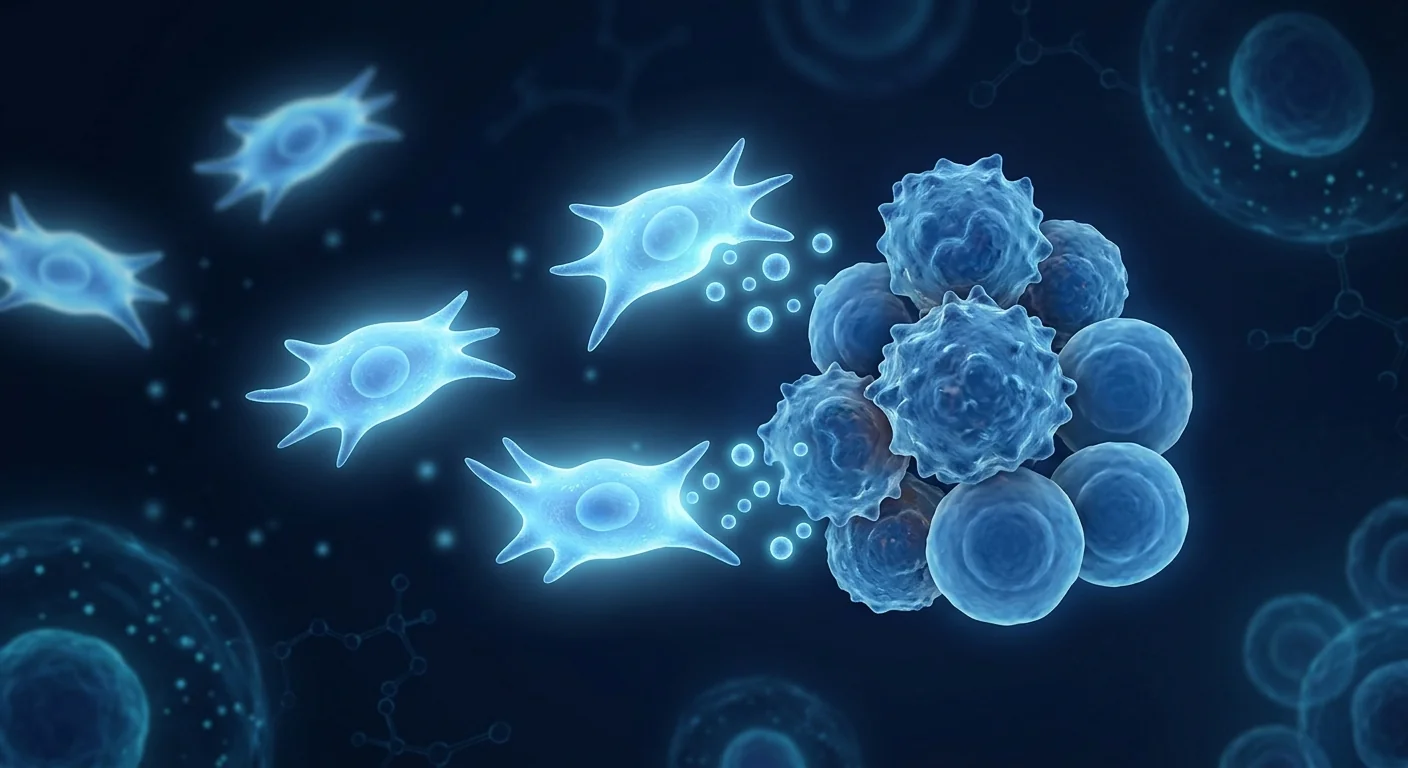
CAR-NK cell therapy engineers natural killer (NK) cells with a chimeric antigen receptor so they can recognize a selected target while retaining the innate surveillance system that already allows NK cells to detect stressed or abnormal cells. That combination is the central idea: a synthetic receptor adds precision, but the cell does not lose its native killing machinery [1].
The platform is being investigated mainly for cancer. It is often discussed as a possible “off-the-shelf” counterpart to patient-specific CAR-T therapy because healthy-donor, cord-blood, NK-cell-line, or induced-pluripotent-stem-cell sources can potentially yield standardized batches for many recipients. That is a manufacturing goal—not a guarantee that every product is immediately available, interchangeable, inexpensive, or clinically effective.
CAR-NK therapy remains investigational. Early trials, particularly in CD19-positive blood cancers, have produced encouraging responses with relatively low reported rates of severe cytokine-release syndrome (CRS), neurotoxicity, and graft-versus-host disease (GvHD). The datasets are still small, products differ substantially, and no result should be generalized to all targets or solid tumors [2].
What is a natural killer cell?
NK cells are cytotoxic lymphocytes of the innate immune system that can act without first being trained against one exact antigen. They continuously integrate activating and inhibitory signals. Healthy cells normally display major histocompatibility complex class I molecules that engage inhibitory NK receptors. A stressed, infected, or malignant cell may lose these “self” signals or gain stress ligands; the balance can then shift toward killing, a principle known as missing-self recognition [3].
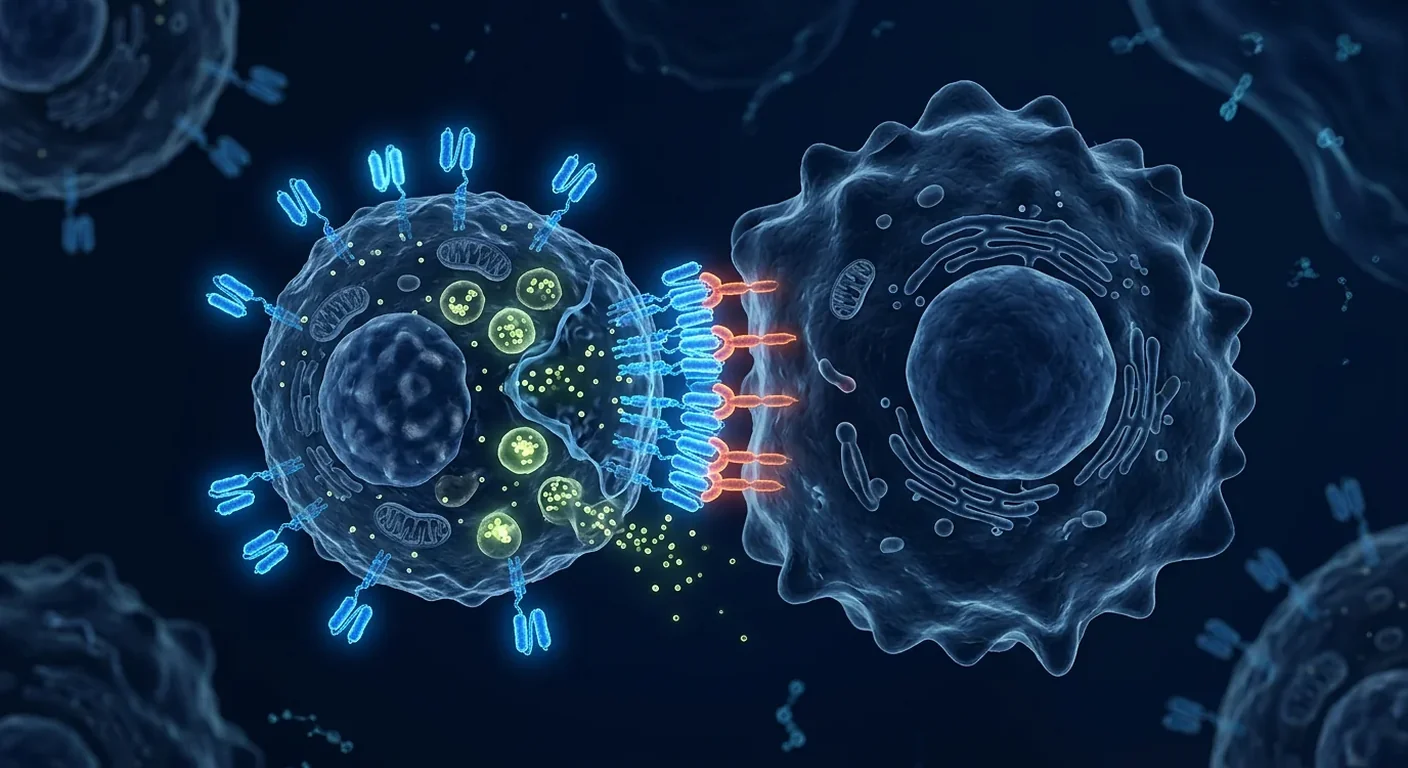
After activation, an NK cell forms an immune synapse with its target and releases perforin and granzymes. Perforin helps deliver granzymes, which activate programmed cell death. NK cells can also signal through death receptors and can perform antibody-dependent cellular cytotoxicity (ADCC): CD16 on the NK cell recognizes the Fc portion of antibodies attached to a target. These routes make an NK cell more than a passive carrier for a CAR.
What does the chimeric antigen receptor contain?
A CAR is a modular synthetic receptor that links extracellular target recognition to intracellular activation. Although designs vary, most contain four functional parts:
- Binding domain: commonly a single-chain variable fragment (scFv) derived from an antibody, or another ligand-binding scaffold, which recognizes a surface antigen such as CD19 or BCMA.
- Hinge or spacer: provides reach and flexibility. Its length can affect access to antigens located close to or far from the tumor-cell membrane.
- Transmembrane domain: anchors the receptor and influences stability, assembly, and signaling behavior.
- Intracellular signaling domains: trigger activation after antigen binding. CAR-NK constructs may use CD3ζ together with costimulatory domains such as CD28 or 4-1BB, or NK-adapted modules such as 2B4, DAP10, or DAP12.
The engineering cassette may add more than the receptor. “Armored” designs can express IL-15 to support survival, a high-affinity CD16 receptor to strengthen ADCC, chemokine receptors to improve trafficking, or an inducible suicide switch to terminate the cells if necessary. Adding functions can improve potency but also raises manufacturing, testing, and regulatory complexity [4].
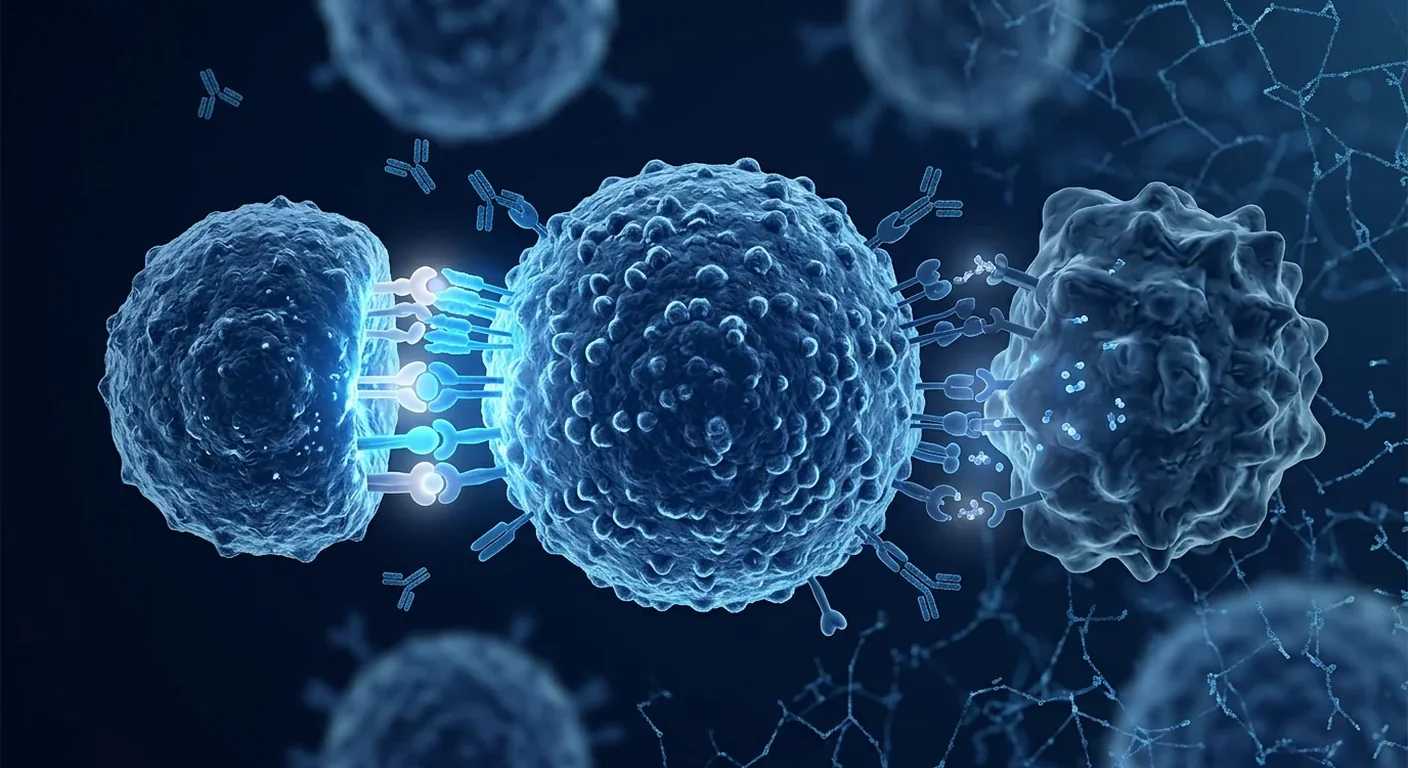
How does “dual killing” work?
CAR-NK cells can kill through CAR-dependent recognition and through CAR-independent NK biology. When the chosen antigen is present, CAR binding clusters the receptor, activates intracellular signaling, and directs degranulation toward the tumor cell. If a malignant cell has little or none of that antigen, native activating receptors—including NKG2D, natural cytotoxicity receptors, and DNAM-1—may still detect stress ligands. CD16 can add a third route when a compatible therapeutic antibody coats the target.
This does not make antigen escape impossible. A tumor can suppress NK function, shed ligands, alter antigen density, recruit inhibitory cells, or become physically inaccessible. Native recognition may partly cover heterogeneous antigen expression, while dual-target CARs or combinations with monoclonal antibodies attempt to widen coverage. Each strategy must prove that increased complexity improves outcomes without unacceptable on-target injury to healthy tissue [5].
Where do CAR-NK cells come from?
| Source | Potential advantage | Important limitation |
|---|---|---|
| Peripheral blood | Mature primary NK biology; autologous or allogeneic collection | Donor variability, limited starting numbers, expansion and gene-transfer difficulty |
| Umbilical cord blood | Banked units, youthful cells, allogeneic availability | Immature phenotype and small starting dose require activation and expansion |
| NK-92 cell line | Uniform, expandable, comparatively easy to engineer | Tumor-derived line must be irradiated before infusion, limiting proliferation and persistence |
| Induced pluripotent stem cells (iPSCs) | Clonal master bank, repeatable engineering, theoretically very large scale | Long differentiation process and strict controls for genomic integrity and residual pluripotent cells |
Primary donor NK cells retain physiological receptor diversity but can be hard to transduce and expand consistently. NK-92 offers a reproducible research and manufacturing platform, yet mandatory irradiation creates a biological trade-off. iPSCs can be edited once at the master-cell-bank stage and differentiated repeatedly, supporting multi-feature products, but this is a sophisticated process with its own safety and comparability requirements [6].
Why might CAR-NK become off-the-shelf?
Allogeneic NK cells generally carry a lower intrinsic risk of causing GvHD than conventional donor T cells, making multi-patient manufacturing biologically plausible. A manufacturer could collect or derive cells in advance, engineer and expand a large batch, perform release testing, cryopreserve aliquots, and distribute doses to treatment centers. This could shorten vein-to-vein time and avoid dependence on the number and fitness of a heavily treated patient’s own lymphocytes.
Off-the-shelf does not mean ordinary pharmacy stock. Cellular products still require controlled storage, identity and potency tests, chain of custody, qualified thawing or preparation, and clinical coordination. Recipient immunity can reject donor cells, lymphodepleting chemotherapy may be required, and repeat dosing may be needed. Scale can reduce per-dose costs only if the product remains consistent through expansion, freezing, transport, and administration.
What does early human evidence show?
The best-known early signal came from a phase 1/2 study of cord-blood-derived anti-CD19 CAR-NK cells in 11 people with relapsed or refractory CD19-positive lymphoma or chronic lymphocytic leukemia. The cells also expressed IL-15 and an inducible caspase-9 safety switch. Eight of 11 participants responded, including seven complete responses; responses occurred within 30 days. Investigators reported no CRS, neurotoxicity, or GvHD, and CAR-NK cells were detectable at low levels for at least 12 months [7].
Those findings established clinical plausibility, not comparative superiority. Eleven participants cannot define uncommon toxicity, durability, ideal dose, or performance against current standards. Subsequent early programs have explored cord-blood, peripheral-blood, NK-92, and iPSC-derived products targeting CD19, CD20, BCMA, CD33, CD70, HER2, mesothelin, and other antigens. Published and conference-reported results are most developed in B-cell malignancies; solid-tumor activity remains much less certain [8].
How to read an early response rate
A response in a small, single-arm dose-escalation trial can justify a larger study, but it does not show that the treatment is better than CAR-T therapy, transplantation, antibodies, or other standard care. Follow-up duration, prior therapies, bridging treatment, retreatment, and independent response assessment all matter.
How does safety compare with CAR-T?
Early CAR-NK studies suggest severe CRS, ICANS, and GvHD may be less frequent than with CAR-T, but the evidence is not yet large enough to promise a uniformly safer therapy. NK cells often produce a different cytokine profile and tend to persist for less time than activated T cells. Allogeneic NK cells also do not normally mount the same classical T-cell receptor attack on recipient tissue.
Potential harms remain substantial: infusion reactions, fever, cytopenias and infection after lymphodepletion, tumor-lysis syndrome, on-target/off-tumor injury, and toxicity from accompanying cytokines or genetic modifications. Products containing IL-15 require attention to autonomous expansion or systemic inflammation. Gene-transfer methods introduce risks related to insertion, editing errors, or clonal abnormalities. Safety switches provide an emergency control but do not prevent every complication.
Shorter persistence can limit prolonged toxicity, yet the same feature may reduce tumor control. “Safer because it disappears” is therefore an incomplete argument; exposure must be long enough to achieve the intended biological effect and predictable enough to manage risk [9].
Why are persistence and host rejection difficult?
NK cells may contract quickly after infusion because they depend on cytokine support and face rejection by the recipient’s recovering immune system. IL-2 can stimulate NK cells but also expand regulatory T cells; IL-15 is attractive because it supports NK survival, although uncontrolled signaling can be toxic. Membrane-bound or locally secreted cytokine designs try to concentrate support around the engineered cell.
Lymphodepletion creates temporary space and cytokine availability but adds infection and marrow-suppression risks. Repeat dosing may compensate for short persistence and is more practical with a banked product, though recipient antibodies or T-cell responses can make later doses less effective. Engineers are also modifying HLA expression or adding immune-evasion signals, changes that require careful testing because evasion may complicate control of the infused cells.
Why have solid tumors been harder?
A solid tumor is a trafficking, access, metabolism, and immunosuppression problem as well as a targeting problem. CAR-NK cells must leave the circulation, follow the right chemokine gradients, enter dense tumor stroma, survive low oxygen and nutrient competition, and remain active among TGF-β, adenosine, suppressive myeloid cells, and inhibitory checkpoints. A target antigen may also be patchy or shared with an essential healthy tissue.
Experimental solutions include chemokine-receptor engineering, local or regional delivery, checkpoint disruption, dominant-negative TGF-β receptors, cytokine armoring, metabolic rewiring, and logic-gated receptors. These may improve laboratory models, but every added circuit introduces another attribute that must remain stable and measurable during clinical manufacturing [10].
What are the manufacturing barriers?
A CAR-NK product must be reproducible as a medicine, not merely active in one laboratory experiment. Key steps include donor or master-bank qualification, NK-cell selection or differentiation, activation, genetic modification, expansion, harvest, formulation, storage, and release. Primary NK cells can resist viral gene transfer; nonviral electroporation may be transient or reduce viability; prolonged expansion can change receptor profiles and function.
- Identity and purity: confirm NK phenotype, CAR expression, and absence of unwanted cells.
- Potency: use a validated assay linked to the proposed mechanism, not viability alone.
- Safety: test sterility, mycoplasma, endotoxin, replication-competent virus where relevant, genomic integrity, and residual undifferentiated cells for iPSC platforms.
- Consistency: show comparable function between donors, batches, manufacturing sites, scales, and post-thaw doses.
- Logistics: define shelf life, temperature control, administration window, traceability, and what constitutes a usable dose.
Potency assays are particularly challenging because CAR recognition, innate receptor killing, ADCC, cytokine secretion, serial killing, and persistence can all contribute. A single short cytotoxicity assay may not predict clinical performance [11].
What is the regulatory status?
CAR-NK therapies are investigational and should be accessed through appropriately authorized clinical trials or regulated pathways. As of this article’s review date, the U.S. FDA’s approved cellular and gene therapy list contains several CAR-T products but no CAR-NK product. Authorization to begin a clinical trial is not marketing approval, and designations such as orphan-drug or fast-track status do not establish efficacy.
Regulators assess each product as its own biologic. A result from one CD19 CAR-NK platform does not validate another source, vector, signaling cassette, dose, or indication. Meaningful consent should state the trial phase, alternatives, unknowns, required follow-up, costs, and whether emergency care is available. Commercial descriptions that present CAR-NK as routinely approved cancer treatment should be treated cautiously.
Questions patients should ask about a CAR-NK trial
- What exact disease, antigen, and trial phase are being studied?
- What is the cell source, and is the product autologous or allogeneic?
- Which CAR, cytokine support, safety switch, or gene edits are included?
- Why is lymphodepletion needed, and what are its infection and cytopenia risks?
- What evidence is published for this exact product—not merely for CAR-NK as a category?
- How are CRS, neurotoxicity, tumor lysis, infection, and off-tumor effects monitored?
- Are repeat doses planned, and what is known about persistence or rejection?
- Who pays for treatment, travel, complications, and long-term follow-up?
Frequently Asked Questions
Is CAR-NK the same as NK-cell therapy?
No. CAR-NK is one engineered form of NK-cell therapy. Unmodified or cytokine-activated NK-cell products do not necessarily carry a synthetic CAR.
Is CAR-NK better than CAR-T?
Not established. CAR-NK may offer allogeneic manufacturing and a different toxicity profile, while approved CAR-T products have much larger disease-specific evidence bases and demonstrated durable remissions in selected blood cancers.
Can one CAR-NK dose treat many people?
A manufacturing batch may be divided into doses for multiple recipients, especially with cord-blood or iPSC platforms. Each recipient still receives a controlled product dose; cells are not shared after administration.
Does innate killing prevent antigen escape?
It may provide an additional route against some antigen-low cells, but it cannot guarantee control. Tumors can evade both CAR and innate pathways.
Can CAR-NK treat solid tumors?
Clinical trials are testing this, but evidence is earlier and less convincing than in selected B-cell malignancies. Trafficking, hostile tumor microenvironments, and safe antigen selection remain major barriers.
Is CAR-NK approved?
No CAR-NK product appears on the FDA approved cellular and gene therapy list as of the review date. Regulatory status differs by jurisdiction and should be checked for the exact product.
Limitations and medical disclaimer
CAR-NK is a rapidly changing research field, and early outcomes can change as cohorts mature. Cross-trial comparisons are unreliable because cell sources, constructs, lymphodepletion, dosing, diseases, and response definitions differ. Conference abstracts may precede peer-reviewed full reports. This review explains the platform and does not recommend a specific product or imply access at VELAR.
This article is educational and is not medical advice. Cancer treatment decisions require an oncology and cellular-therapy team that can review pathology, antigen expression, prior therapy, organ function, infection risk, approved alternatives, trial eligibility, and emergency support.
References
- Shimasaki N, Jain A, Campana D. NK cells for cancer immunotherapy. Nature Reviews Drug Discovery. 2020;19:200–218. doi:10.1038/s41573-019-0052-1 ↩
- Vivier E, Rebuffet L, Narni-Mancinelli E, et al. Natural killer cell therapies. Nature. 2024;626:727–736. doi:10.1038/s41586-023-06945-1 ↩
- Kärre K. Natural killer cell recognition of missing self. Nature Immunology. 2008;9:477–480. doi:10.1038/ni0508-477 ↩
- Zhang L, Meng Y, Feng X, Han Z. CAR-NK cells for cancer immunotherapy: from bench to bedside. Biomarker Research. 2022;10:12. doi:10.1186/s40364-022-00364-6 ↩
- Frankel NW, Deng H, Yucel G, et al. Precision off-the-shelf natural killer cell therapies for oncology with logic-gated gene circuits. Cell Reports. 2024;43:114145. doi:10.1016/j.celrep.2024.114145 ↩
- Li Y, Hermanson DL, Moriarity BS, Kaufman DS. Human iPSC-derived natural killer cells engineered with chimeric antigen receptors enhance anti-tumor activity. Cell Stem Cell. 2018;23:181–192.e5. doi:10.1016/j.stem.2018.06.002 ↩
- Liu E, Marin D, Banerjee P, et al. Use of CAR-transduced natural killer cells in CD19-positive lymphoid tumors. New England Journal of Medicine. 2020;382:545–553. doi:10.1056/NEJMoa1910607 ↩
- Jørgensen LV, Christensen EB, Barnkob MB, Barington T. The clinical landscape of CAR NK cells. Experimental Hematology & Oncology. 2025;14. doi:10.1186/s40164-025-00633-8 ↩
- Daher M, Rezvani K. Next generation natural killer cells for cancer immunotherapy: the promise of genetic engineering. Current Opinion in Immunology. 2018;51:146–153. doi:10.1016/j.coi.2018.03.013 ↩
- Wang W, Liu Y, He Z, et al. Breakthrough of solid tumor treatment: CAR-NK immunotherapy. Cell Death Discovery. 2024;10:40. doi:10.1038/s41420-024-01815-9 ↩
- Pfefferle A, Contet J, Wong K, et al. Optimisation of a primary human CAR-NK cell manufacturing pipeline. Clinical & Translational Immunology. 2024;13:e1507. doi:10.1002/cti2.1507 ↩
- Daher M, et al. Cord blood NK cells engineered to express IL-15 and a CD19-targeted CAR show long-term persistence and potent antitumor activity. Leukemia. 2018;32:520–531. doi:10.1038/leu.2017.226 ↩
- Klingemann H, Boissel L, Toneguzzo F. Natural killer cells for immunotherapy—advantages of the NK-92 cell line over blood NK cells. Frontiers in Immunology. 2016;7:91. doi:10.3389/fimmu.2016.00091 ↩
- Guo F, Zhang Y, Cui J. Manufacturing CAR-NK against tumors: who is the ideal supplier? Chinese Journal of Cancer Research. 2024;36:1–16. doi:10.21147/j.issn.1000-9604.2024.01.01 ↩
- Yang R, Yang Y, Liu R, et al. Advances in CAR-NK cell therapy for hematological malignancies. Frontiers in Immunology. 2024;15:1414264. doi:10.3389/fimmu.2024.1414264 ↩
CAR-NK细胞疗法通过嵌合抗原受体(CAR)改造自然杀伤(NK)细胞,使其能够识别选定的靶点,同时保留NK细胞已有的、能够检测受损或异常细胞的先天监视系统。这种组合是核心理念:合成受体增加了精确性,但细胞不会失去其固有的杀伤机制[1]。
该平台主要用于癌症研究。它常被讨论为患者特异性CAR-T疗法的一种可能的“现成”对应物,因为健康供者、脐带血、NK细胞系或诱导多能干细胞来源有可能为许多受体提供标准化批次。这是一个生产目标——并非保证每种产品都能立即获得、可互换、廉价或具有临床疗效。
CAR-NK疗法仍处于研究阶段。早期试验,特别是在CD19阳性血液癌症中,取得了令人鼓舞的反应,且严重细胞因子释放综合征(CRS)、神经毒性和移植物抗宿主病(GvHD)的报告发生率相对较低。数据集仍然很小,产品差异很大,任何结果都不应推广到所有靶点或实体瘤[2]。
什么是自然杀伤细胞?
NK细胞是先天免疫系统中的细胞毒性淋巴细胞,无需预先针对特定抗原进行训练即可发挥作用。它们持续整合激活和抑制信号。健康细胞通常会表达主要组织相容性复合体I类分子,这些分子与抑制性NK受体结合。受损、感染或恶性细胞可能会失去这些“自身”信号或获得应激配体;此时平衡可能转向杀伤,这一原理被称为“缺失自我识别”[3]。
激活后,NK细胞与靶细胞形成免疫突触,并释放穿孔素和颗粒酶。穿孔素有助于递送颗粒酶,后者激活程序性细胞死亡。NK细胞还可以通过死亡受体发出信号,并可以执行抗体依赖性细胞毒性(ADCC):NK细胞上的CD16识别附着在靶细胞上的抗体的Fc段。这些途径使NK细胞不仅仅是CAR的被动载体。
嵌合抗原受体包含什么?
CAR是一种模块化合成受体,它将细胞外靶点识别与细胞内激活联系起来。尽管设计各异,但大多数包含四个功能部分:
- 结合域:通常是源自抗体的单链可变片段(scFv),或另一种配体结合支架,识别表面抗原,如CD19或BCMA。
- 铰链或间隔区:提供延伸和柔韧性。其长度会影响对位于肿瘤细胞膜附近或远处的抗原的接近。
- 跨膜域:锚定受体并影响稳定性、组装和信号传导行为。
- 细胞内信号域:抗原结合后触发激活。CAR-NK构建体可以使用CD3ζ以及共刺激域,如CD28或4-1BB,或NK适应性模块,如2B4、DAP10或DAP12。
工程化盒可能不仅仅添加受体。“武装”设计可以表达IL-15以支持存活,高亲和力CD16受体以增强ADCC,趋化因子受体以改善归巢,或可诱导自杀开关以在必要时终止细胞。增加功能可以提高效力,但也会增加制造、测试和监管的复杂性[4]。
“双重杀伤”如何运作?
CAR-NK细胞可以通过CAR依赖性识别和CAR非依赖性NK生物学机制进行杀伤。当选定的抗原存在时,CAR结合会使受体聚集,激活细胞内信号传导,并引导脱颗粒作用指向肿瘤细胞。如果恶性细胞几乎没有或根本没有该抗原,天然激活受体——包括NKG2D、天然细胞毒性受体和DNAM-1——可能仍然会检测到应激配体。当兼容的治疗性抗体覆盖靶细胞时,CD16可以增加第三条途径。
这并不能使抗原逃逸变得不可能。肿瘤可以抑制NK功能、脱落配体、改变抗原密度、招募抑制性细胞或变得物理上不可及。天然识别可能部分覆盖异质性抗原表达,而双靶点CAR或与单克隆抗体的组合则试图扩大覆盖范围。每种策略都必须证明,增加的复杂性在不造成对健康组织不可接受的脱靶损伤的情况下,能够改善治疗结果[5]。
CAR-NK细胞从何而来?
| 来源 | 潜在优势 | 重要局限性 |
|---|---|---|
| 外周血 | 成熟的原代NK生物学;自体或异体采集 | 供者变异性,起始细胞数量有限,扩增和基因转移困难 |
| 脐带血 | 库存储备,年轻细胞,异体可用性 | 未成熟表型和小起始剂量需要激活和扩增 |
| NK-92细胞系 | 均一,可扩增,相对易于工程化 | 肿瘤来源的细胞系在输注前必须经过辐照,限制了增殖和持久性 |
| 诱导多能干细胞(iPSCs) | 克隆主细胞库,可重复工程化,理论上可大规模生产 | 分化过程漫长,对基因组完整性和残留多能细胞有严格控制 |
原代供者NK细胞保留了生理性受体多样性,但难以稳定转导和扩增。NK-92提供了一个可重复的研究和生产平台,但强制辐照带来了生物学上的权衡。iPSCs可以在主细胞库阶段进行一次编辑并反复分化,支持多功能产品,但这是一种复杂的过程,有其自身的安全性和可比性要求[6]。
为什么CAR-NK可能成为现成产品?
异体NK细胞引起GvHD的内在风险通常低于传统供者T细胞,这使得多患者生产在生物学上具有可行性。制造商可以预先收集或衍生细胞,工程化并扩增大批次,进行放行检测,低温保存等分试样,并将剂量分发给治疗中心。这可以缩短从采血到输注的时间,并避免依赖于经过大量治疗的患者自身淋巴细胞的数量和健康状况。
“现成”并不意味着普通的药房库存。细胞产品仍需要受控储存、身份和效力测试、监管链、合格的解冻或制备以及临床协调。受体免疫系统可能会排斥供者细胞,可能需要淋巴清除化疗,并且可能需要重复给药。只有当产品在扩增、冷冻、运输和给药过程中保持一致时,规模化生产才能降低每剂成本。
早期人体证据显示了什么?
最著名的早期信号来自一项针对11名复发或难治性CD19阳性淋巴瘤或慢性淋巴细胞白血病患者的脐带血来源抗CD19 CAR-NK细胞的1/2期研究。这些细胞还表达IL-15和可诱导的caspase-9安全开关。11名参与者中有8名出现反应,包括7名完全缓解;反应在30天内发生。研究人员报告没有CRS、神经毒性或GvHD,并且CAR-NK细胞在低水平下可检测至少12个月[7]。
这些发现确立了临床可行性,而非比较优势。11名参与者无法定义不常见的毒性、持久性、理想剂量或与当前标准的表现。随后的早期项目探索了靶向CD19、CD20、BCMA、CD33、CD70、HER2、间皮素和其他抗原的脐带血、外周血、NK-92和iPSC衍生产品。已发表和会议报告的结果在B细胞恶性肿瘤中最为成熟;实体瘤的活性仍不确定[8]。
如何解读早期反应率
在小型、单臂剂量递增试验中获得的反应可以支持进行更大规模的研究,但这并不能表明该治疗优于CAR-T疗法、移植、抗体或其他标准护理。随访时间、既往治疗、桥接治疗、再治疗以及独立的反应评估都至关重要。
安全性与CAR-T相比如何?
早期CAR-NK研究表明,严重CRS、ICANS和GvHD的发生频率可能低于CAR-T,但证据尚不足以保证这是一种普遍更安全的疗法。NK细胞通常产生不同的细胞因子谱,并且往往比活化的T细胞持续时间更短。异体NK细胞通常也不会对受体组织发起相同的经典T细胞受体攻击。
潜在危害仍然很大:输注反应、发热、淋巴清除后的血细胞减少和感染、肿瘤溶解综合征、脱靶/脱瘤损伤以及伴随细胞因子或基因修饰的毒性。含有IL-15的产品需要关注自主扩增或全身炎症。基因转移方法引入了与插入、编辑错误或克隆异常相关的风险。安全开关提供了紧急控制,但不能预防所有并发症。
较短的持久性可以限制长期毒性,但同样的特点也可能降低肿瘤控制。因此,“因为它消失了所以更安全”是一个不完整的论点;暴露时间必须足够长以达到预期的生物学效应,并且足够可预测以管理风险[9]。
为什么持久性和宿主排斥反应很困难?
NK细胞在输注后可能会迅速收缩,因为它们依赖细胞因子支持并面临受体恢复中的免疫系统的排斥。IL-2可以刺激NK细胞,但也会扩增调节性T细胞;IL-15具有吸引力,因为它支持NK细胞存活,尽管不受控制的信号传导可能具有毒性。膜结合或局部分泌的细胞因子设计试图将支持集中在工程化细胞周围。
淋巴清除创造了暂时的空间和细胞因子可用性,但增加了感染和骨髓抑制的风险。重复给药可以弥补短暂的持久性,并且对于库存产品来说更实用,尽管受体抗体或T细胞反应可能使后续剂量效果降低。工程师们还在修改HLA表达或添加免疫逃逸信号,这些改变需要仔细测试,因为逃逸可能会使对输注细胞的控制复杂化。
为什么实体瘤更难治疗?
实体瘤不仅是靶向问题,也是归巢、进入、代谢和免疫抑制问题。CAR-NK细胞必须离开循环,遵循正确的趋化因子梯度,进入致密的肿瘤基质,在低氧和营养竞争中存活,并在TGF-β、腺苷、抑制性髓系细胞和抑制性检查点中保持活性。靶抗原也可能分布不均或与必需的健康组织共享。
实验性解决方案包括趋化因子受体工程、局部或区域递送、检查点破坏、显性负性TGF-β受体、细胞因子武装、代谢重编程和逻辑门控受体。这些可能改善实验室模型,但每个添加的回路都引入了另一个属性,该属性在临床生产过程中必须保持稳定和可测量[10]。
制造障碍有哪些?
CAR-NK产品必须作为药物具有可重复性,而不仅仅是在一个实验室实验中具有活性。关键步骤包括供者或主细胞库鉴定、NK细胞选择或分化、激活、基因修饰、扩增、收获、制剂、储存和放行。原代NK细胞可能抵抗病毒基因转移;非病毒电穿孔可能短暂或降低活力;长时间扩增可能改变受体谱和功能。
- 特性和纯度:确认NK表型、CAR表达以及不存在不需要的细胞。
- 效力:使用与拟议机制相关的经过验证的检测方法,而不仅仅是活力。
- 安全性:测试无菌性、支原体、内毒素、相关复制能力病毒、基因组完整性以及iPSC平台中残留的未分化细胞。
- 一致性:显示不同供者、批次、生产地点、规模和解冻后剂量之间的可比功能。
- 物流:定义保质期、温度控制、给药窗口、可追溯性以及构成可用剂量的标准。
效力检测尤其具有挑战性,因为CAR识别、先天受体杀伤、ADCC、细胞因子分泌、连续杀伤和持久性都可能有所贡献。单一的短期细胞毒性检测可能无法预测临床表现[11]。
监管状态如何?
CAR-NK疗法仍处于研究阶段,应通过经适当授权的临床试验或受监管的途径获取。截至本文审查日期,美国FDA批准的细胞和基因疗法清单中包含几种CAR-T产品,但没有CAR-NK产品。启动临床试验的授权并非上市批准,孤儿药或快速通道等指定并不能确立疗效。
监管机构将每种产品作为其自身的生物制品进行评估。一种CD19 CAR-NK平台的结果不能验证另一种来源、载体、信号传导盒、剂量或适应症。有意义的知情同意应说明试验阶段、替代方案、未知因素、所需随访、费用以及是否提供紧急护理。将CAR-NK描述为常规批准的癌症治疗的商业宣传应谨慎对待。
患者应向CAR-NK试验提出的问题
- 正在研究的具体疾病、抗原和试验阶段是什么?
- 细胞来源是什么,产品是自体还是异体?
- 包含哪些CAR、细胞因子支持、安全开关或基因编辑?
- 为什么需要淋巴清除,其感染和血细胞减少风险是什么?
- 针对这种具体产品(而不仅仅是CAR-NK作为一个类别)发表了哪些证据?
- 如何监测CRS、神经毒性、肿瘤溶解、感染和脱靶效应?
- 是否计划重复给药,关于持久性或排斥反应已知哪些信息?
- 谁支付治疗、差旅、并发症和长期随访的费用?
常见问题
CAR-NK与NK细胞疗法相同吗?
不。CAR-NK是NK细胞疗法的一种工程化形式。未经修饰或细胞因子激活的NK细胞产品不一定携带合成CAR。
CAR-NK比CAR-T更好吗?
尚未确定。CAR-NK可能提供异体生产和不同的毒性特征,而获批的CAR-T产品具有更大的疾病特异性证据基础,并在选定的血液癌症中显示出持久缓解。
一剂CAR-NK可以治疗很多人吗?
一个生产批次可以分成多份剂量供多个受体使用,特别是对于脐带血或iPSC平台。每个受体仍然接受受控的产品剂量;细胞在给药后不会共享。
先天杀伤能防止抗原逃逸吗?
它可能为一些抗原表达低的细胞提供额外的途径,但不能保证控制。肿瘤可以逃避CAR和先天途径。
CAR-NK可以治疗实体瘤吗?
临床试验正在测试这一点,但证据比在选定的B细胞恶性肿瘤中更早期且说服力更弱。归巢、恶劣的肿瘤微环境和安全的抗原选择仍然是主要障碍。
CAR-NK获批了吗?
截至审查日期,FDA批准的细胞和基因疗法清单上没有CAR-NK产品。监管状态因司法管辖区而异,应针对具体产品进行核实。
局限性和医疗免责声明
CAR-NK是一个快速变化的科研领域,早期结果可能随着队列的成熟而改变。跨试验比较不可靠,因为细胞来源、构建体、淋巴清除、剂量、疾病和反应定义各不相同。会议摘要可能早于同行评审的完整报告。本综述解释了该平台,不推荐特定产品,也不暗示在VELAR可获得。
本文为教育性质,并非医疗建议。癌症治疗决策需要肿瘤学和细胞治疗团队,他们可以审查病理、抗原表达、既往治疗、器官功能、感染风险、批准的替代方案、试验资格和紧急支持。
参考文献
- Shimasaki N, Jain A, Campana D. NK cells for cancer immunotherapy. Nature Reviews Drug Discovery. 2020;19:200–218. doi:10.1038/s41573-019-0052-1 ↩
- Vivier E, Rebuffet L, Narni-Mancinelli E, et al. Natural killer cell therapies. Nature. 2024;626:727–736. doi:10.1038/s41586-023-06945-1 ↩
- Kärre K. Natural killer cell recognition of missing self. Nature Immunology. 2008;9:477–480. doi:10.1038/ni0508-477 ↩
- Zhang L, Meng Y, Feng X, Han Z. CAR-NK cells for cancer immunotherapy: from bench to bedside. Biomarker Research. 2022;10:12. doi:10.1186/s40364-022-00364-6 ↩
- Frankel NW, Deng H, Yucel G, et al. Precision off-the-shelf natural killer cell therapies for oncology with logic-gated gene circuits. Cell Reports. 2024;43:114145. doi:10.1016/j.celrep.2024.114145 ↩
- Li Y, Hermanson DL, Moriarity BS, Kaufman DS. Human iPSC-derived natural killer cells engineered with chimeric antigen receptors enhance anti-tumor activity. Cell Stem Cell. 2018;23:181–192.e5. doi:10.1016/j.stem.2018.06.002 ↩
- Liu E, Marin D, Banerjee P, et al. Use of CAR-transduced natural killer cells in CD19-positive lymphoid tumors. New England Journal of Medicine. 2020;382:545–553. doi:10.1056/NEJMoa1910607 ↩
- Jørgensen LV, Christensen EB, Barnkob MB, Barington T. The clinical landscape of CAR NK cells. Experimental Hematology & Oncology. 2025;14. doi:10.1186/s40164-025-00633-8 ↩
- Daher M, Rezvani K. Next generation natural killer cells for cancer immunotherapy: the promise of genetic engineering. Current Opinion in Immunology. 2018;51:146–153. doi:10.1016/j.coi.2018.03.013 ↩
- Wang W, Liu Y, He Z, et al. Breakthrough of solid tumor treatment: CAR-NK immunotherapy. Cell Death Discovery. 2024;10:40. doi:10.1038/s41420-024-01815-9 ↩
- Pfefferle A, Contet J, Wong K, et al. Optimisation of a primary human CAR-NK cell manufacturing pipeline. Clinical & Translational Immunology. 2024;13:e1507. doi:10.1002/cti2.1507 ↩
- Daher M, et al. Cord blood NK cells engineered to express IL-15 and a CD19-targeted CAR show long-term persistence and potent antitumor activity. Leukemia. 2018;32:520–531. doi:10.1038/leu.2017.226 ↩
- Klingemann H, Boissel L, Toneguzzo F. Natural killer cells for immunotherapy—advantages of the NK-92 cell line over blood NK cells. Frontiers in Immunology. 2016;7:91. doi:10.3389/fimmu.2016.00091 ↩
- Guo F, Zhang Y, Cui J. Manufacturing CAR-NK against tumors: who is the ideal supplier? Chinese Journal of Cancer Research. 2024;36:1–16. doi:10.21147/j.issn.1000-9604.2024.01.01 ↩
- Yang R, Yang Y, Liu R, et al. Advances in CAR-NK cell therapy for hematological malignancies. Frontiers in Immunology. 2024;15:1414264. doi:10.3389/fimmu.2024.1414264 ↩
يعمل العلاج بالخلايا CAR-NK على هندسة الخلايا القاتلة الطبيعية (NK) باستخدام مستقبل مستضد خيمري بحيث يمكنها التعرف على هدف محدد مع الاحتفاظ بنظام المراقبة الفطري الذي يسمح بالفعل للخلايا القاتلة الطبيعية باكتشاف الخلايا المجهدة أو غير الطبيعية. هذا المزيج هو الفكرة الأساسية: يضيف المستقبل الاصطناعي دقة، لكن الخلية لا تفقد آليتها القاتلة الأصلية [1].
يتم التحقيق في هذه المنصة بشكل أساسي لعلاج السرطان. غالبًا ما يتم مناقشتها كبديل محتمل "جاهز للاستخدام" للعلاج بالخلايا التائية CAR-T الخاص بالمريض، لأن مصادر الخلايا القاتلة الطبيعية من المتبرعين الأصحاء، أو دم الحبل السري، أو خطوط الخلايا القاتلة الطبيعية، أو الخلايا الجذعية المحفزة متعددة القدرات يمكن أن تنتج دفعات موحدة للعديد من المتلقين. هذا هدف تصنيعي - وليس ضمانًا بأن كل منتج متاح على الفور، أو قابل للتبديل، أو غير مكلف، أو فعال سريريًا.
لا يزال العلاج بالخلايا CAR-NK قيد التحقيق. أنتجت التجارب المبكرة، خاصة في سرطانات الدم الإيجابية لـ CD19، استجابات مشجعة مع معدلات منخفضة نسبيًا من متلازمة إطلاق السيتوكين الشديدة (CRS)، والسمية العصبية، ومرض رفض الطعم مقابل المضيف (GvHD). لا تزال مجموعات البيانات صغيرة، وتختلف المنتجات بشكل كبير، ولا ينبغي تعميم أي نتيجة على جميع الأهداف أو الأورام الصلبة [2].
ما هي الخلية القاتلة الطبيعية؟
الخلايا القاتلة الطبيعية هي خلايا ليمفاوية سامة للخلايا من الجهاز المناعي الفطري يمكنها العمل دون تدريب مسبق ضد مستضد واحد محدد. إنها تدمج باستمرار الإشارات المنشطة والمثبطة. تعرض الخلايا السليمة عادةً جزيئات معقد التوافق النسيجي الرئيسي من الفئة الأولى التي تشارك مستقبلات NK المثبطة. قد تفقد الخلية المجهدة أو المصابة أو الخبيثة هذه الإشارات "الذاتية" أو تكتسب روابط الإجهاد؛ يمكن أن يتحول التوازن بعد ذلك نحو القتل، وهو مبدأ يُعرف بالتعرف على "الذات المفقودة" [3].
بعد التنشيط، تشكل الخلية القاتلة الطبيعية تشابكًا مناعيًا مع هدفها وتطلق البيرفورين والجرانزيمات. يساعد البيرفورين في توصيل الجرانزيمات، التي تنشط موت الخلايا المبرمج. يمكن للخلايا القاتلة الطبيعية أيضًا إرسال إشارات عبر مستقبلات الموت ويمكنها أداء سمية خلوية معتمدة على الأجسام المضادة (ADCC): يتعرف CD16 على الخلية القاتلة الطبيعية على الجزء Fc من الأجسام المضادة المرتبطة بالهدف. هذه المسارات تجعل الخلية القاتلة الطبيعية أكثر من مجرد حامل سلبي لـ CAR.
ماذا يحتوي مستقبل المستضد الخيمري؟
CAR هو مستقبل اصطناعي معياري يربط التعرف على الهدف خارج الخلية بالتنشيط داخل الخلية. على الرغم من اختلاف التصميمات، إلا أن معظمها يحتوي على أربعة أجزاء وظيفية:
- مجال الارتباط: عادةً ما يكون جزءًا متغيرًا أحادي السلسلة (scFv) مشتقًا من جسم مضاد، أو سقالة أخرى مرتبطة بالربيطة، والتي تتعرف على مستضد سطحي مثل CD19 أو BCMA.
- المفصلة أو الفاصل: يوفر الوصول والمرونة. يمكن أن يؤثر طوله على الوصول إلى المستضدات الموجودة بالقرب من غشاء الخلية السرطانية أو بعيدًا عنه.
- مجال عبر الغشاء: يثبت المستقبل ويؤثر على الاستقرار والتجميع وسلوك الإشارة.
- مجالات الإشارة داخل الخلية: تؤدي إلى التنشيط بعد ارتباط المستضد. قد تستخدم تركيبات CAR-NK CD3ζ جنبًا إلى جنب مع مجالات التحفيز المشترك مثل CD28 أو 4-1BB، أو وحدات متكيفة مع NK مثل 2B4 أو DAP10 أو DAP12.
قد تضيف كاسيت الهندسة أكثر من المستقبل. يمكن للتصميمات "المدرعة" أن تعبر عن IL-15 لدعم البقاء، أو مستقبل CD16 عالي التقارب لتقوية ADCC، أو مستقبلات الكيموكين لتحسين الحركة، أو مفتاح انتحاري قابل للتحريض لإنهاء الخلايا إذا لزم الأمر. يمكن أن يؤدي إضافة الوظائف إلى تحسين الفعالية ولكنه يزيد أيضًا من تعقيد التصنيع والاختبار والتنظيم [4].
كيف يعمل "القتل المزدوج"؟
يمكن لخلايا CAR-NK أن تقتل من خلال التعرف المعتمد على CAR ومن خلال بيولوجيا NK المستقلة عن CAR. عندما يكون المستضد المختار موجودًا، يؤدي ارتباط CAR إلى تجميع المستقبل، وتنشيط الإشارة داخل الخلية، وتوجيه إزالة التحبب نحو الخلية السرطانية. إذا كانت الخلية الخبيثة تحتوي على القليل من هذا المستضد أو لا تحتوي عليه على الإطلاق، فقد تظل المستقبلات المنشطة الأصلية - بما في ذلك NKG2D ومستقبلات السمية الخلوية الطبيعية و DNAM-1 - تكتشف روابط الإجهاد. يمكن لـ CD16 إضافة مسار ثالث عندما يغطي جسم مضاد علاجي متوافق الهدف.
هذا لا يجعل هروب المستضد مستحيلاً. يمكن للورم أن يثبط وظيفة NK، أو يطرح الروابط، أو يغير كثافة المستضد، أو يجند خلايا مثبطة، أو يصبح غير قابل للوصول جسديًا. قد يغطي التعرف الأصلي جزئيًا التعبير غير المتجانس عن المستضد، بينما تحاول CARs ذات الهدف المزدوج أو المجموعات مع الأجسام المضادة وحيدة النسيلة توسيع التغطية. يجب أن تثبت كل استراتيجية أن التعقيد المتزايد يحسن النتائج دون إصابة غير مقبولة للأنسجة السليمة [5].
من أين تأتي خلايا CAR-NK؟
| المصدر | ميزة محتملة | قيود مهمة |
|---|---|---|
| الدم المحيطي | بيولوجيا NK الأولية الناضجة؛ جمع ذاتي أو خيفي | تغير المتبرع، أعداد بدء محدودة، صعوبة التوسع ونقل الجينات |
| دم الحبل السري | وحدات مخزنة، خلايا شابة، توفر خيفي | النمط الظاهري غير الناضج والجرعة الأولية الصغيرة تتطلب التنشيط والتوسع |
| خط خلايا NK-92 | موحد، قابل للتوسع، سهل الهندسة نسبيًا | يجب تشعيع الخط المشتق من الورم قبل التسريب، مما يحد من التكاثر والمثابرة |
| الخلايا الجذعية المحفزة متعددة القدرات (iPSCs) | بنك رئيسي استنساخي، هندسة قابلة للتكرار، نطاق نظري كبير جدًا | عملية تمايز طويلة وضوابط صارمة لسلامة الجينوم والخلايا الجذعية المتبقية |
تحتفظ خلايا NK الأولية للمتبرع بتنوع المستقبلات الفسيولوجي ولكن قد يكون من الصعب نقلها وتوسيعها باستمرار. توفر NK-92 منصة بحث وتصنيع قابلة للتكرار، ومع ذلك فإن التشعيع الإلزامي يخلق مفاضلة بيولوجية. يمكن تعديل iPSCs مرة واحدة في مرحلة بنك الخلايا الرئيسي وتمايزها بشكل متكرر، مما يدعم المنتجات متعددة الميزات، ولكن هذه عملية معقدة لها متطلبات السلامة والمقارنة الخاصة بها [6].
لماذا قد تصبح CAR-NK جاهزة للاستخدام؟
تحمل خلايا NK الخيفية عمومًا خطرًا جوهريًا أقل للتسبب في GvHD من الخلايا التائية التقليدية للمتبرع، مما يجعل التصنيع متعدد المرضى ممكنًا بيولوجيًا. يمكن للمصنع جمع الخلايا أو اشتقاقها مسبقًا، وهندسة وتوسيع دفعة كبيرة، وإجراء اختبارات الإطلاق، وتجميد العينات، وتوزيع الجرعات على مراكز العلاج. يمكن أن يؤدي ذلك إلى تقصير وقت "من الوريد إلى الوريد" وتجنب الاعتماد على عدد ولياقة الخلايا الليمفاوية للمريض الذي تلقى علاجًا مكثفًا.
جاهز للاستخدام لا يعني مخزون صيدلية عادي. لا تزال المنتجات الخلوية تتطلب تخزينًا متحكمًا فيه، واختبارات الهوية والفعالية، وسلسلة الحضانة، والذوبان أو التحضير المؤهل، والتنسيق السريري. يمكن أن يرفض الجهاز المناعي للمتلقي خلايا المتبرع، وقد يتطلب الأمر علاجًا كيميائيًا مزيلًا للخلايا الليمفاوية، وقد تكون هناك حاجة إلى جرعات متكررة. يمكن أن يقلل الحجم من تكاليف الجرعة فقط إذا ظل المنتج متسقًا خلال التوسع والتجميد والنقل والإدارة.
ماذا تظهر الأدلة البشرية المبكرة؟
جاءت الإشارة المبكرة الأكثر شهرة من دراسة المرحلة 1/2 لخلايا CAR-NK المضادة لـ CD19 المشتقة من دم الحبل السري في 11 شخصًا مصابًا بسرطان الغدد الليمفاوية أو سرطان الدم الليمفاوي المزمن الإيجابي لـ CD19 المنتكس أو المقاوم للعلاج. عبرت الخلايا أيضًا عن IL-15 ومفتاح أمان كاسبيز-9 قابل للتحريض. استجاب ثمانية من 11 مشاركًا، بما في ذلك سبع استجابات كاملة؛ حدثت الاستجابات في غضون 30 يومًا. أبلغ المحققون عن عدم وجود CRS أو سمية عصبية أو GvHD، وكانت خلايا CAR-NK قابلة للكشف بمستويات منخفضة لمدة 12 شهرًا على الأقل [7].
أثبتت هذه النتائج المعقولية السريرية، وليس التفوق المقارن. لا يمكن لـ 11 مشاركًا تحديد السمية غير الشائعة، أو المتانة، أو الجرعة المثالية، أو الأداء مقابل المعايير الحالية. استكشفت البرامج المبكرة اللاحقة منتجات مشتقة من دم الحبل السري، والدم المحيطي، و NK-92، و iPSC تستهدف CD19، و CD20، و BCMA، و CD33، و CD70، و HER2، والميزوثيلين، ومستضدات أخرى. النتائج المنشورة والمبلغ عنها في المؤتمرات هي الأكثر تطورًا في الأورام الخبيثة B-cell؛ لا يزال نشاط الورم الصلب أقل يقينًا بكثير [8].
كيف تقرأ معدل الاستجابة المبكر
يمكن أن تبرر الاستجابة في تجربة صغيرة أحادية الذراع لتصعيد الجرعة دراسة أكبر، لكنها لا تظهر أن العلاج أفضل من العلاج بالخلايا التائية CAR-T، أو الزرع، أو الأجسام المضادة، أو الرعاية القياسية الأخرى. مدة المتابعة، والعلاجات السابقة، والعلاج الجسري، وإعادة العلاج، وتقييم الاستجابة المستقل، كلها أمور مهمة.
كيف تقارن السلامة مع CAR-T؟
تشير الدراسات المبكرة لـ CAR-NK إلى أن CRS الشديدة، و ICANS، و GvHD قد تكون أقل تكرارًا مما هي عليه مع CAR-T، لكن الأدلة ليست كبيرة بما يكفي بعد لضمان علاج أكثر أمانًا بشكل موحد. غالبًا ما تنتج خلايا NK ملفًا مختلفًا من السيتوكينات وتميل إلى البقاء لفترة أقصر من الخلايا التائية المنشطة. كما أن خلايا NK الخيفية لا تشن عادةً نفس هجوم مستقبلات الخلايا التائية الكلاسيكية على أنسجة المتلقي.
تظل الأضرار المحتملة كبيرة: تفاعلات التسريب، والحمى، وقلة الكريات والعدوى بعد إزالة الخلايا الليمفاوية، ومتلازمة انحلال الورم، وإصابة "على الهدف/خارج الورم"، والسمية من السيتوكينات المصاحبة أو التعديلات الجينية. تتطلب المنتجات التي تحتوي على IL-15 اهتمامًا بالتوسع الذاتي أو الالتهاب الجهازي. تُدخل طرق نقل الجينات مخاطر تتعلق بالإدخال، أو أخطاء التحرير، أو التشوهات الاستنساخية. توفر مفاتيح الأمان تحكمًا طارئًا ولكنها لا تمنع كل المضاعفات.
يمكن أن يحد البقاء الأقصر من السمية المطولة، ومع ذلك قد تقلل نفس الميزة من السيطرة على الورم. "أكثر أمانًا لأنه يختفي" هو بالتالي حجة غير مكتملة؛ يجب أن يكون التعرض طويلًا بما يكفي لتحقيق التأثير البيولوجي المقصود وقابلًا للتنبؤ به بما يكفي لإدارة المخاطر [9].
لماذا يصعب البقاء ورفض المضيف؟
قد تنكمش خلايا NK بسرعة بعد التسريب لأنها تعتمد على دعم السيتوكينات وتواجه الرفض من قبل الجهاز المناعي للمتلقي الذي يتعافى. يمكن لـ IL-2 أن يحفز خلايا NK ولكنه يوسع أيضًا الخلايا التائية التنظيمية؛ IL-15 جذاب لأنه يدعم بقاء NK، على الرغم من أن الإشارة غير المنضبطة يمكن أن تكون سامة. تحاول تصميمات السيتوكينات المرتبطة بالغشاء أو المفرزة محليًا تركيز الدعم حول الخلية المهندسة.
يخلق إزالة الخلايا الليمفاوية مساحة مؤقتة وتوفر السيتوكينات ولكنه يضيف مخاطر العدوى وتثبيط نخاع العظم. قد تعوض الجرعات المتكررة عن البقاء القصير وهي أكثر عملية مع منتج مخزن، على الرغم من أن الأجسام المضادة للمتلقي أو استجابات الخلايا التائية يمكن أن تجعل الجرعات اللاحقة أقل فعالية. يقوم المهندسون أيضًا بتعديل تعبير HLA أو إضافة إشارات التهرب المناعي، وهي تغييرات تتطلب اختبارًا دقيقًا لأن التهرب قد يعقد التحكم في الخلايا المحقونة.
لماذا كانت الأورام الصلبة أصعب؟
الورم الصلب هو مشكلة حركة، ووصول، وأيض، وتثبيط مناعي، بالإضافة إلى مشكلة استهداف. يجب أن تغادر خلايا CAR-NK الدورة الدموية، وتتبع تدرجات الكيموكين الصحيحة، وتدخل سدى الورم الكثيف، وتنجو من نقص الأكسجين والمنافسة على المغذيات، وتظل نشطة بين TGF-β، والأدينوزين، والخلايا النخاعية المثبطة، ونقاط التفتيش المثبطة. قد يكون المستضد المستهدف أيضًا متقطعًا أو مشتركًا مع نسيج صحي أساسي.
تشمل الحلول التجريبية هندسة مستقبلات الكيموكين، والتوصيل المحلي أو الإقليمي، وتعطيل نقاط التفتيش، ومستقبلات TGF-β السلبية السائدة، وتدريع السيتوكينات، وإعادة توصيل الأيض، والمستقبلات ذات البوابات المنطقية. قد تحسن هذه النماذج المختبرية، لكن كل دائرة مضافة تُدخل سمة أخرى يجب أن تظل مستقرة وقابلة للقياس أثناء التصنيع السريري [10].
ما هي عوائق التصنيع؟
يجب أن يكون منتج CAR-NK قابلاً للتكاثر كدواء، وليس مجرد نشط في تجربة معملية واحدة. تشمل الخطوات الرئيسية تأهيل المتبرع أو البنك الرئيسي، واختيار أو تمايز خلايا NK، والتنشيط، والتعديل الجيني، والتوسع، والحصاد، والتركيب، والتخزين، والإطلاق. يمكن لخلايا NK الأولية أن تقاوم نقل الجينات الفيروسي؛ قد يكون التثقيب الكهربائي غير الفيروسي مؤقتًا أو يقلل من قابلية البقاء؛ يمكن أن يغير التوسع المطول ملفات تعريف المستقبلات والوظيفة.
- الهوية والنقاء: تأكيد النمط الظاهري لـ NK، وتعبير CAR، وغياب الخلايا غير المرغوب فيها.
- الفعالية: استخدام فحص معتمد مرتبط بالآلية المقترحة، وليس قابلية البقاء وحدها.
- السلامة: اختبار التعقيم، والميكوبلازما، والسموم الداخلية، والفيروس القادر على التكاثر حيثما كان ذلك مناسبًا، وسلامة الجينوم، والخلايا غير المتمايزة المتبقية لمنصات iPSC.
- الاتساق: إظهار وظيفة قابلة للمقارنة بين المتبرعين، والدفعات، ومواقع التصنيع، والمقاييس، والجرعات بعد الذوبان.
- اللوجستيات: تحديد مدة الصلاحية، والتحكم في درجة الحرارة، ونافذة الإدارة، والتتبع، وما يشكل جرعة قابلة للاستخدام.
تعتبر فحوصات الفعالية صعبة بشكل خاص لأن التعرف على CAR، والقتل بواسطة المستقبلات الفطرية، و ADCC، وإفراز السيتوكينات، والقتل المتسلسل، والبقاء، كلها يمكن أن تساهم. قد لا يتنبأ فحص سمية خلوية قصير واحد بالأداء السريري [11].
ما هو الوضع التنظيمي؟
علاجات CAR-NK قيد التحقيق ويجب الوصول إليها من خلال التجارب السريرية المصرح بها بشكل مناسب أو المسارات المنظمة. اعتبارًا من تاريخ مراجعة هذه المقالة، تحتوي قائمة إدارة الغذاء والدواء الأمريكية (FDA) للعلاجات الخلوية والجينية المعتمدة على العديد من منتجات CAR-T ولكن لا يوجد منتج CAR-NK. لا يمثل الترخيص ببدء تجربة سريرية موافقة تسويقية، ولا تثبت التعيينات مثل حالة الدواء اليتيم أو المسار السريع الفعالية.
يقوم المنظمون بتقييم كل منتج كمنتج بيولوجي خاص به. لا تؤكد نتيجة من منصة CD19 CAR-NK واحدة مصدرًا آخر، أو ناقلًا، أو كاسيت إشارة، أو جرعة، أو مؤشرًا. يجب أن تنص الموافقة المستنيرة على مرحلة التجربة، والبدائل، والمجهول، والمتابعة المطلوبة، والتكاليف، وما إذا كانت الرعاية الطارئة متاحة. يجب التعامل بحذر مع الأوصاف التجارية التي تقدم CAR-NK كعلاج للسرطان معتمد بشكل روتيني.
أسئلة يجب على المرضى طرحها حول تجربة CAR-NK
- ما هو المرض الدقيق، والمستضد، ومرحلة التجربة التي يتم دراستها؟
- ما هو مصدر الخلية، وهل المنتج ذاتي أم خيفي؟
- ما هي CAR، ودعم السيتوكينات، ومفتاح الأمان، أو تعديلات الجينات المتضمنة؟
- لماذا هناك حاجة لإزالة الخلايا الليمفاوية، وما هي مخاطر العدوى وقلة الكريات؟
- ما هي الأدلة المنشورة لهذا المنتج المحدد - وليس فقط لـ CAR-NK كفئة؟
- كيف يتم مراقبة CRS، والسمية العصبية، وانحلال الورم، والعدوى، والآثار خارج الورم؟
- هل هناك خطط لجرعات متكررة، وما هو المعروف عن البقاء أو الرفض؟
- من يدفع تكاليف العلاج، والسفر، والمضاعفات، والمتابعة طويلة الأمد؟
الأسئلة المتكررة
هل CAR-NK هو نفسه العلاج بالخلايا NK؟
لا. CAR-NK هو شكل هندسي واحد من العلاج بالخلايا NK. لا تحمل منتجات الخلايا NK غير المعدلة أو المنشطة بالسيتوكينات بالضرورة CAR اصطناعي.
هل CAR-NK أفضل من CAR-T؟
لم يتم إثبات ذلك. قد توفر CAR-NK تصنيعًا خيفيًا وملف سمية مختلفًا، بينما تمتلك منتجات CAR-T المعتمدة قواعد أدلة أكبر بكثير خاصة بالأمراض وأظهرت مغفرة دائمة في سرطانات الدم المختارة.
هل يمكن لجرعة واحدة من CAR-NK علاج العديد من الأشخاص؟
يمكن تقسيم دفعة تصنيعية إلى جرعات لعدة متلقين، خاصة مع منصات دم الحبل السري أو iPSC. لا يزال كل متلقي يتلقى جرعة منتج متحكم فيها؛ لا يتم مشاركة الخلايا بعد الإعطاء.
هل يمنع القتل الفطري هروب المستضد؟
قد يوفر مسارًا إضافيًا ضد بعض الخلايا منخفضة المستضد، لكنه لا يضمن السيطرة. يمكن للأورام التهرب من كل من مسارات CAR والمسارات الفطرية.
هل يمكن لـ CAR-NK علاج الأورام الصلبة؟
تختبر التجارب السريرية ذلك، لكن الأدلة مبكرة وأقل إقناعًا مما هي عليه في الأورام الخبيثة B-cell المختارة. لا تزال حركة الخلايا، والبيئات الدقيقة المعادية للورم، واختيار المستضد الآمن تشكل عوائق رئيسية.
هل CAR-NK معتمد؟
لا يظهر أي منتج CAR-NK في قائمة إدارة الغذاء والدواء الأمريكية للعلاجات الخلوية والجينية المعتمدة اعتبارًا من تاريخ المراجعة. يختلف الوضع التنظيمي حسب الولاية القضائية ويجب التحقق منه للمنتج المحدد.
القيود وإخلاء المسؤولية الطبية
CAR-NK هو مجال بحث سريع التغير، ويمكن أن تتغير النتائج المبكرة مع نضوج المجموعات. المقارنات بين التجارب غير موثوقة لأن مصادر الخلايا، والتركيبات، وإزالة الخلايا الليمفاوية، والجرعات، والأمراض، وتعريفات الاستجابة تختلف. قد تسبق الملخصات المؤتمرية التقارير الكاملة التي تمت مراجعتها من قبل الأقران. تشرح هذه المراجعة المنصة ولا توصي بمنتج معين أو تشير إلى الوصول إليه في VELAR.
هذه المقالة تعليمية وليست نصيحة طبية. تتطلب قرارات علاج السرطان فريقًا متخصصًا في الأورام والعلاج الخلوي يمكنه مراجعة علم الأمراض، وتعبير المستضد، والعلاج السابق، ووظيفة الأعضاء، وخطر العدوى، والبدائل المعتمدة، وأهلية التجربة، والدعم الطارئ.
المراجع
- Shimasaki N, Jain A, Campana D. NK cells for cancer immunotherapy. Nature Reviews Drug Discovery. 2020;19:200–218. doi:10.1038/s41573-019-0052-1 ↩
- Vivier E, Rebuffet L, Narni-Mancinelli E, et al. Natural killer cell therapies. Nature. 2024;626:727–736. doi:10.1038/s41586-023-06945-1 ↩
- Kärre K. Natural killer cell recognition of missing self. Nature Immunology. 2008;9:477–480. doi:10.1038/ni0508-477 ↩
- Zhang L, Meng Y, Feng X, Han Z. CAR-NK cells for cancer immunotherapy: from bench to bedside. Biomarker Research. 2022;10:12. doi:10.1186/s40364-022-00364-6 ↩
- Frankel NW, Deng H, Yucel G, et al. Precision off-the-shelf natural killer cell therapies for oncology with logic-gated gene circuits. Cell Reports. 2024;43:114145. doi:10.1016/j.celrep.2024.114145 ↩
- Li Y, Hermanson DL, Moriarity BS, Kaufman DS. Human iPSC-derived natural killer cells engineered with chimeric antigen receptors enhance anti-tumor activity. Cell Stem Cell. 2018;23:181–192.e5. doi:10.1016/j.stem.2018.06.002 ↩
- Liu E, Marin D, Banerjee P, et al. Use of CAR-transduced natural killer cells in CD19-positive lymphoid tumors. New England Journal of Medicine. 2020;382:545–553. doi:10.1056/NEJMoa1910607 ↩
- Jørgensen LV, Christensen EB, Barnkob MB, Barington T. The clinical landscape of CAR NK cells. Experimental Hematology & Oncology. 2025;14. doi:10.1186/s40164-025-00633-8 ↩
- Daher M, Rezvani K. Next generation natural killer cells for cancer immunotherapy: the promise of genetic engineering. Current Opinion in Immunology. 2018;51:146–153. doi:10.1016/j.coi.2018.03.013 ↩
- Wang W, Liu Y, He Z, et al. Breakthrough of solid tumor treatment: CAR-NK immunotherapy. Cell Death Discovery. 2024;10:40. doi:10.1038/s41420-024-01815-9 ↩
- Pfefferle A, Contet J, Wong K, et al. Optimisation of a primary human CAR-NK cell manufacturing pipeline. Clinical & Translational Immunology. 2024;13:e1507. doi:10.1002/cti2.1507 ↩
- Daher M, et al. Cord blood NK cells engineered to express IL-15 and a CD19-targeted CAR show long-term persistence and potent antitumor activity. Leukemia. 2018;32:520–531. doi:10.1038/leu.2017.226 ↩
- Klingemann H, Boissel L, Toneguzzo F. Natural killer cells for immunotherapy—advantages of the NK-92 cell line over blood NK cells. Frontiers in Immunology. 2016;7:91. doi:10.3389/fimmu.2016.00091 ↩
- Guo F, Zhang Y, Cui J. Manufacturing CAR-NK against tumors: who is the ideal supplier? Chinese Journal of Cancer Research. 2024;36:1–16. doi:10.21147/j.issn.1000-9604.2024.01.01 ↩
- Yang R, Yang Y, Liu R, et al. Advances in CAR-NK cell therapy for hematological malignancies. Frontiers in Immunology. 2024;15:1414264. doi:10.3389/fimmu.2024.1414264 ↩