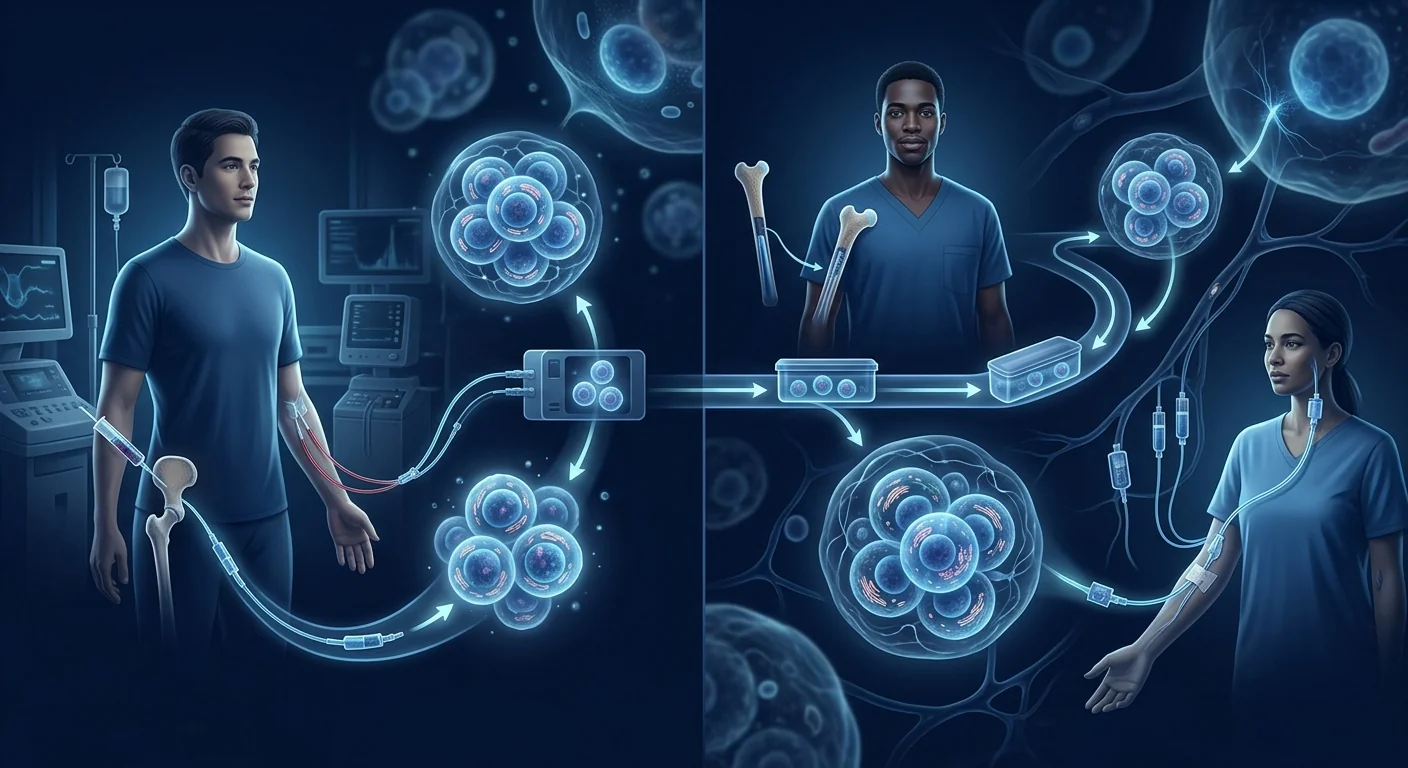
If you read enough about regenerative medicine, two words appear on almost every page: autologous and allogeneic. They sound technical, but the idea behind them is simple. Autologous means the cells come from — and are returned to — the same person. Allogeneic means the cells come from a donor and are given to someone else. That one difference in origin ripples through everything that follows: how the cells are collected, how consistent they are, how quickly they can be ready, and what safety questions matter most. Understanding it is the single most useful thing a patient can learn before evaluating any cell-therapy offer.
What "autologous" means
In an autologous approach, a patient is both the donor and the recipient. Cells are harvested from the person's own body — commonly mesenchymal stem cells (MSCs) drawn from bone marrow or extracted from adipose (fat) tissue — then processed and given back to that same individual. Because the cells are genetically identical to the recipient, the appeal is intuitive and real.[1][2][3][4]
The advantages are meaningful. There is no risk of immune rejection, because the body recognises the cells as its own. There is no possibility of transmitting an infection from a donor. And using a patient's own cells sidesteps some of the regulatory and ethical questions that donor tissue can raise. For many people, "my own cells" is also simply reassuring.
But autologous therapy carries genuine limitations that are easy to overlook. Collecting the cells requires an invasive harvest procedure — a bone-marrow aspiration or a liposuction-style extraction — which is uncomfortable and not risk-free. More importantly, the quantity and quality of a person's own stem cells vary with age and health. Older patients, and those with chronic illness, often have fewer and less potent cells. There is a difficult irony here: the people who most need regenerative support may be exactly those whose own cells are least able to provide it. Autologous cells also cannot be prepared in advance — each batch is made to order — and cell yield and behaviour can differ from one harvest to the next.
What "allogeneic" means
In an allogeneic approach, the cells come from a healthy, screened donor and are given to a different person. A widely used source is umbilical cord tissue — specifically Wharton's jelly, the gel-like connective tissue inside the cord — collected from consenting mothers after normal, healthy births. These are perinatal tissues that would otherwise be discarded, and they are a rich source of young MSCs.
The strengths of the allogeneic model follow from that youth and scale. Donor cells from birth tissue are young, highly proliferative and biologically vigorous, and they do not depend on the age or illness of the person being treated. Because a single donation can be screened, expanded in culture and banked, the same well-characterised cell line can be released as a standardised, "off-the-shelf" dose — ready when needed, with consistent numbers and quality from one patient to the next. The recipient also avoids any harvest procedure entirely, and the model scales in a way that patient-by-patient collection cannot.
The responsibilities are equally clear. Because the cells come from another person, rigorous donor screening and disciplined manufacturing are essential — testing for infectious agents, verifying cell identity and potency, and controlling every step under quality systems. There are also theoretical immune considerations whenever donor cells enter another body. Those considerations, however, are smaller than most people expect — and the reason is worth understanding.
The key science: why MSCs are low-immunogenic
Most cells in the body display molecular "identity tags" called HLA (human leukocyte antigen) markers. The immune system reads these tags to tell self from non-self, which is why organ transplants require careful donor–recipient matching and lifelong immune-suppressing drugs. Mesenchymal stem cells are different. MSCs express relatively low levels of HLA class I and little to no HLA class II (HLA-DR), the markers that most strongly provoke rejection. In practical terms, they are low-immunogenic — they do not wave the flags that normally trigger an immune attack.
On top of that, MSCs are actively immunomodulatory: rather than inflaming the immune system, they tend to calm it, secreting signals that dampen excessive immune activity. This combination — a quiet surface and a calming influence — is precisely why allogeneic MSC therapy is practical and so widely studied. Unlike an organ transplant, allogeneic MSCs generally do not require HLA matching and are usually well tolerated with a low risk of rejection. This is a defining biological feature of MSCs specifically; it should not be assumed for every cell type.
The honest headline
There is no universal "best" between autologous and allogeneic. Each has real strengths and real trade-offs, and the right answer depends on the condition, the cell type, patient factors and — above all — the quality of the cells and the standards behind them. Source quality and manufacturing rigour matter more than the autologous-versus-allogeneic label alone. A poorly controlled process is a concern whichever origin it starts from.
How to think about choosing
Because there is no single right answer, a thoughtful decision weighs several factors together rather than defaulting to one label. Three considerations do most of the work:
- The condition and the cell type. Different applications call for different cells, and what is appropriate for one indication may be a poor fit for another. Some clinical contexts have historically relied on autologous cells; others are built around standardised allogeneic products. The cell type in question — and the evidence behind its use — should lead the decision.
- Patient age and health. Because a person's own stem cell reserves decline with age and chronic illness, autologous potency is highest in younger, healthier people and can be limited precisely when the need is greatest. Allogeneic cells from young donor tissue sidestep this, at the cost of requiring flawless screening and manufacturing.
- Quality control and standards. This is the factor that too often goes unmentioned. Consistent dosing, verified cell identity and potency, sterility, and transparent quality systems separate credible cell therapy from marketing — and they apply no matter where the cells originate.
Where umbilical-cord (Wharton's jelly) MSCs fit
Umbilical-cord MSCs sit firmly on the allogeneic side, and they illustrate why that model has drawn so much interest. Harvested from Wharton's jelly after healthy births, they are young and highly proliferative, and — because they can be screened, expanded and banked — they lend themselves to standardised, quality-controlled batches with consistent dosing. Their low-immunogenic, immunomodulatory nature is what makes off-the-shelf allogeneic use feasible in the first place. This is the approach VELAR works with: ethically sourced, donor-screened cord-tissue MSCs prepared under controlled conditions. None of that makes autologous therapy wrong — in the right context, using a patient's own cells is entirely appropriate. It simply reflects a considered choice for standardisation, availability and consistent cell quality.
The most important question a patient can ask is not "are these my cells or a donor's?" but "how were these cells screened, characterised and made?" Origin is one variable among several; quality is the one that never becomes optional.
— VELAR Clinical Team
The VELAR perspective
At VELAR Center, we think the autologous-versus-allogeneic debate is best met with balance rather than slogans. Both models are legitimate; both have earned their place in different settings; and neither is a shortcut around the harder work of sourcing, screening and manufacturing cells to a consistent standard. Our own practice uses ethically sourced, donor-screened umbilical-cord MSCs — chosen for their youth, standardisation and quality control — but we describe that as a considered trade-off, not a claim of superiority over every alternative. If you want a clear, honest conversation about which approach suits a particular situation, and why, that is exactly where a responsible consultation begins.
References
- Uccelli A, Moretta L, Pistoia V. Mesenchymal stem cells in health and disease. Nature Reviews Immunology. 2008;8(9):726-736. doi:10.1038/nri2395 ↩
- Shi Y, Wang Y, Li Q, et al. Immunoregulatory mechanisms of mesenchymal stem and stromal cells in inflammatory diseases. Nature Reviews Nephrology. 2018;14(8):493-507. doi:10.1038/s41581-018-0023-5 ↩
- Spees JL, Lee RH, Gregory CA. Mechanisms of mesenchymal stem/stromal cell function. Stem Cell Research & Therapy. 2016;7(1):125. doi:10.1186/s13287-016-0363-7 ↩
- Galipeau J, Sensébé L. Mesenchymal stromal cells: clinical challenges and therapeutic opportunities. Cell Stem Cell. 2018;22(6):824-833. doi:10.1016/j.stem.2018.05.004 ↩
- Pittenger MF, Discher DE, Péault BM, Phinney DG, Hare JM, Caplan AI. Mesenchymal stem cell perspective: cell biology to clinical progress. NPJ Regenerative Medicine. 2019;4:22. doi:10.1038/s41536-019-0083-6 ↩
- Caplan AI. Mesenchymal stem cells: time to change the name! Stem Cells Translational Medicine. 2017;6(6):1445-1451. doi:10.1002/sctm.17-0051 ↩
- Dominici M, Le Blanc K, Mueller I, et al. Minimal criteria for defining multipotent mesenchymal stromal cells. Cytotherapy. 2006;8(4):315-317. doi:10.1080/14653240600855905 ↩
- Lalu MM, McIntyre L, Pugliese C, et al. Safety of cell therapy with mesenchymal stromal cells (SafeCell). PLoS One. 2012;7(10):e47559. doi:10.1371/journal.pone.0047559 ↩
- Naji A, Eitoku M, Favier B, Deschaseaux F, Rouas-Freiss N, Suganuma N. Biological functions of mesenchymal stem cells. Cellular and Molecular Life Sciences. 2019;76(17):3323-3348. doi:10.1007/s00018-019-03125-1 ↩
- Bronckaers A, Hilkens P, Martens W, et al. Mesenchymal stem/stromal cells as a pharmacological approach to accelerate angiogenesis. Pharmacology & Therapeutics. 2014;143(2):181-196. doi:10.1016/j.pharmthera.2014.02.013 ↩
- Wang Y, Chen X, Cao W, Shi Y. Plasticity of mesenchymal stem cells in immunomodulation. Nature Immunology. 2014;15(11):1009-1016. doi:10.1038/ni.3002 ↩
- Weiss DJ, Bertoncello I, Borok Z, et al. Stem cells and cell therapies in lung biology and lung diseases. Proceedings of the American Thoracic Society. 2011;8(3):223-272. doi:10.1513/pats.201012-071DW ↩
参考文献
- Uccelli A, Moretta L, Pistoia V. Mesenchymal stem cells in health and disease. Nature Reviews Immunology. 2008;8(9):726-736. doi:10.1038/nri2395 ↩
- Shi Y, Wang Y, Li Q, et al. Immunoregulatory mechanisms of mesenchymal stem and stromal cells in inflammatory diseases. Nature Reviews Nephrology. 2018;14(8):493-507. doi:10.1038/s41581-018-0023-5 ↩
- Spees JL, Lee RH, Gregory CA. Mechanisms of mesenchymal stem/stromal cell function. Stem Cell Research & Therapy. 2016;7(1):125. doi:10.1186/s13287-016-0363-7 ↩
- Galipeau J, Sensébé L. Mesenchymal stromal cells: clinical challenges and therapeutic opportunities. Cell Stem Cell. 2018;22(6):824-833. doi:10.1016/j.stem.2018.05.004 ↩
- Pittenger MF, Discher DE, Péault BM, Phinney DG, Hare JM, Caplan AI. Mesenchymal stem cell perspective: cell biology to clinical progress. NPJ Regenerative Medicine. 2019;4:22. doi:10.1038/s41536-019-0083-6 ↩
- Caplan AI. Mesenchymal stem cells: time to change the name! Stem Cells Translational Medicine. 2017;6(6):1445-1451. doi:10.1002/sctm.17-0051 ↩
- Dominici M, Le Blanc K, Mueller I, et al. Minimal criteria for defining multipotent mesenchymal stromal cells. Cytotherapy. 2006;8(4):315-317. doi:10.1080/14653240600855905 ↩
- Lalu MM, McIntyre L, Pugliese C, et al. Safety of cell therapy with mesenchymal stromal cells (SafeCell). PLoS One. 2012;7(10):e47559. doi:10.1371/journal.pone.0047559 ↩
- Naji A, Eitoku M, Favier B, Deschaseaux F, Rouas-Freiss N, Suganuma N. Biological functions of mesenchymal stem cells. Cellular and Molecular Life Sciences. 2019;76(17):3323-3348. doi:10.1007/s00018-019-03125-1 ↩
- Bronckaers A, Hilkens P, Martens W, et al. Mesenchymal stem/stromal cells as a pharmacological approach to accelerate angiogenesis. Pharmacology & Therapeutics. 2014;143(2):181-196. doi:10.1016/j.pharmthera.2014.02.013 ↩
- Wang Y, Chen X, Cao W, Shi Y. Plasticity of mesenchymal stem cells in immunomodulation. Nature Immunology. 2014;15(11):1009-1016. doi:10.1038/ni.3002 ↩
- Weiss DJ, Bertoncello I, Borok Z, et al. Stem cells and cell therapies in lung biology and lung diseases. Proceedings of the American Thoracic Society. 2011;8(3):223-272. doi:10.1513/pats.201012-071DW ↩
如果你读的再生医学资料够多,两个词几乎会出现在每一页上:自体(autologous)与异体(allogeneic)。它们听起来专业,但背后的概念很简单。自体是指细胞取自同一个人,也回输给这个人。异体是指细胞取自供者,给予另一个人。这一来源上的差别会波及之后的一切:细胞如何采集、有多稳定、多快能备好,以及哪些安全问题最为关键。在评估任何细胞疗法之前,理解这一点是患者能学到的最有用的一件事。
“自体”是什么意思
在自体方式中,患者既是供者也是受者。细胞取自本人的身体——常见的是从骨髓抽取或从脂肪组织提取的间充质干细胞(MSC)——经过处理后回输给这同一个人。由于这些细胞与受者在基因上完全相同,其吸引力既直观又真实。
其优势是实实在在的。不存在免疫排斥的风险,因为身体会将这些细胞识别为自身的。也不可能从供者传播感染。而使用患者自身的细胞,还能规避供者组织可能引发的一些监管与伦理问题。对许多人来说,“我自己的细胞”本身也令人安心。
但自体疗法带有容易被忽视的真实局限。采集细胞需要一次有创的采集操作——骨髓穿刺或类似抽脂的提取——既不舒适,也并非毫无风险。更重要的是,一个人自身干细胞的数量与质量会随年龄和健康状况而变化。年长者以及患有慢性病的人,其细胞往往更少、活力更弱。这里有一个令人为难的反讽:最需要再生支持的人,恰恰可能是自身细胞最无力提供支持的人。自体细胞也无法预先备好——每一批都是按需制备——而且细胞产量与表现可能因每次采集而不同。
“异体”是什么意思
在异体方式中,细胞取自健康、经筛查的供者,给予另一个人。一种广泛使用的来源是脐带组织——具体是华通氏胶(Wharton's jelly),即脐带内部凝胶状的结缔组织——在正常健康分娩后,经知情同意的母亲处采集。这些是本会被丢弃的围产期组织,也是年轻 MSC 的丰富来源。
异体模式的优势正源于这种年轻与规模。来自出生组织的供者细胞年轻、增殖力强、生物活力充沛,且不依赖于受治疗者的年龄或病况。由于单次捐献即可筛查、在培养中扩增并储存起来,同一条充分表征的细胞系便可作为标准化、“随取即用”的剂量放行——需要时即备好,且在不同患者之间数量与质量保持一致。受者也完全免去了采集操作,而这种模式的可扩展性是逐一患者采集所无法比拟的。
其责任同样明确。由于细胞来自他人,严格的供者筛查与规范的制造至关重要——检测感染性病原、验证细胞身份与效力,并在质量体系下控制每一个步骤。每当供者细胞进入另一具身体,也存在理论上的免疫考量。然而,这些考量比大多数人预期的要小——其原因值得了解。
关键科学:为何 MSC 低免疫原性
体内大多数细胞会展示称为 HLA(人类白细胞抗原)标志的分子“身份标签”。免疫系统读取这些标签以区分自我与非我,这也是器官移植需要谨慎的供受者配型和终身免疫抑制药物的原因。间充质干细胞则不同。MSC 表达相对低水平的 HLA I 类,且几乎不表达 HLA II 类(HLA-DR)——而后者正是最强烈激发排斥的标志。就实际而言,它们是低免疫原性的——它们并不挥舞那些通常会触发免疫攻击的旗帜。
此外,MSC 还具有主动的免疫调节作用:它们非但不激化免疫系统,反而倾向于平息它,分泌抑制过度免疫活动的信号。这种组合——安静的表面与平息的影响——正是异体 MSC 疗法之所以可行且被广泛研究的原因。与器官移植不同,异体 MSC 通常不需要 HLA 配型,一般耐受良好,排斥风险低。这是 MSC 所特有的一项决定性生物学特征;不应假定其适用于每一种细胞类型。
诚实的标题
在自体与异体之间,并不存在放之四海的“最佳”。二者各有真实的优势与真实的取舍,正确答案取决于病情、细胞类型、患者因素——以及最重要的,细胞的质量与背后的标准。来源质量与制造的严谨程度,比单单“自体还是异体”的标签更为重要。无论从哪种来源开始,一个失控的流程都令人担忧。
如何思考选择
由于并无唯一正确答案,审慎的决定会将若干因素放在一起权衡,而非默认某一标签。三项考量承担了大部分工作:
- 病情与细胞类型。不同的应用需要不同的细胞,适合某一适应症的未必适合另一种。有些临床情境历来依赖自体细胞;另一些则围绕标准化的异体产品构建。所涉及的细胞类型——及其使用背后的证据——应当主导决定。
- 患者的年龄与健康。由于一个人自身的干细胞储备会随年龄与慢性病而下降,自体效力在更年轻、更健康的人身上最高,而恰恰在最需要时可能受限。来自年轻供者组织的异体细胞规避了这一点,代价是需要无懈可击的筛查与制造。
- 质量控制与标准。这正是常被略去不谈的因素。稳定的剂量、经验证的细胞身份与效力、无菌性,以及透明的质量体系,将可信的细胞疗法与营销区分开来——而无论细胞源自何处,这些都同样适用。
脐带(华通氏胶)MSC 的位置
脐带 MSC 稳稳地站在异体一侧,也说明了这一模式为何引起如此多的关注。它们在健康分娩后自华通氏胶采集,年轻且增殖力强,并且——因为可被筛查、扩增与储存——适合制成标准化、质控良好、剂量一致的批次。其低免疫原性、免疫调节的特性,正是使随取即用的异体使用从一开始便可行的原因。这也是 VELAR 所采用的方式:符合伦理来源、经供者筛查、在受控条件下制备的脐带组织 MSC。这一切并不意味着自体疗法有错——在恰当的情境下,使用患者自身的细胞完全适宜。它只是反映了对标准化、可获得性与稳定细胞质量的一种深思熟虑的选择。
患者能问的最重要的问题,不是“这些是我的细胞还是供者的?”,而是“这些细胞是如何被筛查、表征与制造的?”来源只是众多变量之一;质量才是那个永远不能成为可选项的因素。
— VELAR 临床团队
VELAR 的观点
在 VELAR 中心,我们认为面对自体与异体之争,最好以平衡而非口号来回应。两种模式都是正当的;二者都在不同情境中赢得了自己的位置;而无论哪一种,都无法绕开将细胞制备至稳定标准这一更艰苦的工作——采集、筛查与制造。我们自己的实践采用符合伦理来源、经供者筛查的脐带 MSC——因其年轻、标准化与质量控制而选择——但我们将其描述为一种深思熟虑的取舍,而非声称优于所有替代方案。如果你想就哪种方式适合某一具体情况、以及为什么,进行一次清晰而诚实的对话,那正是负责任咨询的起点。
المراجع
- Uccelli A, Moretta L, Pistoia V. Mesenchymal stem cells in health and disease. Nature Reviews Immunology. 2008;8(9):726-736. doi:10.1038/nri2395 ↩
- Shi Y, Wang Y, Li Q, et al. Immunoregulatory mechanisms of mesenchymal stem and stromal cells in inflammatory diseases. Nature Reviews Nephrology. 2018;14(8):493-507. doi:10.1038/s41581-018-0023-5 ↩
- Spees JL, Lee RH, Gregory CA. Mechanisms of mesenchymal stem/stromal cell function. Stem Cell Research & Therapy. 2016;7(1):125. doi:10.1186/s13287-016-0363-7 ↩
- Galipeau J, Sensébé L. Mesenchymal stromal cells: clinical challenges and therapeutic opportunities. Cell Stem Cell. 2018;22(6):824-833. doi:10.1016/j.stem.2018.05.004 ↩
- Pittenger MF, Discher DE, Péault BM, Phinney DG, Hare JM, Caplan AI. Mesenchymal stem cell perspective: cell biology to clinical progress. NPJ Regenerative Medicine. 2019;4:22. doi:10.1038/s41536-019-0083-6 ↩
- Caplan AI. Mesenchymal stem cells: time to change the name! Stem Cells Translational Medicine. 2017;6(6):1445-1451. doi:10.1002/sctm.17-0051 ↩
- Dominici M, Le Blanc K, Mueller I, et al. Minimal criteria for defining multipotent mesenchymal stromal cells. Cytotherapy. 2006;8(4):315-317. doi:10.1080/14653240600855905 ↩
- Lalu MM, McIntyre L, Pugliese C, et al. Safety of cell therapy with mesenchymal stromal cells (SafeCell). PLoS One. 2012;7(10):e47559. doi:10.1371/journal.pone.0047559 ↩
- Naji A, Eitoku M, Favier B, Deschaseaux F, Rouas-Freiss N, Suganuma N. Biological functions of mesenchymal stem cells. Cellular and Molecular Life Sciences. 2019;76(17):3323-3348. doi:10.1007/s00018-019-03125-1 ↩
- Bronckaers A, Hilkens P, Martens W, et al. Mesenchymal stem/stromal cells as a pharmacological approach to accelerate angiogenesis. Pharmacology & Therapeutics. 2014;143(2):181-196. doi:10.1016/j.pharmthera.2014.02.013 ↩
- Wang Y, Chen X, Cao W, Shi Y. Plasticity of mesenchymal stem cells in immunomodulation. Nature Immunology. 2014;15(11):1009-1016. doi:10.1038/ni.3002 ↩
- Weiss DJ, Bertoncello I, Borok Z, et al. Stem cells and cell therapies in lung biology and lung diseases. Proceedings of the American Thoracic Society. 2011;8(3):223-272. doi:10.1513/pats.201012-071DW ↩
إذا قرأت ما يكفي عن الطب التجديدي، ستظهر كلمتان في كل صفحة تقريباً: ذاتي (autologous) وخيفي/غيري (allogeneic). تبدوان تقنيّتين، لكن الفكرة وراءهما بسيطة. الذاتي يعني أن الخلايا تُؤخذ من الشخص نفسه وتُعاد إليه. والخيفي يعني أن الخلايا تُؤخذ من متبرّع وتُعطى لشخص آخر. وهذا الفارق الوحيد في المنشأ ينعكس على كل ما يليه: كيف تُجمع الخلايا، ومدى ثباتها، وكم تستغرق حتى تصبح جاهزة، وأي أسئلة الأمان أكثر أهمية. وفهم ذلك هو أنفع ما يمكن أن يتعلّمه المريض قبل تقييم أي عرض للعلاج الخلوي.
ماذا يعني «الذاتي»
في النهج الذاتي، يكون المريض متبرّعاً ومتلقّياً في آنٍ واحد. تُجمع الخلايا من جسم الشخص نفسه — وغالباً خلايا جذعية وسيطة (MSCs) تُسحب من نخاع العظم أو تُستخرج من النسيج الدهني — ثم تُعالَج وتُعاد إلى الفرد نفسه. ولأن الخلايا مطابقة وراثياً للمتلقّي، فإن الجاذبية بديهية وحقيقية.
المزايا ملموسة. فلا خطر رفض مناعي، لأن الجسم يتعرّف على الخلايا بوصفها خلاياه. ولا إمكانية لنقل عدوى من متبرّع. واستخدام خلايا المريض نفسه يتجاوز بعض الأسئلة التنظيمية والأخلاقية التي قد يثيرها نسيج المتبرّع. وبالنسبة لكثيرين، فإن «خلاياي أنا» أمر مطمئن ببساطة.
لكن العلاج الذاتي يحمل قيوداً حقيقية يسهل إغفالها. فجمع الخلايا يتطلب إجراء حصاد باضِعاً — رشف نخاع العظم أو استخراجاً شبيهاً بشفط الدهون — وهو غير مريح وليس خالياً من المخاطر. والأهم أن كمية الخلايا الجذعية للشخص نفسه ونوعيتها تتغيّران مع العمر والصحة. فكثيراً ما يكون لدى كبار السن ومن يعانون أمراضاً مزمنة خلايا أقل عدداً وأضعف فاعلية. وهنا مفارقة عسيرة: قد يكون أكثر الناس حاجةً إلى الدعم التجديدي هم بالضبط من تكون خلاياهم الذاتية أعجز عن توفيره. كما لا يمكن تحضير الخلايا الذاتية مسبقاً — إذ تُصنع كل دفعة عند الطلب — وقد يختلف مردود الخلايا وسلوكها من حصاد إلى آخر.
ماذا يعني «الخيفي»
في النهج الخيفي، تأتي الخلايا من متبرّع سليم مفحوص وتُعطى لشخص مختلف. ومن المصادر الواسعة الاستخدام نسيج الحبل السري — وتحديداً هلام وارتون (Wharton's jelly)، النسيج الضام الهلامي داخل الحبل — الذي يُجمع من أمهاتٍ موافِقات بعد ولاداتٍ طبيعية سليمة. وهذه أنسجة محيطة بالولادة كانت ستُطرح لولا ذلك، وهي مصدر غني بخلايا MSC اليافعة.
وتنبع قوة النموذج الخيفي من هذا الفتوّ وهذه القابلية للتوسّع. فخلايا المتبرّع من نسيج الولادة يافعة وعالية التكاثر ونشطة بيولوجياً، ولا تعتمد على عمر من يُعالَج أو مرضه. ولأن التبرّع الواحد يمكن فحصه وتوسيعه في المزرعة وتخزينه، فإن السلالة الخلوية نفسها جيدة التوصيف يمكن إطلاقها كجرعة موحّدة «جاهزة للاستعمال» — متاحة عند الحاجة، بأعداد ونوعية ثابتة من مريض إلى آخر. كما يتجنّب المتلقّي أي إجراء حصاد كلياً، ويتوسّع النموذج على نحوٍ يعجز عنه الجمع مريضاً مريضاً.
والمسؤوليات واضحة بالقدر نفسه. فلأن الخلايا تأتي من شخص آخر، فإن الفحص الصارم للمتبرّع والتصنيع المنضبط أمران ضروريان — اختبار العوامل المُعدية، والتحقق من هوية الخلايا وفاعليتها، وضبط كل خطوة ضمن أنظمة الجودة. وثمة أيضاً اعتبارات مناعية نظرية كلما دخلت خلايا متبرّع جسماً آخر. غير أن هذه الاعتبارات أصغر مما يتوقعه معظم الناس — والسبب جدير بالفهم.
العلم الأساس: لماذا خلايا MSC منخفضة المناعية
تعرض معظم خلايا الجسم «بطاقات هوية» جزيئية تُسمى مؤشرات HLA (مستضدّات الكريّات البيض البشرية). ويقرأ الجهاز المناعي هذه البطاقات ليميّز الذات عن غير الذات، ولهذا تتطلب زراعة الأعضاء مطابقةً دقيقة بين المتبرّع والمتلقّي وأدويةً كابتة للمناعة مدى الحياة. أما الخلايا الجذعية الوسيطة فمختلفة. فهي تعبّر عن مستويات منخفضة من HLA من الصنف الأول، وقليل جداً أو لا شيء من الصنف الثاني (HLA-DR) — وهي المؤشرات الأشد استفزازاً للرفض. وعملياً، فهي منخفضة المناعية — لا ترفع الرايات التي تُطلق عادةً هجوماً مناعياً.
وفوق ذلك، فإن MSC مُعدِّلة للمناعة بفاعلية: فبدل أن تلهب الجهاز المناعي، تميل إلى تهدئته، مُفرزةً إشارات تُخمِد النشاط المناعي المفرط. وهذا المزيج — سطح هادئ وتأثير مهدّئ — هو بالضبط ما يجعل العلاج الخيفي بخلايا MSC عملياً ومدروساً على نطاق واسع. فبخلاف زراعة الأعضاء، لا تتطلب خلايا MSC الخيفية عموماً مطابقة HLA، وتكون عادةً جيدة التحمّل بخطر رفض منخفض. وهذه سمة بيولوجية مميّزة لخلايا MSC تحديداً؛ ولا ينبغي افتراضها لكل نوع من الخلايا.
العنوان الصادق
لا يوجد «أفضل» شامل بين الذاتي والخيفي. فلكلٍّ نقاط قوة حقيقية ومقايضات حقيقية، والجواب الصحيح يتوقف على الحالة، ونوع الخلايا، وعوامل المريض — وقبل كل شيء، جودة الخلايا والمعايير التي وراءها. جودة المصدر وصرامة التصنيع أهم من مجرّد تسمية «ذاتي مقابل خيفي». فالعملية سيئة الضبط مبعث قلق أياً كان المنشأ الذي تبدأ منه.
كيف تفكّر في الاختيار
لأنه لا جواب وحيداً صحيحاً، فإن القرار المتأنّي يوازن بين عدة عوامل معاً بدل الركون إلى تسمية واحدة. وثلاثة اعتبارات تؤدي معظم العمل:
- الحالة ونوع الخلايا. تستدعي التطبيقات المختلفة خلايا مختلفة، وما يناسب استطباباً قد يكون غير ملائم لآخر. فبعض السياقات السريرية اعتمدت تاريخياً على الخلايا الذاتية؛ وأخرى بُنيت حول منتجات خيفية موحّدة. ونوع الخلايا المعني — والأدلة وراء استخدامه — ينبغي أن يقود القرار.
- عمر المريض وصحته. لأن مخزون الشخص من خلاياه الجذعية يتراجع مع العمر والمرض المزمن، تكون الفاعلية الذاتية أعلى لدى الأصغر سناً والأوفر صحة، وقد تكون محدودة تحديداً حين تشتد الحاجة. أما الخلايا الخيفية من نسيج متبرّع يافع فتتجاوز ذلك، مقابل اشتراط فحص وتصنيع لا تشوبهما شائبة.
- ضبط الجودة والمعايير. هذا هو العامل الذي كثيراً ما يُغفل ذكره. فالجرعة الثابتة، وهوية الخلايا وفاعليتها المُتحقَّق منهما، والتعقيم، وأنظمة الجودة الشفافة، هي ما يفصل العلاج الخلوي الموثوق عن التسويق — وهي تنطبق أياً كان منشأ الخلايا.
أين تقع خلايا الحبل السري (هلام وارتون)
تقع خلايا الحبل السري بثبات في الجانب الخيفي، وهي تجسّد لماذا استقطب هذا النموذج هذا القدر من الاهتمام. فهي تُجمع من هلام وارتون بعد ولاداتٍ سليمة، يافعة وعالية التكاثر، ولأنها قابلة للفحص والتوسيع والتخزين، فإنها تصلح لدفعات موحّدة مضبوطة الجودة بجرعات ثابتة. وطبيعتها المنخفضة المناعية والمعدِّلة للمناعة هي ما يجعل الاستخدام الخيفي الجاهز ممكناً أصلاً. وهذا هو النهج الذي تعمل به VELAR: خلايا MSC من نسيج الحبل، ذات مصدر أخلاقي ومفحوصة من المتبرّع، مُحضَّرة في ظروف مضبوطة. ولا شيء من ذلك يجعل العلاج الذاتي خاطئاً — ففي السياق المناسب، يكون استخدام خلايا المريض نفسه ملائماً تماماً. إنه ببساطة يعكس خياراً مدروساً للتوحيد والإتاحة وثبات جودة الخلايا.
أهم سؤال يمكن أن يطرحه المريض ليس «أهذه خلاياي أم خلايا متبرّع؟» بل «كيف فُحصت هذه الخلايا ووُصِّفت وصُنِّعت؟» فالمنشأ متغيّر واحد بين عدة متغيّرات؛ أما الجودة فهي المتغيّر الذي لا يصبح اختيارياً أبداً.
— الفريق السريري في VELAR
منظور VELAR
في مركز VELAR، نرى أن جدل الذاتي مقابل الخيفي يُواجَه على أفضل وجه بالتوازن لا بالشعارات. فكلا النموذجين مشروع؛ وكلاهما اكتسب موضعه في سياقات مختلفة؛ ولا أحد منهما اختصار يلتفّ حول العمل الأصعب المتمثل في تدبير الخلايا وفحصها وتصنيعها وفق معيار ثابت. وممارستنا نفسها تستخدم خلايا MSC من الحبل السري، ذات مصدر أخلاقي ومفحوصة من المتبرّع — اختيرت لفتوّها وتوحيدها وضبط جودتها — لكننا نصف ذلك بوصفه مقايضة مدروسة، لا ادعاءً بالتفوّق على كل بديل. وإذا أردت حواراً واضحاً وصادقاً عن أي نهج يناسب حالة بعينها، ولماذا، فهذا تحديداً حيث تبدأ الاستشارة المسؤولة.