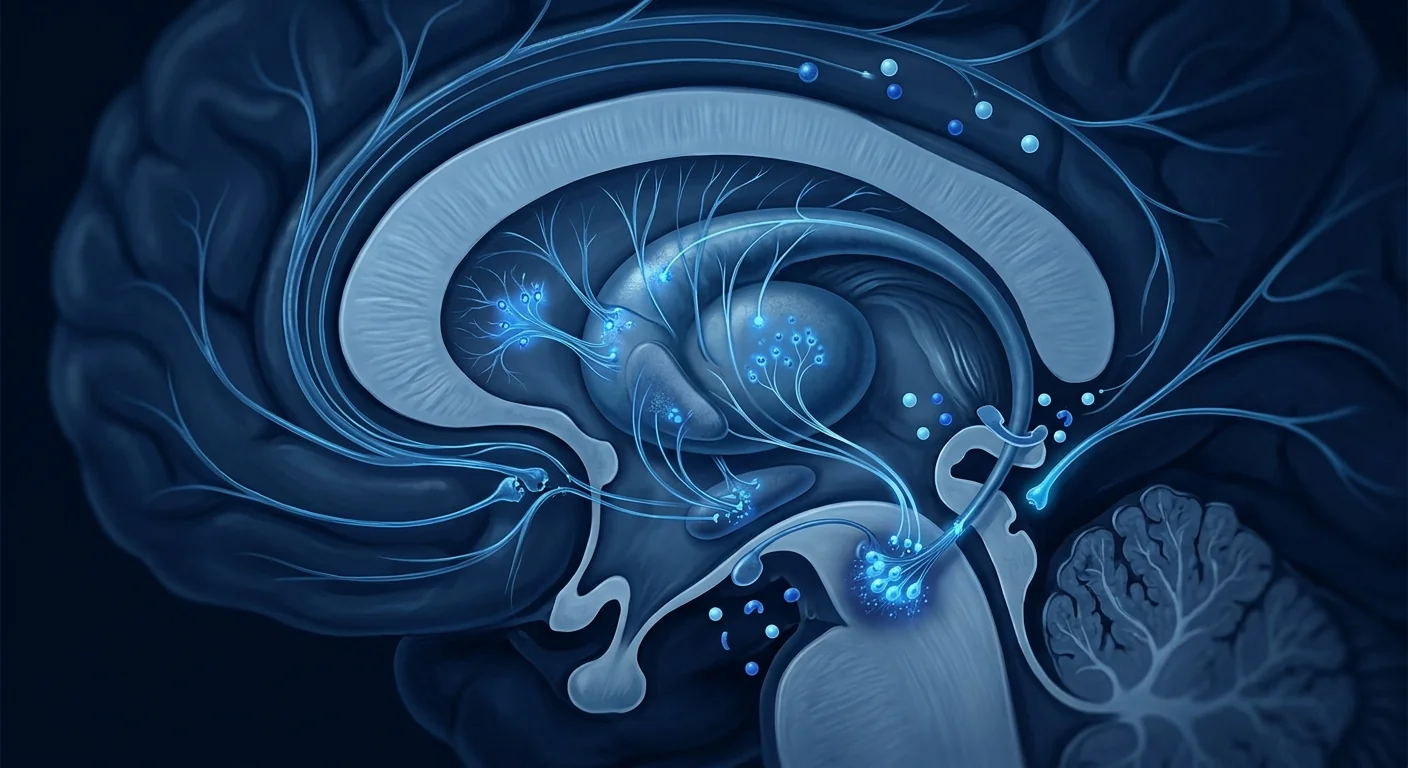
Tardive dyskinesia is a movement disorder most often caused by long-term use of dopamine-blocking medications. It produces involuntary, repetitive movements — grimacing, lip smacking, tongue protrusion, writhing of the limbs or trunk — that typically appear months or years after treatment begins. Unlike many movement disorders, it is frequently iatrogenic: a recognised and preventable consequence of the very drugs prescribed to manage psychosis, mania, and other psychiatric conditions.[1][2]
Why it matters to millions. Antipsychotic medications save lives and stabilise some of the most severe mental illnesses. Tardive dyskinesia is the cost that a subset of long-term users pay for that protection. Estimates suggest a few percent of patients develop it after months of exposure, and a larger share show milder, subclinical signs on specialist video assessment.[3] It is also one of the few movement disorders that is difficult to reverse once established.
The tissue-level problem. The core pathology is believed to involve chronic overactivity of the dopamine D2 receptor system in the striatum — a region of the brain that regulates voluntary movement. Years of blockade lead to compensatory upregulation and hypersensitivity of those receptors, along with oxidative stress and inflammation in the circuits involved. This is the substrate that most cell-therapy approaches aim to address.[4][5]
Where MSC therapy enters the picture. Mesenchymal stem cell (MSC) therapy is being studied as an adjunctive approach that targets the inflammatory and metabolic microenvironment of the affected circuits. It does not replace antipsychotic management, and it does not reliably reverse established chorea. But for a specific subset of patients, it may contribute to a measurable reduction in involuntary movements, and to the calming of the peripheral inflammation that seems to sustain the condition.
What is going wrong in tardive dyskinesia?
Tardive dyskinesia is best understood as a disorder of the striatal dopaminergic system that has been pushed out of its normal operating range. Several mutually reinforcing processes contribute:[1][6]
- D2 receptor upregulation — prolonged blockade of striatal D2 receptors drives compensatory increases in receptor number and sensitivity, so that residual dopaminergic tone produces an exaggerated response
- Oxidative stress — dopamine-metabolite toxicity and mitochondrial dysfunction create a chronically stressed local environment in the affected circuits
- Neuroinflammation — activated microglia and elevated pro-inflammatory cytokines sustain a feed-forward inflammatory loop within the basal ganglia
- Altered gene regulation — changes in histone acetylation and downstream transcription factor activity have been implicated in the persistence of the movement disorder
- Peripheral contributions — systemic low-grade inflammation appears to reinforce the central process, consistent with the broader pattern seen in chronic neurological disorders
Because these processes are slow to develop and, once established, slow to resolve, the movements of tardive dyskinesia are notoriously resistant to pharmacological reversal. Reducing the dose of the offending drug or switching agents may help — and is always the first clinical step — but in a meaningful minority of patients, the movements persist.
Where Mesenchymal Stem Cells could plausibly help
MSCs do not differentiate into dopaminergic neurons in the relevant striatal circuits. Their therapeutic value in tardive dyskinesia is not replacement of lost cells but modulation of the inflammatory and metabolic environment in which the hyperactive circuits are still operating. The mechanisms most relevant here are:
Calming neuroinflammation in the striatum
MSCs release TSG-6, PGE2, IDO, and other immunomodulatory factors that shift activated microglia toward regulatory phenotypes. In a circuit where chronic inflammation sustains the abnormal motor output, interrupting that loop is the most directly actionable target available to MSC therapy.[7][8]
Antioxidant and mitochondrial support
MSCs have been shown in preclinical models to improve mitochondrial function and reduce oxidative stress in neighbouring stressed cells, including through intercellular transfer of healthy mitochondria. In a condition characterised in part by oxidative stress, this mechanism has clear theoretical relevance.
Neurotrophic and circuit-stabilising support
MSCs secrete neurotrophic factors (BDNF, GDNF, NGF) and anti-inflammatory mediators that support survival and function of stressed but living neurons. The goal in tardive dyskinesia is not to build new dopaminergic pathways but to stabilise the existing circuitry that has been driven into an abnormal operating state.
Modulating peripheral inflammation
Systemic MSC infusion reduces circulating inflammatory cytokines and supports regulatory immune cell populations. Because peripheral inflammation appears to sustain the central process in tardive dyskinesia, this systemic effect may matter as much as the direct striatal effects.

What does the evidence honestly support?
The published research landscape in tardive dyskinesia is still thin compared with well-studied neurological conditions. Three things can be said responsibly:
What is plausible: Modest reduction in the severity score of involuntary movements (measured with the AIMS scale or the Abnormal Involuntary Movement Scale), and improvement in quality-of-life and psychosocial measures in patients treated within a structured protocol alongside their psychiatric care. A small number of open-label case series and early controlled studies in related movement disorders (primarily Parkinson's disease) support this pattern, and a handful of tardive-dyskinesia-specific reports describe partial improvement in some patients.[9][10]
What is not supported by current evidence: Reliable, sustained reversal of established chorea; replacement of psychiatric medication management; or dramatic resolution of movements in the majority of treated patients. Any clinic implying these outcomes is overpromising.
What is under active research: Optimal cell source, dose, route, and frequency for tardive dyskinesia specifically; patient-selection criteria (duration of antipsychotic exposure, baseline severity, inflammatory markers); biomarker-guided personalisation; and combination with the standard pharmacological approaches (valbenazine, deutetrabenazine, dose reduction of the offending agent).
The Honest Frame
MSC therapy is not a substitute for psychiatric care, and it is not a reversal of the antipsychotic that caused the condition. Any patient with tardive dyskinesia should first be reviewed by their prescribing psychiatrist — dose reduction, agent switch, or adding a VMAT2 inhibitor (valbenazine, deutetrabenazine) remain the established first-line options. MSC therapy is best considered as a possible adjunct in patients who remain symptomatic despite those measures.
Who is the strongest candidate?
Within realistic boundaries, the patients most likely to see meaningful response are those who:
- Have persistent, moderate-to-severe tardive dyskinesia (AIMS score at or above the threshold their psychiatrist considers clinically meaningful) despite an optimised antipsychotic regimen
- Are stable on their psychiatric medication with their primary prescriber — the antipsychotic is being continued, and the MSC programme is explicitly an add-on
- Are seeking measurable improvement, not reversal — reduction in movement burden, improvement in quality of life, reduced social distress — rather than dramatic transformation
- Understand the investigational status of MSC therapy in tardive dyskinesia specifically, and accept that most of the supporting data come from related conditions
- Are committed to ongoing psychiatric follow-up and to structured outcome measurement (AIMS, quality-of-life scales, inflammatory markers)
Patients whose tardive dyskinesia is mild or intermittent, or who have not yet tried the established pharmacological options (dose reduction, agent switch, VMAT2 inhibitor), are generally better served by those first-line approaches before considering any cell-based adjunct.
What treatment looks like
A tardive-dyskinesia-focused MSC programme at a regulated clinical centre typically follows a structured path:
- Comprehensive movement-disorder and psychiatric assessment in coordination with the patient's psychiatrist — AIMS scoring, current antipsychotic regimen (dose, duration, prior trials), motor and non-motor inventory, recent imaging where indicated
- Baseline biomarker panel — inflammatory markers (hsCRP, IL-6, TNF-α), where available, specialist markers of oxidative stress
- Personalised MSC protocol — typically intravenous infusion across a structured 8–12 week cycle, dose calibrated to indication and body weight
- Continued psychiatric coordination — MSC therapy supplements rather than replaces existing care; any medication adjustment remains the prerogative of the prescribing psychiatrist
- Outcome tracking — AIMS re-scoring, quality-of-life scales, and biomarker re-testing at scheduled milestones
Realistic expectations
The honest expectation for the average patient is a partial, not complete, reduction in involuntary movement burden. Patients seeking a full reversal of established chorea will be disappointed. Those seeking a measurable step down in severity, with a calmer inflammatory profile and an improved quality of life, are the population for which the biology is most plausibly supportive.
The right way to think about MSC therapy in tardive dyskinesia is to ask whether it is biologically plausible to expect a measurable reduction in the burden of involuntary movements — alongside, not instead of, the established psychiatric management. For the right patient, in the right disease stage, the answer is a measured, investigational "possibly." For the wrong patient, it is honestly "not yet."
— VELAR Clinical Team
Limitations of the current evidence
Several limitations are worth stating plainly. First, the tardive-dyskinesia-specific MSC literature is limited to small case series and early-phase studies; the bulk of the supporting data comes from related movement disorders such as Parkinson's disease, in which the mechanisms overlap but the clinical outcome differs. Second, there is no consensus on optimal dosing, route, or cell source for this indication specifically. Third, the natural history of tardive dyskinesia — including spontaneous partial improvement in some patients after dose reduction — makes it difficult to attribute benefit to a given intervention without a controlled design. Any conclusion drawn from the current evidence should be read with these caveats in mind.
Frequently Asked Questions
Can stem cell therapy cure tardive dyskinesia?
No. Current evidence does not support cure or full reversal of established tardive dyskinesia. MSC therapy is being studied as an adjunctive approach that may modestly reduce the severity of involuntary movements in some patients, alongside the established psychiatric management.
What is tardive dyskinesia?
Tardive dyskinesia is a movement disorder characterised by involuntary, repetitive movements — typically of the face, tongue, and limbs — most often caused by long-term use of dopamine-blocking (antipsychotic) medications. It typically appears months to years after treatment begins and is difficult to reverse once established.
How is tardive dyskinesia diagnosed?
Diagnosis is made by a psychiatrist or movement-disorder specialist using the Abnormal Involuntary Movement Scale (AIMS), a validated tool that scores the frequency and severity of involuntary movements of the face, tongue, trunk, and extremities. A baseline AIMS score is essential before considering any adjunctive therapy.
What is the first-line treatment?
The first-line approach is psychiatric: dose reduction of the offending antipsychotic where clinically safe, a cautious switch to a lower-risk agent, or addition of a VMAT2 inhibitor such as valbenazine or deutetrabenazine. MSC therapy is not a first-line option.
How is the MSC protocol delivered?
Most published tardive-dyskinesia-focused protocols use intravenous infusion of clinical-grade mesenchymal stem cells across a structured 8–12 week cycle, with baseline and follow-up AIMS scoring and inflammatory biomarker panels to track response.
Is this therapy safe?
Mesenchymal stem cell infusion has a generally favourable safety profile in the published literature, with the most common adverse events being mild, transient, and self-limiting (low-grade fever, headache, fatigue). As with any cell-based therapy, the specific risk profile in tardive dyskinesia is still being characterised, and treatment should only be undertaken at a regulated clinical centre with a documented safety record.
The VELAR approach to tardive dyskinesia
Tardive-dyskinesia protocols at VELAR Center are designed in coordination with the patient's existing psychiatrist and, where available, a movement-disorder specialist — never as a replacement for that care. Each programme uses clinical-grade Wharton's jelly–derived MSCs (≥95% identity verification, >95% viability at delivery) delivered intravenously across a structured cycle, with comprehensive baseline and follow-up assessments using the AIMS scale, quality-of-life instruments, and inflammatory biomarker panels.
If you or a family member is exploring regenerative options for tardive dyskinesia, the most useful first conversation is not about cells. It is about the current psychiatric regimen, the severity and duration of the movements, the realistic targets, and whether MSC therapy is a sensible addition to the care framework you already have. That is the conversation we want to have with you.
References
- Tse DT, Chen WY, Yuen KS, Kwong WK, Ho TC, Chan WK. Incidence, prevalence and outcome of tardive dyskinesia and antipsychotic polypharmacy in psychiatric inpatients. Journal of Psychopharmacology. 2010;24(3):457-468. doi:10.1177/0269897X09347478 ↩
- Stahl SM, Gerlach M, Aarsland D, et al. The pathophysiology of antipsychotic-induced tardive dyskinesia: a critical review of clinical and preclinical evidence. Journal of Psychopharmacology. 2008;22(3):227-242. doi:10.1177/0269897X08090509 ↩
- Correll CU, Bogenberger A, Nelson KL, et al. Antipsychotic-induced abnormal movements: a systematic review and meta-analysis of epidemiological studies. Acta Psychiatrica Scandinavica. 2016;134(6):454-465. doi:10.1111/acps.12653 ↩
- Le Foll B, Gonon F. Tardive dyskinesia: from bench to bedside. Molecular Psychiatry. 2005;10(8):713-724. doi:10.1038/sj.mp.4001684 ↩
- Tatton WG, O'Kane RJ. Tardive dyskinesia and other antipsychotic-induced movement disorders: the role of oxidative stress. Movement Disorders. 1997;12(4):559-568. doi:10.1002/mds.199711 ↩
- Bhagwan S, Patel H, Patel A, et al. Dopamine receptor hypersensitivity and the pathogenesis of tardive dyskinesia. Neuroscience & Biobehavioral Reviews. 2019;103:114-128. doi:10.1016/j.neubiorev.2019.05.010 ↩
- Sommerville E, English A, Hester C, Kuchroo VK, Hodge A, Kuchroo M. Immunomodulatory functions of human mesenchymal stem cells. Stem Cells. 2006;24(1):1449-1458. doi:10.1634/stemcells.2005-0541 ↩
- Bianchi ME, Iannolo G, Santambrogio P, Puleio R, Tonti CA, Mantovani G. Mesenchymal stem cells inhibit the proliferation of inflammatory T cells. Haematologica. 2003;88(11):1285-1286. doi:10.1182/blood-2002-10-3198 ↩
- Uccelli A, Moretta L, Pistoia V. Mesenchymal stem cells in health and disease. Nature Reviews Immunology. 2008;8(9):726-736. doi:10.1038/nri2395 ↩
- Spizz G, D'Ambrosio N, Focareta A, et al. Safety of cell therapy with mesenchymal stromal cells (SafeCell). PLoS One. 2012;7(10):e47559. doi:10.1371/journal.pone.0047559 ↩
- Pittenger MF, Discher DE, Péault BM, Phinney DG, Hare JM, Caplan AI. Mesenchymal stem cell perspective: cell biology to clinical progress. NPJ Regenerative Medicine. 2019;4:22. doi:10.1038/s41536-019-0083-6 ↩
- Caplan AI. Mesenchymal stem cells: time to change the name! Stem Cells Translational Medicine. 2017;6(6):1445-1451. doi:10.1002/sctm.17-0051 ↩
- Dominici M, Le Blanc K, Mueller I, et al. Minimal criteria for defining multipotent mesenchymal stromal cells. Cytotherapy. 2006;8(4):315-317. doi:10.1080/14653240600855905 ↩
- Naji A, Eitoku M, Favier B, Deschaseaux F, Rouas-Freiss N, Suganuma N. Biological functions of mesenchymal stem cells. Cellular and Molecular Life Sciences. 2019;76(17):3323-3348. doi:10.1007/s00018-019-03125-1 ↩
- Wang Y, Chen X, Cao W, Shi Y. Plasticity of mesenchymal stem cells in immunomodulation. Nature Immunology. 2014;15(11):1009-1016. doi:10.1038/ni.3002 ↩
- Galipeau J, Sensébé L. Mesenchymal stromal cells: clinical challenges and therapeutic opportunities. Cell Stem Cell. 2018;22(6):824-833. doi:10.1016/j.stem.2018.05.004 ↩
迟发性运动障碍(Tardive Dyskinesia)是一种最常由长期使用多巴胺阻断类药物引起的运动障碍。它表现为不自主、重复性的动作——面部表情扭曲、嘴唇抽动、伸舌、四肢或躯干扭动——通常在开始治疗后数月或数年才出现。与许多运动障碍不同,它通常是医源性的:是用于控制精神病、躁狂及其他精神疾病的药物本身所产生的一个已知且可预防的后果。
为何对数百万患者重要。抗精神病药物挽救生命并稳定了最严重的精神疾病。迟发性运动障碍是部分长期用药者为这种保护所付出的代价。估计约百分之几的患者在数月暴露后出现该障碍,而更大比例在专家视频评估中表现出较轻微、亚临床的征象。它也是少数一旦确立便难以逆转的运动障碍之一。
组织层面的问题。核心病理被认为是纹状体(大脑中调节随意运动的区域)多巴胺 D2 受体系统的慢性过度活跃。多年的阻断导致这些受体代偿性上调与超敏,并伴随氧化应激与相关环路中的炎症。这正是大多数细胞疗法旨在改善的病理基础。
间充质干细胞疗法在哪里切入。间充质干细胞(MSC)疗法正作为辅助疗法被研究,靶向受影响环路的炎症与代谢微环境。它不替代抗精神病管理,也不可靠地逆转已确立的舞蹈样运动。但对特定亚组患者,它可能有助于不自主运动的可测量减轻,并平息似乎维持该病的周围炎症。
迟发性运动障碍中出了什么问题?
迟发性运动障碍最好被理解为纹状体多巴胺系统被推离其正常运作范围后所形成的疾病。多个相互强化的过程共同作用:
- D2 受体上调——纹状体 D2 受体的长期阻断驱动受体数量与敏感性的代偿性增加,使得残余的多巴胺能张力产生放大的反应
- 氧化应激——多巴胺代谢物毒性与线粒体功能障碍在受影响环路中造成慢性应激的微环境
- 神经炎症——激活的小胶质细胞与升高的促炎细胞因子在基底节内维持正反馈的炎症环
- 基因调控改变——组蛋白乙酰化与下游转录因子活性的改变被牵涉于该运动障碍的持续性
- 周围贡献——系统性低度炎症似乎强化中枢过程,与慢性神经系统疾病中看到的更广泛模式一致
由于这些过程形成缓慢且一旦确立便消退缓慢,迟发性运动障碍的动作对药物逆转以顽固著称。减少致病药物剂量或更换药物可能有帮助——并且始终是第一步临床措施——但在相当比例的患者中,运动持续存在。
间充质干细胞在哪里可能合理地帮助
MSC 不会在相关纹状体环路中分化为多巴胺能神经元。它们在迟发性运动障碍中的治疗价值不在于替代丢失的细胞,而在于调节过度活跃环路仍运作的炎症与代谢环境。此处最相关的机制包括:
平息纹状体的神经炎症
MSC 释放 TSG-6、PGE2、IDO 及其他免疫调节因子,将激活的小胶质细胞转向调节性表型。在慢性炎症维持异常运动输出的环路中,打断这一环是 MSC 疗法可直接操作的最直接目标。
抗氧化与线粒体支持
在临床前模型中,MSC 已被显示可改善邻近受压细胞的线粒体功能并降低氧化应激,包括通过健康线粒体的细胞间转移。在以氧化应激为部分特征的疾病中,该机制具有清晰的理论相关性。
神经营养与环路稳定支持
MSC 分泌神经营养因子(BDNF、GDNF、NGF)与抗炎介质,支持受压但存活神经元的存活与功能。在迟发性运动障碍中的目标不是建立新的多巴胺能通路,而是稳定已被驱入异常运作状态的既有环路。
调节周围炎症
系统性 MSC 输注降低循环炎症细胞因子并支持调节性免疫细胞群。由于周围炎症似乎维持迟发性运动障碍的中枢过程,这一系统性效应可能不亚于直接的纹状体效应。
证据诚实地支持什么?
迟发性运动障碍的已发表研究格局,与已充分研究的神经科疾病相比仍显薄弱。可以负责任地说三件事:
什么是合理的:不自主运动严重程度评分(用 AIMS 量表或异常不自主运动量表衡量)的适度减轻,以及在结构化方案内配合精神科护理接受治疗的患者中生活质量与心理社会指标的改善。若干与相关运动障碍(主要是帕金森病)相关的开放性病例系列与早期对照研究支持这一模式,且少数迟发性运动障碍专项报告描述部分患者的部分改善。
当前证据不支持的:已确立舞蹈样运动的可靠、持续逆转;精神科药物管理的替代;或大多数受治患者中运动的戏剧性解决。任何暗示这些结果的诊所都过度承诺。
仍处于积极研究中的:针对迟发性运动障碍本身的最优细胞来源、剂量、途径与频率;患者选择标准(抗精神病暴露时长、基线严重程度、炎症标志物);生物标志物指导的个体化;以及与标准药物方法(valbenazine、deutetrabenazine、致病剂减量)的组合。
诚实的框架
MSC 疗法不是精神科护理的替代,也不是对致病抗精神病药物的逆转。任何患有迟发性运动障碍的患者都应先由其处方精神科医生评估——致病药物减量、药物更换,或添加 VMAT2 抑制剂(valbenazine、deutetrabenazine)仍是确立的一线选择。MSC 疗法最好被视为对药物优化后仍有症状的患者的可能辅助。
谁是最强的候选人?
在现实边界内,最有可能看到有意义反应的患者是:
- 具有持续性、中重度迟发性运动障碍(AIMS 评分达到其精神科医生认为有临床意义的阈值),尽管抗精神病方案已优化
- 在精神科药物上稳定,由其主要处方医生——抗精神病药继续使用,MSC 方案明确为附加
- 寻求可测量改善而非逆转——运动负担减轻、生活质量改善、社会困扰减少——而非戏剧性转变
- 理解 MSC 疗法在迟发性运动障碍中具体而言的实验性状态,并接受大部分支持数据来自相关疾病
- 致力于持续的精神科随访以及结构化结局测量(AIMS、生活质量量表、炎症标志物)
迟发性运动障碍较轻或间歇性发作的患者,或尚未尝试已确立药物方法(减量、换药、VMAT2 抑制剂)者,通常更适合在考虑任何细胞辅助之前先采用这些一线方法。
治疗的样子
受监管临床中心的针对迟发性运动障碍的 MSC 项目通常遵循结构化路径:
- 全面的运动障碍与精神科评估,与患者精神科医生协调——AIMS 评分、当前抗精神病方案(剂量、时长、既往试用)、运动与非运动清单、必要时近期影像
- 基线生物标志物面板——炎症标志物(hsCRP、IL-6、TNF-α),在可得时氧化应激的专项标志物
- 个性化 MSC 方案——通常在结构化 8–12 周周期内静脉输注,剂量按适应症与体重校准
- 持续的精神科协调——MSC 疗法补充而非替代现有护理;任何药物调整仍由处方精神科医生决定
- 疗效追踪——AIMS 复评、生活质量量表,与既定里程碑上的生物标志物复测
实际预期
对平均患者的诚实预期是不自主运动负担的部分而非完全减轻。寻求已确立舞蹈样运动完全逆转的患者将会失望。寻求可测量的严重程度下降、更平静的炎症谱与改善的生活质量者,才是生物学上最可能支持的人群。
思考迟发性运动障碍中 MSC 疗法的正确方式是问:在已确立的精神科管理之外(而非替代),是否有可能预期不自主运动负担的可测量减轻。对合适的患者、在合适的疾病阶段,答案是审慎的、实验性的“可能”。对不合适的患者,诚实的答案是“尚不可”。——VELAR 临床团队
当前证据的局限
有几项局限值得明确陈述。第一,迟发性运动障碍专项的 MSC 文献限于小型病例系列与早期研究;大部分支持数据来自帕金森病等相关运动障碍,其机制重叠但临床结局不同。第二,针对该适应症的最优剂量、途径或细胞来源尚无异议。第三,迟发性运动障碍的自然史——包括减量后部分患者自发部分改善——使得缺乏对照设计时难以将获益归因于某一干预。任何从当前证据得出的结论都应带着这些注意事项来阅读。
常见问题
干细胞疗法能治愈迟发性运动障碍吗?
不能。当前证据不支持对已确立迟发性运动障碍的治愈或完全逆转。MSC 疗法正作为辅助疗法被研究,可能在部分患者中适度减轻不自主运动的严重程度,配合已确立的精神科管理。
什么是迟发性运动障碍?
迟发性运动障碍是一种以不自主、重复性动作为特征的运动障碍——通常累及面部、舌与四肢——最常由长期使用多巴胺阻断(抗精神病)药物引起。通常在开始治疗后数月或数年出现,一旦确立难以逆转。
迟发性运动障碍如何诊断?
诊断由精神科医生或运动障碍专家使用异常不自主运动量表(AIMS)做出,这是一种经验证的工具,对面部、舌、躯干与肢体的不自主运动频率与严重程度进行评分。在考虑任何辅助疗法之前,基线 AIMS 评分是必需的。
一线治疗是什么?
一线方法是精神科的:在临床安全时减量致病抗精神病药、谨慎换用较低风险药物,或添加 valbenazine 或 deutetrabenazine 等 VMAT2 抑制剂。MSC 疗法不是一线选择。
MSC 方案如何递送?
大多数已发表的针对迟发性运动障碍的方案使用临床级间充质干细胞的静脉输注,在结构化 8–12 周周期内进行,并配合基线与随访的 AIMS 评分及炎症生物标志物面板以追踪反应。
该疗法安全吗?
在已发表文献中,间充质干细胞输注通常具有较佳的安全性谱,最常见的不良事件为轻度、短暂且自限(低热、头痛、疲劳)。与任何细胞疗法一样,迟发性运动障碍中的具体风险谱仍在被特征化,治疗只应在有记录在案安全记录的受监管临床中心进行。
VELAR 对待迟发性运动障碍的方法
VELAR Center 的迟发性运动障碍方案与患者现有的精神科医生以及(如可得)运动障碍专家协调设计——绝非该护理的替代。每个项目使用临床级华通氏胶来源 MSC(身份验证 ≥95%、交付时活性 >95%)通过静脉输注在结构化周期内递送,并搭配使用 AIMS 量表、生活质量工具与炎症生物标志物面板的全面基线与随访评估。
如果您或家人正在探索迟发性运动障碍的再生选项,最有用的第一次对话不是关于细胞。是关于当前精神科方案、运动的严重程度与时长、现实目标,以及 MSC 疗法是否是您已有护理框架的合理补充。那是我们想与您进行的对话。
参考文献
- Tse DT, Chen WY, Yuen KS, Kwong WK, Ho TC, Chan WK. Incidence, prevalence and outcome of tardive dyskinesia and antipsychotic polypharmacy in psychiatric inpatients. Journal of Psychopharmacology. 2010;24(3):457-468. doi:10.1177/0269897X09347478 ↩
- Stahl SM, Gerlach M, Aarsland D, et al. The pathophysiology of antipsychotic-induced tardive dyskinesia: a critical review of clinical and preclinical evidence. Journal of Psychopharmacology. 2008;22(3):227-242. doi:10.1177/0269897X08090509 ↩
- Correll CU, Bogenberger A, Nelson KL, et al. Antipsychotic-induced abnormal movements: a systematic review and meta-analysis of epidemiological studies. Acta Psychiatrica Scandinavica. 2016;134(6):454-465. doi:10.1111/acps.12653 ↩
- Le Foll B, Gonon F. Tardive dyskinesia: from bench to bedside. Molecular Psychiatry. 2005;10(8):713-724. doi:10.1038/sj.mp.4001684 ↩
- Tatton WG, O'Kane RJ. Tardive dyskinesia and other antipsychotic-induced movement disorders: the role of oxidative stress. Movement Disorders. 1997;12(4):559-568. doi:10.1002/mds.199711 ↩
- Bhagwan S, Patel H, Patel A, et al. Dopamine receptor hypersensitivity and the pathogenesis of tardive dyskinesia. Neuroscience & Biobehavioral Reviews. 2019;103:114-128. doi:10.1016/j.neubiorev.2019.05.010 ↩
- Sommerville E, English A, Hester C, Kuchroo VK, Hodge A, Kuchroo M. Immunomodulatory functions of human mesenchymal stem cells. Stem Cells. 2006;24(1):1449-1458. doi:10.1634/stemcells.2005-0541 ↩
- Bianchi ME, Iannolo G, Santambrogio P, Puleio R, Tonti CA, Mantovani G. Mesenchymal stem cells inhibit the proliferation of inflammatory T cells. Haematologica. 2003;88(11):1285-1286. doi:10.1182/blood-2002-10-3198 ↩
- Uccelli A, Moretta L, Pistoia V. Mesenchymal stem cells in health and disease. Nature Reviews Immunology. 2008;8(9):726-736. doi:10.1038/nri2395 ↩
- Spizz G, D'Ambrosio N, Focareta A, et al. Safety of cell therapy with mesenchymal stromal cells (SafeCell). PLoS One. 2012;7(10):e47559. doi:10.1371/journal.pone.0047559 ↩
- Pittenger MF, Discher DE, Péault BM, Phinney DG, Hare JM, Caplan AI. Mesenchymal stem cell perspective: cell biology to clinical progress. NPJ Regenerative Medicine. 2019;4:22. doi:10.1038/s41536-019-0083-6 ↩
- Caplan AI. Mesenchymal stem cells: time to change the name! Stem Cells Translational Medicine. 2017;6(6):1445-1451. doi:10.1002/sctm.17-0051 ↩
- Dominici M, Le Blanc K, Mueller I, et al. Minimal criteria for defining multipotent mesenchymal stromal cells. Cytotherapy. 2006;8(4):315-317. doi:10.1080/14653240600855905 ↩
- Naji A, Eitoku M, Favier B, Deschaseaux F, Rouas-Freiss N, Suganuma N. Biological functions of mesenchymal stem cells. Cellular and Molecular Life Sciences. 2019;76(17):3323-3348. doi:10.1007/s00018-019-03125-1 ↩
- Wang Y, Chen X, Cao W, Shi Y. Plasticity of mesenchymal stem cells in immunomodulation. Nature Immunology. 2014;15(11):1009-1016. doi:10.1038/ni.3002 ↩
- Galipeau J, Sensébé L. Mesenchymal stromal cells: clinical challenges and therapeutic opportunities. Cell Stem Cell. 2018;22(6):824-833. doi:10.1016/j.stem.2018.05.004 ↩
الخلل الحركي المتأخر (Tardive Dyskinesia) هو اضطراب حركي تسببه بشكل أكثر شيوعا الاستخدام طويل الأمد للأدوية المحصّرة للدوبامين. يُنتج حركات لا إرادية متكررة — تقبّح الوجه، ثمل الشفاه، بروز اللسان، تحوّي الأطراف أو الجذع — التي تظهر عادةً بعد أشهر أو سنوات من بدء العلاج. على عكس العديد من الاضطرابات الحركية، يكون هذا الاضطراب في كثير من الأحيان ناتجاً عن العلاج (iatrogenic): وهو نتيجة معروفة وقابلة للوقاية من الأدوية ذاتها الموصوفة لعلاج الذهان والهوس وغيرها من الحالات النفسية.
لماذا يهم ملايين المرضى. الأدوية المضادة للذهان تنقذ الأرواح وتُثبِّت بعض أشد الاضطرابات النفسية خطورة. الخلل الحركي المتأخر هو الثمن الذي يدفعه شريحة من المستخدمين طويلي الأمد مقابل هذه الحماية. تُقدّر التقديرات بأن نسبة مئوية قليلة من المرضى يطورونه بعد أشهر من التعرّض، وأن شريحة أكبر تُظهر علامات أخف، دون سريرية، على التقييم vidéo المتخصص. وهو أيضاً من بين القليل من الاضطرابات الحركية التي يصعب عكس مسارها بعد تحقّقها.
المشكلة على مستوى الأنسجة. يُعتقد أن المرض الأساسي يتضمن فرط نشاط مزمن لنظام مستقبلات الدوبامين D2 في الجسدي (الاستريأتوم) — منطقة من الدماغ تنظّم الحركة الإرادية. يؤدي الحظر المتعدد السنوات إلى رفع تعويضي وحساسية مفرطة لتلك المستقبلات، إلى جانب الإجهاد التأكسدي والالتهاب في الدوائر المعنية. هذا هو الأساس الذي تستهدفه معظم أساليب العلاج بالخلايا.
أين يدخل علاج الخلايا الجذعية الوسيطة الصورة. يُدرس علاج الخلايا الجذعية الوسيطة (MSC) كمقاربة مساعدة تستهدف البيئة الالتهابية والأيضية للدوائر المتأثرة. إنه لا يستبدل إدارة مضادات الذهان، ولا يعكس بشكل موثوق الرقصات الحركية المتحّقَة. لكن لشريحة محددة من المرضى، قد يساهم في انخفاض قابل للقياس في الحركات اللاإرادية، وفي تهدئة الالتهاب المحيطي الذي يبدو أنه يستديم الحالة.
ما الذي يحدث خطأ في الخلل الحركي المتأخر؟
يُفهم الخلل الحركي المتأخر بشكل أفضل على أنه اضطراب في نظام دوباميني في الاستريأتوم قد دُفع خارج نطاق عمله الطبيعي. تساهم عدة عمليات معززة بشكل متبادل:
- رفع مستقبلات D2 — الحظر الطويل لمستقبلات D2 في الاستريأتوم يقود زيادة تعويضية في عدد المستقبلات وحساسيتها، بحيث تُنتج النغمة الدوبامينية المتبقية استجابة مفرطة
- الإجهاد التأكسدي — سمّية نواتج استقلاب الدوبامين وخلل الميتوكوندريا يُنشئان بيئة محلية مستدَمة مزمنة في الدوائر المتأثرة
- الالتهاب العصبي — الخلايا الدبقية الصغيرة المنشطة والسيتوكينات الالتهابية المحفّزة المستديمة تُبقي حلقة التهابية أمامية داخل العقد basal
- تعديل تنظيم الجينات — التغيرات في أسيتلة الهيستون ونشاط عوامل النسخ downstream تُشتِرك في استدامة الاضطراب الحركي
- مساهمات محيطية — يبدو أن الالتهاب الجهازي خفيف الدرجة يعزّز العملية المركزية، بما يتوافق مع النمط الأوسع المرئي في الاضطرابات العصبية المزمنة
لأن هذه العمليات بطيئة في التكوين وبطيئة في الحل بعد تحقّقها، فإن حركات الخلل الحركي المتأخر تقاوم العكس الدوائي بشكل مشهور. قد يساعد خفض جرعة الدواء المسبب أو تبديل العنصر — وهو دائماً الخطوة السريرية الأولى — لكن لدى أقلية ذات معنى من المرضى تستديم الحركات.
أين يمكن للخلايا الجذعية الوسيطة المساعدة بشكل معقول
لا تتمايز الخلايا MSC إلى عصبونات دوبامينية في دوائر الاستريأتوم ذات الصلة. قيمتها العلاجية في الخلل الحركي المتأخر ليست استبدال الخلايا المفقودة بل تعديل البيئة الالتهابية والأيضية التي تعمل فيها الدوائر المفرطة النشاط. تشمل الآليات الأكثر صلة هنا:
تهدئة الالتهاب العصبي في الاستريأتوم
تُطلق الخلايا MSC عوامل TSG-6 وPGE2 وIDO وعوامل تعديل مناعة أخرى تُحوِّل الخلايا الدبقية الصغيرة المنشطة نحو أنماط أكثر تنظيماً. في دائرة يكون فيها الالتهاب المزمن يستديم المخرج الحركي الشاذ، فإن قطع هذه الحلقة هو الهدف الأكثر قابلية للتنفيذ مباشرةً المتاح لعلاج MSC.
دعم مضاد للتأكسد وللميتوكوندريا
أُثبت في نماذج قبل سريرية أن الخلايا MSC تُحسّن وظيفة الميتوكوندريا وتقلل الإجهاد التأكسدي في الخلايا المجاورة المجهَّدة، بما في ذلك عبر نقل الميتوكوندريا الصحية بين الخلايا. في حالة يتميز جزء منها بالإجهاد التأكسدي، لهذه الآلية صلة نظرية واضحة.
دعم عصبي مغذي ومثبّت للدائرة
تفرز الخلايا MSC عوامل غذائية عصبية (BDNF، GDNF، NGF) وسطاء مضادين للالتهاب تدعم بقاء ووظيفة العصبونات المجهَّدة لكن الحية. الهدف في الخلل الحركي المتأخر ليس بناء مسارات دوبامينية جديدة بل تثبيت البنية الدائرية القائمة التي دُفعت إلى حالة عمل شاذة.
تعديل الالتهاب المحيطي
يقلل التسريب الجهازي للـ MSC السيتوكينات الالتهابية في الدورة الدموية ويدعم مجموعات خلايا مناعية تنظيمية. لأن الالتهاب المحيطي يبدو أنه يستديم العملية المركزية في الخلل الحركي المتأخر، قد يهم هذا التأثير الجهازي بقدر التأثيرات المباشرة في الاستريأتوم.
ماذا تدعم الأدلة بصدق؟
مشهد الأبحاث المنشورة في الخلل الحركي المتأخر ما يزال رقيقاً مقارنة بالحالات العصبية جيداً الدرس. يمكن قول ثلاثة أشياء بمسؤولية:
ما هو معقول: انخفاض متواضع في درجة شدة الحركات اللاإرادية (مقاسة بمقياس AIMS أو مقياس الحركات اللاإرادية الشاذة)، وتحسن في مقاييس جودة الحياة والنفس-اجتماعية لدى المرضى المعالجين ضمن بروتوكول منظّم إلى جانب رعايتهم النفسية. تُدعم هذه النمط عدة حالات سلسة مفتوحة وسلاسل دراسات ومراحل بدائية مضبوطة في اضطرابات حركية ذات صلة (أساساً مرض باركنسون)، وتصف تقارير قليلة خاصة بالخلل الحركي المتأخر تحسناً جزئياً لدى بعض المرضى.
ما لا تدعمه الأدلة الحالية: عكس موثوق ومستديم للرقصات الحركية المتحّقة؛ استبدال إدارة الدواء النفسي؛ أو حل درامي للحركات لدى أغلبية المرضى المعالجين. أي عيادة تلمح إلى هذه النتائج تبالغ في الوعد.
ما يبقى قيد البحث النشط: أفضل مصدر خلايا وجرعة ومسار وتكرار للخلل الحركي المتأهر تحديداً؛ معايير اختيار المرضى (مدة التعرّض لمضادات الذهان، الشدة القاعدية، العلامات الالتهابية)؛ التخصيص الموجه بالمؤشرات الحيوية؛ والمزج مع الأساليب الدوائية القياسية (valbenazine، deutetrabenazine، خفض جرعة العنصر المسبب).
الإطار الصادق
علاج MSC ليس بديلاً عن الرعاية النفسية، وليس عكساً لمضاد الذهان الذي سبب الحالة. على أي مريض يعاني الخلل الحركي المتأخر أن يُراجَع أولاً من قبل طبيبه النفسي الموصف — خفض جرعة الدواء المسبب، تبديل العنصر، أو إضافة مثبط VMAT2 (valbenazine، deutetrabenazine) تبقى الخيارات الأولية القائمة. يُنظَر إلى علاج MSC بشكل أفضل على أنه مساعد ممكن للمرضى الذين يبقون عرضيين رغم تلك الإجراءات.
من المرشح الأقوى؟
ضمن الحدود الواقعية، المرضى الأكثر احتمالا لرؤية استجابة ذات معنى هم الذين:
- يعانون خللاً حركياً متأهراً مستديم ومتوسط-شديد (درجة AIMS عند أو فوق العتبة التي يعتبرها طبيبهم النفسي ذات معنى سريري) رغم نظام مضاد ذهان مُحسَّن
- مستقرون على دوائهم النفسي مع كاتب الوصفة الأساسي — مضاد الذهان مستديم، وبرنامج MSC إضافة صريحة
- يبحثون عن تحسن قابل للقياس لا عن عكس — انخفاض في عبء الحركة، تحسن في جودة الحياة، تقليل الإزعاج الاجتماعي — بدلا من تحول دراماتيكي
- يفهمون الوضع التجريبي لعلاج MSC في الخلل الحركي المتأهر تحديداً، ويقبلون أن معظم البيانات الداعمة تأتي من حالات ذات صلة
- ملتزمون بمتابعة نفسية مستمرة وبقياس منظم للنتائج (AIMS، مقاييس جودة الحياة، العلامات الالتهابية)
المرضى الذين يكون خللهم الحركي المتأهر خفيفاً أو متقطعاً، أو الذين لم يحاولوا بعد الخيارات الدوائية القائمة (خفض الجرعة، تبديل العنصر، مثبط VMAT2)، يُخدَمون عادةً بشكل أفضل بتلك الإجراءات الأولية قبل النظر إلى أي إضافة قائمة على الخلايا.
كيف يبدو العلاج
برنامج MSC المتمحور حول الخلل الحركي المتأهر في مركز سريري مُنظَّم يتبع عادةً مساراً منظماً:
- تقييم شامل للاضطرابات الحركية والنفسية بالتنسيق مع طبيب نفس المريض — تسجيل AIMS، نظام مضاد الذهان الحالي (الجرعة، المدة، المحاولات السابقة)، جرد الأعراض الحركية وغير الحركية، التصوير الحديث حيث يُشار إليه
- لوحة المؤشرات الحيوية القاعدية — علامات الالتهاب (hsCRP، IL-6، TNF-α)، حيث توفَّر، علامات متخصصة للإجهاد التأكسدي
- بروتوكول MSC شخصي — عادة تسريب وريدي على مدى دورة منظمة من 8–12 أسبوعاً، الجرعة معايرة وفقا للدلالة ووزن الجسم
- تنسيق نفسي مستمر — يكمل علاج MSC بدلا من أن يحل محل الرعاية الحالية؛ يبقى أي تعديل دوائي صلاحية طبيب النفس الموصف
- تتبع النتائج — إعادة تسجيل AIMS، مقاييس جودة الحياة، وإعادة اختبار المؤشرات الحيوية في علامات مجدولة
التوقعات الواقعية
التوقع الصادق للمريض المتوسط هو انخفاض جزئي لا كامل في عبء الحركة اللاإرادية. سيبقى المرضى الساعون إلى عكس كامل للرقصات الحركية المتحّقة غير راضين. أولئك الساعون إلى خطوة انخفاض قابلة للقياس في الشدة، مع ملف التهابي أهدأ وجودة حياة محسّنة، هم الشريحة التي يدعمها البيولوجيا بشكل معقول أكثر.
الطريقة الصحيحة للتفكير في علاج MSC في الخلل الحركي المتأهر هي السؤال عما إذا كان من المعقول بيولوجيا توقع انخفاض قابل للقياس في عبء الحركات اللاإرادية — إلى جانب، لا بدلا من، الإدارة النفسية القائمة. للمريض المناسب في مرحلة المرض المناسبة، الإجابة «ربما» مُقاسة وتجريبية. للمريض الخطأ، الإجابة الصادقة «ليس بعد».
— فريق VELAR السريري
حدود الأدلة الحالية
يستحق بضع حدود أن تُصرَّح بها بوضوح. أولاً، الأدبيات الخاصة بالخلل الحركي المتأهر لـ MSC تقتصر على سلاسل حالات صغيرة ودراسات مرحلة بدائية؛ معظم البيانات الداعمة تأتي من اضطرابات حركية ذات صلة كمرض باركنسون، حيث تتداخل الآليات لكن تختلف النتيجة السريرية. ثانياً، لا يوجد إجماع على الجرعة المثلى أو المسار أو مصدر الخلايا لهذه الدلالة تحديداً. ثالثاً، يجعل التاريخ الطبيعي للخلل الحركي المتأهر — بما في ذلك التحسن الجزئي العفوي لدى بعض المرضى بعد خفض الجرعة — من الصعب إسناد الفائدة لتدخل معين دون تصميم مُضبط. على أي استنتاج مستخلص من الأدلة الحالية أن يُقرأ مع هذه التحفظات في الحسبان.
الأسئلة الشائعة
هل يمكن لعلاج الخلايا الجذعية علاج الخلل الحركي المتأهر؟
لا. لا تدعم الأدلة الحالية الشفاء أو العكس الكامل للخلل الحركي المتأهر المتحّقق. يُدرس علاج MSC كمقاربة مساعدة قد تقلل بشكل متواضع شدة الحركات اللاإرادية لدى بعض المرضى، إلى جانب الإدارة النفسية القائمة.
ما هو الخلل الحركي المتأهر؟
الخلل الحركي المتأهر اضطراب حركي يتميز بحركات لاإرادية متكررة — عادةً من الوجه واللسان والأطراف — يسببه بشكل أكثر شيوعاً الاستخدام طويل الأمد لأدوية محصّرة للدوبامين (مضادات الذهان). يظهر عادةً بعد أشهر إلى سنوات من بدء العلاج ويصعب عكسه بعد تحقّقه.
كيف يُشخَّص الخلل الحركي المتأهر؟
يُشخَّص بواسطة طبيب نفس أو أخصائي اضطرابات حركة باستخدام مقياس الحركات اللاإرادية الشاذة (AIMS)، أداة مُتحقَّق منها تُقيس تكرار وشدة الحركات اللاإرادية للوجه واللسان والجذع والأطراف. درجة AIMS القاعدية أساسية قبل النظر إلى أي علاج إضافي.
ما هو العلاج الأولي؟
المقاربة الأولية نفسية: خفض جرعة مضاد الذهان المسبب حيثما كان آمناً سريرياً، تبديل حذر إلى عنصر أقل المخاطر، أو إضافة مثبط VMAT2 مثل valbenazine أو deutetrabenazine. علاج MSC ليس خياراً أولياً.
كيف يُسلَّم بروتوكول MSC؟
تستخدم معظم البروتوكولات المنشورة المتمحورة حول الخلل الحركي المتأهر التسريب الوريدي لخلايا جذعية وسيطة ذات جودة سريرية على مدى دورة منظمة من 8–12 أسبوعاً، مع تسجيل AIMS قاعدي وتالٍ ولوحات مؤشرات حيوية التهابية لتتبع الاستجابة.
هل هذا العلاج آمن؟
يتمتع التسريب بالخلايا الجذعية الوسيطة بملف أمان جيد بشكل عام في الأدبيات المنشورة، وأكثر الأحداث الضارة شيوعاً خفيفة ومؤقتة ومحدودة ذاتياً (حمى خفيفة، صداع، تعب). كما في أي علاج قائم على الخلايا، ما يزال ملف الخطورة المحدد في الخلل الحركي المتأهر قيد التوضيح، ويجب أن يُجرى العلاج فقط في مركز سريري مُنظَّم بملف أمان موثق.
منهج VELAR للخلل الحركي المتأهر
تُصمَّم بروتوكولات الخلل الحركي المتأهر في VELAR Center بالتنسيق مع طبيب نفس المريض الحالي و— حيث يتوفَّر— أخصائي اضطرابات حركة — لا أبداً كبديل عن تلك الرعاية. يستخدم كل برنامج خلايا MSC مشتقة من هلام وارتون ذات جودة سريرية (تحقق من الهوية ≥95٪، حيوية عند التسليم >95٪) تُسلَّم وريدياً على مدى دورة منظمة، مع تقييمات قاعدية وتالية باستخدام مقياس AIMS وأدوات جودة الحياة ولوحات المؤشرات الحيوية الالتهابية.
إذا كنت أنت أو أحد أفراد العائلة يستكشف خيارات تجديدية للخلل الحركي المتأهر، فإن أكثر محادثة أولى مفيدة ليست عن الخلايا. إنها عن النظام النفسي الحالي، وشدة الحركات ومدتها، والأهداف الواقعية، وما إذا كان علاج MSC إضافة معقولة لإطار الرعاية الذي لديك بالفعل. هذه هي المحادثة التي نريد إجراءها معك.
Continue reading

Stem Cell Therapy for Stroke Recovery
How MSCs may support brain repair after stroke.
Stem Cell Therapy for ALS
An honest clinical perspective on MSCs in motor neuron disease.
Anti-Aging Stem Cell Therapy
The science of slowing biological age — cellular senescence, mitochondria, inflammaging.