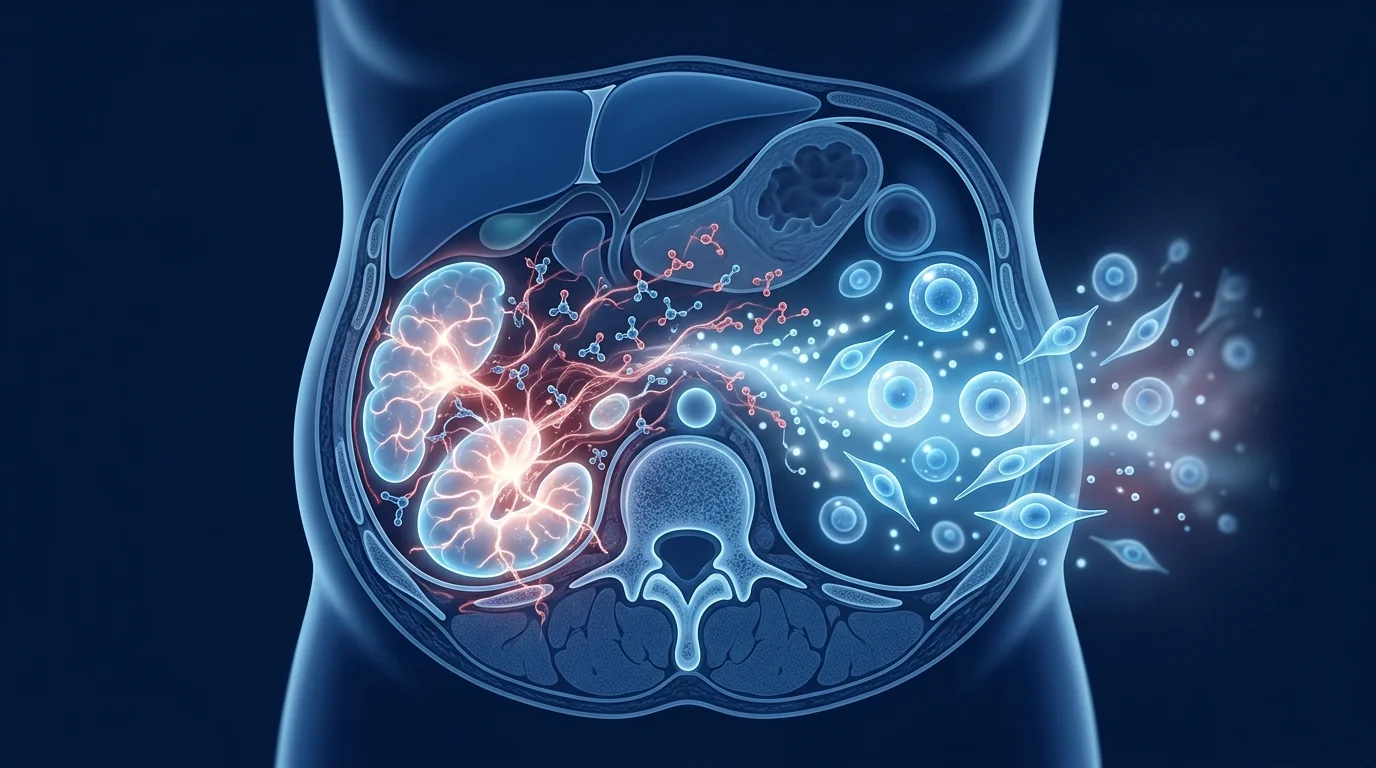
Metabolic syndrome is rarely diagnosed as a single event. It accumulates quietly — a creeping waistline, a creeping blood pressure, a creeping cholesterol — until the clinical threshold is crossed and a cluster of risk factors that share a name. The name is convenient, but the biology underneath is specific, and it is this biology that makes the condition interesting to a regenerative-medicine audience. At its core, metabolic syndrome is driven by chronic low-grade inflammation and insulin resistance — two processes that Mesenchymal Stem Cell therapy is plausibly able to influence, alongside (never instead of) the diet, activity, and standard metabolic care that remain the foundation of treatment.[1][2][3]
The disease is a cluster, not a single organ problem. Metabolic syndrome is defined by the co-occurrence of at least three of several risk factors — elevated waist circumference (abdominal/visceral adiposity), raised blood pressure, elevated triglycerides, low HDL cholesterol, and elevated fasting glucose. No two patients present identically, but the underlying driver is strikingly consistent: a body that is quietly inflamed and increasingly resistant to the signals of its own metabolism.[4]
Where standard care falls short. Modern metabolic management is excellent at controlling the individual numbers — statins for lipids, antihypertensives for pressure, metformin for glucose. What those therapies do not do, directly, is reduce the systemic inflammatory tone or improve the deep tissue-level insulin resistance that bind the whole cluster together. That is the specific gap a regenerative approach is being studied to fill.
What is metabolic syndrome
Metabolic syndrome is a defined cluster of at least three of five metabolic risk factors — central (visceral) obesity, hypertension, elevated triglycerides, low HDL cholesterol, and elevated fasting glucose — that, together, multiply cardiovascular and diabetes risk well beyond any single factor in isolation.[5]
It is estimated that roughly one in four adults worldwide carries at least some of these risk factors, and the prevalence is rising in parallel with the global obesity epidemic. The condition is a gateway: untreated, it is one of the strongest and most consistent predictors of both type 2 diabetes and premature cardiovascular disease. It is also, in many cases, a condition that is still largely silent — the numbers are abnormal on paper, but the patient feels fine, which is precisely why it is frequently undertreated.[6]
Why the cluster matters more than any single number
Each risk factor on its own is manageable. The cluster is the problem: the factors reinforce one another through shared biology (inflammation, insulin resistance, endothelial dysfunction), so the total cardiovascular risk of a patient with three factors is greater than the simple sum of the three. Treating the cluster means addressing the shared driver, not just the individual readouts.
What is actually going wrong
Metabolic syndrome does not begin at the diagnosis threshold. It begins years earlier, with a slow accumulation of metabolic stress. The mechanisms most relevant to a regenerative-therapy discussion are:[7]
- Visceral adipose inflammation — abdominal (visceral) fat is not inert storage; it is metabolically active tissue that, as it expands, releases pro-inflammatory cytokines (TNF-α, IL-6) and adipokines that raise the whole-body inflammatory tone
- Insulin resistance — peripheral tissues (muscle, liver, fat) stop responding efficiently to insulin, so the pancreas compensates with rising insulin levels and the metabolic milieu progressively worsens
- Dyslipidaemia — a characteristic pattern of high triglycerides, low HDL, and small dense LDL particles that is more atherogenic than the lipid panel alone suggests
- Endothelial dysfunction and low-grade prothrombotic state — the vascular lining becomes less responsive and more prone to clotting, an early and reversible driver of cardiovascular risk
- Adipose tissue dysfunction and "metabolic overflow" — as subcutaneous fat reaches capacity, lipids overflow into the liver and muscle, driving fatty liver and worsening insulin resistance (the vicious cycle that links the waistline to the liver and to type 2 diabetes)
The unifying theme is chronic low-grade inflammation — sometimes called "inflammaging" — a low but persistent activation of innate immune pathways that is present in metabolic syndrome even in the absence of overt infection or autoimmunity. This is the substrate that makes the condition biologically continuous with the type 2 diabetes, fatty liver, and cardiovascular disease that so often follow it.
What MSCs may biologically contribute
MSCs are not a weight-loss or "metabolic reset" therapy, and any clinic implying a dramatic reversal of established disease is overselling. What MSCs do is enter the inflammatory and metabolic environment and modulate it. The relevant actions in metabolic-syndrome biology include:
Systemic anti-inflammatory recalibration
The chronic low-grade inflammation that underlies metabolic syndrome is the single most addressable biological lever for a regenerative therapy. MSCs sense the inflammatory cytokine milieu and release factors such as TSG-6, PGE2, IDO, and IL-10 that interrupt the pro-inflammatory cascade. The downstream effect can be measurable improvements in the inflammatory markers (hsCRP, IL-6) and, through them, in insulin sensitivity — improvements that do not depend on adding another drug.[8]
Insulin-sensitivity improvement
By reducing the inflammatory tone in muscle, liver, and adipose tissue, MSCs can improve the signalling efficiency of insulin. This is an improvement in sensitivity, not a replacement of lost beta-cell function — an important distinction in a condition where insulin resistance, not beta-cell failure, is the primary early driver.
Adipose-tissue modulation
Emerging research suggests MSC-derived factors can influence adipocyte behaviour, favouring healthier (smaller, more insulin-sensitive) adipocytes over the large, inflamed, dysfunctional ones that characterise metabolic obesity. The effect is modest and still under study, but it is the mechanism most specific to the metabolic-syndrome context.
Endothelial and microvascular support
VEGF and other angiogenic and endothelial-repair factors released by MSCs may improve vascular lining function, which is most relevant for patients whose metabolic syndrome is already showing early cardiovascular strain.[9]

What the evidence supports — and what it doesn't
An honest summary of the published research landscape:
What is plausible: Modest reduction in inflammatory markers (hsCRP, IL-6), modest improvement in insulin sensitivity (HOMA-IR), modest favourable shifts in lipid profile and waist-to-height ratio, and possible easing of the cardiometabolic risk burden in some patients — particularly those who are still in the earlier, inflammation-driven phase of the syndrome and who combine MSC therapy with sustained lifestyle change. This is consistent with what immunomodulation and inflammatory-tone reduction could realistically deliver.
What is not supported by current evidence: Reversal of established metabolic syndrome, durable weight loss, resolution of hypertension or dyslipidaemia on the strength of MSC therapy alone, or protection from cardiovascular events without ongoing lifestyle and medical management. Any clinic implying these outcomes is overstating what the biology and the current trial data support.
What remains under active investigation: Optimal cell source and dose, ideal timing in the metabolic-syndrome course (before versus after the full cluster is established), response prediction from baseline inflammatory and metabolic biomarkers, and how MSC therapy interacts with the newer metabolic agents (GLP-1 and dual GLP-1/GIP agonists, SGLT2 inhibitors) that have transformed cardiometabolic care in the last decade.
The Honest Frame
MSC therapy for metabolic syndrome is, at present, an adjunctive and investigational protocol — a possible addition to standard metabolic care, not a replacement for it. Sustained caloric balance, regular physical activity, weight management, and guideline-directed medication remain the foundation. Regenerative therapy is best considered alongside that foundation, not instead of it.
Who is the strongest candidate
Within realistic boundaries, the patients most likely to see a meaningful response are those who:
- Are in the earlier, inflammation-driven phase, before the full cluster is firmly established and before significant target-organ damage
- Have elevated inflammatory markers (hsCRP, IL-6) alongside the classic risk factors — a marker that the inflammatory substrate MSCs can target is present
- Are committed to diet, activity, and weight management — MSC therapy amplifies metabolic improvement; it cannot substitute for the lifestyle change that is the primary treatment
- Have early signs of cardiometabolic strain (mild fatty liver, endothelial dysfunction, microalbuminuria) that may benefit from anti-inflammatory and vascular support
- Are coordinating with their physician on any treatment and medication changes
Patients with long-standing, fully established metabolic syndrome plus target-organ damage (advanced fatty liver, established cardiovascular disease) are less likely to see substantial benefit from MSC therapy alone — though it may still play a supportive, anti-inflammatory role in carefully selected cases.
What treatment looks like
A metabolic-syndrome-focused MSC programme at a regulated clinical centre typically follows this structure:
- Comprehensive metabolic assessment — waist circumference and body composition, fasting glucose and insulin, HbA1c, lipid profile, blood pressure, liver function and imaging (for fatty liver), inflammatory markers (hsCRP, IL-6)
- Cardiometabolic risk stratification — cardiovascular history, family history, and an honest assessment of which risk factors are inflammation-driven versus structural
- Coordination with the patient's physician — MSC therapy supplements rather than replaces medical management; medication adjustments remain the prerogative of the prescribing physician
- Personalised MSC protocol — typically intravenous infusion across a structured 8–12 week cycle, dose calibrated to body weight and indication
- Structured lifestyle protocol — caloric balance, physical activity, sleep, and weight-management guidance designed to amplify and sustain the cellular response
- Outcome tracking — repeat inflammatory and metabolic panels at 3, 6, and 12-month milestones
Realistic expectations
Outcomes vary substantially by disease duration, baseline inflammatory tone, lifestyle adherence, MSC quality, and dosing protocol. Some patients see measurable improvement in inflammatory markers within a few months; others build benefit gradually; a minority do not respond. A reputable clinic discusses this variability honestly during consultation, not after.
Safety considerations specific to metabolic syndrome
Several considerations deserve attention in this population:
- Cardiovascular screening — metabolic syndrome is, by definition, a cardiovascular-risk condition; medical clearance and cardiovascular assessment are part of every consultation
- Concurrent medications — many patients are on statins, antihypertensives, or metabolic drugs; MSC therapy does not replace these, and any adjustment remains with the prescribing physician
- Fatty liver status — patients with significant non-alcoholic fatty liver disease require careful protocol design and additional monitoring
- Cell quality — clinical-grade, ISCT-verified MSCs delivered under qualified medical supervision is a non-negotiable foundation
The right way to think about MSC therapy in metabolic syndrome is not "will this reverse my condition or make my numbers normal on their own?" — biology cannot deliver that today. It is "is there a measurable reduction in my chronic inflammatory tone and an improvement in my insulin sensitivity, alongside the diet, activity, and medication that already form the core of my care?" For the right patient, the answer is increasingly yes.
— VELAR Clinical Team
The VELAR approach to metabolic syndrome
Metabolic-syndrome protocols at VELAR Center are designed in coordination with each patient's existing physician. Each programme uses clinical-grade Wharton's jelly–derived MSCs (≥95% identity verification, >95% viability at delivery) delivered via personalised intravenous infusion, paired with a structured lifestyle protocol and inflammatory and metabolic biomarker tracking at the 3, 6, and 12-month milestones.
If you are considering regenerative therapy as part of your metabolic care, the most useful first conversation is not about cells. It is about which risk factors you carry, how much of your burden is inflammation-driven, and whether MSC therapy is a sensible addition to the lifestyle and medical framework you already have. That conversation — honest, data-driven, in coordination with your existing team — is what we offer at VELAR.
References
- Uccelli A, Moretta L, Pistoia V. Mesenchymal stem cells in health and disease. Nature Reviews Immunology. 2008;8(9):726-736. doi:10.1038/nri2395 ↩
- Shi Y, Wang Y, Li Q, Popp D, Wei H, Ohsie S, et al. Immunoregulatory mechanisms of mesenchymal stromal cells. Stem Cells. 2012;30(11):2231-2239. doi:10.1002/stem.1550 ↩
- Spees JL, Lee RH, Gregory CA. Mechanisms of mesenchymal stem/stromal cell function. Stem Cell Research & Therapy. 2016;7(1):125. doi:10.1186/s13287-016-0363-7 ↩
- Alberti KG, Eckel RH, Grundy SM, et al. Harmonizing the metabolic syndrome: a joint statement of the International Diabetes Federation Task Force on Epidemiology and Preventions; the National Heart, Lung, and Blood Institute American Heart Association, World Heart Federation, International Atherosclerosis Society, and International Association for the Study of Obesity. Circulation. 2009;120(16):1696-1703. doi:10.1161/CIRCULATIONAHA.109.192644 ↩
- Grundy SM. Metabolic syndrome: a major global health concern. Current Opinion in Lipidology. 2013;24(2):85-90. doi:10.1097/MOL.0b013e32ffa488 ↩
- Kahn SE, Hull RL, Utzschneider KT. Molecular mechanisms linking obesity and insulin resistance to type 2 diabetes and cardiovascular disease. New England Journal of Medicine. 2006;354(7):716-731. doi:10.1056/NEJMra050699 ↩
- Ridker PM. Antiinflammatory therapy with low-dose methotrexate for presumably atherothrombotic events. New England Journal of Medicine. 2017;377(12):1123. doi:10.1056/NEJMoa1614392 ↩
- Lahiri S, Kumar S, Sharma S, et al. Anti-inflammatory effects of mesenchymal stromal cells in metabolic and vascular disease. BioMed Research International. 2020;2020:6612716. doi:10.1155/2020/6612716 ↩
- Bronckaers A, Hilkens P, Martens W, van Eijndt M, van Laar J, van Dijk W, et al. Mesenchymal stem/stromal cells as a pharmacological and therapeutic approach to accelerate angiogenesis. Pharmacology & Therapeutics. 2014;143(2):181-196. doi:10.1016/j.pharmthera.2014.02.013 ↩
- Pittenger MF, Discher DE, Péault BM, Phinney DG, Hare JM, Caplan AI. Mesenchymal stem cell perspective: cell biology to clinical progress. NPJ Regenerative Medicine. 2019;4:22. doi:10.1038/s41536-019-0083-6 ↩
- Dominici M, Le Blanc K, Mueller I, et al. Minimal criteria for defining multipotent mesenchymal stromal cells of the International Society for Cellular Therapy. Cytotherapy. 2006;8(4):315-317. doi:10.1080/14653240600855905 ↩
- Lalu MM, McIntyre L, Pugliese C, et al. Safety of cell therapy with mesenchymal stromal cells (SafeCell): a systematic review and meta-analysis. PLoS One. 2012;7(10):e47559. doi:10.1371/journal.pone.0047559 ↩
- Galipeau J, Sensébé L. Mesenchymal stromal cells: clinical challenges and therapeutic opportunities. Cell Stem Cell. 2018;22(6):824-833. doi:10.1016/j.stem.2018.05.004 ↩
- Naji A, Eitoku M, Favier B, Deschaseaux F, Rouas-Freiss N, Suganuma N. Biological functions of mesenchymal stem cells and clinical implications. Cellular and Molecular Life Sciences. 2019;76(17):3323-3348. doi:10.1007/s00018-019-03125-1 ↩
- Caplan AI. Mesenchymal stem cells: time to change the name! Stem Cells Translational Medicine. 2017;6(6):1445-1451. doi:10.1002/sctm.17-0051 ↩
- Zang L, Hao H, Liu J, et al. Mesenchymal stem cell therapy in metabolic and inflammatory disease: a systematic review. Diabetology & Metabolic Syndrome. 2017;9:36. doi:10.1186/s13098-017-0233-1 ↩
参考文献
- Uccelli A, Moretta L, Pistoia V. Mesenchymal stem cells in health and disease. Nature Reviews Immunology. 2008;8(9):726-736. doi:10.1038/nri2395 ↩
- Shi Y, Wang Y, Li Q, Popp D, Wei H, Ohsie S, et al. Immunoregulatory mechanisms of mesenchymal stromal cells. Stem Cells. 2012;30(11):2231-2239. doi:10.1002/stem.1550 ↩
- Spees JL, Lee RH, Gregory CA. Mechanisms of mesenchymal stem/stromal cell function. Stem Cell Research & Therapy. 2016;7(1):125. doi:10.1186/s13287-016-0363-7 ↩
- Alberti KG, Eckel RH, Grundy SM, et al. Harmonizing the metabolic syndrome. Circulation. 2009;120(16):1696-1703. doi:10.1161/CIRCULATIONAHA.109.192644 ↩
- Grundy SM. Metabolic syndrome: a major global health concern. Current Opinion in Lipidology. 2013;24(2):85-90. doi:10.1097/MOL.0b013e32ffa488 ↩
- Kahn SE, Hull RL, Utzschneider KT. Molecular mechanisms linking obesity and insulin resistance to type 2 diabetes and cardiovascular disease. New England Journal of Medicine. 2006;354(7):716-731. doi:10.1056/NEJMra050699 ↩
- Ridker PM. Antiinflammatory therapy with low-dose methotrexate for presumably atherothrombotic events. New England Journal of Medicine. 2017;377(12):1123. doi:10.1056/NEJMoa1614392 ↩
- Lahiri S, Kumar S, Sharma S, et al. Anti-inflammatory effects of mesenchymal stromal cells in metabolic and vascular disease. BioMed Research International. 2020;2020:6612716. doi:10.1155/2020/6612716 ↩
- Bronckaers A, Hilkens P, Martens W, et al. Mesenchymal stem/stromal cells as a pharmacological and therapeutic approach to accelerate angiogenesis. Pharmacology & Therapeutics. 2014;143(2):181-196. doi:10.1016/j.pharmthera.2014.02.013 ↩
- Pittenger MF, Discher DE, Péault BM, Phinney DG, Hare JM, Caplan AI. Mesenchymal stem cell perspective: cell biology to clinical progress. NPJ Regenerative Medicine. 2019;4:22. doi:10.1038/s41536-019-0083-6 ↩
- Dominici M, Le Blanc K, Mueller I, et al. Minimal criteria for defining multipotent mesenchymal stromal cells. Cytotherapy. 2006;8(4):315-317. doi:10.1080/14653240600855905 ↩
- Lalu MM, McIntyre L, Pugliese C, et al. Safety of cell therapy with mesenchymal stromal cells (SafeCell). PLoS One. 2012;7(10):e47559. doi:10.1371/journal.pone.0047559 ↩
- Galipeau J, Sensébé L. Mesenchymal stromal cells: clinical challenges and therapeutic opportunities. Cell Stem Cell. 2018;22(6):824-833. doi:10.1016/j.stem.2018.05.004 ↩
- Naji A, Eitoku M, Favier B, et al. Biological functions of mesenchymal stem cells and clinical implications. Cellular and Molecular Life Sciences. 2019;76(17):3323-3348. doi:10.1007/s00018-019-03125-1 ↩
- Caplan AI. Mesenchymal stem cells: time to change the name! Stem Cells Translational Medicine. 2017;6(6):1445-1451. doi:10.1002/sctm.17-0051 ↩
- Zang L, Hao H, Liu J, et al. Mesenchymal stem cell therapy in metabolic and inflammatory disease. Diabetology & Metabolic Syndrome. 2017;9:36. doi:10.1186/s13098-017-0233-1 ↩
代谢综合征很少被诊断为单一事件。它悄然累积——腰围逐渐增大、血压逐渐升高、胆固醇逐渐上升——直到越过临床阈值,一组共享一个名称的风险因素被命名。这个名称很方便,但底层的生物学是具体的,而这正是该病症对再生医学受众有趣的所在。从根本上说,代谢综合征由慢性低度炎症与胰岛素抵抗驱动——而间充质干细胞疗法正被研究以影响这两个过程,同时(而非替代)饮食、运动与标准代谢护理——后者仍是治疗的基础。
该疾病是一组,而非单一器官问题。代谢综合征被定义为至少三种风险因素同时出现——腰围增大(腹部/内脏脂肪)、血压升高、甘油三酯升高、HDL 胆固醇降低、空腹血糖升高。没有两位患者表现完全相同,但底层驱动因素惊人地一致:一个身体正悄然发炎,且对自身代谢信号越来越抵抗。
标准护理在何处不足。现代代谢管理在控制各个数字方面非常出色——他汀类降脂、降压药控制血压、二甲双胍控制血糖。这些疗法不直接做到的,是降低全身炎症水平,或改善将整组病症联系在一起的深层组织水平胰岛素抵抗。这正是再生方法被研究以填补的特定缺口。
代谢综合征是什么
代谢综合征是五种代谢风险因素中至少三种的组合——中心性(内脏)肥胖、高血压、甘油三酯升高、HDL 胆固醇降低、空腹血糖升高——它们共同使心血管与糖尿病风险远超任何单一因素。
据估计,全球约四分之一的成年人至少携带这些风险因素中的一部分,其患病率正随全球肥胖流行而上升。该病症是一个入口:未治疗时,它是 2 型糖尿病与早发心血管疾病最强且最一致的预测因子之一。它也是一种在许多情况下仍然无声的疾病——数字在纸面上异常,但患者感觉良好,这正是它经常被治疗不足的原因。
为何这组比任何单一数字更重要
每个风险因素单独来看都可管理。这组才是问题:这些因素通过共享生物学(炎症、胰岛素抵抗、内皮功能障碍)相互强化,因此携带三个因素的患者的心血管风险大于三者之和。治疗这组意味着处理共享驱动因素,而非仅仅各个读数。
实际出了什么问题
代谢综合征并不在诊断阈值处开始。它早在数年前就开始了,伴随着代谢应激的缓慢累积。与再生疗法讨论最相关的机制有:
- 内脏脂肪炎症——腹部(内脏)脂肪不是惰性储存;它是代谢活跃组织,随着扩张释放促炎细胞因子(TNF-α、IL-6)与脂肪因子,抬高全身炎症水平
- 胰岛素抵抗——外周组织(肌肉、肝脏、脂肪)停止对胰岛素的有效反应,胰腺以升高的胰岛素水平代偿,代谢环境逐步恶化
- 血脂异常——高甘油三酯、低 HDL、小而密 LDL 颗粒的特征性模式,比脂质面板本身更具动脉粥样硬化性
- 内皮功能障碍与低度促凝状态——血管内膜反应性降低且更易形成血栓,这是心血管风险的早期且可逆驱动因素
- 脂肪组织功能障碍与"代谢溢出"——当皮下脂肪达到容量,脂质溢出至肝脏与肌肉,驱动脂肪肝并加重胰岛素抵抗(将腰围与肝脏、2 型糖尿病联系起来的恶性循环)
统一的主题是慢性低度炎症——有时称为"炎症衰老"——在没有明显感染或自身免疫的情况下,先天免疫通路持续的低度激活。这正是使该病症在生物学上连续地通向 2 型糖尿病、脂肪肝与心血管疾病的基质。
MSC 在生物层面可能贡献的
MSC 不是一种减重或"代谢重置"疗法,任何暗示戏剧性逆转已确立疾病的诊所都言过其实。MSC 实际做的是进入炎症与代谢环境并对其进行调节。其在代谢综合征生物学中的相关作用包括:
全身抗炎再校准
驱动代谢综合征的慢性低度炎症是再生疗法最可处理的单一生物杠杆。MSC 感知炎症细胞因子环境并释放 TSG-6、PGE2、IDO 与 IL-10 等因子打断促炎级联。下游效应可以是炎症标志物(hsCRP、IL-6)与由此胰岛素敏感性的可测量改善——而不依赖于添加另一种药物。
胰岛素敏感性改善
通过降低肌肉、肝脏与脂肪组织中的炎症水平,MSC 可改善胰岛素的信号效率。这是敏感性的改善,而非替代丢失的 β 细胞功能——在胰岛素抵抗(而非 β 细胞衰竭)是主要早期驱动因素的病症中,这是一个重要区别。
脂肪组织调节
新兴研究表明 MSC 衍生的因子可影响脂肪细胞行为,倾向于更健康(更小、胰岛素敏感性更高)的脂肪细胞,而非代谢肥胖所特征的、大型、发炎、功能障碍的脂肪细胞。该效应温和且仍在研究,但它是与代谢综合征情境最特定的机制。
内皮与微血管支持
MSC 释放的 VEGF 与其他血管生成及内皮修复因子可改善血管内膜功能,这对代谢综合征已显现早期心血管压力的患者最相关。
证据支持什么——以及不支持什么
对已发表研究领域的诚实总结:
什么是合理的:炎症标志物(hsCRP、IL-6)的适度降低、胰岛素敏感性(HOMA-IR)的适度改善、血脂谱与腰高比的适度有利变化,以及在某些患者中——尤其是仍处于综合征较早、炎症驱动阶段且将 MSC 疗法与持续生活方式改变相结合的患者——心血管代谢风险负担的可能减轻。这与免疫调节与炎症水平降低实际可能交付的相一致。
当前证据不支持的:已确立代谢综合征的逆转、持久的体重减轻、仅凭 MSC 疗法解决高血压或血脂异常,或在没有持续生活方式与医疗管理的情况下保护心血管事件。任何暗示这些结果的诊所都过度声明了生物学与当前试验数据所支持的。
仍处于积极研究中的:最优细胞来源与剂量、代谢综合征进程中的理想时机(在完整集群确立之前 versus 之后)、从基线炎症与代谢生物标志物预测反应,以及 MSC 疗法与较新的代谢药物(GLP-1 及双重 GLP-1/GIP 激动剂、SGLT2 抑制剂)如何相互作用——后者在近十年改变了心血管代谢护理。
诚实的框架
目前代谢综合征的 MSC 疗法是一种辅助性与探索性方案——标准代谢护理的可能补充,而非替代。持续的卡路里平衡、规律体力活动、体重管理与指南导向用药仍是基础。再生疗法最好与那个基础一同考虑,而非取代。
谁是最强的候选人
在现实边界内,最有可能看到有意义反应的患者是:
- 处于较早的炎症驱动阶段,在完整集群确立之前且在没有显著靶器官损伤之前
- 携带升高的炎症标志物(hsCRP、IL-6)加上经典风险因素——标志着 MSC 可靶向的炎症基质存在
- 致力于饮食、活动与体重管理——MSC 疗法放大代谢改善;它无法替代作为主要治疗的生活方式改变
- 有早期心血管代谢压力迹象(轻度脂肪肝、内皮功能障碍、微量白蛋白尿)可能受益于抗炎与血管支持
- 正与其医师协调任何治疗与用药变更
患有长期、完全确立的代谢综合征加靶器官损伤(晚期脂肪肝、已确立心血管疾病)的患者,较不可能仅从 MSC 疗法看到实质性受益——尽管在仔细选定的病例中它仍可能扮演支持性的抗炎角色。
治疗的样子
受监管临床中心的针对代谢综合征的 MSC 项目通常遵循该结构:
- 全面代谢评估——腰围与体成分、空腹血糖与胰岛素、HbA1c、血脂谱、血压、肝功能与影像学(针对脂肪肝)、炎症标志物(hsCRP、IL-6)
- 心血管代谢风险分层——心血管病史、家族史,以及就哪些风险因素是炎症驱动 versus 结构性的诚实评估
- 与患者的医师协调——MSC 疗法补充而非替代医学管理;用药调整仍由处方医师决定
- 个性化 MSC 方案——通常在结构化的 8–12 周周期内静脉输注,剂量按体重与适应症校准
- 结构化生活方式方案——卡路里平衡、体力活动、睡眠与体重管理指导,旨在放大并维持细胞反应
- 疗效追踪——在 3、6 与 12 个月里程碑重复炎症与代谢面板
实际预期
疗效因疾病持续时间、基线炎症水平、生活方式依从性、MSC 质量与给药方案而显著不同。一些患者在数月内看到炎症标志物的可测量改善;其他人逐渐建立受益;少数无反应。信誉良好的诊所在咨询期间诚实地讨论这一可变性,而非之后。
代谢综合征特有的安全性考量
该人群中有几项考量值得关注:
- 心血管筛查——代谢综合征本质上是心血管风险病症;医疗清除与心血管评估是每次咨询的一部分
- 并发用药——许多患者在使用他汀类、降压药或代谢药物;MSC 疗法不替代这些,任何调整仍由处方医师决定
- 脂肪肝状态——有显著非酒精性脂肪肝疾病的患者需要仔细的方案设计与额外监测
- 细胞质量——在合格医疗监督下递送的临床级、ISCT 验证的 MSC 是不可妥协的基础
思考代谢综合征中 MSC 疗法的正确方式不是"这能逆转我的疾病或让我的数字自己正常吗?"——生物学今天无法做到。而是"在已经构成我护理核心的饮食、活动与药物之外,是否有关于我慢性炎症水平的可测量降低与胰岛素敏感性的改善?"对合适的患者,答案越来越是肯定的。
——VELAR 临床团队
VELAR 的代谢综合征方法
VELAR Center 的代谢综合征方案与每位患者现有的医师协调设计。每个项目使用临床级华通氏胶来源 MSC(身份验证 ≥95%、交付时活性 >95%)通过个性化静脉输注递送,搭配结构化的生活方式方案与在 3、6 与 12 个月里程碑的炎症与代谢生物标志物追踪。
如果您正在考虑作为代谢护理一部分的再生疗法,最有用的第一次对话不是关于细胞。是关于您携带哪些风险因素、您的负担有多少是炎症驱动的,以及 MSC 疗法是否是您已有生活方式与医疗框架的合理补充。那种对话——诚实的、数据驱动的、与您现有团队协调的——就是我们在 VELAR 提供的。
نادراً ما يُشخَّص متلازمة الأيض بوصفها حدثاً واحداً. فهي تتراكم بهدوء — محيط خصر متزايد، ضغط دم متزايد، كوليسترول متزايد — حتى يُعبر عن العتبة السريرية وتُسَمَّى مجموعة من عوامل الخطر التي تشترك في اسم واحد. الاسم مريح، لكن البيولوجيا الكامنة محددة، وهذا هو ما يجعل الحالة مثيرة للاهتمام لجمهور الطب التجديدي. في جذرها، تُقَدَّم متلازمة الأيض بالالتهاب المزمن منخفض الدرجة ومقاومة الأنسولين — عمليتان يمكن أن يؤثر عليهما علاج الخلايا الجذعية الوسيطة (MSC) بشكل معقول، إلى جانب (وليس بدلاً من) النظام الغذائي والنشاط والرعاية الأيضية القياسية التي تظل أساس العلاج.
المرض هو عناقيد، وليس مشكلة عضو واحد. تُعرَّف متلازمة الأيض بالوجود المشترك لأقل من ثلاثة من عوامل الخطر — محيط خصر مرتفع (دهون بطنية/حشوية)، ارتفاع ضغط الدم، ارتفاع الدهون الثلاثية، انخفاض HDL، وارتفاع الجلوكوز الصائم. لا يظهر أي مريضين بنفس الشكل تماماً، لكن المحرك الكامن متطابق بشكل لافت: جسم ملتهب بهدوء ويصبح أكثر مقاومة لإشارات استقلابه الخاص.
أين تفشل الرعاية القياسية. إدارة الأيض الحديثة ممتازة في التحكم في الأرقام الفردية — الستاتين للدهون، مضادات ارتفاع الضغط، الميتفورمين للجلوكوز. ما لا تفعله هذه العلاجات بشكل مباشر هو خفض درجة الالتهاب الجهازي أو تحسين مقاومة الأنسولين على مستوى الأنسجة العميقة التي تربط العناقيد كلها معاً. هذا هو الفجوة المحددة التي يُدرَس ملءُها عبر نهج تجديدي.
ما هي متلازمة الأيض
متلازمة الأيض هي عناقيد معرَّفة من ثلاثة على الأقل من خمسة عوامل خطرة أيضية — سمنة مركزية (حشوية)، ارتفاع ضغط الدم، ارتفاع الدهون الثلاثية، انخفاض HDL، وارتفاع الجلوكوز الصائم — والتي معاً تُضاعِف خطر القلب والأوعية الدموية وخطر السكري بشكل يتجاوز أي عامل مفرد بمفرده.
يُقدَّر أن نحو واحد من كل أربعة بالغين حول العالم يحمل على الأقل بعض هذه عوامل الخطر، ويرتفع الانتشار بالتوازي مع وباء السمنة العالمي. الحالة هي بوابه: إذا لم تُعالَج، فهي واحدة من أقوى أكثر المتنبئات الاستمراره بمرض السكري من النوع 2 وبمرض القلب والأوعية الدموية المبكر. وهي أيضاً، في كثير من الحالات، حالة صامتة إلى حد كبير — الأرقام شاذة على الورق لكن المريض يشعر بالخير، وهذا تحديداً سبب كونها غالباً غير معالجة بما يكفي.
لماذا العناقيد أهم من أي رقم مفرد
كل عامل خطر بمفرده قابل للإدارة. العناقيد هي المشكلة: العوامل تعزز بعضها بعضا عبر بيولوجيا مشتركة (الالتهاب، مقاومة الأنسولين، خلل الأوعية الدقيقة)، لذلك خطر القلب والأوعية الدموية لمريض بعوامل ثلاثة أكبر من المجموع البسيط للعوامل الثلاثة. علاج العناقيد يعني معالجة المحرك المشترك، لا مجرد القراءات الفردية.
ما الذي يحدث خطأ بالفعل
لا تبدأ متلازمة الأيض عند عتبة التشخيص. تبدأ قبل سنوات، مع تراكم بطيء لإجهاد الأيض. الآليات الأكثر صلة بمناقشة العلاج التجديدي هي:
- التهاب الدهون الحشوية — الدهون البطنية (الحشوية) ليست تخزيناً خامل؛ إنها نسيج أيضي نشط يفرز، مع توسعه، سيتوكينات مؤيدة للالتهاب (TNF-α، IL-6) وعوامل دهنية ترفع درجة الالتهاب الجهازي
- مقاومة الأنسولين — تتوقف الأنسجة المحيطية (العضلات، الكبد، الدهون) عن الاستجابة الفعالة للأنسولين، فيعوض البنكرياس بمستويات أنسولين مرتفعة ويفقد المحيط الأيضي تقدمه تدريجيا
- خلل الدهون — نمط مميز من ارتفاع الدهون الثلاثية، انخفاض HDL، وجزيئات LDL الصغيرة الكثيفة، وهو أكثر تسبباً في تصلب الشرايين مما يقترحه ملف الدهون وحده
- خلل البطانة وحالة مضادة للانعزال منخفضة الدرجة — تصبح البطانة الوعائية أقل استجابة وأكثر ميلاً للتجلط، وهو محرك مبكر وعكوس لخطر القلب والأوعية الدموية
- خلل النسيج الدهني و"الفيض الأيضي" — عندما تصل الدهون تحت الجلد إلى قدرتها، يفيض الليبيد إلى الكبد والعضلات، مما يقود الكبد الدهني ويزيد مقاومة الأنسولين (الدورة الخبيثة التي تربط محيط الخصر بالكبد وبداء السكري من النوع 2)
السمة الموحدة هي الالتهاب المزمن منخفض الدرجة — يُسمّى أحياناً "شيخوخة الالتهاب" — وهي تنشيط منخفض لكنه مستمر لطرق المناعة الفطرية الموجودة في متلازمة الأيض حتى في غياب عدوى أو مناعة ذاتية واضحة. هذه هي المصفوفة التي تجعل الحالة مستمرة بيولوجياً مع داء السكري من النوع 2 والكبد الدهني وأمراض القلب والأوعية الدموية التي غالباً ما تتبعها.
ما يمكن أن تساهم به MSC بيولوجياً
MSC ليست علاج "خسارة الوزن" أو "إعادة ضبط الأيض"، وأي عيادة تقترح عكساً درامياً لمرض قائم تبالغ في البيع. ما تفعله MSC هو الدخول إلى البيئة الالتهابية والأيضية وتعديلها. تشمل أفعالها ذات الصلة في بيولوجيا متلازمة الأيض:
إعادة معايرة مضادة للالتهاب جهازية
الالتهاب المزمن منخفض الدرجة الذي يقود متلازمة الأيض هو رافعة بيولوجية واحدة قابلة للعلاج بشكل كبير للعلاج التجديدي. تستشعر MSC وسط السيتوكينات الالتهابي وتطلق عوامل مثل TSG-6 وPGE2 وIDO وIL-10 تقاطع الشلال المؤيد للالتهاب. التأثير المتلقي يمكن أن يكون تحسينات قابلة للقياس في علامات الالتهاب (hsCRP، IL-6) ومن خلالهما في حساسية الأنسولين — دون الاعتماد على إضافة دواء آخر.
تحسين حساسية الأنسولين
من خلال خفض درجة الالتهاب في العضلات والكبد ونسيج الدهون، يمكن لـ MSC تحسين كفاءة إشارة الأنسولين. هذا تحسين في الحساسية، وليس استبدال وظيفة خلايا بيتا المفقودة — وهو فرق مهم في حالة تكون فيها مقاومة الأنسولين (وليس فشل خلايا بيتا) المحرك المبكر الرئيسي.
تعديل نسيج الدهون
تقترح الأبحاث الناشئة أن عوامل مشتقة من MSC يمكن أن تؤثر على سلوك الخلايا الدهنية، مؤيدة الخلايا الدهنية الأصح (الأصغر، الأكثر حساسية للأنسولين) على الخلايا الكبيرة الملتهبة الخلية المجهدة المميزة للسمنة الأيضية. التأثير متواضع وما زال قيد الدراسة، لكنه الآلية الأكثر تحديدية لسياق متلازمة الأيض.
دعم البطانة والأوعية الدقيقة
قد تحسّن VEGF وعوامل تولد الأوعية وإصلاح البطانة الأخرى التي تطلقها MSC وظيفة البطانة الوعائية، وهذا الأكثر صلة للمرضى الذين بدأت متلازمة الأيض عندهم تُظهر إجهاداً قلبياً وعائياً مبكراً.
ما تدعمه الأدلة — وما لا تدعمه
ملخص صادق لمشهد الأبحاث المنشورة:
ما هو معقول: انخفاض متواضع في علامات الالتهاب (hsCRP، IL-6)، تحسن متواضع في حساسية الأنسولين (HOMA-IR)، انحرافات محسنة متواضعة في ملف الدهون ونسبة محيط الخصر إلى الطول، وإحتمال تخفيف عبء خطر القلب والأيض لدى بعض المرضى — خاصة أولئك الذين لا يزالون في المرحلة المبكرة المدفوعة بالالتهاب من المتلازمة والذين يجمعون علاج MSC مع تغيير نمط حياة مستدام. هذا متسق مع ما يمكن أن يقدمه تعديل المناعة وخفض درجة الالتهاب بشكل واقعي.
ما لا تدعمه الأدلة الحالية: عكس متلازمة الأيض القائمة، خسارة وزن دائمة، حل ارتفاع ضغط الدم أو خلل الدهون بقوة علاج MSC وحده، أو الحماية من أحداث القلب والأوعية الدموية دون إدارة نمط حياة وطبية مستمرة. أي عيادة تقترح هذه النتائج تبالغ في ما تدعمه البيولوجيا وبيانات التجربة الحالية.
ما يبقى قيد البحث النشط: مصدر الخلايا والجرعة المثلى، التوقيت المثالي في مسار متلازمة الأيض (قبل تثبيت العناقيد الكاملة بالكامل مقابل بعد ذلك)، التنبؤ بالاستجابة من المؤشرات الحيوية الالتهابية والأيضية الأساسية، وكيف يتفاعل علاج MSC مع العوامل الأيضية الأحدث (ناهضات GLP-1 وناهضات GLP-1/GIP المزدوجة، مثبطات SGLT2) التي حولت رعاية القلب والأيض في العقد الماضي.
الإطار الصادق
علاج MSC لمتلازمة الأيض، في الوقت الحالي، بروتوكول مساعد واستقصائي — إضافة محتملة للرعاية الأيضية القياسية، وليس بديلا عنها. توازن السعرات المستمر، النشاط البدني المنتظم، إدارة الوزن، والأدوية الموجهة بالخطوط الإرشادية تظل الأساس. يُنظَر إلى العلاج التجديدي بشكل أفضل جنبا إلى جنب مع ذلك الأساس، وليس بدلا منه.
من المرشح الأقوى
ضمن الحدود الواقعية، المرضى الأكثر احتمالا لرؤية استجابة ذات معنى هم الذين:
- في المرحلة المبكرة المدفوعة بالالتهاب، قبل تثبيت العناقيد الكاملة وغياب تلف الأعضاء المستهدفة الكبير
- لديهم علامات التهابية مرتفعة (hsCRP، IL-6) إلى جانب عوامل الخطر الكلاسيكية — علامة أن المصفوفة الالتهابية التي يمكن لـ MSC استهدافها موجودة
- ملتزمون بالنظام الغذائي والنشاط وإدارة الوزن — يضخم علاج MSC التحسينات الأيضية؛ لا يستطيع استبدال تغيير نمط الحياة الذي هو العلاج الرئيسي
- لديهم علامات مبكرة لإجهاد القلب والأيض (كبد دهني خفيف، خلل بطانة، بيلة ألبومينية دقيقة) قد تستفيد من الدعم المضاد للالتهاب والوعائي
- ينسقون مع طبيبهم بشأن أي تغييرات في العلاج والدواء
المرضى الذين يعانون من متلازمة أيض طويلة الأمد ومستقرة بالكامل مع تلف الأعضاء المستهدفة (الكبد الدهني المتقدم، مرض قلب وعائي قائم) أقل احتمالا لرؤية فائدة جوهرية من علاج MSC وحده — رغم أنه قد يلعب دورا داعما ومضادا للالتهاب في حالات مختارة بعناية.
كيف يبدو العلاج
برنامج MSC المتمحور حول متلازمة الأيض في مركز سريري منظم يتبع عادة هذا الهيكل:
- تقييم أيضي شامل — محيط الخصر والتكوين الجسدي، الجلوكوز الصائم والأنسولين الصائم، HbA1c، ملف الدهون، ضغط الدم، وظائف الكبد والتصوير (للكبد الدهني)، علامات الالتهاب (hsCRP، IL-6)
- تسلسل خطر القلب والأوعية والأيض — تاريخ القلب والأوعية، التاريخ العائلي، وتقييم صادق لعوامل الخطر المدفوعة بالالتهاب مقابل عوامل بنية
- التنسيق مع طبيب المريض — يكمل علاج MSC الإدارة الطبية بدل أن يحل محلها؛ تظل تعديلات الأدوية صلاحية الطبيب الوصف
- بروتوكول MSC شخصي — عادة تسريب وريدي على مدى دورة منظمة من 8–12 أسبوعا، الجرعة معايرة لوزن الجسم والدلالة
- بروتوكول نمط حياة منظم — توازن السعرات، النشاط البدني، النوم، وإدارة الوزن مصمم لتضخيم الاستجابة الخلوية وحفظها
- تتبع النتائج — تكرار لوحات الالتهاب والأيض في علامات 3 و6 و12 شهرا
التوقعات الواقعية
تختلف النتائج بشكل كبير حسب مدة المرض، درجة الالتهاب الأساسية، الالتزام بنمط الحياة، جودة MSC، وبروتوكول الجرعات. يرى بعض المرضى تحسنا قابلا للقياس في علامات الالتهاب خلال بضعة أشهر؛ يبني آخرون الفائدة تدريجيا؛ أقلية لا تستجيب. تناقش العيادة ذات السمعة الجيدة هذا التباين بصدق أثناء الاستشارة، لا بعدها.
اعتبارات السلامة الخاصة بمتلازمة الأيض
عدة اعتبارات تستحق الاهتمام في هذه الشريحة:
- فرز القلب والأوعية — متلازمة الأيض هي، بالتعريف، حالة خطر قلب وعائي؛ التصريح الطبي والتقييم القلبي الوعائي جزء من كل استشارة
- الأدوية المتزامنة — كثير من المرضى على الستاتين أو مضادات ارتفاع الضغط أو الأدوية الأيضية؛ علاج MSC لا يستبدل هذه، وأي تعديل يظل مع الطبيب الوصف
- حالة الكبد الدهني — المرضى الذين يعانون من مرض الكبد الدهني الكحولي الكبير يحتاجون إلى تصميم بروتوكول دقيق ومراقبة إضافية
- جودة الخلايا — MSC ذات الجودة السريرية المعتمدة من ISCT المُسلَّمة تحت إشراف طبي مؤهل أساس غير قابل للتفاوض
الطريقة الصحيحة للتفكير في علاج MSC في متلازمة الأيض ليست "هل سيُعكس حالتي أو يجعل أرقام طبيعية من تلقاء نفسها؟" — البيولوجيا لا تستطيع تقديم ذلك اليوم. بل "هل هناك تخفيض قابل للقياس في درجتي الالتهابية المزمنة وتحسين في حساسية الأنسولين، إلى جانب النظام الغذائي والنشاط والدواء التي تشكل بالفعل جوهر رعايتي؟" بالنسبة للمريض المناسب، الإجابة بشكل متزايد نعم.
— فريق VELAR السريري
منهج VELAR لمتلازمة الأيض
تُصمَّم بروتوكولات متلازمة الأيض في VELAR Center بالتنسيق مع طبيب كل مريض الحالي. يستخدم كل برنامج MSC ذات الجودة السريرية المشتقة من هلام وارتون (تحقق من الهوية ≥95٪، حيوية عند التسليم >95٪) تُلصَّم عبر تسريب وريدي شخصي، مقترنة ببروتوكول نمط حياة منظم وتتبع المؤشرات الحيوية الالتهابية والأيضية في علامات 3 و6 و12 شهرا.
إذا كنت تفكر في العلاج التجديدي كجزء من رعاية الأيض الخاصة بك، فإن أكثر محادثة أولى مفيدة ليست عن الخلايا. إنها عن أي عوامل الخطر التي تحملها، وكم من عبء مدفوع بالالتهاب، وما إذا كان علاج MSC إضافة معقولة لإطار نمط الحياة والرعاية الطبية الذي لديك بالفعل. هذه المحادثة — صادقة، مدفوعة بالبيانات، بالتنسيق مع فريقك الحالي — هي ما نقدمه في VELAR.