For most people, the first encounter with hair loss is not a medical problem — it is a mirror moment. A wider parting, a thinning crown, more strands in the shower drain than expected. The medical reality behind that moment is often a slow, multi-year process that has been unfolding at the cellular level long before it becomes visible. Modern regenerative dermatology is increasingly interested in that cellular layer — and Mesenchymal Stem Cell therapy is one of the more biologically reasoned approaches in active study today.
Why hair follicles fail
The human hair follicle is a small, complex organ that cycles through three main phases: anagen (active growth), catagen (transition), and telogen (rest, then shedding). The various forms of hair loss disrupt this cycle through different mechanisms — and understanding the mechanism matters because it predicts which interventions can help.[1][2][3][4]
The most common forms of clinical hair loss are:
- Androgenetic alopecia — pattern hair loss in men and women, driven by genetic sensitivity to dihydrotestosterone (DHT) and progressive miniaturisation of follicles in androgen-sensitive zones
- Alopecia areata — autoimmune hair loss, where the immune system mistakenly attacks the hair follicle
- Telogen effluvium — diffuse shedding triggered by physiological stress: illness, surgery, severe stress, postpartum changes, nutritional deficiency, certain medications
- Scarring (cicatricial) alopecia — destruction of the follicle itself, leading to permanent loss; the most difficult category to treat
- Female pattern hair loss — distinct mechanism with diffuse central thinning, often with hormonal contributors
The first three categories — non-scarring alopecias — share a common feature: the hair follicle itself is generally still alive. It is stressed, miniaturised, or paused, but not destroyed. That distinction is critical, because it defines the biological window in which any regenerative intervention can plausibly work.
Where the scalp microenvironment matters
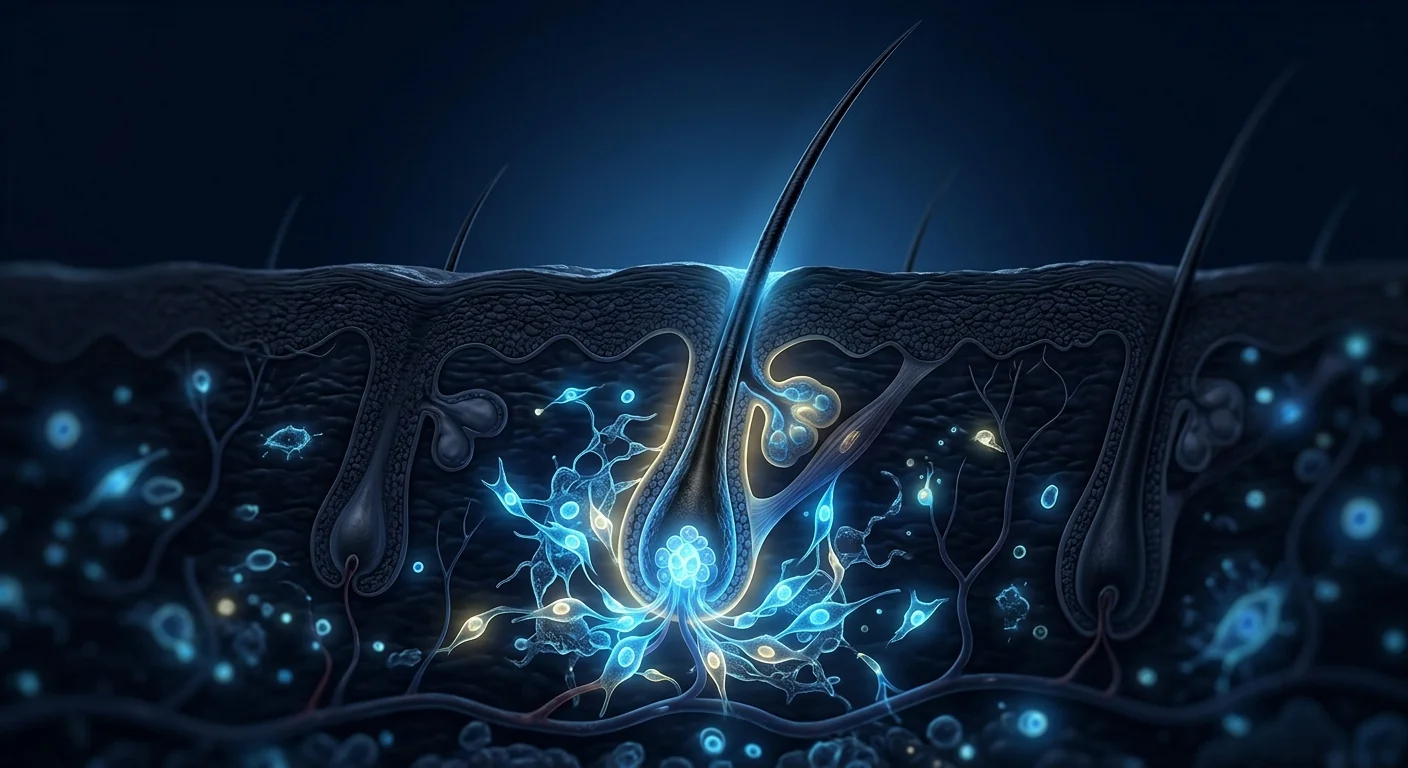
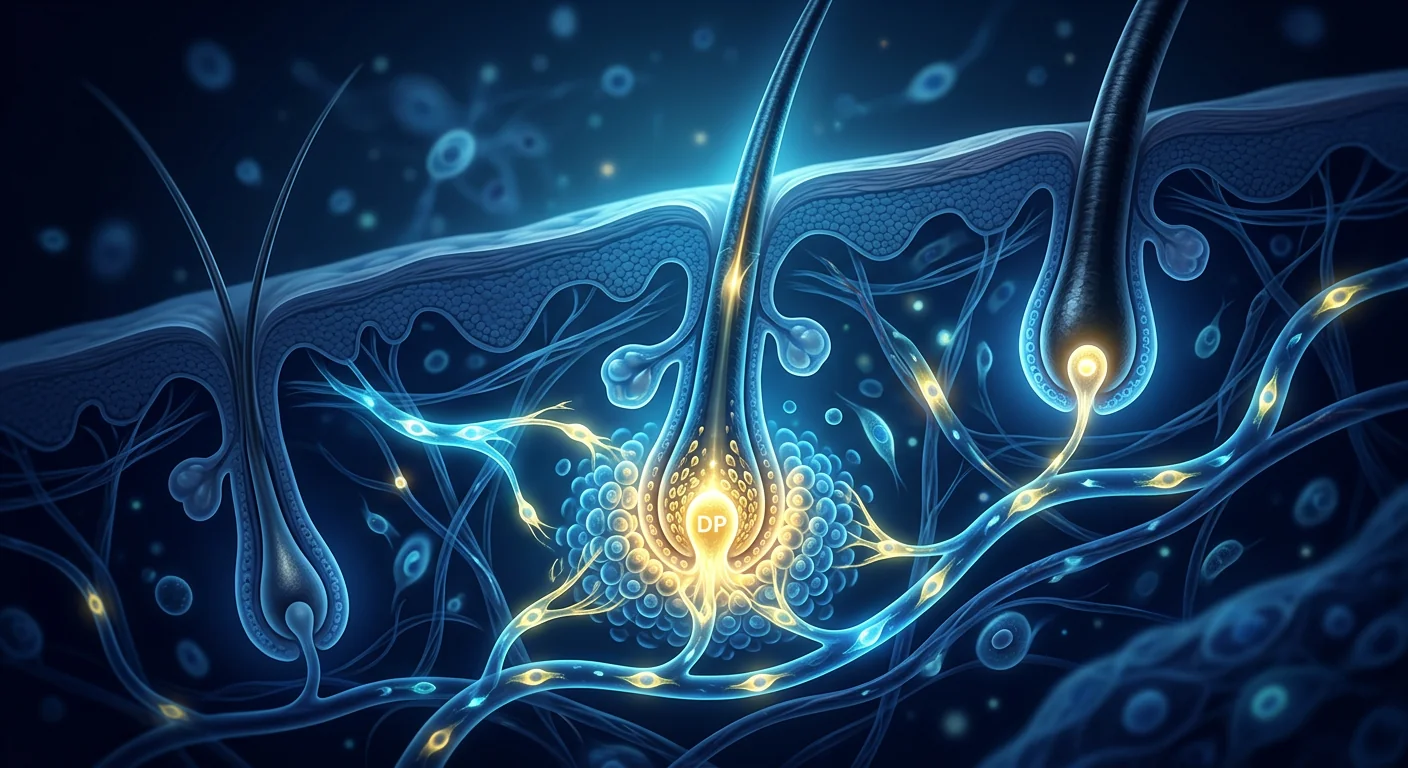
A healthy follicle depends not only on its own cells but on the surrounding tissue: the dermal papilla (a cluster of mesenchymal cells that signals follicular activity), local microvasculature, sebaceous glands, and the immune environment of the scalp. In progressive hair loss, the dermal papilla cells lose function, microvascular supply diminishes, and chronic low-grade scalp inflammation can develop.
This is the layer at which MSC therapy is positioned. MSCs do not become hair follicles. They cannot create new follicles where none exist. What they can do is alter the cellular environment in ways that support struggling follicles.
What MSCs may biologically contribute
Anti-inflammatory effect on the scalp
Chronic low-grade follicular inflammation contributes to follicle miniaturisation, particularly in androgenetic alopecia. MSC paracrine signalling reduces local inflammation, potentially slowing the inflammatory contribution to ongoing miniaturisation.
Dermal papilla support
MSCs share embryological origin and many surface markers with dermal papilla cells. They release growth factors — including VEGF, FGF, IGF-1, and HGF — that support dermal papilla function and may help reactivate miniaturised follicles toward thicker hair production.
Microvascular improvement
VEGF and angiogenic signals improve local scalp blood supply. Better local perfusion supports the metabolic demands of the active anagen phase.
Immunomodulation in autoimmune hair loss
In alopecia areata, the underlying biology is an immune attack on the follicle. MSC immunomodulation — promotion of regulatory T-cells, dampening of effector T-cell activity — has direct relevance, similar to its mechanism in other autoimmune conditions.
What evidence supports — and what it doesn't
An honest summary of where the published research stands:
What is plausible: Visible improvement in hair density, thickness, and growth phase distribution in patients with active (non-scarring) hair loss treated early. Evidence is most consistent in androgenetic alopecia and in selected alopecia areata cases. Improvement typically requires multiple sessions and ongoing follicular support.
What is not supported: Restoration of hair in scarred or completely lost zones, replacement of hair transplantation in severe pattern baldness, or guaranteed response in every patient. Any clinic implying these outcomes is overstating biology.
What remains under active investigation: Optimal protocols (cell source, concentration, route of delivery), combination with other therapies (PRP, finasteride, minoxidil, low-level laser), and predictors of which patients respond best.
The Honest Frame
MSC therapy for hair loss is, at present, best understood as one tool in a larger toolkit. The patients who do best generally combine cellular therapy with appropriate medical management (e.g. finasteride or topical minoxidil where indicated), nutritional optimisation, and scalp care. Regenerative therapy is positioned to amplify and protect — not replace — the rest of that toolkit.
Who is the strongest candidate?
- Early to mid-stage non-scarring hair loss — visible thinning but follicles still active, not in advanced miniaturisation
- Androgenetic alopecia in men or women, particularly in patients also on or considering medical therapy
- Selected alopecia areata cases in coordination with a dermatologist
- Telogen effluvium following a recoverable trigger (post-illness, postpartum, severe stress)
- Patients realistic about timeline — improvement is typically visible at 3–6 months, refined over 12 months
Patients with completely scarred follicles, very advanced pattern baldness with extensive bald zones, or active untreated underlying conditions (severe nutritional deficiency, untreated thyroid disease) are unlikely to see the same benefit and are better served by addressing those issues first.
What treatment looks like
- Comprehensive scalp and medical evaluation — type of hair loss, duration, family history, hormonal screening where relevant, current medications, scalp examination, dermoscopy
- Identification of contributing factors — nutritional deficiencies (iron, vitamin D, zinc), thyroid status, hormonal influences in women, medication side-effects
- Personalised protocol — typically a series of 3–4 MSC sessions across 8–12 weeks, with locally directed scalp delivery and (in selected cases) supportive intravenous infusion. Concurrent medical therapy continues where appropriate
- Adjunct support — nutritional optimisation, scalp care, topical or oral medical therapy as indicated
- Outcome tracking — standardised scalp photography, hair density measurement, and clinical assessment at 3, 6, and 12-month milestones
Realistic expectations
Hair loss biology continues even when MSC therapy produces a good response — particularly in androgenetic alopecia, where the underlying genetic drive to miniaturise does not go away. Sustained results generally require ongoing care, just as they do with most non-cellular hair therapies. A reputable clinic discusses this honestly during consultation.
Safety and what every patient should know
When delivered with clinical-grade cells under qualified medical supervision, MSC therapy for hair loss has an excellent safety profile. Local soreness or transient redness at scalp injection sites are the most common side-effects. Serious adverse events are uncommon in the published literature.
The most preventable risks in this space are non-clinical-grade cells, unverified sterility, or non-MSC products marketed under the "stem cell" label. Verifying cell source, laboratory certification, and access to a Certificate of Analysis is part of any responsible treatment decision.
For the right patient — early to mid-stage non-scarring hair loss, with realistic expectations and willingness to combine MSC therapy with appropriate medical care — regenerative protocols can be a meaningful contributor to long-term outcome. They do not replace the rest of the toolkit, and they are not a one-time fix. They are a tool that, used well, makes the toolkit more effective.
— VELAR Clinical Team
The VELAR approach to hair loss
Hair-focused protocols at VELAR Center begin with a comprehensive scalp and medical evaluation, including identification of any reversible contributing factors. Each programme uses clinical-grade Wharton's jelly–derived MSCs (≥95% identity verification, >95% viability at delivery) delivered through scalp-directed and where appropriate systemic protocols, paired with concurrent medical therapy and nutritional support.
If you are exploring regenerative options for hair loss, the most useful conversation is not about cells in isolation. It is about your specific type and stage of loss, your existing care, and whether MSC therapy is a sensible addition to a broader plan. That is the conversation we want to have with you.
References
- Uccelli A, Moretta L, Pistoia V. Mesenchymal stem cells in health and disease. Nature Reviews Immunology. 2008;8(9):726-736. doi:10.1038/nri2395 ↩
- Shi Y, Wang Y, Li Q, et al. Immunoregulatory mechanisms of mesenchymal stem and stromal cells in inflammatory diseases. Nature Reviews Nephrology. 2018;14(8):493-507. doi:10.1038/s41581-018-0023-5 ↩
- Spees JL, Lee RH, Gregory CA. Mechanisms of mesenchymal stem/stromal cell function. Stem Cell Research & Therapy. 2016;7(1):125. doi:10.1186/s13287-016-0363-7 ↩
- Galipeau J, Sensébé L. Mesenchymal stromal cells: clinical challenges and therapeutic opportunities. Cell Stem Cell. 2018;22(6):824-833. doi:10.1016/j.stem.2018.05.004 ↩
- Pittenger MF, Discher DE, Péault BM, Phinney DG, Hare JM, Caplan AI. Mesenchymal stem cell perspective: cell biology to clinical progress. NPJ Regenerative Medicine. 2019;4:22. doi:10.1038/s41536-019-0083-6 ↩
- Caplan AI. Mesenchymal stem cells: time to change the name! Stem Cells Translational Medicine. 2017;6(6):1445-1451. doi:10.1002/sctm.17-0051 ↩
- Dominici M, Le Blanc K, Mueller I, et al. Minimal criteria for defining multipotent mesenchymal stromal cells. Cytotherapy. 2006;8(4):315-317. doi:10.1080/14653240600855905 ↩
- Lalu MM, McIntyre L, Pugliese C, et al. Safety of cell therapy with mesenchymal stromal cells (SafeCell). PLoS One. 2012;7(10):e47559. doi:10.1371/journal.pone.0047559 ↩
- Naji A, Eitoku M, Favier B, Deschaseaux F, Rouas-Freiss N, Suganuma N. Biological functions of mesenchymal stem cells. Cellular and Molecular Life Sciences. 2019;76(17):3323-3348. doi:10.1007/s00018-019-03125-1 ↩
- Bronckaers A, Hilkens P, Martens W, et al. Mesenchymal stem/stromal cells as a pharmacological approach to accelerate angiogenesis. Pharmacology & Therapeutics. 2014;143(2):181-196. doi:10.1016/j.pharmthera.2014.02.013 ↩
- Wang Y, Chen X, Cao W, Shi Y. Plasticity of mesenchymal stem cells in immunomodulation. Nature Immunology. 2014;15(11):1009-1016. doi:10.1038/ni.3002 ↩
- Weiss DJ, Bertoncello I, Borok Z, et al. Stem cells and cell therapies in lung biology and lung diseases. Proceedings of the American Thoracic Society. 2011;8(3):223-272. doi:10.1513/pats.201012-071DW ↩
参考文献
- Uccelli A, Moretta L, Pistoia V. Mesenchymal stem cells in health and disease. Nature Reviews Immunology. 2008;8(9):726-736. doi:10.1038/nri2395 ↩
- Shi Y, Wang Y, Li Q, et al. Immunoregulatory mechanisms of mesenchymal stem and stromal cells in inflammatory diseases. Nature Reviews Nephrology. 2018;14(8):493-507. doi:10.1038/s41581-018-0023-5 ↩
- Spees JL, Lee RH, Gregory CA. Mechanisms of mesenchymal stem/stromal cell function. Stem Cell Research & Therapy. 2016;7(1):125. doi:10.1186/s13287-016-0363-7 ↩
- Galipeau J, Sensébé L. Mesenchymal stromal cells: clinical challenges and therapeutic opportunities. Cell Stem Cell. 2018;22(6):824-833. doi:10.1016/j.stem.2018.05.004 ↩
- Pittenger MF, Discher DE, Péault BM, Phinney DG, Hare JM, Caplan AI. Mesenchymal stem cell perspective: cell biology to clinical progress. NPJ Regenerative Medicine. 2019;4:22. doi:10.1038/s41536-019-0083-6 ↩
- Caplan AI. Mesenchymal stem cells: time to change the name! Stem Cells Translational Medicine. 2017;6(6):1445-1451. doi:10.1002/sctm.17-0051 ↩
- Dominici M, Le Blanc K, Mueller I, et al. Minimal criteria for defining multipotent mesenchymal stromal cells. Cytotherapy. 2006;8(4):315-317. doi:10.1080/14653240600855905 ↩
- Lalu MM, McIntyre L, Pugliese C, et al. Safety of cell therapy with mesenchymal stromal cells (SafeCell). PLoS One. 2012;7(10):e47559. doi:10.1371/journal.pone.0047559 ↩
- Naji A, Eitoku M, Favier B, Deschaseaux F, Rouas-Freiss N, Suganuma N. Biological functions of mesenchymal stem cells. Cellular and Molecular Life Sciences. 2019;76(17):3323-3348. doi:10.1007/s00018-019-03125-1 ↩
- Bronckaers A, Hilkens P, Martens W, et al. Mesenchymal stem/stromal cells as a pharmacological approach to accelerate angiogenesis. Pharmacology & Therapeutics. 2014;143(2):181-196. doi:10.1016/j.pharmthera.2014.02.013 ↩
- Wang Y, Chen X, Cao W, Shi Y. Plasticity of mesenchymal stem cells in immunomodulation. Nature Immunology. 2014;15(11):1009-1016. doi:10.1038/ni.3002 ↩
- Weiss DJ, Bertoncello I, Borok Z, et al. Stem cells and cell therapies in lung biology and lung diseases. Proceedings of the American Thoracic Society. 2011;8(3):223-272. doi:10.1513/pats.201012-071DW ↩
对大多数人而言,第一次遇到脱发不是一个医学问题——而是一个镜子前的瞬间。中分线变宽、头顶变薄、淋浴排水管中的发丝比预期多。那一瞬间背后的医学现实通常是一个缓慢的、多年来在细胞层面展开的过程,远在变得可见之前就已开始。现代再生皮肤病学越来越关注那一细胞层面——而间充质干细胞疗法是当前积极研究中较具生物学合理性的方法之一。
毛囊为何会失败
人类毛囊是一个小而复杂的器官,循环经过三个主要阶段:生长期(活跃生长)、退行期(过渡)与休止期(休息然后脱落)。各种形式的脱发通过不同机制扰乱该循环——理解机制很重要,因为它预测哪些干预可以有所帮助。
临床脱发最常见的形式是:
- 雄激素性脱发——男性与女性的图样脱发,由对二氢睾酮(DHT)的遗传敏感性以及雄激素敏感区域中毛囊的渐进性微小化驱动
- 斑秃——自身免疫性脱发,免疫系统错误地攻击毛囊
- 休止期脱发——由生理压力触发的弥漫性脱落:疾病、手术、严重压力、产后变化、营养不足、某些药物
- 瘢痕性(纤维化)脱发——毛囊本身的破坏,导致永久性丧失;最难治疗的类别
- 女性图样脱发——具有弥漫性中央变薄的独特机制,常有荷尔蒙因素
前三类——非瘢痕性脱发——共享一个共同特征:毛囊本身通常仍然活着。它处于应激、微小化或暂停状态,但未被破坏。这一区分至关重要,因为它定义了任何再生干预可能合理工作的生物学窗口。
头皮微环境为何重要
健康的毛囊不仅依赖于自身的细胞,还依赖于周围的组织:真皮乳头(一群发出毛囊活动信号的间充质细胞)、局部微脉管系统、皮脂腺,以及头皮的免疫环境。在进展性脱发中,真皮乳头细胞失去功能、微血管供应减少,并可能发展出慢性低度头皮炎症。
这是 MSC 疗法被定位的层面。MSC 不会变成毛囊。它们不能在没有毛囊的地方创造新毛囊。它们能做的是以支持挣扎中毛囊的方式改变细胞环境。
MSC 在生物层面可能贡献的
对头皮的抗炎效应
慢性低度毛囊炎症促成毛囊微小化,特别是在雄激素性脱发中。MSC 旁分泌信号减少局部炎症,可能减缓持续微小化的炎症贡献。
真皮乳头支持
MSC 与真皮乳头细胞共享胚胎学起源与许多表面标志物。它们释放生长因子——包括 VEGF、FGF、IGF-1 与 HGF——支持真皮乳头功能并可能帮助重新激活微小化的毛囊朝向更粗的发干生产。
微血管改善
VEGF 与血管生成信号改善局部头皮血液供应。更好的局部灌注支持活跃生长期的代谢需求。
自身免疫性脱发的免疫调节
在斑秃中,根本生物学是免疫对毛囊的攻击。MSC 免疫调节——促进调节性 T 细胞、抑制效应 T 细胞活性——具有直接相关性,类似于其在其他自身免疫疾病中的机制。
证据支持什么——以及不支持什么
对已发表研究领域的诚实总结:
什么是合理的:在早期治疗的活动性(非瘢痕性)脱发患者中,毛发密度、粗细与生长期分布的可见改善。证据在雄激素性脱发与选定的斑秃病例中最一致。改善通常需要多次会话与持续的毛囊支持。
什么不被支持:瘢痕或完全失去区域中毛发的恢复、严重图样秃发中毛发移植的替代,或每位患者的保证反应。任何暗示这些结果的诊所都过度声明生物学。
仍处于积极研究中的:最优方案(细胞来源、浓度、递送途径)、与其他疗法的组合(PRP、非那雄胺、米诺地尔、低能激光)以及哪些患者反应最佳的预测因素。
诚实的框架
目前脱发的 MSC 疗法最好被理解为更大工具包中的一个工具。表现最佳的患者通常将细胞治疗与适当的医学管理(例如适应症时的非那雄胺或外用米诺地尔)、营养优化与头皮护理相结合。再生疗法定位为放大与保护——而非替代——该工具包的其余部分。
谁是最强的候选人?
- 早期至中期非瘢痕性脱发——可见变薄但毛囊仍活跃,未处于晚期微小化
- 男性或女性的雄激素性脱发,特别是同时接受或考虑医学治疗的患者
- 选定的斑秃病例,与皮肤病学专家协调
- 休止期脱发跟随可恢复触发因素后(病后、产后、严重压力)
- 对时间表现实的患者——改善通常在 3–6 个月可见,在 12 个月精炼
具有完全瘢痕化毛囊、非常晚期图样秃发伴广泛秃区,或有活动性未治疗的潜在情况(严重营养不足、未治疗的甲状腺疾病)的患者不太可能看到相同的受益,最好先解决那些问题。
治疗的样子
- 全面头皮与医疗评估——脱发类型、持续时间、家族史、相关时的荷尔蒙筛查、当前用药、头皮检查、皮肤镜检查
- 识别促成因素——营养不足(铁、维生素 D、锌)、甲状腺状况、女性中的荷尔蒙影响、药物副作用
- 个性化方案——通常在 8–12 周内一系列 3–4 次 MSC 会话,搭配局部头皮递送与(在选定病例中)支持性静脉输注。同时进行的医学治疗在适当时继续
- 辅助支持——营养优化、头皮护理、按指示的外用或口服医学治疗
- 疗效追踪——标准化头皮摄影、毛发密度测量与临床评估在 3、6 与 12 个月里程碑
实际预期
即使 MSC 疗法产生良好反应,脱发生物学仍然继续——特别是在雄激素性脱发中,潜在的微小化遗传驱动力不会消失。持续效果通常需要持续护理,正如大多数非细胞性毛发疗法一样。信誉良好的诊所在咨询期间诚实地讨论这一点。
安全性与每位患者应知道的
在合格医疗监督下使用临床级细胞递送时,脱发的 MSC 疗法具有出色的安全性概况。头皮注射部位的局部酸痛或暂时发红是最常见的副作用。在已发表的文献中,严重不良事件不常见。
该领域最大的可预防风险是非临床级细胞、未经验证的无菌性,或以"干细胞"名义营销的非 MSC 产品。验证细胞来源、实验室认证以及获取分析证书是任何负责任治疗决定的一部分。
对合适的患者——早期至中期非瘢痕性脱发,预期现实并愿意将 MSC 疗法与适当医疗护理相结合——再生方案可以是长期疗效的有意义贡献者。它们不替代工具包的其余部分,也不是一次性修复。它们是一种工具,使用得当,使工具包更有效。
——VELAR 临床团队
VELAR 的脱发方法
VELAR Center 针对头发的方案从全面的头皮与医学评估开始,包括识别任何可逆促成因素。每个项目使用临床级华通氏胶来源 MSC(身份验证 ≥95%、交付时活性 >95%)通过头皮定向递送与(在适当时)系统性方案,搭配同时进行的医学治疗与营养支持。
如果您正在探索脱发的再生选项,最有用的对话不是孤立地谈论细胞。是关于您具体的脱发类型与阶段、您现有的护理,以及 MSC 疗法是否是更广泛计划的合理补充。那是我们想与您进行的对话。
بالنسبة لمعظم الناس، اللقاء الأول مع تساقط الشعر ليس مشكلة طبية — إنه لحظة أمام المرآة. فرق أوسع، تاج أرق، خصلات أكثر في مصرف الاستحمام مما كان متوقعاً. الواقع الطبي خلف تلك اللحظة هو في الغالب عملية بطيئة متعددة السنوات تكشّفت على المستوى الخلوي قبل وقت طويل من أن تصبح مرئية. الطب التجديدي الجلدي الحديث مهتم بشكل متزايد بتلك الطبقة الخلوية — وعلاج الخلايا الجذعية الوسيطة من بين الأساليب الأكثر منطقاً بيولوجياً قيد الدراسة النشطة اليوم.
لماذا تفشل بصيلات الشعر
بصيلة شعر الإنسان عضو صغير ومعقد يدور عبر ثلاث مراحل رئيسية: طور النمو (نمو نشط)، طور الانتقال، وطور الراحة (راحة ثم تساقط). تعطل أشكال تساقط الشعر المختلفة هذه الدورة من خلال آليات مختلفة — وفهم الآلية مهم لأنه يتنبأ بأي التدخلات يمكن أن تساعد.
أكثر أشكال تساقط الشعر السريرية شيوعاً هي:
- الثعلبة الأندروجينية — تساقط الشعر النمطي لدى الرجال والنساء، مدفوعاً بالحساسية الوراثية لـ ديهيدرو تستوستيرون (DHT) والتقزم التدريجي للبصيلات في المناطق الحساسة للأندروجين
- الثعلبة البقعية — تساقط شعر مناعي ذاتي، حيث يهاجم الجهاز المناعي بصيلات الشعر عن طريق الخطأ
- الثعلبة الكربية — تساقط منتشر يحفزه إجهاد فسيولوجي: مرض، جراحة، إجهاد شديد، تغيرات ما بعد الولادة، نقص تغذوي، بعض الأدوية
- الثعلبة الندبية (المسببة للتندب) — تدمير البصيلة نفسها، مما يؤدي إلى فقدان دائم؛ الفئة الأصعب علاجاً
- تساقط الشعر النمطي عند النساء — آلية متميزة مع ترقق مركزي منتشر، غالباً مع مساهمين هرمونيين
الفئات الثلاث الأولى — الثعلبات غير الندبية — تشترك في ميزة مشتركة: بصيلة الشعر نفسها لا تزال حية بشكل عام. هي مُجهَدة، مقزّمة، أو متوقفة، لكن لم تُدمَر. هذا التمييز حاسم، لأنه يحدد النافذة البيولوجية التي يمكن لأي تدخل تجديدي أن يعمل فيها بشكل معقول.
أين تهم البيئة الدقيقة لفروة الرأس
تعتمد البصيلة الصحية ليس فقط على خلاياها الخاصة بل على الأنسجة المحيطة: الحليمة الجلدية (مجموعة من الخلايا الوسيطة التي تشير إلى نشاط البصيلة)، الأوعية الدقيقة المحلية، الغدد الدهنية، والبيئة المناعية لفروة الرأس. في تساقط الشعر التدريجي، تفقد خلايا الحليمة الجلدية وظيفتها، تتضاءل الإمدادات الوعائية الدقيقة، وقد يتطور التهاب فروة الرأس المنخفض الدرجة المزمن.
هذه هي الطبقة التي يقع فيها علاج MSC. MSC لا تصبح بصيلات شعر. لا تستطيع إنشاء بصيلات جديدة حيث لا توجد. ما تستطيعه هو تغيير البيئة الخلوية بطرق تدعم البصيلات المُكافحة.
ما يمكن أن تساهم به MSC بيولوجياً
التأثير المضاد للالتهاب على فروة الرأس
يساهم التهاب البصيلات المنخفض الدرجة المزمن في تقزم البصيلات، خاصة في الثعلبة الأندروجينية. تقلل إشارات MSC شبه الإفرازية الالتهاب الموضعي، مما قد يبطئ المساهمة الالتهابية في التقزم المستمر.
دعم الحليمة الجلدية
تشترك MSC في الأصل الجنيني والعديد من علامات السطح مع خلايا الحليمة الجلدية. تطلق عوامل نمو — تشمل VEGF وFGF وIGF-1 وHGF — تدعم وظيفة الحليمة الجلدية وقد تساعد على إعادة تنشيط البصيلات المقزمة نحو إنتاج شعر أسمك.
التحسين الوعائي الدقيق
تحسن إشارات VEGF والمولدة للأوعية إمدادات دم فروة الرأس المحلية. تروية محلية أفضل تدعم المتطلبات الأيضية لطور النمو النشط.
تعديل المناعة في تساقط الشعر المناعي الذاتي
في الثعلبة البقعية، البيولوجيا الكامنة هي هجوم مناعي على البصيلة. لتعديل المناعة لـ MSC — تعزيز الخلايا التائية التنظيمية، تخفيف نشاط الخلايا التائية الفعالة — صلة مباشرة، مماثلة لآليتها في حالات المناعة الذاتية الأخرى.
ما تدعمه الأدلة — وما لا تدعمه
ملخص صادق لمكان وقوف الأبحاث المنشورة:
ما هو معقول: تحسن مرئي في كثافة الشعر وسماكته وتوزيع طور النمو لدى المرضى المصابين بتساقط شعر نشط (غير ندبي) المعالجين مبكراً. الأدلة الأكثر اتساقاً في الثعلبة الأندروجينية وفي حالات الثعلبة البقعية المختارة. يتطلب التحسن عادة جلسات متعددة ودعم بصيلات مستمر.
ما لا تدعمه: استعادة الشعر في المناطق المتندبة أو المفقودة تماماً، استبدال زراعة الشعر في الصلع النمطي الشديد، أو استجابة مضمونة لكل مريض. أي عيادة تُلمح إلى هذه النتائج تبالغ في البيولوجيا.
ما يبقى قيد البحث النشط: البروتوكولات المثلى (مصدر الخلايا، التركيز، طريقة التسليم)، الجمع مع علاجات أخرى (PRP، فيناستيريد، مينوكسيديل، الليزر منخفض المستوى)، ومتنبئات أي المرضى يستجيبون أفضل.
الإطار الصادق
علاج MSC لتساقط الشعر، في الوقت الحالي، يُفهَم بشكل أفضل على أنه أداة واحدة في مجموعة أدوات أكبر. المرضى الذين يقومون بأفضل أداء عموماً يجمعون العلاج الخلوي مع الإدارة الطبية المناسبة (مثل فيناستيريد أو مينوكسيديل الموضعي حيث يكون مُشاراً إليه)، تحسين التغذية، والعناية بفروة الرأس. يقع العلاج التجديدي في موضع التضخيم والحماية — لا الاستبدال — لبقية تلك المجموعة.
من المرشح الأقوى؟
- تساقط الشعر غير الندبي في المرحلة المبكرة إلى المتوسطة — ترقق مرئي لكن البصيلات لا تزال نشطة، ليست في تقزم متقدم
- الثعلبة الأندروجينية لدى الرجال أو النساء، خاصة المرضى الذين يتلقون أو يفكرون في العلاج الطبي أيضاً
- حالات الثعلبة البقعية المختارة بالتنسيق مع طبيب الجلدية
- الثعلبة الكربية بعد محفز قابل للاسترداد (بعد المرض، بعد الولادة، إجهاد شديد)
- المرضى الواقعيون بشأن الجدول الزمني — التحسن عادة مرئي عند 3–6 أشهر، يتم تحسينه على مدى 12 شهراً
المرضى الذين لديهم بصيلات متندبة تماماً، صلع نمطي متقدم جداً مع مناطق صلعاء واسعة، أو حالات كامنة نشطة غير معالجة (نقص تغذوي شديد، مرض غدة درقية غير معالج) أقل احتمالاً لرؤية الفائدة نفسها ويُخدَمون بشكل أفضل بمعالجة تلك المسائل أولاً.
كيف يبدو العلاج
- تقييم شامل لفروة الرأس وطبي — نوع تساقط الشعر، المدة، التاريخ العائلي، الفحص الهرموني عند الصلة، الأدوية الحالية، فحص فروة الرأس، تنظير الجلد
- تحديد العوامل المساهمة — نقص تغذوي (حديد، فيتامين د، زنك)، حالة الغدة الدرقية، التأثيرات الهرمونية لدى النساء، الآثار الجانبية للأدوية
- بروتوكول شخصي — عادة سلسلة من 3–4 جلسات MSC على مدى 8–12 أسبوعاً، مع تسليم موجه محلياً إلى فروة الرأس و(في حالات مختارة) تسريب وريدي داعم. يستمر العلاج الطبي المتزامن حيث يكون مناسباً
- الدعم المساعد — تحسين التغذية، العناية بفروة الرأس، العلاج الطبي الموضعي أو الفموي حسب الإشارة
- تتبع النتائج — تصوير قياسي لفروة الرأس، قياس كثافة الشعر، والتقييم السريري في علامات 3 و6 و12 شهراً
التوقعات الواقعية
تستمر بيولوجيا تساقط الشعر حتى عند إنتاج علاج MSC استجابة جيدة — خاصة في الثعلبة الأندروجينية، حيث الدافع الجيني الكامن للتقزم لا يزول. تتطلب النتائج المستدامة عموماً رعاية مستمرة، تماماً كما تفعل معظم علاجات الشعر غير الخلوية. تناقش العيادة ذات السمعة الجيدة هذا بصدق أثناء الاستشارة.
السلامة وما يجب أن يعرفه كل مريض
عند التسليم بخلايا ذات جودة سريرية تحت إشراف طبي مؤهل، يتمتع علاج MSC لتساقط الشعر بملف أمان ممتاز. الألم الموضعي أو الاحمرار العابر في مواقع حقن فروة الرأس هي الآثار الجانبية الأكثر شيوعاً. الأحداث السلبية الخطيرة غير شائعة في الأدبيات المنشورة.
أكثر المخاطر القابلة للوقاية في هذا المجال هي خلايا غير سريرية الجودة، عقامة غير مُتحقَّق منها، أو منتجات غير MSC تُسوَّق تحت اسم "الخلايا الجذعية". التحقق من مصدر الخلايا، اعتماد المختبر، والوصول إلى شهادة تحليل جزء من أي قرار علاج مسؤول.
للمريض المناسب — تساقط الشعر غير الندبي في المرحلة المبكرة إلى المتوسطة، مع توقعات واقعية واستعداد لدمج علاج MSC مع الرعاية الطبية المناسبة — يمكن لبروتوكولات التجديد أن تكون مساهماً ذا معنى في النتيجة طويلة الأمد. لا تستبدل بقية مجموعة الأدوات، وليست إصلاحاً لمرة واحدة. إنها أداة، عند استخدامها جيداً، تجعل مجموعة الأدوات أكثر فعالية.
— فريق VELAR السريري
منهج VELAR لتساقط الشعر
تبدأ بروتوكولات VELAR Center المتمحورة حول الشعر بتقييم شامل لفروة الرأس وطبي، بما في ذلك تحديد أي عوامل مساهمة قابلة للعكس. يستخدم كل برنامج MSC ذات الجودة السريرية المشتقة من هلام وارتون (تحقق من الهوية ≥95٪، حيوية عند التسليم >95٪) تُسلَّم من خلال بروتوكولات موجهة لفروة الرأس وحيث يكون مناسباً جهازية، مقترنة بعلاج طبي متزامن ودعم تغذوي.
إذا كنت تستكشف خيارات تجديدية لتساقط الشعر، فإن أكثر محادثة مفيدة ليست عن الخلايا بمعزل. إنها عن نوع ومرحلة تساقطك المحدد، رعايتك الحالية، وما إذا كان علاج MSC إضافة معقولة لخطة أوسع. هذه هي المحادثة التي نريد إجراءها معك.