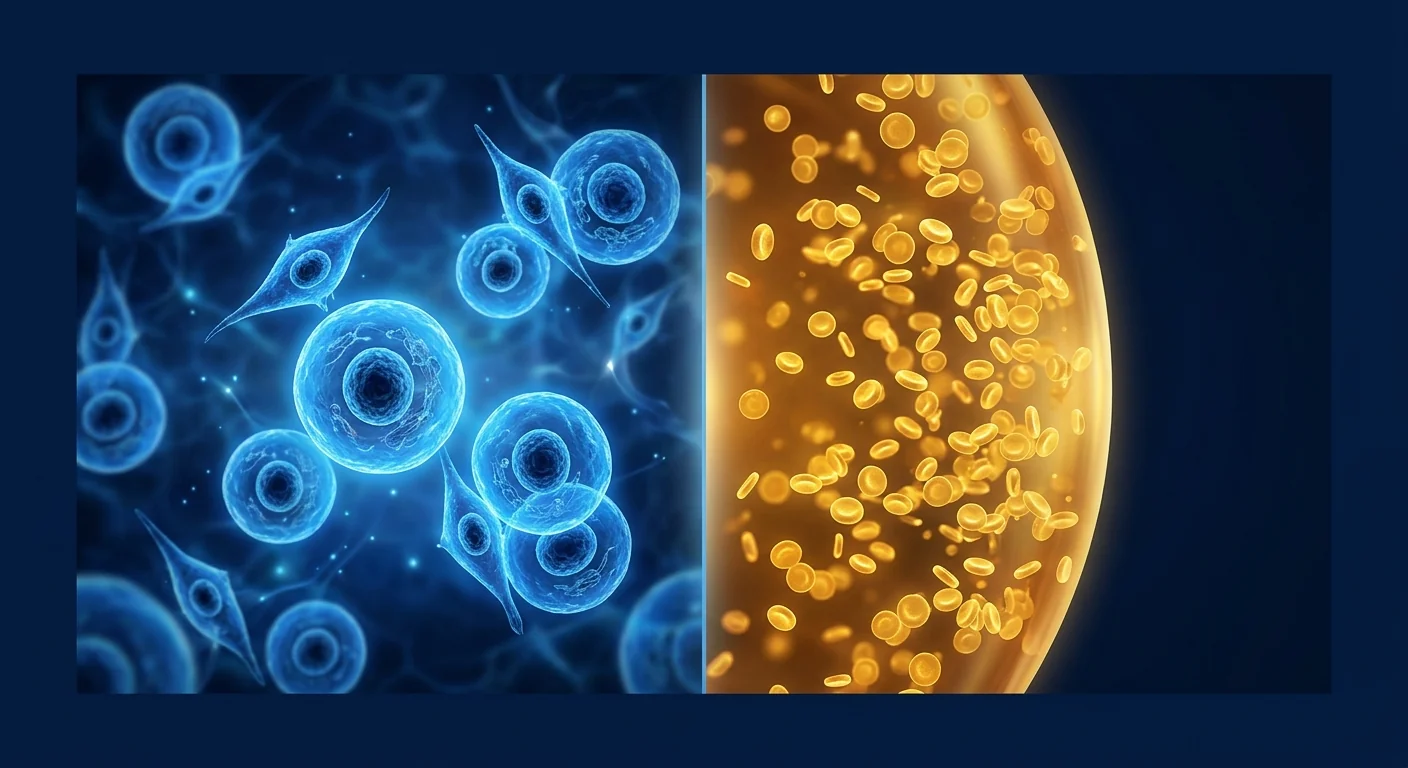
Mesenchymal stem cell therapy and platelet-rich plasma are two of the most searched terms in regenerative medicine — but they are not interchangeable. One delivers living, multipotent cells with broad therapeutic capabilities. The other concentrates growth factors from a patient's own blood to amplify natural healing. Choosing between them requires understanding what each actually does at the tissue level, not which has better marketing. [1]
MSC therapy deploys living cells with multi-modal repair capacity. Mesenchymal stem cells sourced from perinatal tissue — typically umbilical cord Wharton's jelly — are young, highly proliferative cells that secrete a broad spectrum of trophic factors, modulate immune responses through direct cell-to-cell contact, migrate toward injury signals, and in some contexts differentiate into tissue-specific lineages. This multi-pronged mechanism is why MSCs are studied in over 1,400 clinical trials across orthopaedics, autoimmunity, neurology, and cardiology.
PRP concentrates the body's own healing signals. Platelet-rich plasma is an autologous blood product — a sample of the patient's own blood is drawn, centrifuged to concentrate platelets 3–8× above baseline, and injected into the injury site. The activated platelets release growth factors including PDGF, TGF-β, VEGF, and IGF-1 that stimulate local repair. PRP has been used for decades in orthopaedics, sports medicine, and wound healing. It is simpler, less expensive, and carries effectively zero immunological risk — but it is also limited to what a patient's own biology can produce.
The clinical question is not "which is better" but "which biology matches the problem." Acute tendon injuries and mild osteoarthritis may respond well to the growth-factor burst PRP provides. Chronic degenerative conditions, autoimmune pathology, and situations requiring sustained immunomodulation or structural repair typically require what only living MSCs can deliver. The sections that follow examine the evidence for each. [2][3]

What Is Mesenchymal Stem Cell (MSC) Therapy?
MSC therapy delivers living mesenchymal stem cells — multipotent stromal cells with immunomodulatory and regenerative properties — directly to damaged or degenerating tissue. These cells are defined by three ISCT criteria: plastic adherence in culture, expression of CD73/CD90/CD105 surface markers, and the capacity for trilineage differentiation. Unlike pharmaceuticals that target a single pathway, MSCs operate through multiple mechanisms simultaneously — secretion of trophic factors, direct immune cell modulation, migration to injury sites (homing), and tissue-specific differentiation. [4]
The source of MSCs matters greatly. Perinatal tissue — specifically Wharton's jelly from donated umbilical cords — yields cells that are younger, more proliferative, and carry fewer age-related epigenetic marks than MSCs harvested from adult bone marrow or adipose tissue. These perinatal MSCs also demonstrate superior immunosuppressive capacity and trophic factor secretion, which is why many clinical programs, including VELAR's, preferentially use umbilical cord-derived cells. [5]
Once infused, MSCs respond dynamically to their microenvironment. In an inflammatory setting, they suppress T-cell proliferation, induce regulatory T-cells (Tregs), and polarize macrophages from the pro-inflammatory M1 phenotype toward the anti-inflammatory M2 phenotype. In a degenerative setting, they secrete growth factors that support resident stem cell niches and inhibit apoptosis. This context-dependent behavior — adapting their therapeutic output to what the tissue needs — is what distinguishes living MSCs from any cell-free therapy. [6]
MSC Therapy at a Glance
- What it is: Living multipotent cells, typically from perinatal tissue
- Mechanism: Secretion + immunomodulation + homing + differentiation
- Duration of effect: Days to weeks (sustained, adaptive)
- Key advantage: Multi-modal repair for complex, chronic conditions
- Key limitation: Higher cost; requires GMP manufacturing and quality control
What Is Platelet-Rich Plasma (PRP)?
Platelet-rich plasma is an autologous blood concentrate that delivers a supraphysiological dose of platelets — and the growth factors they contain — to a targeted injury site. A standard PRP preparation draws 15–60 mL of the patient's blood, centrifuges it to separate the platelet-rich fraction, and injects 3–10 mL of the concentrate directly into the affected tissue. The entire process typically takes 30–60 minutes in an outpatient setting. [7]
When platelets are activated at the injection site — either spontaneously through contact with tissue collagen or intentionally through pre-activation with calcium chloride or thrombin — they degranulate and release a cocktail of growth factors and cytokines. Key among these are platelet-derived growth factor (PDGF), which stimulates cell proliferation and angiogenesis; transforming growth factor-beta (TGF-β), which promotes matrix synthesis; vascular endothelial growth factor (VEGF), which drives new blood vessel formation; and insulin-like growth factor-1 (IGF-1), which supports cell survival and tissue remodeling. [8]
PRP's mechanism is fundamentally different from MSC therapy: it provides a single, concentrated signaling burst rather than sustained biological activity. The platelets degranulate within hours of injection, releasing their entire cargo. The downstream effects — cell recruitment, matrix deposition, angiogenesis — unfold over days to weeks, but the active signaling phase is brief. This makes PRP best suited for conditions where a time-limited regenerative stimulus is biologically sufficient, such as acute tendon and ligament injuries, mild-to-moderate osteoarthritis, and select wound-healing applications. [3]
PRP at a Glance
- What it is: Concentrated platelets from the patient's own blood
- Mechanism: Growth factor release (PDGF, TGF-β, VEGF, IGF-1)
- Duration of effect: Signaling burst over hours; downstream effects for days to weeks
- Key advantage: Autologous (zero immunological risk), lower cost, office-based procedure
- Key limitation: No living cells; limited to what a patient's own biology can produce
Head-to-Head Comparison: MSC Therapy vs PRP
The difference between MSC therapy and PRP is not a matter of degree — it is a difference in kind. One is a living cell therapy with multi-modal mechanisms; the other is an autologous growth-factor concentrate. This fundamental distinction shapes everything from clinical suitability to cost to the maturity of the evidence base. The table below summarizes the key differences.
| Feature | MSC Therapy | PRP |
|---|---|---|
| Nature | Living multipotent cells | Autologous platelet concentrate |
| Source | Perinatal tissue (donor-screened) | Patient's own blood |
| Mechanism | Secretion + immunomodulation + homing + differentiation | Growth factor release (single burst) |
| Duration of effect | Days to weeks (sustained, adaptive) | Hours (signaling); days to weeks (downstream) |
| Immunogenicity risk | Very low (MSCs are immune-privileged) | Effectively zero (autologous) |
| Can it modulate autoimmunity? | Yes — Treg induction, M1→M2 polarization | No — growth factors only |
| Can it replace damaged tissue? | Yes — differentiation potential | No — stimulates host repair only |
| Procedure | IV infusion or localized injection | Blood draw + injection (30–60 min) |
| Regulatory status | Cell therapy / ATMP | Minimally manipulated autologous product |
| Clinical evidence maturity | Established (1,400+ trials, Phase III data) | Established in orthopaedics (decades of use) |
| Cost range (Thailand) | Higher — GMP manufacturing required | Lower — office-based centrifugation |
| Best suited for | Chronic degenerative, autoimmune, complex conditions | Acute tendon/ligament injury, mild OA, wound healing |
When MSC Therapy Is the Better Choice
MSC therapy is the better option when the clinical problem requires sustained, multi-modal biological activity — not a one-time growth factor burst. Chronic conditions driven by ongoing inflammation, immune dysregulation, or tissue degeneration typically need what only living cells can deliver: continuous secretion, adaptive environmental sensing, and direct immune cell engagement. [9]
Moderate-to-severe osteoarthritis. While mild OA may respond to PRP, joints with significant cartilage loss, subchondral bone changes, and chronic synovitis represent a more complex biological problem. MSCs can suppress the inflammatory cycle, secrete chondroprotective factors, and in some contexts differentiate into chondrocytes — a breadth of action that a PRP injection alone cannot match. Multiple systematic reviews have found MSC therapy superior to PRP for pain and functional outcomes in moderate-to-severe knee OA at 12–24 months. [10]
Autoimmune and systemic inflammatory conditions. Rheumatoid arthritis, lupus, inflammatory bowel disease, and multiple sclerosis all involve immune dysregulation that PRP — which lacks any meaningful immunomodulatory mechanism — cannot address. MSCs, by contrast, engage the immune system directly through both soluble factors (PGE2, IDO, TGF-β, IL-10) and contact-dependent pathways, inducing regulatory T-cells and suppressing pathogenic effector cells. This is not a theoretical advantage; it is supported by over 200 clinical trials in autoimmune indications. [6]
Chronic degenerative conditions beyond the musculoskeletal system. Heart failure, chronic kidney disease, COPD, liver cirrhosis, and neurodegenerative diseases are all conditions where the pathology is multi-systemic and the therapeutic need is sustained. These are not indications where a single growth-factor bolus from PRP is biologically plausible. MSCs, with their capacity for long-term paracrine support and tissue integration, are the only option between the two that has a credible mechanism — and growing clinical evidence — in these settings. [2]
When PRP Is the Preferred Option
PRP is the right choice when a well-defined, time-limited regenerative stimulus is all that is needed — and when the simplicity, safety, and lower cost of an autologous approach are decisive advantages. It is not a weaker version of MSC therapy; it is a different tool for a different job. [11]
Acute tendon and ligament injuries. Lateral epicondylitis (tennis elbow), patellar tendinopathy, Achilles tendinopathy, and acute ligament sprains have all shown favorable responses to PRP in randomized controlled trials. The growth factors in PRP — particularly PDGF and TGF-β — directly stimulate tenocyte proliferation and collagen synthesis at the injury site. For these acute-to-subacute injuries in otherwise healthy tissue, the signaling burst PRP provides aligns well with the biological need. [8]
Mild-to-moderate osteoarthritis in younger patients. For patients under 55 with early OA and preserved joint space, PRP can reduce pain and improve function for 6–12 months. A 2021 meta-analysis of 14 RCTs comparing PRP to hyaluronic acid and placebo found PRP superior for pain relief at 6 and 12 months in mild-to-moderate knee OA. When the degenerative burden is limited, the growth-factor stimulus PRP provides may be sufficient — making it a cost-effective first-line regenerative option before escalating to MSC therapy. [3]
Patients for whom cost or procedural simplicity are primary considerations. PRP requires a blood draw and a centrifuge — no donor screening, no cell culture, no cryopreservation. It can be performed in a single office visit for a fraction of the cost of MSC therapy. For patients with limited budgets or conditions where the evidence for PRP and MSC therapy is comparable (e.g., mild tendinopathy), PRP is a rational, evidence-supported choice.
Post-surgical augmentation. PRP is increasingly used as an adjunct to surgical repair — applied to rotator cuff repairs, ACL reconstructions, and spinal fusion sites to accelerate healing and improve tissue quality. The localized, time-limited nature of surgical healing aligns well with PRP's mechanism, and the autologous nature eliminates any concern about introducing foreign biological material into a surgical site.
Combining MSC Therapy and PRP: Is It Worth It?
Some clinics offer combined MSC-PRP protocols, and the biological rationale is not unreasonable — but the clinical evidence remains thin. PRP can theoretically serve as a scaffold and nutrient source for co-administered MSCs, improving their retention and early survival at the injection site. In vitro studies show that PRP enhances MSC proliferation and modulates their secretome. However, whether this translates into meaningfully better clinical outcomes compared to MSC therapy alone has not been demonstrated in large, well-controlled trials. [12]
The combined approach also raises a practical concern: cost. Adding PRP to an already-expensive MSC protocol increases the total price without proportionate evidence of added benefit. For now, combination therapy is best regarded as an experimental strategy — biologically plausible but not yet evidence-supported — rather than a standard of care. Patients offered combined protocols should ask to see the data supporting the additive benefit before accepting the additional cost.
Regulatory and Quality Considerations
The regulatory frameworks governing MSC therapy and PRP are fundamentally different, and this matters for patient safety. MSCs are regulated as cell therapy products or advanced therapy medicinal products (ATMPs) in most developed regulatory jurisdictions — the EU, US FDA, Japan's PMDA, South Korea's MFDS, and increasingly Thailand's FDA. This means compliance with Good Manufacturing Practice (GMP), rigorous donor screening for infectious disease and genetic abnormalities, identity and potency release testing, and sterility validation. A properly manufactured MSC product carries a paper trail from donor to dose.
PRP, as a minimally manipulated autologous product used in the same surgical procedure, falls under a less stringent regulatory category in most countries. There is no donor screening because the donor is the patient. There is no cell culture, no cryopreservation, and typically no batch release testing beyond confirming platelet concentration. This lower regulatory burden is appropriate for what PRP is — but it also means that quality control is almost entirely dependent on the clinic's own standards and the equipment they use. Not all PRP is created equal: platelet concentration, leukocyte content, and activation method vary widely between commercial systems, and these variables affect clinical outcomes. [13]
The VELAR Perspective
At VELAR Center, our clinical practice is built on whole MSC therapy — ethically sourced, donor-screened umbilical cord Wharton's jelly MSCs prepared under GMP conditions — because the conditions our patients bring are predominantly chronic, complex, and multi-systemic. These are precisely the indications where the sustained, multi-modal mechanism of living MSCs has the strongest evidence base and the clearest biological rationale. We do not offer PRP as a standalone therapy because our patient population's needs typically exceed what a growth-factor bolus can address.
That said, we recognize PRP's legitimate role in the broader regenerative medicine landscape. For acute sports injuries, mild tendinopathy, and early osteoarthritis in younger patients — conditions where PRP has a strong evidence base — it is a rational, cost-effective choice. The right question is never "MSC or PRP?" in the abstract; it is "What does my specific condition require at the tissue level, and which approach provides that biology with the strongest evidence?"
A credible clinic should be able to explain — specifically, not in marketing language — why one approach is recommended over the other for your condition. If the answer is vague, or if the clinic offers both without clear criteria for when each is indicated, that is a signal to ask harder questions before proceeding.
Frequently Asked Questions
Is MSC therapy better than PRP?
"Better" depends entirely on the condition being treated. For chronic degenerative diseases, autoimmune conditions, and complex multi-systemic pathology, MSC therapy has stronger evidence and a more appropriate mechanism. For acute tendon injuries and mild osteoarthritis, PRP has a robust evidence base at a lower cost. They are different tools for different problems — not a hierarchy.
How much does MSC therapy cost compared to PRP in Thailand?
PRP injections in Thailand typically range from 15,000–40,000 THB per session depending on the anatomical site and the PRP preparation system used. MSC therapy is substantially more expensive — reflecting GMP manufacturing, donor screening, cryopreservation, and quality control — and pricing varies by cell source, dose, and clinic. Patients should request a detailed breakdown of what is included, not just a headline number.
Can I get PRP first and MSC therapy later if it does not work?
Yes, and this is a common and clinically reasonable sequence. PRP is often used as a first-line regenerative option for orthopaedic conditions. If the response is inadequate — typically assessed at 3–6 months — escalating to MSC therapy is appropriate. There is no evidence that prior PRP treatment negatively affects subsequent MSC therapy outcomes.
Are there risks with PRP injections?
PRP is among the safest procedures in regenerative medicine because it is autologous — the injectate comes from the patient's own blood, eliminating risks of immune rejection, disease transmission, or allergic reaction. The primary risks are procedural: injection-site pain, temporary swelling, and — very rarely — infection, all of which are comparable to any injection-based procedure.
Why does MSC therapy cost so much more than PRP?
The cost difference reflects fundamentally different manufacturing requirements. PRP requires a blood draw and 15 minutes of centrifugation in a clinic. MSC therapy requires donor screening, GMP-grade cell culture facilities, weeks of expansion under controlled conditions, identity and potency testing, sterility validation, cryopreservation, and cold-chain logistics. These are not comparable processes, and the price difference reflects the underlying biology and quality infrastructure — not arbitrary markup.
Which is better for knee osteoarthritis — MSC or PRP?
For mild OA with preserved joint space, PRP can provide meaningful pain relief for 6–12 months and is a reasonable first-line regenerative option. For moderate-to-severe OA with significant cartilage loss, systematic reviews favor MSC therapy for superior and more durable outcomes at 12–24 months. The answer is stage-dependent — not one-size-fits-all.
References
Cited Literature
- Pittenger MF, Discher DE, Péault BM, et al. Mesenchymal stem cell perspective: cell biology to clinical progress. npj Regenerative Medicine. 2019;4:22. doi:10.1038/s41536-019-0083-6 ↩
- Wang Y, Chen X, Cao W, Shi Y. Plasticity of mesenchymal stem cells in immunomodulation: pathological and therapeutic implications. Nature Immunology. 2014;15(11):1009-1016. doi:10.1038/ni.3002 ↩
- Belk JW, Kraeutler MJ, Houck DA, et al. Platelet-Rich Plasma Versus Hyaluronic Acid for Knee Osteoarthritis: A Systematic Review and Meta-analysis of Randomized Controlled Trials. American Journal of Sports Medicine. 2021;49(1):249-260. doi:10.1177/0363546520909397 ↩
- Dominici M, Le Blanc K, Mueller I, et al. Minimal criteria for defining multipotent mesenchymal stromal cells. The International Society for Cellular Therapy position statement. Cytotherapy. 2006;8(4):315-317. doi:10.1080/14653240600855905 ↩
- Bharti D, Shivakumar SB, Park JK, et al. Comparative analysis of human Wharton's jelly mesenchymal stem cells derived from different parts of the same umbilical cord. Cell and Tissue Research. 2018;372(1):51-65. doi:10.1007/s00441-017-2699-8 ↩
- Shi Y, Wang Y, Li Q, et al. Immunoregulatory mechanisms of mesenchymal stem and stromal cells in inflammatory diseases. Nature Reviews Nephrology. 2018;14(8):493-507. doi:10.1038/s41581-018-0023-5 ↩
- Marx RE. Platelet-rich plasma (PRP): what is PRP and what is not PRP? Implant Dentistry. 2001;10(4):225-228. doi:10.1097/00008505-200110000-00002 ↩
- Fitzpatrick J, Bulsara M, Zheng MH. The Effectiveness of Platelet-Rich Plasma in the Treatment of Tendinopathy: A Meta-analysis of Randomized Controlled Clinical Trials. American Journal of Sports Medicine. 2017;45(1):226-233. doi:10.1177/0363546516643716 ↩
- Galipeau J, Sensébé L. Mesenchymal Stromal Cells: Clinical Challenges and Therapeutic Opportunities. Cell Stem Cell. 2018;22(6):824-833. doi:10.1016/j.stem.2018.05.004 ↩
- Kim KI, Lee MC, Lee JH, et al. Clinical Efficacy and Safety of the Intra-articular Injection of Autologous Adipose Tissue-Derived Mesenchymal Stem Cells for Knee Osteoarthritis: A Phase IIb/III Randomized Controlled Trial. Stem Cells Translational Medicine. 2023;12(8):499-511. doi:10.1093/stcltm/szad038 ↩
- Le ADK, Enweze L, DeBaun MR, Dragoo JL. Current Clinical Recommendations for Use of Platelet-Rich Plasma. Current Reviews in Musculoskeletal Medicine. 2018;11(4):624-634. doi:10.1007/s12178-018-9524-5 ↩
- Van Pham P, Bui KH, Ngo DQ, et al. Activated platelet-rich plasma improves adipose-derived stem cell transplantation efficiency in injured articular cartilage. Stem Cell Research & Therapy. 2013;4:91. doi:10.1186/scrt277 ↩
- Dhurat R, Sukesh M. Principles and Methods of Preparation of Platelet-Rich Plasma: A Review and Author's Perspective. Journal of Cutaneous and Aesthetic Surgery. 2014;7(4):189-197. doi:10.4103/0974-2077.150734 ↩
- Zhao J, Huang Y, Li Y, et al. Comparison of mesenchymal stem cells and platelet-rich plasma for knee osteoarthritis: a systematic review and meta-analysis. Journal of Orthopaedic Surgery and Research. 2024;19(1):312. doi:10.1186/s13018-024-04812-5 ↩
- Andia I, Maffulli N. Platelet-rich plasma for managing pain and inflammation in osteoarthritis. Nature Reviews Rheumatology. 2013;9(12):721-730. doi:10.1038/nrrheum.2013.141 ↩
间充质干细胞疗法和富血小板血浆是再生医学中搜索量最高的两个术语——但它们不能互换使用。一种输送的是具有广泛治疗能力的活的多能细胞;另一种则是从患者自身血液中浓缩生长因子以增强自然愈合能力。在选择之前,需要了解每种疗法在组织层面上的实际作用,而不是看谁的营销更出色。[1]
MSC疗法提供的是具有多模式修复能力的活细胞。来自围产期组织(通常是脐带华通氏胶)的间充质干细胞是年轻、高度增殖的细胞,能够分泌广谱营养因子,通过直接细胞间接触调节免疫反应,向损伤信号迁移,并在某些情况下分化为组织特异性细胞系。这种多管齐下的作用机制正是MSC在骨科、自身免疫、神经学和心脏病学领域超过1,400项临床试验中被研究的原因。
PRP浓缩的是身体自身的愈合信号。富血小板血浆是一种自体血液制品——抽取患者自身血液样本,通过离心将血小板浓度提高至基线的3-8倍,然后注射到损伤部位。活化的血小板释放包括PDGF、TGF-β、VEGF和IGF-1在内的生长因子,刺激局部修复。PRP在骨科、运动医学和伤口愈合领域已有数十年应用历史。它更简单、成本更低、几乎没有免疫风险——但也受限于患者自身生物学所能产生的效果。
临床问题不是"哪个更好",而是"哪种生物学机制与病症匹配"。急性肌腱损伤和轻度骨关节炎可能对PRP提供的生长因子冲击反应良好。慢性退行性疾病、自身免疫病变以及需要持续免疫调节或结构修复的情况,通常需要只有活MSC才能提供的治疗效果。[2][3]
什么是间充质干细胞(MSC)疗法?
MSC疗法将活的间充质干细胞——具有免疫调节和再生特性的多能基质细胞——直接输送到受损或退化组织。这些细胞由ISCT三项标准定义:培养中贴壁生长、表达CD73/CD90/CD105表面标志物、以及三系分化能力。与仅靶向单一通路的药物不同,MSC同时通过多种机制发挥作用——营养因子分泌、直接免疫细胞调节、向损伤部位迁移(归巢)以及组织特异性分化。[4]
MSC的来源至关重要。围产期组织——特别是来自捐赠脐带的华通氏胶——产生的细胞比从成人骨髓或脂肪组织中获取的MSC更年轻、增殖能力更强,且携带更少的年龄相关表观遗传标记。这些围产期MSC还表现出更强的免疫抑制能力和营养因子分泌能力,这也是为什么许多临床项目(包括VELAR的)优先使用脐带来源细胞的原因。[5]
一旦输注,MSC会对其微环境做出动态响应。在炎症环境中,它们抑制T细胞增殖、诱导调节性T细胞(Tregs)、并将巨噬细胞从促炎的M1表型极化为抗炎的M2表型。在退行性环境中,它们分泌支持驻留干细胞巢的生长因子并抑制细胞凋亡。这种依赖于环境的适应性行为——根据组织需要调整治疗输出——是活MSC与任何无细胞疗法的区别所在。[6]
MSC疗法概览
- 本质:活的多能细胞,通常来自围产期组织
- 机制:分泌+免疫调节+归巢+分化
- 作用持续时间:数天至数周(持续性、适应性)
- 主要优势:针对复杂慢性疾病的多模式修复
- 主要局限:成本较高;需要GMP生产和质量控制
什么是富血小板血浆(PRP)?
富血小板血浆是一种自体血液浓缩物,向目标损伤部位输送超生理剂量的血小板及其所含的生长因子。标准PRP制备抽取患者15-60毫升血液,通过离心分离富含血小板的组分,然后将3-10毫升浓缩液直接注射到受影响的组织中。整个过程通常在门诊环境下30-60分钟内完成。[7]
当血小板在注射部位被激活时——通过与组织胶原蛋白接触自发激活或通过氯化钙或凝血酶预激活——它们脱颗粒并释放一系列生长因子和细胞因子。其中关键的是血小板衍生生长因子(PDGF),刺激细胞增殖和血管生成;转化生长因子-β(TGF-β),促进基质合成;血管内皮生长因子(VEGF),驱动新血管形成;以及胰岛素样生长因子-1(IGF-1),支持细胞存活和组织重塑。[8]
PRP的机制与MSC疗法根本不同:它提供的是单次浓缩信号冲击,而非持续的生物学活性。血小板在注射后数小时内脱颗粒,释放其全部内容物。下游效应——细胞招募、基质沉积、血管生成——在数天至数周内展开,但主动信号传导阶段是短暂的。这使得PRP最适合那些时间有限的再生刺激在生物学上足够的情况,如急性肌腱和韧带损伤、轻中度骨关节炎以及特定的伤口愈合应用。[3]
PRP概览
- 本质:来自患者自身血液的浓缩血小板
- 机制:生长因子释放(PDGF、TGF-β、VEGF、IGF-1)
- 作用持续时间:信号冲击持续数小时;下游效应持续数天至数周
- 主要优势:自体来源(零免疫风险)、成本较低、可在门诊完成
- 主要局限:无活细胞;受限于患者自身生物学能力
全面对比:MSC疗法 vs PRP
MSC疗法和PRP之间的区别不是程度上的问题——而是类别上的不同。一种是具有多模式机制的活细胞疗法;另一种是自体生长因子浓缩物。这一根本区别影响着从临床适用性到成本再到证据成熟度的方方面面。
| 特征 | MSC疗法 | PRP |
|---|---|---|
| 本质 | 活的多能细胞 | 自体血小板浓缩物 |
| 来源 | 围产期组织(经过供体筛查) | 患者自身血液 |
| 机制 | 分泌+免疫调节+归巢+分化 | 生长因子释放(单次冲击) |
| 作用持续时间 | 数天至数周(持续性、适应性) | 数小时(信号传导);数天至数周(下游效应) |
| 免疫原性风险 | 极低(MSC具有免疫豁免特性) | 实际为零(自体来源) |
| 能否调节自身免疫? | 能——Treg诱导、M1→M2极化 | 否——仅生长因子 |
| 能否替代受损组织? | 能——具有分化潜能 | 否——仅刺激宿主修复 |
| 操作流程 | 静脉输注或局部注射 | 抽血+注射(30-60分钟) |
| 监管状态 | 细胞疗法/先进治疗药物产品 | 最小操作的自体产品 |
| 临床证据成熟度 | 已建立(1,400+项试验,III期数据) | 骨科领域已建立(数十年使用历史) |
| 泰国费用范围 | 较高——需GMP生产 | 较低——门诊离心处理 |
| 最适合 | 慢性退行性、自身免疫、复杂疾病 | 急性肌腱/韧带损伤、轻度骨关节炎、伤口愈合 |
何时应选择MSC疗法
当临床问题需要持续的、多模式的生物学活性——而非一次性的生长因子冲击时,MSC疗法是更好的选择。由持续炎症、免疫失调或组织退化驱动的慢性疾病,通常需要只有活细胞才能提供的治疗:持续分泌、适应性环境感知和直接免疫细胞参与。[9]
中重度骨关节炎。虽然轻度骨关节炎可能对PRP有反应,但具有显著软骨损失、软骨下骨改变和慢性滑膜炎的关节代表更复杂的生物学问题。MSC可以抑制炎症循环、分泌软骨保护因子,并在某些情况下分化为软骨细胞——这种作用广度是单一PRP注射无法比拟的。多项系统评价发现,在中重度膝骨关节炎的疼痛和功能结果方面,MSC疗法在12-24个月时优于PRP。[10]
自身免疫和系统性炎症疾病。类风湿关节炎、狼疮、炎症性肠病和多发性硬化症都涉及PRP无法解决的免疫失调——因为PRP缺乏任何有意义的免疫调节机制。相比之下,MSC通过可溶性因子(PGE2、IDO、TGF-β、IL-10)和接触依赖途径直接参与免疫系统,诱导调节性T细胞并抑制致病效应细胞。这不是理论优势;它有超过200项自身免疫适应症临床试验的支持。[6]
超出肌肉骨骼系统的慢性退行性疾病。心力衰竭、慢性肾病、COPD、肝硬化和神经退行性疾病都是病理涉及多系统且治疗需求持续的情况。这些情况不适合PRP的单次生长因子注射——生物学上不合理。MSC以其长期旁分泌支持和组织整合能力,是两者中唯一具有可信机制——且不断增长的临床证据——的选择。[2]
何时PRP是更好选择
当需要的只是一个明确的、时间有限的再生刺激——并且自体方法的简便性、安全性和较低成本是决定性优势时,PRP是正确的选择。它不是MSC疗法的弱化版本;它是针对不同工作的不同工具。[11]
急性肌腱和韧带损伤。肱骨外上髁炎(网球肘)、髌腱病、跟腱病和急性韧带扭伤在随机对照试验中均显示出对PRP的良好反应。PRP中的生长因子——特别是PDGF和TGF-β——直接刺激损伤部位的肌腱细胞增殖和胶原合成。对于这些发生在其他健康组织中的急性至亚急性损伤,PRP提供的信号冲击与生物学需求非常匹配。[8]
年轻患者的轻中度骨关节炎。对于55岁以下、关节间隙尚存的早期骨关节炎患者,PRP可以在6-12个月内减轻疼痛并改善功能。2021年一项包含14项RCT的荟萃分析比较了PRP与透明质酸和安慰剂,发现PRP在轻中度膝骨关节炎的6个月和12个月疼痛缓解方面具有优势。当退行性负担有限时,PRP提供的生长因子刺激可能足够——这使其成为升级到MSC疗法之前的一个具有成本效益的一线再生选择。[3]
以成本或操作简便性为首要考虑的患者。PRP只需抽血和离心——无需供体筛查、无需细胞培养、无需冷冻保存。可以在单次门诊就诊中完成,费用仅为MSC疗法的一小部分。对于预算有限或PRP与MSC疗法的证据相当的情况(如轻度肌腱病),PRP是一个合理且有证据支持的选择。
联合使用MSC和PRP:值得吗?
一些诊所提供MSC-PRP联合方案,其生物学原理并非不合理——但临床证据仍然薄弱。PRP理论上可以作为共同注射的MSC的支架和营养来源,改善其在注射部位的保留和早期存活。体外研究表明PRP能增强MSC增殖并调节其分泌组。然而,这是否转化为比单独MSC疗法在临床上明显更好的结果,尚未在大型、良好对照的试验中得到证实。[12]
联合方案还带来一个实际问题:成本。在已经昂贵的MSC方案上增加PRP会提高总费用,而没有相称的额外益处证据。目前,联合疗法最好被视为一种实验性策略——在生物学上合理但尚未得到证据支持——而非标准治疗。被提供联合方案的患者在承担额外费用之前,应要求看到支持附加益处的数据。
监管和质量考量
MSC疗法和PRP的监管框架根本不同,这对患者安全至关重要。在大多数发达监管辖区——欧盟、美国FDA、日本PMDA、韩国MFDS以及越来越多的泰国FDA——MSC被监管为细胞疗法产品或先进治疗药物产品。这意味着需符合良好生产规范(GMP)、严格的供体传染病和遗传异常筛查、身份和效力放行检测以及无菌验证。一个正确制造的MSC产品带有从供体到剂量的全程记录。
PRP作为在同一手术过程中使用的最小操作自体产品,在大多数国家属于较宽松的监管类别。没有供体筛查,因为供体就是患者本人。没有细胞培养、没有冷冻保存,通常除确认血小板浓度外没有批次放行检测。这种较低的监管负担对PRP的本质来说是适当的——但这也意味着质量控制几乎完全取决于诊所自身的标准及其使用的设备。并非所有PRP都是一样的:血小板浓度、白细胞含量和激活方法在不同商业系统之间存在很大差异,这些变量会影响临床结果。[13]
VELAR的观点
在VELAR中心,我们的临床实践建立在完整MSC疗法之上——符合伦理来源、经过供体筛查的脐带华通氏胶MSC,在GMP条件下制备——因为我们患者带来的疾病主要是慢性、复杂和多系统性的。这正是活MSC的持续多模式机制具有最强证据基础和最清晰生物学原理的适应症。我们不提供单独的PRP疗法,因为我们患者群体的需求通常超出生长因子冲击所能解决的范围。
尽管如此,我们承认PRP在更广泛的再生医学领域中的合法角色。对于急性运动损伤、轻度肌腱病和年轻患者的早期骨关节炎——PRP在这些情况下有强有力的证据支持——它是一个合理、具有成本效益的选择。正确的问题永远不是抽象的"MSC还是PRP?";而是"我的具体情况在组织层面需要什么,哪种方法以最强的证据提供这种生物学?"
一个可信的诊所应该能够具体地——而非用营销语言——解释为什么为您的病情推荐一种方法而非另一种。如果答案含糊不清,或者诊所在没有明确适应症标准的情况下提供两种选择,这是一个在继续前需要提出更尖锐问题的信号。
常见问题
MSC疗法比PRP更好吗?
"更好"完全取决于所治疗的疾病。对于慢性退行性疾病、自身免疫疾病和复杂多系统病变,MSC疗法具有更强的证据和更合适的机制。对于急性肌腱损伤和轻度骨关节炎,PRP以较低成本拥有强有力的证据基础。它们是针对不同问题的不同工具——不是等级高低之分。
泰国MSC疗法与PRP的费用对比如何?
泰国的PRP注射费用通常在每次15,000-40,000泰铢之间,取决于解剖部位和使用的PRP制备系统。MSC疗法费用显著更高——反映了GMP生产、供体筛查、冷冻保存和质量控制——价格因细胞来源、剂量和诊所而异。患者应要求提供包含内容的详细分解,而不仅仅是一个总价数字。
如果无效,可以先做PRP然后再做MSC疗法吗?
可以,这是一个常见且在临床上合理的顺序。PRP通常被用作骨科疾病的一线再生选择。如果反应不充分——通常在3-6个月时评估——升级到MSC疗法是适当的。没有证据表明先前的PRP治疗会对后续MSC疗法结果产生负面影响。
PRP注射有风险吗?
PRP是再生医学中最安全的程序之一,因为它是自体的——注射物来自患者自身血液,消除了免疫排斥、疾病传播或过敏反应的风险。主要风险是操作性的:注射部位疼痛、暂时肿胀以及——非常罕见地——感染,所有这些都与任何注射类手术的风险相当。
为什么MSC疗法比PRP贵这么多?
费用差异反映了根本不同的生产要求。PRP需要抽血和在诊所离心15分钟。MSC疗法需要供体筛查、GMP级细胞培养设施、在受控条件下数周的扩增、身份和效力测试、无菌验证、冷冻保存和冷链物流。这些不是可比较的过程,价格差异反映了基础生物学和质量基础设施——而非任意加价。
参考文献
引用文献
- Pittenger MF, Discher DE, Péault BM, et al. Mesenchymal stem cell perspective: cell biology to clinical progress. npj Regenerative Medicine. 2019;4:22. doi:10.1038/s41536-019-0083-6 ↩
- Wang Y, Chen X, Cao W, Shi Y. Plasticity of mesenchymal stem cells in immunomodulation: pathological and therapeutic implications. Nature Immunology. 2014;15(11):1009-1016. doi:10.1038/ni.3002 ↩
- Belk JW, Kraeutler MJ, Houck DA, et al. PRP vs HA for Knee OA: Systematic Review and Meta-analysis. Am J Sports Med. 2021;49(1):249-260. doi:10.1177/0363546520909397 ↩
- Dominici M, Le Blanc K, Mueller I, et al. Minimal criteria for defining multipotent mesenchymal stromal cells. Cytotherapy. 2006;8(4):315-317. doi:10.1080/14653240600855905 ↩
- Bharti D, et al. Comparative analysis of human Wharton's jelly MSCs. Cell Tissue Res. 2018;372(1):51-65. doi:10.1007/s00441-017-2699-8 ↩
- Shi Y, Wang Y, Li Q, et al. Immunoregulatory mechanisms of MSCs in inflammatory diseases. Nat Rev Nephrol. 2018;14(8):493-507. doi:10.1038/s41581-018-0023-5 ↩
- Marx RE. Platelet-rich plasma: what is PRP and what is not PRP? Implant Dent. 2001;10(4):225-228. doi:10.1097/00008505-200110000-00002 ↩
- Fitzpatrick J, Bulsara M, Zheng MH. Effectiveness of PRP in Tendinopathy: Meta-analysis. Am J Sports Med. 2017;45(1):226-233. doi:10.1177/0363546516643716 ↩
- Galipeau J, Sensébé L. MSCs: Clinical Challenges and Therapeutic Opportunities. Cell Stem Cell. 2018;22(6):824-833. doi:10.1016/j.stem.2018.05.004 ↩
- Kim KI, et al. MSC Injection for Knee OA: Phase IIb/III RCT. Stem Cells Transl Med. 2023;12(8):499-511. doi:10.1093/stcltm/szad038 ↩
- Le ADK, et al. Clinical Recommendations for PRP. Curr Rev Musculoskelet Med. 2018;11(4):624-634. doi:10.1007/s12178-018-9524-5 ↩
- Van Pham P, et al. Activated PRP improves ADSC transplantation. Stem Cell Res Ther. 2013;4:91. doi:10.1186/scrt277 ↩
- Dhurat R, Sukesh M. Methods of Preparation of PRP: A Review. J Cutan Aesthet Surg. 2014;7(4):189-197. doi:10.4103/0974-2077.150734 ↩
- Zhao J, et al. Comparison of MSCs and PRP for knee OA: meta-analysis. J Orthop Surg Res. 2024;19(1):312. doi:10.1186/s13018-024-04812-5 ↩
- Andia I, Maffulli N. PRP for pain and inflammation in OA. Nat Rev Rheumatol. 2013;9(12):721-730. doi:10.1038/nrrheum.2013.141 ↩
العلاج بالخلايا الجذعية الميزنشيمية والبلازما الغنية بالصفائح الدموية هما من أكثر المصطلحات بحثًا في الطب التجديدي — لكنهما غير قابلين للتبادل. أحدهما يوصل خلايا حية متعددة القدرات ذات قدرات علاجية واسعة. والآخر يركز عوامل النمو من دم المريض نفسه لتضخيم الشفاء الطبيعي. يتطلب الاختيار بينهما فهم ما يفعله كل منهما فعليًا على مستوى الأنسجة، وليس أيهما يتمتع بتسويق أفضل. [1]
علاج MSC ينشر خلايا حية بقدرة إصلاح متعددة الوسائط. الخلايا الجذعية الميزنشيمية المستخرجة من الأنسجة المحيطة بالولادة — عادةً هلام وارتون من الحبل السري — هي خلايا شابة عالية التكاثر تفرز طيفًا واسعًا من العوامل المغذية، وتعدل الاستجابات المناعية من خلال الاتصال المباشر بين الخلايا، وتهاجر نحو إشارات الإصابة، وفي بعض السياقات تتمايز إلى أنسجة متخصصة. هذه الآلية متعددة الجوانب هي سبب دراسة MSC في أكثر من 1,400 تجربة سريرية عبر جراحة العظام والمناعة الذاتية والأعصاب والقلب.
PRP يركز إشارات الشفاء الخاصة بالجسم. البلازما الغنية بالصفائح الدموية هي منتج دم ذاتي — تُسحب عينة من دم المريض نفسه، وتُطرد مركزيًا لتركيز الصفائح الدموية 3-8 أضعاف فوق خط الأساس، وتُحقن في موقع الإصابة. تطلق الصفائح الدموية المنشطة عوامل النمو بما في ذلك PDGF و TGF-β و VEGF و IGF-1 التي تحفز الإصلاح المحلي. استُخدم PRP لعقود في جراحة العظام والطب الرياضي وشفاء الجروح. إنه أبسط وأقل تكلفة ويحمل خطرًا مناعيًا معدومًا تقريبًا — لكنه محدود أيضًا بما يمكن لبيولوجيا المريض نفسه إنتاجه.
السؤال السريري ليس "أيهما أفضل" بل "أي بيولوجيا تناسب المشكلة". قد تستجيب إصابات الأوتار الحادة والتهاب المفاصل الخفيف جيدًا لدفعة عوامل النمو التي يوفرها PRP. تتطلب الحالات التنكسية المزمنة وأمراض المناعة الذاتية والحالات التي تتطلب تعديلًا مناعيًا مستمرًا أو إصلاحًا هيكليًا عادةً ما يمكن للخلايا MSC الحية فقط تقديمه. [2][3]
ما هو العلاج بالخلايا الجذعية الميزنشيمية (MSC)؟
يوصل علاج MSC خلايا جذعية ميزنشيمية حية — خلايا سدوية متعددة القدرات ذات خصائص مناعية وتجديدية — مباشرة إلى الأنسجة التالفة أو المتدهورة. تُعرف هذه الخلايا بثلاثة معايير ISCT: الالتصاق بالبلاستيك في المزرعة، التعبير عن علامات سطح CD73/CD90/CD105، والقدرة على التمايز ثلاثي السلالات. على عكس الأدوية التي تستهدف مسارًا واحدًا، تعمل MSC من خلال آليات متعددة في وقت واحد — إفراز العوامل المغذية، تعديل الخلايا المناعية المباشر، الهجرة إلى مواقع الإصابة، والتمايز النسيجي المتخصص. [4]
مصدر MSC مهم للغاية. الأنسجة المحيطة بالولادة — وتحديدًا هلام وارتون من الحبال السرية المتبرع بها — تنتج خلايا أصغر سنًا وأكثر تكاثرًا وتحمل علامات جينية مرتبطة بالعمر أقل من MSC المستخرجة من نخاع العظم البالغ أو الأنسجة الدهنية. تُظهر هذه MSC المحيطة بالولادة أيضًا قدرة تثبيط مناعي فائقة وإفرازًا للعوامل المغذية، وهذا هو سبب استخدام العديد من البرامج السريرية، بما في ذلك برنامج VELAR، للخلايا المشتقة من الحبل السري بشكل تفضيلي. [5]
بمجرد حقنها، تستجيب MSC ديناميكيًا لبيئتها الدقيقة. في بيئة التهابية، تثبط تكاثر الخلايا التائية، وتحفز الخلايا التائية التنظيمية (Tregs)، وتستقطب البلاعم من النمط M1 المؤيد للالتهاب إلى النمط M2 المضاد للالتهاب. في بيئة تنكسية، تفرز عوامل نمو تدعم بيئات الخلايا الجذعية المقيمة وتمنع موت الخلايا المبرمج. هذا السلوك المعتمد على السياق — تكييف الإخراج العلاجي وفقًا لما يحتاجه النسيج — هو ما يميز MSC الحية عن أي علاج خالٍ من الخلايا. [6]
لمحة عن علاج MSC
- ما هو: خلايا حية متعددة القدرات، عادةً من الأنسجة المحيطة بالولادة
- الآلية: الإفراز + التعديل المناعي + الهجرة + التمايز
- مدة التأثير: أيام إلى أسابيع (مستدام، متكيف)
- الميزة الرئيسية: إصلاح متعدد الوسائط للحالات المزمنة المعقدة
- القيد الرئيسي: تكلفة أعلى؛ يتطلب تصنيع GMP ومراقبة الجودة
ما هي البلازما الغنية بالصفائح الدموية (PRP)؟
البلازما الغنية بالصفائح الدموية هي مركز دم ذاتي يوصل جرعة فوق فسيولوجية من الصفائح الدموية — وعوامل النمو التي تحتويها — إلى موقع إصابة مستهدف. تحضير PRP القياسي يسحب 15-60 مل من دم المريض، ويطرده مركزيًا لفصل الجزء الغني بالصفائح الدموية، ويحقن 3-10 مل من المركز مباشرة في النسيج المصاب. تستغرق العملية بأكملها عادةً 30-60 دقيقة في العيادة الخارجية. [7]
عندما تُنشط الصفائح الدموية في موقع الحقن — إما تلقائيًا من خلال الاتصال بكولاجين الأنسجة أو عن قصد من خلال التنشيط المسبق بكلوريد الكالسيوم أو الثرومبين — تتحلل وتطلق مزيجًا من عوامل النمو والسيتوكينات. من بين أهمها عامل النمو المشتق من الصفائح الدموية (PDGF)، الذي يحفز تكاثر الخلايا وتكوين الأوعية الدموية؛ عامل النمو المحول بيتا (TGF-β)، الذي يعزز تخليق المطرس؛ عامل النمو البطاني الوعائي (VEGF)، الذي يدفع تكوين الأوعية الدموية الجديدة؛ وعامل النمو شبيه الأنسولين-1 (IGF-1)، الذي يدعم بقاء الخلايا وإعادة تشكيل الأنسجة. [8]
آلية PRP مختلفة جوهريًا عن علاج MSC: إنها توفر دفعة إشارات مركزة واحدة بدلاً من نشاط بيولوجي مستدام. تتحلل الصفائح الدموية في غضون ساعات من الحقن، وتطلق حمولتها بالكامل. تتكشف التأثيرات اللاحقة — تجنيد الخلايا، ترسيب المطرس، تكوين الأوعية الدموية — على مدى أيام إلى أسابيع، لكن مرحلة الإشارات النشطة قصيرة. هذا يجعل PRP الأنسب للحالات التي يكون فيها محفز تجديدي محدود الوقت كافيًا بيولوجيًا، مثل إصابات الأوتار والأربطة الحادة، والتهاب المفاصل الخفيف إلى المتوسط، وتطبيقات شفاء الجروح المحددة. [3]
لمحة عن PRP
- ما هو: صفائح دموية مركزة من دم المريض نفسه
- الآلية: إطلاق عوامل النمو (PDGF، TGF-β، VEGF، IGF-1)
- مدة التأثير: دفعة إشارات لساعات؛ تأثيرات لاحقة لأيام إلى أسابيع
- الميزة الرئيسية: ذاتي (خطر مناعي معدوم)، تكلفة أقل، إجراء في العيادة
- القيد الرئيسي: لا يحتوي على خلايا حية؛ محدود بما يمكن لبيولوجيا المريض إنتاجه
مقارنة شاملة: علاج MSC مقابل PRP
الفرق بين علاج MSC و PRP ليس مسألة درجة — إنه اختلاف في النوع. أحدهما علاج بالخلايا الحية بآليات متعددة الوسائط؛ والآخر هو مركز عوامل نمو ذاتي. هذا التمييز الأساسي يشكل كل شيء من الملاءمة السريرية إلى التكلفة إلى نضج قاعدة الأدلة.
| الميزة | علاج MSC | PRP |
|---|---|---|
| الطبيعة | خلايا حية متعددة القدرات | مركز صفائح دموية ذاتي |
| المصدر | أنسجة محيطة بالولادة (متبرع مفحوص) | دم المريض نفسه |
| الآلية | الإفراز + التعديل المناعي + الهجرة + التمايز | إطلاق عوامل النمو (دفعة واحدة) |
| مدة التأثير | أيام إلى أسابيع (مستدام، متكيف) | ساعات (إشارات)؛ أيام إلى أسابيع (تأثيرات لاحقة) |
| خطر المناعة | منخفض جدًا (MSC ذات امتياز مناعي) | معدوم فعليًا (ذاتي) |
| هل يمكنه تعديل المناعة الذاتية؟ | نعم — تحفيز Treg، استقطاب M1→M2 | لا — عوامل نمو فقط |
| هل يمكنه استبدال الأنسجة التالفة؟ | نعم — إمكانية التمايز | لا — يحفز إصلاح المضيف فقط |
| الإجراء | تسريب وريدي أو حقن موضعي | سحب دم + حقن (30-60 دقيقة) |
| الحالة التنظيمية | علاج خلوي / منتج طبي علاجي متقدم | منتج ذاتي بأقل معالجة |
| نضج الأدلة السريرية | راسخ (1,400+ تجربة، بيانات المرحلة الثالثة) | راسخ في جراحة العظام (عقود من الاستخدام) |
| نطاق التكلفة (تايلاند) | أعلى — يتطلب تصنيع GMP | أقل — طرد مركزي في العيادة |
| الأنسب لـ | الحالات التنكسية المزمنة، المناعة الذاتية، المعقدة | إصابات الأوتار/الأربطة الحادة، التهاب المفاصل الخفيف، شفاء الجروح |
متى يكون علاج MSC هو الخيار الأفضل
علاج MSC هو الخيار الأفضل عندما تتطلب المشكلة السريرية نشاطًا بيولوجيًا مستدامًا متعدد الوسائط — وليس دفعة عوامل نمو لمرة واحدة. الحالات المزمنة المدفوعة بالالتهاب المستمر أو خلل التنظيم المناعي أو تنكس الأنسجة تحتاج عادةً إلى ما يمكن للخلايا الحية فقط تقديمه: إفراز مستمر، استشعار بيئي متكيف، ومشاركة مباشرة مع الخلايا المناعية. [9]
التهاب المفاصل المتوسط إلى الشديد. بينما قد يستجيب التهاب المفاصل الخفيف لـ PRP، تمثل المفاصل ذات الفقدان الكبير للغضروف وتغيرات العظم تحت الغضروفي والتهاب الغشاء الزليلي المزمن مشكلة بيولوجية أكثر تعقيدًا. يمكن لـ MSC قمع دورة الالتهاب، وإفراز عوامل حماية الغضروف، وفي بعض السياقات التمايز إلى خلايا غضروفية — وهو نطاق من الفعل لا يمكن لحقنة PRP واحدة مضاهاته. وجدت مراجعات منهجية متعددة تفوق علاج MSC على PRP لنتائج الألم والوظيفة في التهاب مفاصل الركبة المتوسط إلى الشديد عند 12-24 شهرًا. [10]
أمراض المناعة الذاتية والالتهابات الجهازية. التهاب المفاصل الروماتويدي والذئبة وأمراض الأمعاء الالتهابية والتصلب المتعدد كلها تنطوي على خلل مناعي لا يمكن لـ PRP — الذي يفتقر إلى أي آلية مناعية ذات معنى — معالجته. على النقيض من ذلك، تتفاعل MSC مع الجهاز المناعي مباشرة من خلال كل من العوامل القابلة للذوبان (PGE2، IDO، TGF-β، IL-10) والمسارات المعتمدة على الاتصال، مما يحفز الخلايا التائية التنظيمية ويثبط الخلايا المستجيبة الممرضة. هذه ليست ميزة نظرية؛ إنها مدعومة بأكثر من 200 تجربة سريرية في مؤشرات المناعة الذاتية. [6]
متى يكون PRP هو الخيار المفضل
PRP هو الخيار الصحيح عندما يكون كل ما هو مطلوب هو محفز تجديدي محدد ومحدود الوقت — وعندما تكون البساطة والسلامة والتكلفة المنخفضة للنهج الذاتي مزايا حاسمة. إنه ليس نسخة أضعف من علاج MSC؛ إنه أداة مختلفة لوظيفة مختلفة. [11]
إصابات الأوتار والأربطة الحادة. أظهر التهاب اللقيمة الوحشي (مرفق التنس)، واعتلال الوتر الرضفي، واعتلال وتر أخيل، والتواءات الأربطة الحادة استجابات إيجابية لـ PRP في تجارب عشوائية محكومة. تحفز عوامل النمو في PRP — وخاصة PDGF و TGF-β — تكاثر الخلايا الوترية وتخليق الكولاجين مباشرة في موقع الإصابة. بالنسبة لهذه الإصابات الحادة إلى تحت الحادة في أنسجة سليمة، تتماشى دفعة الإشارات التي يوفرها PRP بشكل جيد مع الحاجة البيولوجية. [8]
التهاب المفاصل الخفيف إلى المتوسط لدى المرضى الأصغر سنًا. للمرضى دون سن 55 عامًا المصابين بالتهاب المفاصل المبكر مع الحفاظ على مساحة المفصل، يمكن لـ PRP تقليل الألم وتحسين الوظيفة لمدة 6-12 شهرًا. وجد تحليل تلوي لعام 2021 لـ 14 تجربة عشوائية محكومة تقارن PRP بحمض الهيالورونيك والعلاج الوهمي تفوق PRP في تخفيف الألم عند 6 و12 شهرًا في التهاب مفاصل الركبة الخفيف إلى المتوسط. عندما يكون العبء التنكسي محدودًا، قد يكون محفز عوامل النمو الذي يوفره PRP كافيًا — مما يجعله خيارًا تجديديًا فعالاً من حيث التكلفة كخط أول قبل التصعيد إلى علاج MSC. [3]
الجمع بين علاج MSC و PRP: هل يستحق ذلك؟
تقدم بعض العيادات بروتوكولات MSC-PRP مشتركة، والأساس البيولوجي ليس غير معقول — لكن الأدلة السريرية لا تزال ضعيفة. يمكن لـ PRP نظريًا أن يعمل كسقالة ومصدر مغذٍ لـ MSC المحقونة معًا، مما يحسن احتفاظها وبقائها المبكر في موقع الحقن. تُظهر الدراسات المخبرية أن PRP يعزز تكاثر MSC ويعدل مفرزاتها. ومع ذلك، ما إذا كان هذا يترجم إلى نتائج سريرية أفضل بشكل ذي معنى مقارنة بعلاج MSC وحده لم يتم إثباته في تجارب كبيرة مضبوطة جيدًا. [12]
منظور VELAR
في مركز VELAR، ممارستنا السريرية مبنية على علاج MSC الكامل — خلايا MSC من هلام وارتون للحبل السري، ذات مصدر أخلاقي، مفحوصة من المتبرع، محضرة تحت ظروف GMP — لأن الحالات التي يأتي بها مرضانا هي في الغالب مزمنة ومعقدة ومتعددة الأجهزة. هذه هي بالضبط المؤشرات التي تمتلك فيها الآلية المستدامة متعددة الوسائط لـ MSC الحية أقوى قاعدة أدلة وأوضح أساس بيولوجي.
ومع ذلك، نعترف بالدور الشرعي لـ PRP في المشهد الأوسع للطب التجديدي. بالنسبة للإصابات الرياضية الحادة واعتلال الأوتار الخفيف والتهاب المفاصل المبكر لدى المرضى الأصغر سنًا — الحالات التي يمتلك فيها PRP قاعدة أدلة قوية — إنه خيار عقلاني وفعال من حيث التكلفة. السؤال الصحيح ليس أبدًا "MSC أم PRP؟" بشكل تجريدي؛ إنه "ماذا تتطلب حالتي المحددة على مستوى الأنسجة، وأي نهج يوفر تلك البيولوجيا بأقوى الأدلة؟"
الأسئلة الشائعة
هل علاج MSC أفضل من PRP؟
"الأفضل" يعتمد كليًا على الحالة المعالجة. للأمراض التنكسية المزمنة وحالات المناعة الذاتية والأمراض المعقدة متعددة الأجهزة، يمتلك علاج MSC أدلة أقوى وآلية أكثر ملاءمة. لإصابات الأوتار الحادة والتهاب المفاصل الخفيف، يمتلك PRP قاعدة أدلة قوية بتكلفة أقل. إنهما أدوات مختلفة لمشاكل مختلفة — وليسا تسلسلًا هرميًا.
كم تكلفة علاج MSC مقارنة بـ PRP في تايلاند؟
تتراوح حقن PRP في تايلاند عادةً من 15,000-40,000 بات تايلاندي لكل جلسة حسب الموقع التشريحي ونظام تحضير PRP المستخدم. علاج MSC أغلى بكثير — مما يعكس تصنيع GMP وفحص المتبرع والحفظ بالتجميد ومراقبة الجودة — ويختلف السعر حسب مصدر الخلية والجرعة والعيادة. يجب على المرضى طلب تفصيل لما هو مشمول، وليس مجرد رقم إجمالي.
هل يمكنني الحصول على PRP أولاً ثم علاج MSC لاحقًا إذا لم ينجح؟
نعم، هذا تسلسل شائع ومعقول سريريًا. غالبًا ما يستخدم PRP كخيار تجديدي من الخط الأول لحالات العظام. إذا كانت الاستجابة غير كافية — تُقيم عادةً عند 3-6 أشهر — فإن التصعيد إلى علاج MSC مناسب. لا يوجد دليل على أن علاج PRP السابق يؤثر سلبًا على نتائج علاج MSC اللاحق.
لماذا يكلف علاج MSC أكثر بكثير من PRP؟
يعكس فرق التكلفة متطلبات تصنيع مختلفة جوهريًا. يتطلب PRP سحب دم و15 دقيقة من الطرد المركزي في العيادة. يتطلب علاج MSC فحص المتبرع، ومرافق زراعة خلايا بمستوى GMP، وأسابيع من التوسع تحت ظروف محكومة، واختبار الهوية والفعالية، والتحقق من التعقيم، والحفظ بالتجميد، ولوجستيات سلسلة التبريد. هذه ليست عمليات قابلة للمقارنة، ويعكس فرق السعر البيولوجيا الأساسية والبنية التحتية للجودة — وليس زيادة سعرية تعسفية.
المراجع
الأدبيات المستشهد بها
- Pittenger MF, Discher DE, Péault BM, et al. Mesenchymal stem cell perspective: cell biology to clinical progress. npj Regenerative Medicine. 2019;4:22. doi:10.1038/s41536-019-0083-6 ↩
- Wang Y, Chen X, Cao W, Shi Y. Plasticity of MSCs in immunomodulation. Nature Immunology. 2014;15(11):1009-1016. doi:10.1038/ni.3002 ↩
- Belk JW, et al. PRP vs HA for Knee OA: Meta-analysis. Am J Sports Med. 2021;49(1):249-260. doi:10.1177/0363546520909397 ↩
- Dominici M, et al. Minimal criteria for MSCs. Cytotherapy. 2006;8(4):315-317. doi:10.1080/14653240600855905 ↩
- Bharti D, et al. Comparative analysis of Wharton's jelly MSCs. Cell Tissue Res. 2018;372(1):51-65. doi:10.1007/s00441-017-2699-8 ↩
- Shi Y, et al. Immunoregulatory mechanisms of MSCs. Nat Rev Nephrol. 2018;14(8):493-507. doi:10.1038/s41581-018-0023-5 ↩
- Marx RE. PRP: what is PRP and what is not PRP? Implant Dent. 2001;10(4):225-228. doi:10.1097/00008505-200110000-00002 ↩
- Fitzpatrick J, et al. PRP in Tendinopathy: Meta-analysis. Am J Sports Med. 2017;45(1):226-233. doi:10.1177/0363546516643716 ↩
- Galipeau J, Sensébé L. MSCs: Clinical Challenges. Cell Stem Cell. 2018;22(6):824-833. doi:10.1016/j.stem.2018.05.004 ↩
- Kim KI, et al. MSC for Knee OA: Phase IIb/III RCT. Stem Cells Transl Med. 2023;12(8):499-511. doi:10.1093/stcltm/szad038 ↩
- Le ADK, et al. Clinical Recommendations for PRP. Curr Rev Musculoskelet Med. 2018;11(4):624-634. doi:10.1007/s12178-018-9524-5 ↩
- Van Pham P, et al. PRP improves ADSC transplantation. Stem Cell Res Ther. 2013;4:91. doi:10.1186/scrt277 ↩
- Dhurat R, Sukesh M. Methods of PRP Preparation. J Cutan Aesthet Surg. 2014;7(4):189-197. doi:10.4103/0974-2077.150734 ↩
- Zhao J, et al. MSCs vs PRP for knee OA: meta-analysis. J Orthop Surg Res. 2024;19(1):312. doi:10.1186/s13018-024-04812-5 ↩
- Andia I, Maffulli N. PRP for pain in OA. Nat Rev Rheumatol. 2013;9(12):721-730. doi:10.1038/nrrheum.2013.141 ↩