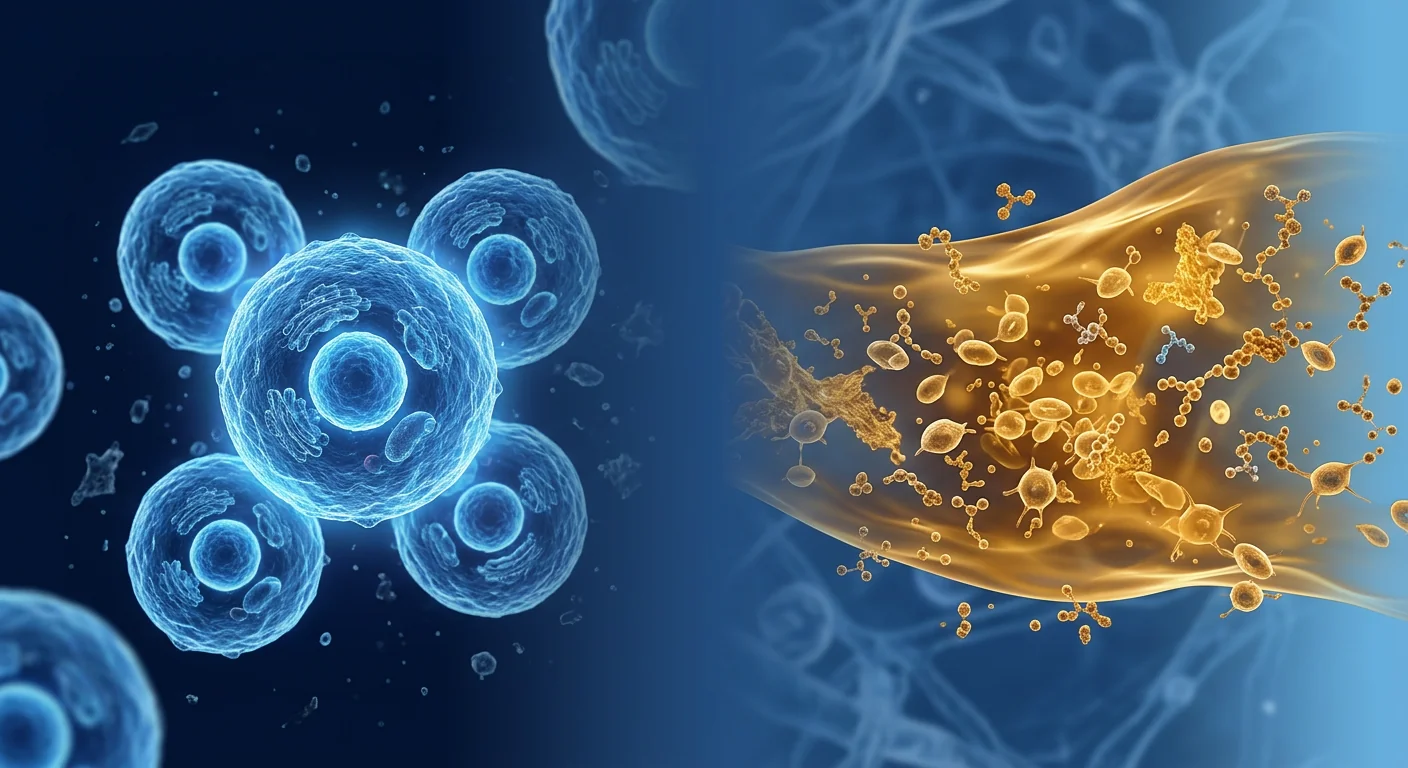
Regenerative medicine offers two of its most widely discussed tools — mesenchymal stem cell (MSC) therapy and platelet-rich plasma (PRP) — and patients frequently encounter both when researching treatment options. They are often mentioned in the same sentence, marketed by the same clinics, and applied to overlapping conditions. But they are not the same thing. Understanding when each approach makes clinical sense — and when neither does — is essential to making an informed decision.
The biological distinction, in plain terms. MSC therapy introduces living cells — multipotent stromal cells capable of modulating inflammation, secreting trophic factors, and differentiating into multiple tissue lineages. These cells are typically sourced from umbilical cord Wharton's jelly, expanded under cGMP conditions, and delivered intravenously or locally. They work primarily through paracrine signalling: the molecules they secrete reshape the local immune environment, reduce fibrosis, and recruit the body's own repair cells. [1] [2]
PRP, by contrast, is not a cell therapy at all. It is a concentrate of platelets — small, anucleate cell fragments — prepared from the patient's own blood by centrifugation. Platelets carry granules packed with growth factors (PDGF, TGF-β, VEGF, IGF-1, and others) that are released upon activation. When injected into injured tissue, PRP delivers a concentrated burst of these signals, amplifying the body's intrinsic healing cascade. The effect is potent but transient — typically lasting days to weeks — and depends entirely on the presence of viable local progenitor cells that can respond to the signal. [3] [4]
The single most important distinction
MSCs bring the repair machinery. PRP calls the repair machinery that is already there. If the local tissue environment is depleted of functional progenitor cells — as it often is in chronic degenerative conditions — PRP may have little to recruit, while MSCs can still deliver therapeutic benefit through their own secreted factors.
How MSCs work: the biology
Mesenchymal stem cells exert their therapeutic effects through a combination of mechanisms that no single growth factor cocktail can replicate. They home to sites of inflammation via chemokine gradients, where they engage in direct cell-cell contact and secrete a broad repertoire of bioactive molecules — cytokines, chemokines, growth factors, extracellular vesicles, and microRNAs — collectively termed the MSC secretome. This secretome suppresses activated T-cells, promotes regulatory T-cell expansion, shifts macrophages from a pro-inflammatory M1 to an anti-inflammatory M2 phenotype, inhibits fibrosis, and promotes angiogenesis. [5] [6]
Crucially, these effects are systemic when delivered intravenously, making MSC therapy the only regenerative option that can address multi-joint, multi-organ, or systemic inflammatory conditions from a single infusion. The cells do not need to engraft permanently — most are cleared within days to weeks — because their therapeutic payload is delivered through the paracrine burst that occurs while they are present. [7]
How PRP works: the biology
PRP's mechanism is simpler and more localised. The platelet α-granules release their cargo — including PDGF (chemotaxis and proliferation), TGF-β (matrix synthesis and fibrosis regulation), VEGF (angiogenesis), EGF (epithelial repair), and IGF-1 (cell survival and metabolism) — creating a concentrated signalling environment that accelerates the normal phases of wound healing: inflammation, proliferation, and remodelling. [8]
The effect is dose-dependent on platelet concentration: typical PRP preparations aim for 3–5 times the baseline platelet count, though some protocols target higher. The quality of PRP varies enormously depending on preparation method (single-spin vs. double-spin), platelet activation strategy, and whether leukocytes are included or excluded (leukocyte-rich vs. leukocyte-poor PRP). These variables make PRP a heterogeneous intervention — and a major reason why clinical trial results are inconsistent. [9]
When MSCs are the stronger choice
MSC therapy tends to be the more appropriate option when the underlying pathology involves systemic inflammation, immune dysregulation, or tissue environments where local progenitor cells are depleted. Specific scenarios include:
- Systemic autoimmune conditions. In lupus, rheumatoid arthritis, and Crohn's disease, the pathology is body-wide. PRP injected into one joint cannot address systemic autoimmunity. Intravenous MSCs can, through systemic immunomodulation. [10]
- Neurodegenerative diseases. ALS, Parkinson's, and multiple sclerosis involve central nervous system pathology where PRP has no plausible mechanism of action. MSC therapy, through neurotrophic factor secretion and immunomodulation, is actively being studied in this space. [11]
- Chronic degenerative conditions. In advanced osteoarthritis with significant cartilage loss, the local progenitor cell population is depleted — PRP may have little to stimulate. Intra-articular MSCs can deliver fresh cells and trophic support directly to the joint. [12]
- Multi-site or multi-organ involvement. A single intravenous MSC infusion can reach multiple affected areas simultaneously — something PRP, which must be injected locally, cannot do.
When PRP is the stronger choice
PRP excels in scenarios where the tissue is structurally intact enough to respond to growth factor signalling, where the injury is acute rather than chronic-degenerative, and where local delivery is both feasible and sufficient.
- Acute tendon and ligament injuries. Tennis elbow, patellar tendinopathy, and partial rotator cuff tears — where the tendon tissue retains viable tenocytes that can respond to growth factors — have some of the strongest PRP clinical evidence. [13]
- Mild to moderate osteoarthritis. When cartilage is thinned but not end-stage, intra-articular PRP can reduce pain and improve function, with several randomized trials showing outcomes comparable to or better than hyaluronic acid. [14]
- Wound healing and aesthetic applications. PRP is widely used in chronic wound care (diabetic ulcers), hair restoration, and facial rejuvenation — contexts where the local progenitor supply is generally viable and the primary need is accelerated healing. [15]
- Cost-sensitive scenarios. PRP is substantially less expensive than MSC therapy, requires no cell culture laboratory, and is generally not subject to the same regulatory complexity — making it a pragmatic first-line regenerative option for many patients.
MSC Therapy
Living cells from Wharton's jelly or other tissue sources. Systemic or local delivery. Immunomodulation + trophic support. Effects can persist for months. Requires cGMP lab. Higher cost. Suitable for systemic and degenerative conditions.
PRP Therapy
Concentrated platelets from patient's own blood. Local injection only. Growth factor signalling. Effects last days to weeks. Prepared at bedside. Lower cost. Best for acute injuries and mild degeneration with viable local progenitor cells.
Where they overlap: combined and sequential approaches
MSC therapy and PRP are not mutually exclusive. A growing body of preclinical and early clinical work explores their use in combination — PRP providing an immediate burst of proliferative and chemotactic signals that may enhance MSC engraftment, survival, and function. PRP has been studied as a scaffold or carrier for MSCs in orthopaedic applications, as a preconditioning agent to prime MSCs before infusion, and as a follow-up treatment to sustain the regenerative environment that MSCs initiate. [16]
Clinically, a common scenario is: PRP is tried first for a localised tendon or joint condition because it is lower cost and lower regulatory complexity. If the response is partial or the condition is more severe than initially appreciated, MSC therapy is then considered as the next step. This sequencing — PRP as first line, MSCs as escalation — is pragmatic and clinically reasonable, provided the patient understands that the two therapies work through fundamentally different mechanisms and are not simply different doses of the same thing.
What the clinical evidence says
The evidence base for the two therapies differs in important ways. MSC therapy has a larger body of safety data from thousands of patients across dozens of clinical trials, with a consistently benign acute safety profile when cells are manufactured under cGMP conditions and administered at evidence-based doses. Efficacy signals are encouraging across autoimmune, inflammatory, and degenerative indications, though most trials remain Phase I/II, and definitive Phase III data are still emerging. [17]
PRP has a larger body of randomized controlled trials in orthopaedic applications — particularly tendinopathy and knee osteoarthritis — but the evidence is marred by heterogeneity. Platelet concentration, leukocyte content, activation method, injection volume, and number of sessions all vary between studies, making it difficult to draw universal conclusions. A PRP preparation that works in one trial may be biologically different from the PRP used in the next. [18]
The honest headline is this: both therapies have credible biological rationale and some clinical evidence. Neither is a proven cure for any condition. Both should be understood as tools in a broader regenerative approach — not as standalone silver bullets.
Safety profiles compared
Both MSC therapy and PRP have favourable safety records when administered appropriately, but the nature of the risk differs.
MSC safety. Allogeneic MSC therapy has a well-documented acute safety profile. Meta-analyses aggregating thousands of patients have not identified dose-dependent increases in serious adverse events, tumorigenicity, or ectopic tissue formation. The most common infusion-related events — low-grade fever, fatigue, transient headache — are typically mild and self-limiting. The primary risks relate to product quality: cells not manufactured under cGMP may carry infection risk, and very high intravenous doses carry a theoretical risk of pulmonary trapping. [19]
PRP safety. PRP is autologous — derived from the patient's own blood — which eliminates risks of immune rejection and disease transmission. Adverse events are generally limited to injection-site pain, swelling, and the rare risk of infection from the injection procedure itself. The main safety concern with PRP is not the product but the injection technique: poorly performed injections into tendon sheaths, nerves, or vascular structures can cause injury. PRP is not appropriate for active infection or malignancy at the injection site.
Cost and practical considerations
The cost differential is significant. PRP injections typically range from a few hundred to a few thousand dollars per session, depending on the anatomic site and the clinic. MSC therapy, which requires a cGMP cell manufacturing facility, comprehensive quality control, and often intravenous or complex local delivery, is an order of magnitude more expensive — reflecting the fundamentally different production pipeline.
For a patient weighing cost against potential benefit, the decision framework might be: if your condition is localised, acute or mildly degenerative, and the tissue retains viable repair capacity, try PRP first — the financial risk is lower, and if it works, you have your answer. If your condition is systemic, severe, or chronic-degenerative, and PRP has already been tried or is mechanistically implausible, MSC therapy may be the more rational investment. A consultation with a clinician who offers both — and is prepared to explain honestly when each is and is not indicated — is the most reliable path to the right decision.
The question patients should ask is not "Which is better — MSC or PRP?" but rather "For my specific condition, at this stage, with this tissue environment, which approach (if either) has a plausible mechanism of action and evidence to support it?"
— VELAR Clinical Team
The VELAR approach
At VELAR Center, we offer both MSC and PRP therapies — not because we are indifferent to which is used, but precisely because the choice matters. Our clinical assessment begins with a detailed evaluation of your condition: its chronicity, severity, systemic involvement, imaging findings, and prior treatment history. From this, we determine whether PRP, MSC therapy, a sequential approach, or neither is the most evidence-aligned recommendation. We are transparent about the evidence gaps, honest about what each therapy can and cannot do, and never push a treatment that does not make biological and clinical sense for your specific situation. A consultation is where that conversation begins — with no pressure and no promises, only an honest clinical assessment.
References
- Pittenger MF, Discher DE, Péault BM, Phinney DG, Hare JM, Caplan AI. Mesenchymal stem cell perspective: cell biology to clinical progress. NPJ Regenerative Medicine. 2019;4:22. doi:10.1038/s41536-019-0083-6 ↩
- Galipeau J, Sensébé L. Mesenchymal stromal cells: clinical challenges and therapeutic opportunities. Cell Stem Cell. 2018;22(6):824-833. doi:10.1016/j.stem.2018.05.004 ↩
- Everts P, Onishi K, Jayaram P, Lana JF, Mautner K. Platelet-rich plasma: new performance understandings and therapeutic considerations in 2020. International Journal of Molecular Sciences. 2020;21(20):7794. doi:10.3390/ijms21207794 ↩
- Andia I, Abate M. Platelet-rich plasma: underlying biology and clinical correlates. Regenerative Medicine. 2013;8(5):645-658. doi:10.2217/rme.13.59 ↩
- Shi Y, Wang Y, Li Q, et al. Immunoregulatory mechanisms of mesenchymal stem and stromal cells in inflammatory diseases. Nature Reviews Nephrology. 2018;14(8):493-507. doi:10.1038/s41581-018-0023-5 ↩
- Naji A, Eitoku M, Favier B, Deschaseaux F, Rouas-Freiss N, Suganuma N. Biological functions of mesenchymal stem cells. Cellular and Molecular Life Sciences. 2019;76(17):3323-3348. doi:10.1007/s00018-019-03125-1 ↩
- Caplan AI, Correa D. The MSC: an injury drugstore. Cell Stem Cell. 2011;9(1):11-15. doi:10.1016/j.stem.2011.06.008 ↩
- Marx RE. Platelet-rich plasma (PRP): what is PRP and what is not PRP? Implant Dentistry. 2001;10(4):225-228. doi:10.1097/00008505-200110000-00002 ↩
- Le ADK, Enweze L, DeBaun MR, Dragoo JL. Current clinical recommendations for use of platelet-rich plasma. Current Reviews in Musculoskeletal Medicine. 2018;11(4):624-634. doi:10.1007/s12178-018-9526-2 ↩
- Wang LT, Liu KJ, Sytwu HK, Yen ML, Yen BL. Advances in mesenchymal stem cell therapy for immune and inflammatory diseases. Journal of Biomedical Science. 2021;28(1):39. doi:10.1186/s12929-021-00737-3 ↩
- Staff NP, Jones DT, Singer W. Mesenchymal stromal cell therapies for neurodegenerative diseases. Mayo Clinic Proceedings. 2019;94(5):892-905. doi:10.1016/j.mayocp.2019.01.001 ↩
- Ha CW, Park YB, Kim SH, Lee HJ. Intra-articular mesenchymal stem cells in osteoarthritis of the knee: a systematic review of clinical outcomes and evidence of cartilage repair. Arthroscopy. 2019;35(1):277-288.e2. doi:10.1016/j.arthro.2018.07.028 ↩
- Chen X, Jones IA, Park C, Vangsness CT. The efficacy of platelet-rich plasma on tendon and ligament healing: a systematic review and meta-analysis with bias assessment. American Journal of Sports Medicine. 2018;46(8):2020-2032. doi:10.1177/0363546517743746 ↩
- Dai WL, Zhou AG, Zhang H, Zhang J. Efficacy of platelet-rich plasma in the treatment of knee osteoarthritis: a meta-analysis of randomized controlled trials. Arthroscopy. 2017;33(3):659-670.e1. doi:10.1016/j.arthro.2016.09.024 ↩
- Gentile P, Garcovich S. Systematic review of platelet-rich plasma use in androgenetic alopecia compared with Minoxidil, Finasteride, and adult stem cell-based therapy. International Journal of Molecular Sciences. 2020;21(8):2702. doi:10.3390/ijms21082702 ↩
- Tobita M, Tajima S, Mizuno H. Adipose tissue-derived mesenchymal stem cells and platelet-rich plasma: stem cell transplantation methods that enhance stemness. Stem Cell Research & Therapy. 2015;6:215. doi:10.1186/s13287-015-0217-8 ↩
- Lalu MM, McIntyre L, Pugliese C, et al. Safety of cell therapy with mesenchymal stromal cells (SafeCell): a systematic review and meta-analysis of clinical trials. PLoS One. 2012;7(10):e47559. doi:10.1371/journal.pone.0047559 ↩
- Filardo G, Di Matteo B, Di Martino A, et al. Platelet-rich plasma intra-articular knee injections show no superiority versus viscosupplementation: a randomized controlled trial. American Journal of Sports Medicine. 2015;43(7):1575-1582. doi:10.1177/0363546515582024 ↩
- Thompson M, Mei SHJ, Wolfe D, et al. Cell therapy with intravascular administration of mesenchymal stromal cells continues to appear safe: an updated systematic review and meta-analysis. Stem Cells Translational Medicine. 2020;9(11):1313-1325. doi:10.1002/sctm.20-0121 ↩
再生医学提供了两种最受讨论的工具——间充质干细胞(MSC)疗法和富血小板血浆(PRP),患者在研究治疗方案时经常会同时遇到这两者。它们经常出现在同一句话中,由同一家诊所推广,并应用于重叠的病症。但它们不是同一回事。理解每种方法何时具有临床意义——以及何时都不适用——对于做出明智的决定至关重要。
生物学上的区别,用简单的话说。MSC疗法引入活细胞——能够调节炎症、分泌营养因子并分化为多种组织谱系的多能基质细胞。这些细胞通常来自脐带沃顿氏胶,在cGMP条件下扩增,并通过静脉或局部递送。它们主要通过旁分泌信号发挥作用:它们分泌的分子重塑局部免疫环境、减少纤维化并招募身体自身的修复细胞。[1] [2]
相比之下,PRP根本不是细胞疗法。它是从患者自身血液中通过离心制备的血小板浓缩物。血小板携带充满生长因子(PDGF、TGF-β、VEGF、IGF-1等)的颗粒,这些因子在激活时释放。当注射到受损组织中时,PRP提供浓缩的信号爆发,放大身体固有的愈合级联反应。这种效应是强效但短暂的——通常持续数天到数周——并完全依赖于局部有活力的祖细胞能够响应信号。[3] [4]
最重要的区别
MSC带来修复机制。PRP调动已有的修复机制。如果局部组织环境缺乏功能性祖细胞——慢性退行性疾病中常见的情况——PRP可能没有可招募的对象,而MSC仍然可以通过自身分泌的因子提供治疗效果。
MSC如何工作:生物学
间充质干细胞通过多种机制的组合发挥其治疗效果,这是任何单一生长因子混合物都无法复制的。它们通过趋化因子梯度归巢到炎症部位,在那里进行直接的细胞间接触并分泌广泛的生物活性分子——细胞因子、趋化因子、生长因子、细胞外囊泡和微小RNA——统称为MSC分泌组。这个分泌组抑制活化的T细胞,促进调节性T细胞扩增,将巨噬细胞从促炎的M1表型转变为抗炎的M2表型,抑制纤维化并促进血管生成。[5] [6]
关键在于,当静脉递送时,这些效应是全身性的,使得MSC疗法成为唯一能够通过单次输注处理多关节、多器官或全身性炎症状况的再生选项。细胞不需要永久植入——大多数在数天到数周内被清除——因为它们的治疗有效载荷是通过存在期间发生的旁分泌爆发传递的。[7]
PRP如何工作:生物学
PRP的机制更简单且更局部。血小板α颗粒释放其内容物——包括PDGF(趋化性和增殖)、TGF-β(基质合成和纤维化调节)、VEGF(血管生成)、EGF(上皮修复)和IGF-1(细胞存活和代谢)——创造浓缩的信号环境,加速伤口愈合的正常阶段:炎症、增殖和重塑。[8]
效果取决于血小板浓度:典型的PRP制备目标为基线血小板计数的3-5倍,尽管一些方案追求更高的目标。PRP的质量因制备方法(单次离心vs.双次离心)、血小板激活策略以及是否包含白细胞(富白细胞vs.贫白细胞PRP)的不同而有很大差异。这些变量使PRP成为一种异质性干预——也是临床试验结果不一致的主要原因。[9]
何时MSC是更强的选择
当潜在病理涉及全身性炎症、免疫失调或局部祖细胞耗尽的组织环境时,MSC疗法往往是更合适的选择。具体场景包括:
- 全身性自身免疫疾病。在狼疮、类风湿性关节炎和克罗恩病中,病理是全身性的。注射到单个关节的PRP无法处理全身性自身免疫。静脉MSC可以通过全身性免疫调节来处理。[10]
- 神经退行性疾病。ALS、帕金森病和多发性硬化涉及中枢神经系统病理,PRP没有合理的机制。MSC疗法通过神经营养因子分泌和免疫调节,正在这一领域积极研究。[11]
- 慢性退行性疾病。在具有显著软骨损失的晚期骨关节炎中,局部祖细胞群已耗尽——PRP可能没有多少可刺激的对象。关节内MSC可以将新鲜细胞和营养支持直接递送到关节。[12]
- 多部位或多器官受累。单次静脉MSC输注可以同时到达多个受影响区域——而必须局部注射的PRP无法做到。
何时PRP是更强的选择
PRP在组织结构足够完整以响应生长因子信号、损伤是急性而非慢性退行性、且局部递送既可行又足够的情况下表现优异。
- 急性肌腱和韧带损伤。网球肘、髌腱病和部分肩袖撕裂——其中肌腱组织保留有活力的肌腱细胞可以响应生长因子——具有最强的PRP临床证据。[13]
- 轻中度骨关节炎。当软骨变薄但未达到末期时,关节内PRP可以减轻疼痛并改善功能,多项随机试验显示结果与透明质酸相当或更好。[14]
- 伤口愈合和美容应用。PRP广泛用于慢性伤口护理(糖尿病性溃疡)、毛发恢复和面部年轻化——这些情况下局部祖细胞供应通常是有活力的,主要需求是加速愈合。[15]
- 成本敏感场景。PRP比MSC疗法便宜得多,不需要细胞培养实验室,通常不受同样的监管复杂性约束——使其成为许多患者务实的首选再生选项。
MSC疗法
来自沃顿氏胶或其他组织来源的活细胞。全身或局部递送。免疫调节+营养支持。效果可持续数月。需要cGMP实验室。成本较高。适用于全身性和退行性疾病。
PRP疗法
来自患者自身血液的浓缩血小板。仅局部注射。生长因子信号。效果持续数天到数周。可在床边制备。成本较低。最适合急性损伤和有活力的局部祖细胞的轻度退行性病变。
重叠之处:联合和序贯方法
MSC疗法和PRP并非互斥。越来越多的临床前和早期临床研究探索它们的联合使用——PRP提供即时的增殖和趋化信号爆发,可能增强MSC植入、存活和功能。PRP已被研究作为骨科应用中MSC的支架或载体、作为输注前预处理MSC的调节剂,以及作为维持MSC启动的再生环境的后续治疗。[16]
在临床上,一个常见场景是:对于局部的肌腱或关节问题先尝试PRP,因为它成本较低且监管复杂性较低。如果反应不完全或病情比最初认为的更严重,则考虑将MSC疗法作为下一步。这种序贯——PRP作为一线,MSC作为升级——是务实且临床合理的,前提是患者理解这两种疗法通过根本不同的机制发挥作用,不仅仅是同一事物的不同剂量。
临床证据怎么说
两种疗法的证据基础在以重要方式存在差异。MSC疗法拥有来自数十项临床试验、数千名患者的更大安全性数据,当细胞在cGMP条件下制造并以循证剂量给药时,急性安全性特征始终良好。在自身免疫、炎症和退行性适应症中的疗效信号令人鼓舞,尽管大多数试验仍为I/II期,决定性的III期数据仍在积累中。[17]
PRP在骨科应用中拥有更多的随机对照试验——特别是肌腱病和膝骨关节炎——但证据被异质性所困扰。血小板浓度、白细胞含量、激活方法、注射体积和疗程次数在各项研究中各不相同,使得难以得出普遍的结论。一项试验中有效的PRP制剂可能在生物学上与下一项试验中使用的PRP不同。[18]
诚实的结论是:两种疗法都有可信的生物学原理和一些临床证据。两者都不是任何病症的已证实疗法。两者都应被理解为更广泛再生方法中的工具——而不是独立的灵丹妙药。
安全性特征对比
MSC疗法和PRP在适当给药时都具有良好的安全记录,但风险的性质不同。
MSC安全性。异体MSC疗法具有充分记录的急性安全性特征。汇总数千名患者的荟萃分析未发现剂量依赖性的严重不良事件、致瘤性或异位组织形成增加。最常见的输注相关事件——低热、乏力、短暂性头痛——通常是轻微且自限性的。主要风险与产品质量相关:未在cGMP条件下制造的细胞可能带来感染风险,极高的静脉剂量存在肺栓塞的理论风险。[19]
PRP安全性。PRP是自体的——来自患者自身的血液——这消除了免疫排斥和疾病传播的风险。不良事件通常限于注射部位疼痛、肿胀以及注射操作本身罕见的感染风险。PRP的主要安全关注点不是产品本身,而是注射技术:对腱鞘、神经或血管结构进行不当注射可能造成损伤。PRP不适用于注射部位的活动性感染或恶性肿瘤。
成本和实际考虑
成本差异很大。根据解剖部位和诊所的不同,PRP注射通常每次从几百到几千美元不等。MSC疗法需要cGMP细胞制造设施、全面的质量控制,且通常需要静脉或复杂的局部递送,费用高出数量级——反映了根本不同的生产流程。
对于权衡成本与潜在收益的患者,决策框架可能是:如果您的病情是局部的、急性或轻度退行性的,且组织保留有活力的修复能力,先尝试PRP——财务风险较低,如果有效,您就有答案了。如果您的病情是全身性的、严重的或慢性退行性的,且PRP已经尝试过或在机制上不可行,MSC疗法可能是更合理的投资。咨询一位能够提供两种选择并准备诚实地解释每种方法何时适用、何时不适用的临床医生,是通往正确决定的最可靠途径。
患者应该问的问题不是"哪个更好——MSC还是PRP?",而是"对于我的特定病情、在这个阶段、在这个组织环境中,哪种方法(如果有的话)具有合理的机制和证据支持?"
— VELAR 临床团队
VELAR的方法
在VELAR中心,我们提供MSC和PRP两种疗法——不是因为我们对使用哪种漠不关心,而是恰恰因为选择很重要。我们的临床评估始于对您病情的详细评估:其慢性程度、严重性、全身受累情况、影像学发现和既往治疗史。从中,我们确定PRP、MSC疗法、序贯方法或两者都不适用,哪一种是最符合证据的建议。我们对证据差距保持透明,诚实地说明每种疗法能做什么和不能做什么,从不推动对您特定情况没有生物学和临床意义的治疗。一次咨询是这段对话的开始——没有压力,没有承诺,只有诚实的临床评估。
参考文献
- Pittenger MF, Discher DE, Péault BM, Phinney DG, Hare JM, Caplan AI. Mesenchymal stem cell perspective: cell biology to clinical progress. NPJ Regenerative Medicine. 2019;4:22. doi:10.1038/s41536-019-0083-6 ↩
- Galipeau J, Sensébé L. Mesenchymal stromal cells: clinical challenges and therapeutic opportunities. Cell Stem Cell. 2018;22(6):824-833. doi:10.1016/j.stem.2018.05.004 ↩
- Everts P, Onishi K, Jayaram P, Lana JF, Mautner K. Platelet-rich plasma: new performance understandings and therapeutic considerations in 2020. International Journal of Molecular Sciences. 2020;21(20):7794. doi:10.3390/ijms21207794 ↩
- Andia I, Abate M. Platelet-rich plasma: underlying biology and clinical correlates. Regenerative Medicine. 2013;8(5):645-658. doi:10.2217/rme.13.59 ↩
- Shi Y, Wang Y, Li Q, et al. Immunoregulatory mechanisms of mesenchymal stem and stromal cells in inflammatory diseases. Nature Reviews Nephrology. 2018;14(8):493-507. doi:10.1038/s41581-018-0023-5 ↩
- Naji A, Eitoku M, Favier B, Deschaseaux F, Rouas-Freiss N, Suganuma N. Biological functions of mesenchymal stem cells. Cellular and Molecular Life Sciences. 2019;76(17):3323-3348. doi:10.1007/s00018-019-03125-1 ↩
- Caplan AI, Correa D. The MSC: an injury drugstore. Cell Stem Cell. 2011;9(1):11-15. doi:10.1016/j.stem.2011.06.008 ↩
- Marx RE. Platelet-rich plasma (PRP): what is PRP and what is not PRP? Implant Dentistry. 2001;10(4):225-228. doi:10.1097/00008505-200110000-00002 ↩
- Le ADK, Enweze L, DeBaun MR, Dragoo JL. Current clinical recommendations for use of platelet-rich plasma. Current Reviews in Musculoskeletal Medicine. 2018;11(4):624-634. doi:10.1007/s12178-018-9526-2 ↩
- Wang LT, Liu KJ, Sytwu HK, Yen ML, Yen BL. Advances in mesenchymal stem cell therapy for immune and inflammatory diseases. Journal of Biomedical Science. 2021;28(1):39. doi:10.1186/s12929-021-00737-3 ↩
- Staff NP, Jones DT, Singer W. Mesenchymal stromal cell therapies for neurodegenerative diseases. Mayo Clinic Proceedings. 2019;94(5):892-905. doi:10.1016/j.mayocp.2019.01.001 ↩
- Ha CW, Park YB, Kim SH, Lee HJ. Intra-articular mesenchymal stem cells in osteoarthritis of the knee: a systematic review of clinical outcomes and evidence of cartilage repair. Arthroscopy. 2019;35(1):277-288.e2. doi:10.1016/j.arthro.2018.07.028 ↩
- Chen X, Jones IA, Park C, Vangsness CT. The efficacy of platelet-rich plasma on tendon and ligament healing: a systematic review and meta-analysis with bias assessment. American Journal of Sports Medicine. 2018;46(8):2020-2032. doi:10.1177/0363546517743746 ↩
- Dai WL, Zhou AG, Zhang H, Zhang J. Efficacy of platelet-rich plasma in the treatment of knee osteoarthritis: a meta-analysis of randomized controlled trials. Arthroscopy. 2017;33(3):659-670.e1. doi:10.1016/j.arthro.2016.09.024 ↩
- Gentile P, Garcovich S. Systematic review of platelet-rich plasma use in androgenetic alopecia compared with Minoxidil, Finasteride, and adult stem cell-based therapy. International Journal of Molecular Sciences. 2020;21(8):2702. doi:10.3390/ijms21082702 ↩
- Tobita M, Tajima S, Mizuno H. Adipose tissue-derived mesenchymal stem cells and platelet-rich plasma: stem cell transplantation methods that enhance stemness. Stem Cell Research & Therapy. 2015;6:215. doi:10.1186/s13287-015-0217-8 ↩
- Lalu MM, McIntyre L, Pugliese C, et al. Safety of cell therapy with mesenchymal stromal cells (SafeCell): a systematic review and meta-analysis of clinical trials. PLoS One. 2012;7(10):e47559. doi:10.1371/journal.pone.0047559 ↩
- Filardo G, Di Matteo B, Di Martino A, et al. Platelet-rich plasma intra-articular knee injections show no superiority versus viscosupplementation: a randomized controlled trial. American Journal of Sports Medicine. 2015;43(7):1575-1582. doi:10.1177/0363546515582024 ↩
- Thompson M, Mei SHJ, Wolfe D, et al. Cell therapy with intravascular administration of mesenchymal stromal cells continues to appear safe: an updated systematic review and meta-analysis. Stem Cells Translational Medicine. 2020;9(11):1313-1325. doi:10.1002/sctm.20-0121 ↩
يقدم الطب التجديدي اثنتين من أكثر أدواته نقاشًا — العلاج بالخلايا الجذعية الوسيطة (MSC) والبلازما الغنية بالصفائح الدموية (PRP) — وغالبًا ما يواجه المرضى كلاهما عند البحث عن خيارات العلاج. يتم ذكرهما في نفس الجملة، وتسويقهما من قبل نفس العيادات، وتطبيقهما على حالات متداخلة. لكنهما ليسا الشيء نفسه. فهم متى يكون لكل نهج معنى سريري — ومتى لا يكون أي منهما كذلك — أمر أساسي لاتخاذ قرار مستنير.
التمييز البيولوجي، بعبارات بسيطة. يقدم علاج MSC خلايا حية — خلايا سدوية متعددة القدرات قادرة على تعديل الالتهاب، وإفراز العوامل الغذائية، والتمايز إلى أنسجة متعددة. تُستخلص هذه الخلايا عادةً من هلام وارتون في الحبل السري، وتُوسع تحت ظروف cGMP، وتُعطى عن طريق الوريد أو موضعيًا. تعمل بشكل أساسي من خلال الإشارات الباراكرينية: الجزيئات التي تفرزها تعيد تشكيل البيئة المناعية المحلية، وتقلل التليف، وتجند خلايا الإصلاح الخاصة بالجسم. [1] [2]
على النقيض من ذلك، فإن PRP ليست علاجًا خلويًا على الإطلاق. إنها مركز من الصفائح الدموية — شظايا خلوية صغيرة بدون نواة — تُحضر من دم المريض نفسه عن طريق الطرد المركزي. تحمل الصفائح الدموية حبيبات مليئة بعوامل النمو (PDGF، TGF-β، VEGF، IGF-1، وغيرها) التي تُطلق عند التنشيط. عند حقنها في الأنسجة المصابة، توفر PRP دفعة مركزة من هذه الإشارات، مما يعزز سلسلة الشفاء الطبيعية للجسم. التأثير قوي لكنه عابر — يستمر عادةً من أيام إلى أسابيع — ويعتمد كليًا على وجود خلايا سلفية محلية قابلة للحياة يمكنها الاستجابة للإشارة. [3] [4]
التمييز الأكثر أهمية
MSC تجلب آلية الإصلاح. PRP تستدعي آلية الإصلاح الموجودة بالفعل. إذا كانت بيئة الأنسجة المحلية مستنفدة من الخلايا السلفية الوظيفية — كما هو شائع في الحالات التنكسية المزمنة — فقد يكون لدى PRP القليل لتجنيده، بينما لا يزال بإمكان MSC تقديم فائدة علاجية من خلال العوامل المفرزة الخاصة بها.
كيف تعمل MSC: البيولوجيا
تمارس الخلايا الجذعية الوسيطة تأثيراتها العلاجية من خلال مزيج من الآليات التي لا يمكن لأي مزيج منفرد من عوامل النمو تكرارها. تتجه إلى مواقع الالتهاب عبر تدرجات الكيموكينات، حيث تشارك في اتصال مباشر بين الخلايا وتفرز مجموعة واسعة من الجزيئات النشطة بيولوجيًا — السيتوكينات، الكيموكينات، عوامل النمو، الحويصلات خارج الخلوية، والحمض النووي الريبوزي الدقيق — المعروفة مجتمعة باسم سيكريتوم MSC. يقوم هذا السيكريتوم بقمع الخلايا التائية المنشطة، وتعزيز توسع الخلايا التائية التنظيمية، وتحويل البلاعم من النمط M1 الالتهابي إلى النمط M2 المضاد للالتهاب، وتثبيط التليف، وتعزيز تكوين الأوعية الدموية. [5] [6]
الأهم من ذلك، أن هذه التأثيرات جهازية عند إعطائها عن طريق الوريد، مما يجعل علاج MSC الخيار التجديدي الوحيد الذي يمكنه معالجة الحالات الالتهابية متعددة المفاصل أو متعددة الأعضاء أو الجهازية من تسريب واحد. لا تحتاج الخلايا إلى الانغراس بشكل دائم — يتم清除 معظمها خلال أيام إلى أسابيع — لأن حمولتها العلاجية تُقدم من خلال الدفعة الباراكرينية التي تحدث أثناء وجودها. [7]
كيف تعمل PRP: البيولوجيا
آلية PRP أبسط وأكثر موضعية. تطلق حبيبات ألفا للصفائح الدموية حمولتها — بما في ذلك PDGF (الانجذاب الكيميائي والتكاثر)، TGF-β (تخليق المصفوفة وتنظيم التليف)، VEGF (تكوين الأوعية الدموية)، EGF (إصلاح الظهارة)، و IGF-1 (بقاء الخلية والتمثيل الغذائي) — مما يخلق بيئة إشارات مركزة تسرع المراحل الطبيعية لالتئام الجروح: الالتهاب، التكاثر، وإعادة التشكيل. [8]
التأثير يعتمد على الجرعة من حيث تركيز الصفائح الدموية: تهدف تحضيرات PRP النموذجية إلى 3-5 أضعاف عدد الصفائح الدموية الأساسي، على الرغم من أن بعض البروتوكولات تستهدف مستويات أعلى. تختلف جودة PRP بشكل كبير اعتمادًا على طريقة التحضير (الطرد المركزي الفردي مقابل المزدوج)، واستراتيجية تنشيط الصفائح الدموية، وما إذا كانت الكريات البيضاء مدرجة أم مستبعدة (PRP الغني بالكريات البيضاء مقابل PRP الفقير بالكريات البيضاء). هذه المتغيرات تجعل PRP تدخلاً غير متجانس — وسببًا رئيسيًا لعدم اتساق نتائج التجارب السريرية. [9]
متى تكون MSC الخيار الأقوى
يميل علاج MSC إلى أن يكون الخيار الأكثر ملاءمة عندما يتضمن المرض الأساسي التهابًا جهازيًا، أو خللًا في تنظيم المناعة، أو بيئات نسيجية استنفدت فيها الخلايا السلفية المحلية. تشمل السيناريوهات المحددة:
- أمراض المناعة الذاتية الجهازية. في الذئبة، والتهاب المفاصل الروماتويدي، ومرض كرون، يكون المرض على مستوى الجسم بالكامل. لا يمكن لـ PRP المحقون في مفصل واحد معالجة المناعة الذاتية الجهازية. يمكن لـ MSC الوريدية ذلك، من خلال التعديل المناعي الجهازي. [10]
- الأمراض التنكسية العصبية. يشمل التصلب الجانبي الضموري (ALS)، ومرض باركنسون، والتصلب المتعدد أمراض الجهاز العصبي المركزي حيث لا توجد آلية معقولة لعمل PRP. يتم دراسة علاج MSC بنشاط في هذا المجال، من خلال إفراز العوامل العصبية والتعديل المناعي. [11]
- الحالات التنكسية المزمنة. في الفصال العظمي المتقدم مع فقدان كبير للغضروف، تكون مجموعة الخلايا السلفية المحلية مستنفدة — قد يكون لدى PRP القليل لتحفيزه. يمكن لـ MSC داخل المفصل توصيل خلايا جديدة ودعم غذائي مباشرة إلى المفصل. [12]
- إصابة متعددة المواقع أو الأعضاء. يمكن لتسريب MSC وريدي واحد الوصول إلى مناطق متعددة متأثرة في وقت واحد — وهو ما لا يمكن لـ PRP، الذي يجب حقنه موضعيًا، القيام به.
متى تكون PRP الخيار الأقوى
تتفوق PRP في السيناريوهات التي يكون فيها النسيج سليمًا هيكليًا بما يكفي للاستجابة لإشارات عوامل النمو، وحيث تكون الإصابة حادة وليست تنكسية مزمنة، وحيث يكون التوصيل الموضعي ممكنًا وكافيًا.
- إصابات الأوتار والأربطة الحادة. مرفق التنس، واعتلال الوتر الرضفي، وتمزقات الكفة المدورة الجزئية — حيث يحتفظ نسيج الوتر بخلايا وتارية قابلة للحياة يمكنها الاستجابة لعوامل النمو — لديها بعض من أقوى الأدلة السريرية لـ PRP. [13]
- الفصال العظمي الخفيف إلى المتوسط. عندما يكون الغضروف رقيقًا ولكن ليس في المرحلة النهائية، يمكن لـ PRP داخل المفصل تقليل الألم وتحسين الوظيفة، مع العديد من التجارب العشوائية التي تظهر نتائج مماثلة أو أفضل من حمض الهيالورونيك. [14]
- التئام الجروح والتطبيقات التجميلية. تستخدم PRP على نطاق واسع في العناية بالجروح المزمنة (قرح السكري)، واستعادة الشعر، وتجديد الوجه — سياقات يكون فيها مخزون الخلايا السلفية المحلية قابلاً للحياة بشكل عام والحاجة الأساسية هي تسريع الشفاء. [15]
- السيناريوهات الحساسة للتكلفة. PRP أقل تكلفة بكثير من علاج MSC، ولا تتطلب مختبر زراعة خلايا، ولا تخضع عمومًا لنفس التعقيد التنظيمي — مما يجعلها خيارًا تجديديًا عمليًا كخط أول للعديد من المرضى.
علاج MSC
خلايا حية من هلام وارتون أو مصادر نسيجية أخرى. توصيل جهازي أو موضعي. تعديل مناعي + دعم غذائي. يمكن أن تستمر التأثيرات لأشهر. يتطلب مختبر cGMP. تكلفة أعلى. مناسب للحالات الجهازية والتنكسية.
علاج PRP
صفائح دموية مركزة من دم المريض نفسه. حقن موضعي فقط. إشارات عوامل النمو. تستمر التأثيرات من أيام إلى أسابيع. تُحضر بجانب السرير. تكلفة أقل. الأفضل للإصابات الحادة والتنكس الخفيف مع خلايا سلفية محلية قابلة للحياة.
حيث تتداخل: النهج المركبة والمتسلسلة
علاج MSC و PRP ليسا متنافيين. يستكشف مجموعة متزايدة من الأعمال قبل السريرية والسريرية المبكرة استخدامهما معًا — حيث توفر PRP دفعة فورية من الإشارات التكاثرية والكيميائية التي قد تعزز انغراس MSC وبقائها ووظيفتها. تمت دراسة PRP كسقالة أو حامل لـ MSC في تطبيقات العظام، وكعامل تكييف مسبق لتحضير MSC قبل التسريب، وكعلاج متابعة للحفاظ على البيئة التجديدية التي تبدأها MSC. [16]
سريريًا، السيناريو الشائع هو: تجربة PRP أولاً لمشكلة وتر أو مفصل موضعية لأنها أقل تكلفة وأقل تعقيدًا تنظيميًا. إذا كانت الاستجابة جزئية أو كانت الحالة أكثر شدة مما تم تقديره في البداية، يتم النظر في علاج MSC كخطوة تالية. هذا التسلسل — PRP كخط أول، MSC كتصعيد — عملي ومعقول سريريًا، شريطة أن يفهم المريض أن العلاجين يعملان من خلال آليات مختلفة بشكل أساسي وليسا مجرد جرعات مختلفة من نفس الشيء.
ماذا تقول الأدلة السريرية
تختلف قاعدة الأدلة للعلاجين بطرق مهمة. يمتلك علاج MSC مجموعة أكبر من بيانات السلامة من آلاف المرضى عبر عشرات التجارب السريرية، مع ملف سلامة حادة حميد باستمرار عندما يتم تصنيع الخلايا تحت ظروف cGMP وإعطاؤها بجرعات قائمة على الأدلة. إشارات الفعالية مشجعة عبر مؤشرات المناعة الذاتية والالتهابات والتنكسية، على الرغم من أن معظم التجارب لا تزال في المرحلة الأولى/الثانية، وبيانات المرحلة الثالثة الحاسمة لا تزال في طور الظهور. [17]
تمتلك PRP مجموعة أكبر من التجارب العشوائية المضبوطة في تطبيقات العظام — خاصة أمراض الأوتار والفصال العظمي للركبة — لكن الأدلة مشوبة بعدم التجانس. يختلف تركيز الصفائح الدموية، ومحتوى الكريات البيضاء، وطريقة التنشيط، وحجم الحقن، وعدد الجلسات بين الدراسات، مما يجعل من الصعب استخلاص استنتاجات عامة. قد تكون تحضيرة PRP التي تعمل في تجربة مختلفة بيولوجيًا عن PRP المستخدمة في التجربة التالية. [18]
الاستنتاج الصادق هو: كلا العلاجين لهما أساس بيولوجي معقول وبعض الأدلة السريرية. لا يعتبر أي منهما علاجًا مثبتًا لأي حالة. يجب فهم كلاهما كأدوات في نهج تجديدي أوسع — وليس كحلول سحرية مستقلة.
مقارنة ملفات السلامة
لكل من علاج MSC و PRP سجلات سلامة مواتية عند إعطائهما بشكل مناسب، لكن طبيعة الخطر تختلف.
سلامة MSC. يمتلك علاج MSC الخيفي ملف سلامة حادة موثق جيدًا. لم تحدد التحليلات التلوية التي جمعت آلاف المرضى زيادات معتمدة على الجرعة في الأحداث الضارة الخطيرة، أو الورم، أو تكوين الأنسجة المنتبذة. أحداث التسريب الأكثر شيوعًا — حمى منخفضة الدرجة، إرهاق، صداع عابر — عادة ما تكون خفيفة ومحدودة ذاتيًا. تتعلق المخاطر الرئيسية بجودة المنتج: الخلايا غير المصنعة تحت cGMP قد تحمل خطر العدوى، والجرعات الوريدية العالية جدًا تحمل خطرًا نظريًا للاحتباس الرئوي. [19]
سلامة PRP. PRP ذاتية — مشتقة من دم المريض نفسه — مما يلغي مخاطر الرفض المناعي وانتقال الأمراض. تقتصر الأحداث الضارة عمومًا على ألم موقع الحقن، والتورم، وخطر العدوى النادر من إجراء الحقن نفسه. القلق الرئيسي للسلامة مع PRP ليس المنتج بل تقنية الحقن: الحقن غير المناسب في أغلفة الأوتار، أو الأعصاب، أو الهياكل الوعائية يمكن أن يسبب إصابة. PRP غير مناسبة للعدوى النشطة أو الورم الخبيث في موقع الحقن.
اعتبارات التكلفة والعملية
الفارق في التكلفة كبير. تتراوح حقن PRP عادةً من بضع مئات إلى بضعة آلاف من الدولارات للجلسة، اعتمادًا على الموقع التشريحي والعيادة. علاج MSC، الذي يتطلب منشأة تصنيع خلايا cGMP، ومراقبة جودة شاملة، وغالبًا توصيل وريدي أو موضعي معقد، أغلى بمرتبة كاملة — مما يعكس خط الإنتاج المختلف بشكل أساسي.
بالنسبة للمريض الذي يوازن بين التكلفة والفائدة المحتملة، قد يكون إطار القرار: إذا كانت حالتك موضعية، حادة أو تنكسية خفيفة، ويحتفظ النسيج بقدرة إصلاح قابلة للحياة، جرب PRP أولاً — المخاطر المالية أقل، وإذا نجحت، لديك إجابتك. إذا كانت حالتك جهازية، شديدة، أو تنكسية مزمنة، وتم تجربة PRP بالفعل أو غير معقولة ميكانيكيًا، فقد يكون علاج MSC الاستثمار الأكثر عقلانية. استشارة مع طبيب يقدم كلا الخيارين — ومستعد لشرح متى يكون كل منهما مناسبًا وغير مناسب بصدق — هي الطريق الأكثر موثوقية للقرار الصحيح.
السؤال الذي يجب أن يطرحه المرضى ليس "أيهما أفضل — MSC أم PRP؟" بل "بالنسبة لحالتي المحددة، في هذه المرحلة، مع هذه البيئة النسيجية، أي نهج (إن وجد) لديه آلية عمل معقولة وأدلة تدعمه؟"
— الفريق السريري لـ VELAR
نهج VELAR
في مركز VELAR، نقدم كلاً من علاجي MSC و PRP — ليس لأننا غير مبالين بأي منهما يُستخدم، ولكن تحديدًا لأن الاختيار مهم. يبدأ تقييمنا السريري بتقييم مفصل لحالتك: مدى إزمانها، وشدتها، وإصابة الأعضاء الجهازية، ونتائج التصوير، وتاريخ العلاج السابق. من هذا، نحدد ما إذا كان PRP، أو علاج MSC، أو نهج متسلسل، أو لا شيء منهما هو التوصية الأكثر توافقًا مع الأدلة. نحن شفافون بشأن فجوات الأدلة، وصادقون بشأن ما يمكن لكل علاج فعله وما لا يمكنه فعله، ولا ندفع أبدًا بعلاج ليس له معنى بيولوجي وسريري لحالتك المحددة. الاستشارة هي حيث تبدأ هذه المحادثة — بدون ضغط وبدون وعود، فقط تقييم سريري صادق.
المراجع
- Pittenger MF, Discher DE, Péault BM, Phinney DG, Hare JM, Caplan AI. Mesenchymal stem cell perspective: cell biology to clinical progress. NPJ Regenerative Medicine. 2019;4:22. doi:10.1038/s41536-019-0083-6 ↩
- Galipeau J, Sensébé L. Mesenchymal stromal cells: clinical challenges and therapeutic opportunities. Cell Stem Cell. 2018;22(6):824-833. doi:10.1016/j.stem.2018.05.004 ↩
- Everts P, Onishi K, Jayaram P, Lana JF, Mautner K. Platelet-rich plasma: new performance understandings and therapeutic considerations in 2020. International Journal of Molecular Sciences. 2020;21(20):7794. doi:10.3390/ijms21207794 ↩
- Andia I, Abate M. Platelet-rich plasma: underlying biology and clinical correlates. Regenerative Medicine. 2013;8(5):645-658. doi:10.2217/rme.13.59 ↩
- Shi Y, Wang Y, Li Q, et al. Immunoregulatory mechanisms of mesenchymal stem and stromal cells in inflammatory diseases. Nature Reviews Nephrology. 2018;14(8):493-507. doi:10.1038/s41581-018-0023-5 ↩
- Naji A, Eitoku M, Favier B, Deschaseaux F, Rouas-Freiss N, Suganuma N. Biological functions of mesenchymal stem cells. Cellular and Molecular Life Sciences. 2019;76(17):3323-3348. doi:10.1007/s00018-019-03125-1 ↩
- Caplan AI, Correa D. The MSC: an injury drugstore. Cell Stem Cell. 2011;9(1):11-15. doi:10.1016/j.stem.2011.06.008 ↩
- Marx RE. Platelet-rich plasma (PRP): what is PRP and what is not PRP? Implant Dentistry. 2001;10(4):225-228. doi:10.1097/00008505-200110000-00002 ↩
- Le ADK, Enweze L, DeBaun MR, Dragoo JL. Current clinical recommendations for use of platelet-rich plasma. Current Reviews in Musculoskeletal Medicine. 2018;11(4):624-634. doi:10.1007/s12178-018-9526-2 ↩
- Wang LT, Liu KJ, Sytwu HK, Yen ML, Yen BL. Advances in mesenchymal stem cell therapy for immune and inflammatory diseases. Journal of Biomedical Science. 2021;28(1):39. doi:10.1186/s12929-021-00737-3 ↩
- Staff NP, Jones DT, Singer W. Mesenchymal stromal cell therapies for neurodegenerative diseases. Mayo Clinic Proceedings. 2019;94(5):892-905. doi:10.1016/j.mayocp.2019.01.001 ↩
- Ha CW, Park YB, Kim SH, Lee HJ. Intra-articular mesenchymal stem cells in osteoarthritis of the knee: a systematic review of clinical outcomes and evidence of cartilage repair. Arthroscopy. 2019;35(1):277-288.e2. doi:10.1016/j.arthro.2018.07.028 ↩
- Chen X, Jones IA, Park C, Vangsness CT. The efficacy of platelet-rich plasma on tendon and ligament healing: a systematic review and meta-analysis with bias assessment. American Journal of Sports Medicine. 2018;46(8):2020-2032. doi:10.1177/0363546517743746 ↩
- Dai WL, Zhou AG, Zhang H, Zhang J. Efficacy of platelet-rich plasma in the treatment of knee osteoarthritis: a meta-analysis of randomized controlled trials. Arthroscopy. 2017;33(3):659-670.e1. doi:10.1016/j.arthro.2016.09.024 ↩
- Gentile P, Garcovich S. Systematic review of platelet-rich plasma use in androgenetic alopecia compared with Minoxidil, Finasteride, and adult stem cell-based therapy. International Journal of Molecular Sciences. 2020;21(8):2702. doi:10.3390/ijms21082702 ↩
- Tobita M, Tajima S, Mizuno H. Adipose tissue-derived mesenchymal stem cells and platelet-rich plasma: stem cell transplantation methods that enhance stemness. Stem Cell Research & Therapy. 2015;6:215. doi:10.1186/s13287-015-0217-8 ↩
- Lalu MM, McIntyre L, Pugliese C, et al. Safety of cell therapy with mesenchymal stromal cells (SafeCell): a systematic review and meta-analysis of clinical trials. PLoS One. 2012;7(10):e47559. doi:10.1371/journal.pone.0047559 ↩
- Filardo G, Di Matteo B, Di Martino A, et al. Platelet-rich plasma intra-articular knee injections show no superiority versus viscosupplementation: a randomized controlled trial. American Journal of Sports Medicine. 2015;43(7):1575-1582. doi:10.1177/0363546515582024 ↩
- Thompson M, Mei SHJ, Wolfe D, et al. Cell therapy with intravascular administration of mesenchymal stromal cells continues to appear safe: an updated systematic review and meta-analysis. Stem Cells Translational Medicine. 2020;9(11):1313-1325. doi:10.1002/sctm.20-0121 ↩