Stem cell banking is one of the most forward-looking investments in health you can make today. The premise is simple: your mesenchymal stem cells (MSCs) are at their most potent when you are younger and healthier. By banking them now — through cryopreservation at ultralow temperatures — you lock in that cellular youth, preserving a therapeutic resource that could be deployed years or decades later when your body needs regeneration most. This article examines how MSC banking works, what the science supports, and what you need to know to make an informed decision.
Why banking matters now. MSC quality — their proliferative capacity, differentiation potential, and paracrine activity — declines measurably with age. Studies show that MSCs harvested from older donors exhibit reduced colony-forming efficiency, shorter telomeres, increased senescence markers, and diminished immunomodulatory potency compared to cells from younger donors. By banking your cells in your 30s or 40s, you preserve a more biologically capable therapeutic product than what would be available from a fresh harvest at age 60 or 70. [1] [2]
Beyond cord blood — the case for adult MSC banking. Cord blood banking — collecting hematopoietic stem cells from umbilical cord blood at birth — has been available for decades. But cord blood contains primarily hematopoietic stem cells, which are lineage-restricted to blood and immune cell production. MSCs, by contrast, are multipotent stromal cells with far broader regenerative capabilities: they can differentiate into bone, cartilage, muscle, and fat lineages, and they secrete a powerful cocktail of anti-inflammatory, immunomodulatory, and pro-regenerative factors. Banking adult MSCs — typically sourced from adipose tissue (fat) or bone marrow — gives you a fundamentally different and more versatile therapeutic asset. [3]
The honest headline
Stem cell banking is not a guarantee of future treatment — it is an insurance policy. The therapies you might one day use your banked cells for are, in many cases, still under investigation. But the direction of regenerative medicine is unmistakable: cell-based therapies are advancing rapidly across cardiology, neurology, orthopedics, autoimmunity, and aesthetics. Banking today hedges against the biological reality that your cells will never be younger than they are right now.
How Cryopreservation Preserves Cellular Potency
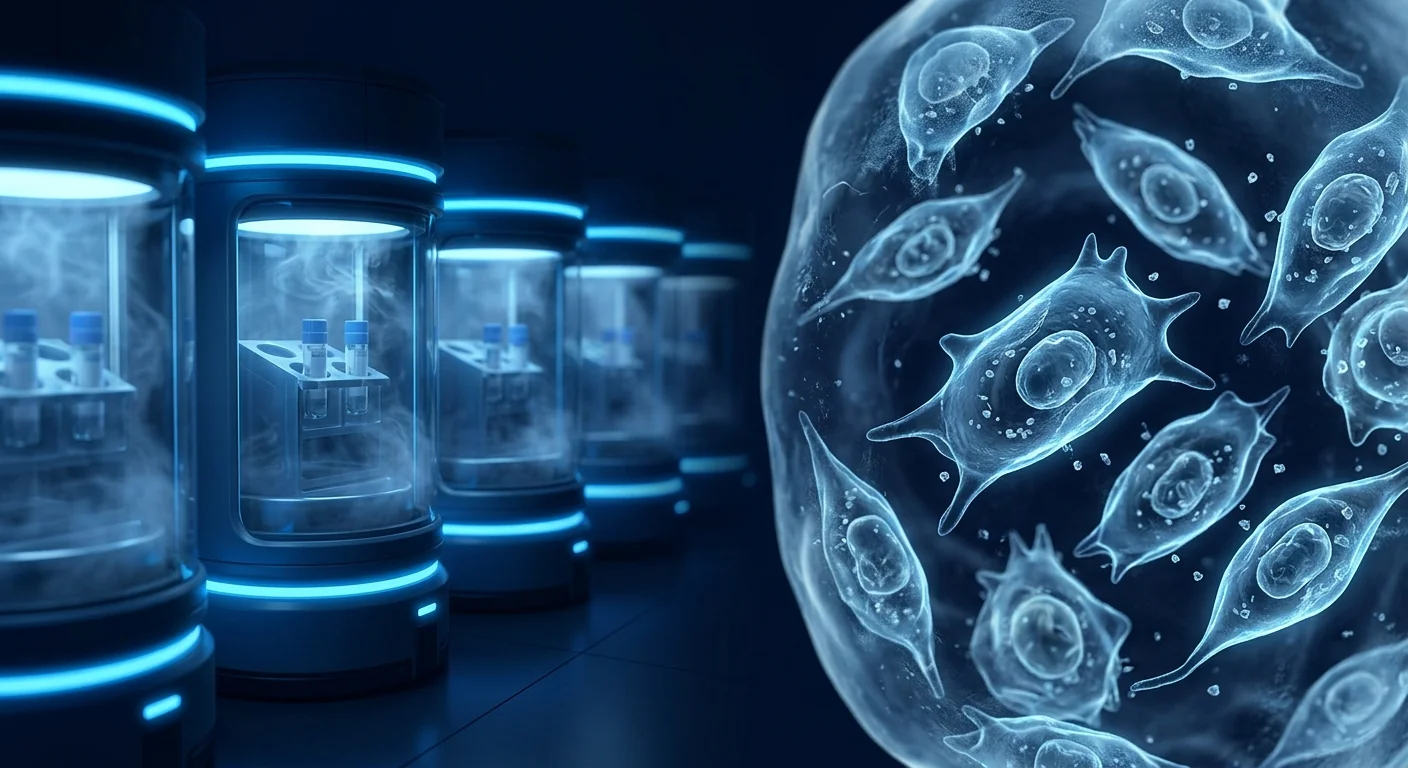
Cryopreservation is not simply freezing cells — it is a precisely controlled process that puts living cells into a state of suspended animation. When done correctly, cryopreserved MSCs can be stored for decades with minimal loss of viability or function. The science behind this has advanced dramatically in the past 20 years.
The cryopreservation process. After harvesting MSCs from adipose tissue or bone marrow, the cells are isolated, expanded in culture under cGMP conditions, and then prepared for freezing. They are suspended in a cryoprotectant solution — typically containing dimethyl sulfoxide (DMSO) at 5–10% — which prevents ice crystal formation inside and between cells. Ice crystals are the enemy: they puncture cell membranes and denature proteins, destroying viability. The cell suspension is then cooled at a controlled rate (approximately −1°C per minute) using a programmable-rate freezer before being transferred to liquid nitrogen vapor-phase storage at approximately −196°C. At this temperature, all biological activity ceases — the cells are in true suspended animation. [4] [5]
What happens after thawing. When properly cryopreserved MSCs are thawed, research consistently shows that they recover with >85–90% viability and retain their characteristic immunophenotype (CD73⁺, CD90⁺, CD105⁺), differentiation capacity, and paracrine secretory profile. Multiple studies have compared fresh versus cryopreserved MSCs head-to-head and found no significant difference in therapeutic efficacy in preclinical models of myocardial infarction, stroke, osteoarthritis, and graft-versus-host disease. The cells are not identical — cryopreserved MSCs show transient changes in heat-shock protein expression and adhesion molecule display immediately post-thaw — but these normalize within 24–48 hours of culture or infusion. [6] [7]
Viability Post-Thaw
Properly cryopreserved MSCs routinely demonstrate >85–90% viability after thawing. Quality banks validate this for every batch. The International Society for Cell & Gene Therapy (ISCT) recommends >70% as the minimum release criterion.
Shelf Life
Cells stored in liquid nitrogen vapor phase at −196°C have no known expiration date. Cord blood units stored for over 25 years have been successfully thawed and transplanted with full engraftment. The theoretical shelf life of cryopreserved MSCs is indefinite.
Expansion Potential
A single MSC harvest can yield millions of cells that can be expanded in culture to therapeutic doses. Banking typically stores multiple vials — each containing 1–10 million cells — providing flexibility for multiple future treatments.
Identity Confirmation
Quality banks perform immunophenotyping on every stored batch, confirming expression of MSC-defining surface markers (CD73, CD90, CD105) and absence of hematopoietic markers (CD34, CD45, CD14, HLA-DR).
Who Should Consider Banking — and When
The ideal window for MSC banking is your 30s through 50s — after your body has finished developing but before the cumulative effects of aging have meaningfully diminished your cells' regenerative capacity. However, the decision is highly personal and depends on your health history, family history, and anticipated future needs.
Strong candidates for banking. Individuals with a family history of degenerative conditions — osteoarthritis, cardiovascular disease, neurodegenerative disorders, autoimmune disease — have a particularly compelling case. If you anticipate needing regenerative therapies later in life, banking your youngest-possible MSCs gives you a superior biological starting material. Athletes and individuals in physically demanding professions may also benefit: having banked cells available for orthopedic or soft-tissue applications provides a treatment option that does not require a fresh harvest — and a younger cell product — at the time of injury. [8]
Timing considerations. MSC quality begins a slow but measurable decline starting around age 35–40, accelerating after 60. Banking in your 30s or 40s captures cells near peak biological quality. That said, cells banked at 55 are still more valuable than cells harvested fresh at 75 — and for many individuals, banking at any age before significant disease onset is worthwhile. The key principle: your youngest available cells are almost always your best cells.
Current and Emerging Therapeutic Applications
Banked MSCs are not speculative assets waiting for science to catch up — they are already relevant to a wide range of therapeutic applications. Many of the conditions that MSCs are being studied for are conditions you may reasonably encounter as you age.
Orthopedic and musculoskeletal. MSCs are being used in clinical settings for osteoarthritis, cartilage defects, tendon injuries, and bone repair. Having your own banked cells eliminates the need for a fresh bone marrow or adipose harvest at the time of treatment — a significant convenience and comfort advantage, especially for older patients. [9]
Autoimmune and inflammatory conditions. The immunomodulatory properties of MSCs — their ability to suppress aberrant T-cell and B-cell responses, modulate macrophage polarization, and secrete anti-inflammatory cytokines — make them candidate therapies for conditions like rheumatoid arthritis, lupus, Crohn's disease, and multiple sclerosis. Several MSC products have received regulatory approval for autoimmune indications including graft-versus-host disease and Crohn's fistula. [10]
Cardiovascular and metabolic. Preclinical and early clinical studies suggest MSCs may improve cardiac function after myocardial infarction, promote vascular repair in peripheral artery disease, and improve metabolic parameters in type 2 diabetes. These are conditions with high prevalence in aging populations — precisely the populations most likely to benefit from banked, younger cells. [11]
Neurodegenerative and age-related decline. Emerging research is exploring MSCs for Alzheimer's, Parkinson's, and general frailty — conditions where the regenerative demands on aged tissue may outstrip what endogenous repair mechanisms can deliver. The logic of banking: younger MSCs have superior neurotrophic factor secretion, better migration to sites of injury, and greater resistance to oxidative stress. [12]
Quality Standards: What Separates a Good Bank from a Bad One
Not all stem cell banks are equal. The difference between a banked cell product that is safe, viable, and therapeutically useful — versus one that is not — comes down to the quality systems and standards the bank operates under.
cGMP compliance. The facility processing and storing your cells should operate under Current Good Manufacturing Practice (cGMP) standards — the same regulatory framework that governs pharmaceutical manufacturing. cGMP ensures traceability, sterility, environmental monitoring, and rigorous quality control at every step from tissue collection through cryopreservation and storage. [13]
Accreditation and certification. Look for banks accredited by international bodies such as the Foundation for the Accreditation of Cellular Therapy (FACT) or AABB (formerly the American Association of Blood Banks). These organizations audit facilities against comprehensive standards covering donor eligibility, processing, storage, distribution, and quality management. ISO 9001 certification for quality management systems and ISO 17025 for laboratory competence are also strong signals of operational rigor.
Release testing. Every banked batch should undergo release testing including sterility (bacterial, fungal, mycoplasma), endotoxin levels, viability, identity (immunophenotyping by flow cytometry), and potency (trilineage differentiation assay or validated surrogate). A bank that cannot produce a certificate of analysis for your stored cells is not operating at a clinical-grade standard.
Storage infrastructure. Cells should be stored in liquid nitrogen vapor phase (not liquid phase, which carries a theoretical risk of cross-contamination between vials). The facility should have redundant power supplies, continuous temperature monitoring with alarm systems, and a disaster recovery plan. These are not luxuries — they are the minimum for preserving a therapeutic asset over decades.
Costs, Logistics, and Practical Considerations
Stem cell banking is a significant financial commitment, but the cost structure has become more accessible in recent years. Most banks charge an initial processing fee — covering tissue collection, cell isolation, expansion, cryopreservation, and quality testing — plus an annual storage fee.
Typical Cost Structure
Initial processing: USD 1,500–5,000 depending on the bank, the number of vials stored, and whether expansion is included.
Annual storage: USD 150–500 per year.
10-year total: Approximately USD 3,000–10,000.
Compared to the cost of a single MSC treatment course — which often runs USD 10,000–25,000 — banking represents a modest fraction of the total therapeutic investment, and the biological quality advantage of younger cells may translate into better outcomes.
The collection procedure. MSC collection is a minimally invasive outpatient procedure — typically a small-volume lipoaspirate (fat harvest) under local anesthesia, or a bone marrow aspirate from the iliac crest. Adipose tissue collection takes 30–60 minutes with minimal downtime; bone marrow aspiration is similarly brief but may involve slightly more post-procedure discomfort. Both are far simpler procedures than most patients anticipate.
What to ask before committing. (1) Is your facility cGMP-certified? (2) What accreditations do you hold (FACT, AABB, ISO)? (3) Can you provide a sample certificate of analysis? (4) How many vials will be stored and at what cell count per vial? (5) What cryoprotectant do you use and what is the validated viability recovery rate? (6) What happens to my cells if the bank ceases operations? (7) Can my cells be shipped to any clinic worldwide, or are there restrictions?
Limitations and Honest Caveats
Stem cell banking is a forward-looking decision, not a proven therapeutic guarantee. Several important limitations deserve honest acknowledgment.
Regulatory uncertainty. The regulatory landscape for cell therapies is evolving rapidly. A banked MSC product that meets today's standards may require additional validation or re-processing to meet future regulatory requirements in your jurisdiction. This is a manageable risk — most quality banks anticipate evolving standards and design their processes accordingly — but it is real.
Not all future therapies may use your cell type. The field of regenerative medicine is moving in multiple directions simultaneously: induced pluripotent stem cells (iPSCs), embryonic stem cells, allogeneic "off-the-shelf" MSC products, and gene-edited cells are all advancing. Your banked MSCs are one arrow in a growing quiver — not necessarily the only arrow you will want or need.
Cost-effectiveness is unproven. There are no randomized controlled trials comparing outcomes in patients treated with their own younger banked MSCs versus allogeneic donor MSCs or fresh autologous MSCs harvested at the time of treatment. The biological rationale is strong — younger cells are demonstrably more potent — but the clinical superiority of banked-younger MSCs over alternatives has not been formally proven in head-to-head trials.
Storage failure risk. While modern cryogenic storage is extremely reliable, no system is failure-proof. Power outages, equipment malfunction, natural disasters, and bank insolvency are all theoretical risks. Quality banks mitigate these with redundant infrastructure and disaster recovery plans, but the risk cannot be reduced to zero.
Frequently Asked Questions
How long can MSCs be stored and still be viable?
Cord blood stem cells have been successfully transplanted after over 25 years of cryogenic storage with full engraftment. MSCs stored in liquid nitrogen vapor phase at −196°C have no known biological expiration — all metabolic activity ceases at this temperature. Quality banks regularly test retained samples to confirm ongoing viability. The theoretical shelf life is indefinite.
What is the difference between cord blood banking and adult MSC banking?
Cord blood contains hematopoietic stem cells (HSCs) that produce blood and immune cells — primarily used for bone marrow transplantation in hematological malignancies. MSCs from adipose tissue or bone marrow are multipotent stromal cells with broader regenerative capabilities: bone, cartilage, muscle, immunomodulation, and anti-inflammatory activity. They serve fundamentally different therapeutic purposes and are complementary rather than alternative options.
Is the collection procedure painful or risky?
Adipose tissue collection (mini-liposuction) is performed under local anesthesia and takes 30–60 minutes. Most patients describe mild discomfort similar to a dental procedure and return to normal activities within 24 hours. Bone marrow aspiration is slightly more involved but still an outpatient procedure with minimal recovery time. Serious complications from either procedure are rare when performed by experienced clinicians.
How much does stem cell banking cost in Thailand?
In Thailand, MSC banking typically costs USD 2,000–4,000 for initial processing and USD 200–400 per year for ongoing storage. Prices vary by facility, number of vials, and whether cell expansion is included. This is generally lower than equivalent services in the United States or Europe, reflecting Thailand's competitive position in the medical tourism and cell therapy sectors.
Can I use my banked cells at any clinic, or only the bank's own clinic?
This depends on the bank's policies and the regulatory framework in the destination country. Most quality banks will release your cells to any licensed medical facility with appropriate documentation and regulatory clearance. However, cross-border shipment of cellular products involves import/export permits, chain-of-custody documentation, and compliance with both the source and destination country's regulations. Confirm shipping policies and any restrictions before banking.
References
- Ganguly P, El-Jawhari JJ, Giannoudis PV, Burska AN, Ponchel F, Jones EA. Age-related changes in bone marrow mesenchymal stromal cells: a potential impact on osteoporosis and osteoarthritis development. Cell Transplantation. 2017;26(9):1520-1529. doi:10.1177/0963689717721201 ↩
- Stolzing A, Jones E, McGonagle D, Scutt A. Age-related changes in human bone marrow-derived mesenchymal stem cells: consequences for cell therapies. Mechanisms of Ageing and Development. 2008;129(3):163-173. doi:10.1016/j.mad.2007.12.002 ↩
- Dominici M, Le Blanc K, Mueller I, et al. Minimal criteria for defining multipotent mesenchymal stromal cells. The International Society for Cellular Therapy position statement. Cytotherapy. 2006;8(4):315-317. doi:10.1080/14653240600855905 ↩
- Hunt CJ. Cryopreservation of human stem cells for clinical application: a review. Transfusion Medicine and Hemotherapy. 2011;38(2):107-123. doi:10.1159/000326623 ↩
- Marquez-Curtis LA, Janowska-Wieczorek A, McGann LE, Elliott JAW. Mesenchymal stromal cells derived from various tissues: biological, clinical and cryopreservation aspects. Cryobiology. 2015;71(2):181-197. doi:10.1016/j.cryobiol.2015.07.003 ↩
- Moll G, Geißler S, Catar R, et al. Cryopreserved or fresh mesenchymal stromal cells: only a matter of taste or key to unleash the full clinical potential of MSC therapy? Advances in Experimental Medicine and Biology. 2016;951:77-98. doi:10.1007/978-3-319-45457-3_7 ↩
- François M, Copland IB, Yuan S, Romieu-Mourez R, Waller EK, Galipeau J. Cryopreserved mesenchymal stromal cells display impaired immunosuppressive properties as a result of heat-shock response and impaired interferon-γ licensing. Cytotherapy. 2012;14(2):147-152. doi:10.3109/14653249.2011.623691 ↩
- Siegel G, Kluba T, Hermanutz-Klein U, Bieback K, Northoff H, Schäfer R. Phenotype, donor age and gender affect function of human bone marrow-derived mesenchymal stromal cells. BMC Medicine. 2013;11:146. doi:10.1186/1741-7015-11-146 ↩
- Freitag J, Bates D, Boyd R, et al. Mesenchymal stem cell therapy in the treatment of osteoarthritis: reparative pathways, safety and efficacy — a review. BMC Musculoskeletal Disorders. 2016;17:230. doi:10.1186/s12891-016-1085-9 ↩
- Le Blanc K, Mougiakakos D. Multipotent mesenchymal stromal cells and the innate immune system. Nature Reviews Immunology. 2012;12(5):383-396. doi:10.1038/nri3209 ↩
- Hare JM, Fishman JE, Gerstenblith G, et al. Comparison of allogeneic vs autologous bone marrow–derived mesenchymal stem cells delivered by transendocardial injection in patients with ischemic cardiomyopathy: the POSEIDON randomized trial. JAMA. 2012;308(22):2369-2379. doi:10.1001/jama.2012.25321 ↩
- Lunn JS, Sakowski SA, Hur J, Feldman EL. Stem cell technology for neurodegenerative diseases. Annals of Neurology. 2011;70(3):353-361. doi:10.1002/ana.22487 ↩
- Thirumala S, Goebel WS, Woods EJ. Manufacturing and banking of mesenchymal stem cells. Expert Opinion on Biological Therapy. 2013;13(5):673-691. doi:10.1517/14712598.2013.763925 ↩
- Galipeau J, Sensébé L. Mesenchymal stromal cells: clinical challenges and therapeutic opportunities. Cell Stem Cell. 2018;22(6):824-833. doi:10.1016/j.stem.2018.05.004 ↩
- Caplan AI. Mesenchymal stem cells: time to change the name! Stem Cells Translational Medicine. 2017;6(6):1445-1451. doi:10.1002/sctm.17-0051 ↩
干细胞储存是当今您可以做出的最具前瞻性的健康投资之一。原理很简单:您的间充质干细胞(MSC)在更年轻、更健康时最具活力。通过超低温冷冻保存将它们储存起来,您就锁定了这种细胞青春,保留了一种治疗资源,可以在数年或数十年后当您的身体最需要再生时调用。本文探讨了MSC储存的工作原理、科学依据以及您在做出明智决策时需要了解的内容。
为什么现在储存至关重要。MSC的质量——其增殖能力、分化潜力和旁分泌活性——会随着年龄增长而可测量地下降。研究表明,与年轻供体相比,从年长供体获取的MSC显示出集落形成效率降低、端粒更短、衰老标志物增加以及免疫调节效力减弱。通过在30多岁或40多岁时储存细胞,您将保留一个比在60或70岁时新鲜采集更具生物学能力的治疗产品。[1] [2]
超越脐带血——成人MSC储存的价值。脐带血储存——在出生时从脐带血中收集造血干细胞——已有数十年的历史。但脐带血主要含有造血干细胞,其在血细胞和免疫细胞生产中具有谱系限制。相比之下,MSC是具有更广泛再生能力的多能基质细胞:它们可以分化为骨、软骨、肌肉和脂肪谱系,并分泌强效的抗炎、免疫调节和促再生因子。储存成人MSC——通常来自脂肪组织或骨髓——为您提供了根本不同且更多功能的治疗资产。[3]
坦诚的声明
干细胞储存并非对未来治疗的保证——它是一种保险政策。您可能有一天会用储存的细胞进行治疗的应用,在许多情况下仍处于研究阶段。但再生医学的方向是明确的:基于细胞的治疗在心脏病学、神经病学、骨科、自身免疫和美容领域正在快速推进。今天的储存是对生物学现实的保障:您的细胞永远不会比现在更年轻。
冷冻保存如何保持细胞活力
冷冻保存不仅仅是冷冻细胞——它是一个精确控制的过程,将活细胞置于假死状态。如果操作得当,冷冻保存的MSC可以储存数十年而活力和功能损失极小。其背后的科学在过去20年中取得了显著进步。
冷冻保存过程。从脂肪组织或骨髓获取MSC后,细胞被分离出来,在cGMP条件下进行培养扩增,然后准备冷冻。它们被悬浮在冷冻保护剂溶液中——通常含有5-10%的二甲基亚砜(DMSO)——以防止细胞内和细胞间冰晶形成。冰晶是敌人:它们刺穿细胞膜并使蛋白质变性,破坏活力。然后使用可编程速率冷冻机以受控速率(约-1°C/分钟)冷却细胞悬液,再转移到约-196°C的液氮气相储存中。在这个温度下,所有生物活动停止——细胞进入真正的假死状态。[4] [5]
解冻后会发生什么。当正确冷冻保存的MSC解冻后,研究一致显示它们恢复超过85-90%的活力,并保留其特征性免疫表型(CD73⁺、CD90⁺、CD105⁺)、分化能力和旁分泌分泌谱。多项研究对新鲜MSC与冷冻保存的MSC进行了头对头比较,在心肌梗死、中风、骨关节炎和移植物抗宿主病的临床前模型中未发现治疗效果的显著差异。细胞并不完全相同——冷冻保存的MSC在解冻后立即显示出热休克蛋白表达和粘附分子显示的短暂变化——但这些在培养或输注后的24-48小时内恢复正常。[6] [7]
解冻后活力
正确冷冻保存的MSC在解冻后常规显示>85-90%的活力。优质储存库对每批样品进行验证。国际细胞与基因治疗学会(ISCT)建议将>70%作为最低释放标准。
保存期限
在-196°C液氮气相中储存的细胞没有已知的过期日期。储存超过25年的脐带血单位已被成功解冻和移植,并实现了完全植入。冷冻保存MSC的理论保存期是无限的。
扩增潜力
单次MSC采集可以产生数百万个细胞,可以在培养中扩增至治疗剂量。储存通常存储多个小瓶——每个含100-1000万个细胞——为多次未来治疗提供灵活性。
身份确认
优质储存库对每个储存批次进行免疫表型分析,确认MSC定义表面标志物(CD73、CD90、CD105)的表达和造血标志物(CD34、CD45、CD14、HLA-DR)的缺失。
谁应该考虑储存——以及何时储存
MSC储存的理想窗口期是30多岁到50多岁——在您的身体完成发育之后,但在衰老的累积效应显著降低细胞再生能力之前。然而,这个决定非常个人化,取决于您的健康史、家族史和预期的未来需求。
储存的强力候选者。有退行性疾病家族史的个体——骨关节炎、心血管疾病、神经退行性疾病、自身免疫疾病——有特别令人信服的理由。如果您预计在晚年需要再生治疗,储存您最年轻的MSC为您提供优越的生物起始材料。运动员和从事体力要求高职业的个体也可能受益:拥有储存的细胞用于骨科或软组织应用,提供了一种不需要在受伤时新鲜采集——以及更年轻的细胞产品的治疗选择。[8]
时机考量。MSC质量从大约35-40岁开始缓慢但可测量的下降,60岁后加速。在30多岁或40多岁时储存可以捕获接近峰值生物质量的细胞。尽管如此,55岁时储存的细胞仍然比75岁时新鲜采集的细胞更有价值——对许多人来说,在任何年龄在显著疾病发作前储存都是值得的。关键原则:您最年轻的可用细胞几乎总是您最好的细胞。
当前和新兴的治疗应用
储存的MSC并非等待科学赶上的投机资产——它们已经与广泛的治疗应用相关。许多正在研究的MSC治疗条件正是您在衰老过程中可能合理遇到的条件。
骨科和肌肉骨骼。MSC在临床上被用于骨关节炎、软骨缺损、肌腱损伤和骨修复。拥有自己储存的细胞无需在治疗时进行新鲜骨髓或脂肪采集——这是一个显著的便利和舒适优势,尤其对年长患者而言。[9]
自身免疫和炎症性疾病。MSC的免疫调节特性——抑制异常T细胞和B细胞反应、调节巨噬细胞极化和分泌抗炎细胞因子的能力——使它们成为类风湿关节炎、狼疮、克罗恩病和多发性硬化等疾病的候选治疗。几种MSC产品已获得监管批准用于自身免疫适应症,包括移植物抗宿主病和克罗恩瘘管。[10]
心血管和代谢。临床前和早期临床研究表明,MSC可能改善心肌梗死后的心脏功能,促进外周动脉疾病的血管修复,并改善2型糖尿病的代谢参数。这些是老年人群中高发的疾病——正是最有可能从储存的更年轻细胞中受益的人群。[11]
神经退行性和年龄相关衰退。新兴研究正在探索MSC用于阿尔茨海默病、帕金森病和一般衰弱——在这些情况下,衰老组织对再生的需求可能超过内源性修复机制的能力。储存的逻辑:更年轻的MSC具有优越的神经营养因子分泌、更好的损伤部位迁移能力和更强的抗氧化应激能力。[12]
质量标准:区分好的储存库和差的储存库
并非所有干细胞储存库都一样。储存的细胞产品是否安全、有活力且在治疗上有用——取决于储存库运营所依据的质量体系和标准。
cGMP合规。处理和储存您细胞的设施应在现行良好生产规范(cGMP)标准下运营——这是与药品制造相同的监管框架。cGMP确保从组织采集到冷冻保存和储存的每一步的可追溯性、无菌性、环境监测和严格的质量控制。[13]
认证和认可。寻找获得国际机构认可的储存库,如细胞治疗认证基金会(FACT)或AABB(前美国血库协会)。这些组织根据涵盖供体资格、处理、储存、分发和质量管理的全面标准对设施进行审计。ISO 9001质量管理体系认证和ISO 17025实验室能力认证也是操作严谨性的有力信号。
放行检测。每个储存批次都应经过放行检测,包括无菌(细菌、真菌、支原体)、内毒素水平、活力、身份(流式细胞术免疫表型分析)和效力(三系分化测定或经验证的替代指标)。一个无法为您的储存细胞提供分析证书的储存库,不符合临床级标准。
储存基础设施。细胞应储存在液氮气相中(而非液相,液相在理论上存在小瓶间交叉污染的风险)。设施应具有冗余电源、带报警系统的持续温度监控和灾难恢复计划。这些不是奢侈品——它们是数十年保存治疗资产的最低要求。
成本、物流和实际考量
干细胞储存是一项重大的财务承诺,但近年来费用结构变得更加可及。大多数储存库收取初始处理费——涵盖组织采集、细胞分离、扩增、冷冻保存和质量检测——加上年度储存费。
典型费用结构
初始处理:1,500-5,000美元,取决于储存库、储存的小瓶数量和是否包含扩增。
年度储存:每年150-500美元。
10年总费用:约3,000-10,000美元。
与单个MSC治疗疗程的费用相比(通常为10,000-25,000美元),储存仅占总治疗投资的一小部分,而更年轻细胞的生物学质量优势可能转化为更好的结果。
采集程序。MSC采集是一种微创门诊程序——通常是在局部麻醉下的小量脂肪抽吸,或从髂嵴抽取骨髓。脂肪组织采集需要30-60分钟,恢复期短;骨髓穿刺同样简短,但可能涉及术后轻微不适。两者都比大多数患者预期的简单得多。
承诺前要问的问题。(1)您的设施是否通过cGMP认证?(2)您持有哪些认证(FACT、AABB、ISO)?(3)您能提供分析证书样本吗?(4)将储存多少个小瓶,每个小瓶的细胞计数是多少?(5)您使用什么冷冻保护剂,经过验证的活力恢复率是多少?(6)如果储存库停止运营,我的细胞会怎么样?(7)我的细胞可以运送到全球任何诊所,还是有限制?
限制与坦诚的告诫
干细胞储存是一个前瞻性的决定,而非经过验证的治疗保证。几个重要限制值得坦诚承认。
监管不确定性。细胞治疗的监管格局正在快速演变。符合今天标准的储存MSC产品可能需要额外的验证或重新处理才能满足您所在司法管辖区的未来监管要求。这是一个可管理的风险——大多数优质储存库会预期不断发展的标准并相应设计其流程——但它是真实存在的。
并非所有未来治疗都可能使用您的细胞类型。再生医学领域同时在多个方向上发展:诱导多能干细胞(iPSC)、胚胎干细胞、异体"现成"MSC产品以及基因编辑细胞都在推进。您储存的MSC是一个不断增长的武器库中的一支箭——不一定是您想要或需要的唯一箭头。
成本效益未经证实。没有随机对照试验比较患者使用自己更年轻的储存MSC与异体供体MSC或治疗时采集的新鲜自体MSC的结果。生物学原理是强有力的——更年轻的细胞明显更具活力——但储存的更年轻MSC相对于替代品的临床优越性尚未在头对头试验中正式证明。
储存失败风险。虽然现代低温储存极其可靠,但没有系统是万无一失的。停电、设备故障、自然灾害和储存库破产都是理论上的风险。优质储存库通过冗余基础设施和灾难恢复计划来缓解这些风险,但风险无法降至零。
常见问题
MSC可以储存多久仍能保持活力?
脐带血干细胞已在超过25年的低温储存后成功移植并实现完全植入。在-196°C液氮气相中储存的MSC没有已知的生物学有效期——在此温度下所有代谢活动停止。优质储存库定期测试保留样品以确认持续活力。理论保存期是无限的。
脐带血储存和成人MSC储存有什么区别?
脐带血含有造血干细胞(HSC),可产生血液和免疫细胞——主要用于血液恶性肿瘤的骨髓移植。来自脂肪组织或骨髓的MSC是具有更广泛再生能力的多能基质细胞:骨、软骨、肌肉、免疫调节和抗炎活性。它们服务于根本不同的治疗目的,是互补而非替代选择。
采集程序疼痛或有风险吗?
脂肪组织采集(微型吸脂)在局部麻醉下进行,需要30-60分钟。大多数患者描述为类似于牙科手术的轻微不适,并在24小时内恢复正常活动。骨髓穿刺略微复杂,但仍是门诊程序,恢复时间短。两者由经验丰富的临床医生操作时,严重并发症都很少见。
在泰国干细胞储存的费用是多少?
在泰国,MSC储存的初始处理费用通常为2,000-4,000美元,年度储存费用为200-400美元。费用因设施、小瓶数量和是否包含细胞扩增而异。这通常低于美国或欧洲的等效服务,反映了泰国在医疗旅游和细胞治疗领域的竞争地位。
我可以在任何诊所使用储存的细胞,还是只能在储存库自己的诊所使用?
这取决于储存库的政策和目的地国家的监管框架。大多数优质储存库会将您的细胞释放给任何有适当文件和监管许可的持照医疗机构。然而,细胞产品的跨境运输涉及进/出口许可、监管链文件以及来源国和目的地国法规的合规性。在储存前确认运输政策和任何限制。
参考文献
- Ganguly P, El-Jawhari JJ, Giannoudis PV, Burska AN, Ponchel F, Jones EA. Age-related changes in bone marrow mesenchymal stromal cells. Cell Transplantation. 2017;26(9):1520-1529. doi:10.1177/0963689717721201 ↩
- Stolzing A, Jones E, McGonagle D, Scutt A. Age-related changes in human bone marrow-derived mesenchymal stem cells. Mech Ageing Dev. 2008;129(3):163-173. doi:10.1016/j.mad.2007.12.002 ↩
- Dominici M, Le Blanc K, Mueller I, et al. Minimal criteria for defining multipotent mesenchymal stromal cells. Cytotherapy. 2006;8(4):315-317. doi:10.1080/14653240600855905 ↩
- Hunt CJ. Cryopreservation of human stem cells for clinical application. Transfus Med Hemother. 2011;38(2):107-123. doi:10.1159/000326623 ↩
- Marquez-Curtis LA, et al. Mesenchymal stromal cells derived from various tissues. Cryobiology. 2015;71(2):181-197. doi:10.1016/j.cryobiol.2015.07.003 ↩
- Moll G, Geißler S, Catar R, et al. Cryopreserved or fresh mesenchymal stromal cells. Adv Exp Med Biol. 2016;951:77-98. doi:10.1007/978-3-319-45457-3_7 ↩
- François M, et al. Cryopreserved mesenchymal stromal cells display impaired immunosuppressive properties. Cytotherapy. 2012;14(2):147-152. doi:10.3109/14653249.2011.623691 ↩
- Siegel G, et al. Phenotype, donor age and gender affect function of human bone marrow-derived mesenchymal stromal cells. BMC Medicine. 2013;11:146. doi:10.1186/1741-7015-11-146 ↩
- Freitag J, et al. Mesenchymal stem cell therapy in the treatment of osteoarthritis. BMC Musculoskelet Disord. 2016;17:230. doi:10.1186/s12891-016-1085-9 ↩
- Le Blanc K, Mougiakakos D. Multipotent mesenchymal stromal cells and the innate immune system. Nat Rev Immunol. 2012;12(5):383-396. doi:10.1038/nri3209 ↩
- Hare JM, et al. Comparison of allogeneic vs autologous bone marrow-derived mesenchymal stem cells. JAMA. 2012;308(22):2369-2379. doi:10.1001/jama.2012.25321 ↩
- Lunn JS, Sakowski SA, Hur J, Feldman EL. Stem cell technology for neurodegenerative diseases. Ann Neurol. 2011;70(3):353-361. doi:10.1002/ana.22487 ↩
- Thirumala S, Goebel WS, Woods EJ. Manufacturing and banking of mesenchymal stem cells. Expert Opin Biol Ther. 2013;13(5):673-691. doi:10.1517/14712598.2013.763925 ↩
- Galipeau J, Sensébé L. Mesenchymal stromal cells: clinical challenges and therapeutic opportunities. Cell Stem Cell. 2018;22(6):824-833. doi:10.1016/j.stem.2018.05.004 ↩
- Caplan AI. Mesenchymal stem cells: time to change the name! Stem Cells Transl Med. 2017;6(6):1445-1451. doi:10.1002/sctm.17-0051 ↩
تخزين الخلايا الجذعية هو أحد أكثر الاستثمارات الاستشرافية في الصحة التي يمكنك القيام بها اليوم. المبدأ بسيط: الخلايا الجذعية الوسيطة (MSCs) تكون في أقصى قوتها عندما تكون أصغر سنًا وأكثر صحة. من خلال تخزينها الآن — عبر الحفظ بالتبريد في درجات حرارة شديدة الانخفاض — فإنك تحافظ على شبابها الخلوي، محتفظًا بمورد علاجي يمكن استخدامه بعد سنوات أو عقود عندما يحتاج جسمك إلى التجديد أكثر من أي وقت مضى. تستعرض هذه المقالة كيفية عمل تخزين الخلايا الجذعية الوسيطة، وما يدعمه العلم، وما تحتاج إلى معرفته لاتخاذ قرار مستنير.
لماذا التخزين مهم الآن. جودة الخلايا الجذعية الوسيطة — قدرتها التكاثرية، وإمكانية تمايزها، ونشاطها الباراكريني — تنخفض بشكل قابل للقياس مع تقدم العمر. تظهر الدراسات أن الخلايا الجذعية الوسيطة المأخوذة من متبرعين أكبر سنًا تظهر كفاءة أقل في تكوين المستعمرات، وتيلوميرات أقصر، وعلامات شيخوخة متزايدة، وقدرة مناعية تنظيمية منخفضة مقارنة بالخلايا من متبرعين أصغر سنًا. من خلال تخزين خلاياك في الثلاثينيات أو الأربعينيات من العمر، فإنك تحتفظ بمنتج علاجي أكثر قدرة بيولوجيًا مما سيكون متاحًا من حصاد جديد في سن الستين أو السبعين. [1] [2]
ما وراء دم الحبل السري — حالة تخزين الخلايا الجذعية الوسيطة البالغة. تخزين دم الحبل السري — جمع الخلايا الجذعية المكونة للدم من دم الحبل السري عند الولادة — متاح منذ عقود. لكن دم الحبل السري يحتوي أساسًا على خلايا جذعية مكونة للدم، وهي مقيدة النسب بإنتاج خلايا الدم والمناعة. على النقيض، الخلايا الجذعية الوسيطة هي خلايا سدوية متعددة القدرات ذات قدرات تجديدية أوسع بكثير: يمكنها التمايز إلى عظام وغضاريف وعضلات ودهون، وتفرز مزيجًا قويًا من العوامل المضادة للالتهابات والمناعية والمساعدة على التجديد. تخزين الخلايا الجذعية الوسيطة البالغة — عادة من الأنسجة الدهنية أو نخاع العظم — يمنحك أصلًا علاجيًا مختلفًا وأكثر تنوعًا. [3]
التصريح الصريح
تخزين الخلايا الجذعية ليس ضمانًا للعلاج المستقبلي — إنه وثيقة تأمين. العلاجات التي قد تستخدم خلاياك المخزنة من أجلها يومًا ما لا تزال، في كثير من الحالات، قيد البحث. لكن اتجاه الطب التجديدي لا لبس فيه: العلاجات القائمة على الخلايا تتقدم بسرعة في أمراض القلب والأعصاب والعظام والمناعة الذاتية والتجميل. التخزين اليوم يحميك من الحقيقة البيولوجية بأن خلاياك لن تكون أبدًا أصغر مما هي عليه الآن.
كيف يحافظ الحفظ بالتبريد على الفعالية الخلوية
الحفظ بالتبريد ليس مجرد تجميد للخلايا — إنه عملية مضبوطة بدقة تضع الخلايا الحية في حالة من السبات. عند إجرائه بشكل صحيح، يمكن تخزين الخلايا الجذعية الوسيطة المحفوظة بالتبريد لعقود مع فقدان ضئيل للحيوية أو الوظيفة. لقد تقدم العلم وراء ذلك بشكل كبير في السنوات العشرين الماضية.
عملية الحفظ بالتبريد. بعد حصاد الخلايا الجذعية الوسيطة من الأنسجة الدهنية أو نخاع العظم، يتم عزل الخلايا وتوسيعها في المزرعة تحت ظروف ممارسات التصنيع الجيدة الحالية (cGMP)، ثم تحضيرها للتجميد. يتم تعليقها في محلول واقٍ من التجمد — يحتوي عادةً على ثنائي ميثيل سلفوكسيد (DMSO) بنسبة 5-10٪ — مما يمنع تكوين بلورات الثلج داخل الخلايا وفيما بينها. بلورات الثلج هي العدو: تثقب أغشية الخلايا وتغير طبيعة البروتينات، مما يدمر الحيوية. ثم يتم تبريد معلق الخلايا بمعدل مضبوط (حوالي -1 درجة مئوية في الدقيقة) باستخدام مجمد قابل للبرمجة قبل نقله إلى تخزين الطور البخاري للنيتروجين السائل عند حوالي -196 درجة مئوية. عند درجة الحرارة هذه، يتوقف كل نشاط بيولوجي — الخلايا في سبات حقيقي. [4] [5]
ماذا يحدث بعد الذوبان. عندما يتم إذابة الخلايا الجذعية الوسيطة المحفوظة بالتبريد بشكل صحيح، تظهر الأبحاث باستمرار أنها تستعيد أكثر من 85-90٪ من الحيوية وتحتفظ بنمطها المناعي المميز (CD73⁺، CD90⁺، CD105⁺)، وقدرة التمايز، والملف الإفرازي الباراكريني. قارنت دراسات متعددة الخلايا الجذعية الوسيطة الطازجة مقابل المحفوظة بالتبريد وجهاً لوجه ولم تجد فرقًا كبيرًا في الفعالية العلاجية في نماذج ما قبل السريرية لاحتشاء عضلة القلب والسكتة الدماغية والتهاب المفاصل التنكسي وداء الطعم ضد الثوي. الخلايا ليست متطابقة — تظهر الخلايا الجذعية الوسيطة المحفوظة بالتبريد تغيرات عابرة في تعبير بروتينات الصدمة الحرارية وعرض جزيئات الالتصاق فور الذوبان — لكنها تعود إلى طبيعتها خلال 24-48 ساعة من الزرع أو التسريب. [6] [7]
الحيوية بعد الذوبان
الخلايا الجذعية الوسيطة المحفوظة بالتبريد بشكل صحيح تظهر روتينيًا >85-90٪ حيوية بعد الذوبان. بنوك الجودة تتحقق من ذلك لكل دفعة. توصي الجمعية الدولية للعلاج الخلوي والجيني (ISCT) بأكثر من 70٪ كمعيار إطلاق أدنى.
مدة الصلاحية
الخلايا المخزنة في الطور البخاري للنيتروجين السائل عند -196 درجة مئوية ليس لها تاريخ انتهاء صلاحية معروف. تم إذابة وزرع وحدات دم الحبل السري المخزنة لأكثر من 25 عامًا بنجاح مع تطعيم كامل. العمر النظري للخلايا الجذعية الوسيطة المحفوظة بالتبريد غير محدد.
إمكانية التوسيع
حصاد واحد للخلايا الجذعية الوسيطة يمكن أن ينتج ملايين الخلايا التي يمكن توسيعها في المزرعة إلى جرعات علاجية. التخزين عادةً ما يخزن قوارير متعددة — كل منها يحتوي على 1-10 مليون خلية — مما يوفر مرونة لعلاجات مستقبلية متعددة.
تأكيد الهوية
بنوك الجودة تجري التنميط المناعي على كل دفعة مخزنة، مؤكدة التعبير عن علامات سطح الخلايا الجذعية الوسيطة المميزة (CD73، CD90، CD105) وغياب العلامات المكونة للدم (CD34، CD45، CD14، HLA-DR).
من يجب أن يفكر في التخزين — ومتى
النافذة المثالية لتخزين الخلايا الجذعية الوسيطة هي من الثلاثينيات إلى الخمسينيات من العمر — بعد أن يكتمل نمو جسمك ولكن قبل أن تؤثر التأثيرات التراكمية للشيخوخة بشكل كبير على القدرة التجديدية لخلاياك. ومع ذلك، القرار شخصي للغاية ويعتمد على تاريخك الصحي وتاريخ عائلتك واحتياجاتك المستقبلية المتوقعة.
المرشحون الأقوياء للتخزين. الأفراد الذين لديهم تاريخ عائلي من الحالات التنكسية — التهاب المفاصل التنكسي، أمراض القلب والأوعية الدموية، الاضطرابات التنكسية العصبية، أمراض المناعة الذاتية — لديهم حجة قوية بشكل خاص. إذا كنت تتوقع الحاجة إلى علاجات تجديدية في وقت لاحق من الحياة، فإن تخزين أصغر خلايا جذعية وسيطة ممكنة يمنحك مادة بداية بيولوجية متفوقة. الرياضيون والأفراد في المهن التي تتطلب جهدًا بدنيًا قد يستفيدون أيضًا: توفر الخلايا المخزنة للاستخدامات العظمية أو الأنسجة الرخوة خيارًا علاجيًا لا يتطلب حصادًا جديدًا — ومنتجًا خلويًا أصغر سنًا — في وقت الإصابة. [8]
اعتبارات التوقيت. جودة الخلايا الجذعية الوسيطة تبدأ انخفاضًا بطيئًا لكن قابلًا للقياس بدءًا من حوالي 35-40 عامًا، متسارعة بعد 60 عامًا. التخزين في الثلاثينيات أو الأربعينيات يلتقط خلايا قريبة من ذروة الجودة البيولوجية. ومع ذلك، الخلايا المخزنة في سن 55 لا تزال أكثر قيمة من الخلايا المحصودة طازجة في سن 75 — وبالنسبة للعديد من الأفراد، التخزين في أي عمر قبل بداية المرض الكبير يستحق العناء. المبدأ الأساسي: أصغر خلاياك المتاحة هي دائمًا تقريبًا أفضل خلاياك.
التطبيقات العلاجية الحالية والناشئة
الخلايا الجذعية الوسيطة المخزنة ليست أصولًا تخمينية تنتظر العلم ليلحق بها — إنها ذات صلة بالفعل بمجموعة واسعة من التطبيقات العلاجية. العديد من الحالات التي تُدرس الخلايا الجذعية الوسيطة لعلاجها هي حالات قد تواجهها بشكل معقول مع تقدمك في العمر.
العظام والعضلات الهيكلية. تُستخدم الخلايا الجذعية الوسيطة في البيئات السريرية لالتهاب المفاصل التنكسي وعيوب الغضاريف وإصابات الأوتار وإصلاح العظام. امتلاك خلاياك المخزنة يلغي الحاجة إلى حصاد نخاع عظمي أو دهون طازج في وقت العلاج — ميزة راحة وملاءمة كبيرة، خاصة للمرضى الأكبر سنًا. [9]
الحالات المناعية الذاتية والالتهابية. الخصائص المناعية التنظيمية للخلايا الجذعية الوسيطة — قدرتها على تثبيط استجابات الخلايا التائية والبائية الشاذة، وتعديل استقطاب الخلايا البلعمية، وإفراز السيتوكينات المضادة للالتهابات — تجعلها علاجات مرشحة لحالات مثل التهاب المفاصل الروماتويدي والذئبة ومرض كرون والتصلب المتعدد. حصلت العديد من منتجات الخلايا الجذعية الوسيطة على موافقة تنظيمية لمؤشرات المناعة الذاتية بما في ذلك داء الطعم ضد الثوي وناسور كرون. [10]
القلب والأوعية الدموية والتمثيل الغذائي. تشير الدراسات ما قبل السريرية والسريرية المبكرة إلى أن الخلايا الجذعية الوسيطة قد تحسن وظيفة القلب بعد احتشاء عضلة القلب، وتعزز الإصلاح الوعائي في مرض الشرايين الطرفية، وتحسن المعايير الأيضية في السكري من النوع الثاني. هذه حالات ذات انتشار مرتفع في السكان المسنين — بالضبط السكان الأكثر احتمالية للاستفادة من الخلايا المخزنة الأصغر سنًا. [11]
التنكس العصبي والتدهور المرتبط بالعمر. تستكشف الأبحاث الناشئة الخلايا الجذعية الوسيطة لمرض الزهايمر وباركنسون والضعف العام — حالات قد تتجاوز فيها المطالب التجديدية على الأنسجة المسنة ما يمكن أن تقدمه آليات الإصلاح الداخلية. منطق التخزين: الخلايا الجذعية الوسيطة الأصغر سنًا لديها إفراز متفوق للعوامل العصبية التغذوية، وهجرة أفضل إلى مواقع الإصابة، ومقاومة أكبر للإجهاد التأكسدي. [12]
معايير الجودة: ما يميز البنك الجيد عن السيئ
ليست كل بنوك الخلايا الجذعية متساوية. الفرق بين منتج خلوي مخزن آمن وحيوي ومفيد علاجيًا — مقابل منتج ليس كذلك — يعود إلى أنظمة ومعايير الجودة التي يعمل البنك بموجبها.
الامتثال لـ cGMP. يجب أن تعمل المنشأة التي تعالج وتخزن خلاياك تحت معايير ممارسات التصنيع الجيدة الحالية (cGMP) — نفس الإطار التنظيمي الذي يحكم تصنيع الأدوية. يضمن cGMP قابلية التتبع والتعقيم والمراقبة البيئية ومراقبة الجودة الصارمة في كل خطوة من جمع الأنسجة مرورًا بالحفظ بالتبريد والتخزين. [13]
الاعتماد والشهادة. ابحث عن بنوك معتمدة من هيئات دولية مثل مؤسسة اعتماد العلاج الخلوي (FACT) أو AABB (الجمعية الأمريكية لبنوك الدم سابقًا). تقوم هذه المنظمات بتدقيق المرافق وفقًا لمعايير شاملة تغطي أهلية المتبرع والمعالجة والتخزين والتوزيع وإدارة الجودة. شهادة ISO 9001 لأنظمة إدارة الجودة وISO 17025 لكفاءة المختبرات هي أيضًا إشارات قوية على الدقة التشغيلية.
اختبار الإطلاق. يجب أن تخضع كل دفعة مخزنة لاختبار الإطلاق بما في ذلك التعقيم (البكتيريا والفطريات والميكوبلازما)، ومستويات السموم الداخلية، والحيوية، والهوية (التنميط المناعي بواسطة قياس التدفق الخلوي)، والفعالية (اختبار التمايز ثلاثي السلالات أو بديل معتمد). البنك الذي لا يستطيع تقديم شهادة تحليل لخلاياك المخزنة لا يعمل بمعيار الدرجة السريرية.
البنية التحتية للتخزين. يجب تخزين الخلايا في الطور البخاري للنيتروجين السائل (وليس الطور السائل، الذي يحمل خطرًا نظريًا للتلوث المتبادل بين القوارير). يجب أن يكون لدى المنشأة مصادر طاقة احتياطية ومراقبة مستمرة لدرجة الحرارة مع أنظمة إنذار وخطة للتعافي من الكوارث. هذه ليست كماليات — إنها الحد الأدنى للحفاظ على أصل علاجي على مدى عقود.
التكاليف واللوجستيات والاعتبارات العملية
تخزين الخلايا الجذعية هو التزام مالي كبير، لكن هيكل التكلفة أصبح أكثر سهولة في السنوات الأخيرة. معظم البنوك تفرض رسوم معالجة أولية — تغطي جمع الأنسجة وعزل الخلايا والتوسيع والحفظ بالتبريد واختبار الجودة — بالإضافة إلى رسوم تخزين سنوية.
هيكل التكلفة النموذجي
المعالجة الأولية: 1,500–5,000 دولار أمريكي حسب البنك وعدد القوارير المخزنة وما إذا كان التوسيع مشمولاً.
التخزين السنوي: 150–500 دولار أمريكي سنويًا.
إجمالي 10 سنوات: حوالي 3,000–10,000 دولار أمريكي.
مقارنة بتكلفة دورة علاج واحدة بالخلايا الجذعية الوسيطة — التي غالبًا ما تبلغ 10,000–25,000 دولار أمريكي — يمثل التخزين جزءًا متواضعًا من إجمالي الاستثمار العلاجي، وقد تترجم ميزة الجودة البيولوجية للخلايا الأصغر سنًا إلى نتائج أفضل.
إجراء التجميع. جمع الخلايا الجذعية الوسيطة هو إجراء خارجي طفيف التوغل — عادةً شفط دهون صغير الحجم تحت التخدير الموضعي، أو شفط نخاع العظم من العرف الحرقفي. يستغرق جمع الأنسجة الدهنية 30-60 دقيقة مع وقت تعطل ضئيل؛ شفط نخاع العظم قصير بالمثل لكن قد يتضمن انزعاجًا أكثر قليلاً بعد الإجراء. كلاهما أبسط بكثير مما يتوقعه معظم المرضى.
ما يجب السؤال عنه قبل الالتزام. (1) هل منشأتكم معتمدة بـ cGMP؟ (2) ما الاعتمادات التي تحملونها (FACT، AABB، ISO)؟ (3) هل يمكنكم تقديم عينة من شهادة التحليل؟ (4) كم عدد القوارير التي سيتم تخزينها وبأي عدد خلايا لكل قارورة؟ (5) ما الواقي من التجمد الذي تستخدمونه وما هو معدل استعادة الحيوية المعتمد؟ (6) ماذا يحدث لخلاياي إذا توقف البنك عن العمل؟ (7) هل يمكن شحن خلاياي إلى أي عيادة في جميع أنحاء العالم، أم أن هناك قيودًا؟
القيود والتحفظات الصريحة
تخزين الخلايا الجذعية هو قرار استشرافي، وليس ضمانًا علاجيًا مثبتًا. تستحق العديد من القيود المهمة اعترافًا صريحًا.
عدم اليقين التنظيمي. المشهد التنظيمي للعلاجات الخلوية يتطور بسرعة. منتج الخلايا الجذعية الوسيطة المخزن الذي يلبي معايير اليوم قد يتطلب تحققًا إضافيًا أو إعادة معالجة لتلبية المتطلبات التنظيمية المستقبلية في منطقتك. هذا خطر يمكن إدارته — معظم بنوك الجودة تتوقع المعايير المتطورة وتصمم عملياتها وفقًا لذلك — لكنه حقيقي.
ليست كل العلاجات المستقبلية قد تستخدم نوع خلاياك. مجال الطب التجديدي يتحرك في اتجاهات متعددة في وقت واحد: الخلايا الجذعية المستحثة متعددة القدرات (iPSCs)، الخلايا الجذعية الجنينية، منتجات الخلايا الجذعية الوسيطة الجاهزة الخيفية، والخلايا المحررة جينيًا كلها تتقدم. خلاياك الجذعية الوسيطة المخزنة هي سهم واحد في جعبة متنامية — وليس بالضرورة السهم الوحيد الذي سترغب فيه أو تحتاجه.
الفعالية من حيث التكلفة غير مثبتة. لا توجد تجارب عشوائية محكومة تقارن النتائج في المرضى المعالجين بخلاياهم الجذعية الوسيطة المخزنة الأصغر سنًا مقابل الخلايا الجذعية الوسيطة الخيفية من متبرع أو الخلايا الجذعية الوسيطة الذاتية الطازجة المحصودة في وقت العلاج. الأساس البيولوجي قوي — الخلايا الأصغر سنًا أكثر فعالية بشكل واضح — لكن التفوق السريري للخلايا الجذعية الوسيطة المخزنة الأصغر سنًا على البدائل لم يتم إثباته رسميًا في تجارب وجهاً لوجه.
خطر فشل التخزين. بينما التخزين الحديث بالتبريد موثوق للغاية، لا يوجد نظام مضمون تمامًا. انقطاع التيار الكهربائي، عطل المعدات، الكوارث الطبيعية، وإفلاس البنك كلها مخاطر نظرية. بنوك الجودة تخفف من هذه المخاطر ببنية تحتية احتياطية وخطط للتعافي من الكوارث، لكن الخطر لا يمكن تخفيضه إلى الصفر.
الأسئلة الشائعة
كم من الوقت يمكن تخزين الخلايا الجذعية الوسيطة وتبقى حيوية؟
تم زرع خلايا دم الحبل السري الجذعية بنجاح بعد أكثر من 25 عامًا من التخزين بالتبريد مع تطعيم كامل. الخلايا الجذعية الوسيطة المخزنة في الطور البخاري للنيتروجين السائل عند -196 درجة مئوية ليس لها تاريخ انتهاء صلاحية بيولوجي معروف — كل نشاط الأيض يتوقف عند درجة الحرارة هذه. بنوك الجودة تختبر بانتظام العينات المحفوظة لتأكيد الحيوية المستمرة. العمر النظري غير محدد.
ما الفرق بين تخزين دم الحبل السري وتخزين الخلايا الجذعية الوسيطة البالغة؟
دم الحبل السري يحتوي على خلايا جذعية مكونة للدم (HSCs) تنتج خلايا الدم والمناعة — تستخدم أساسًا لزرع نخاع العظم في الأورام الدموية الخبيثة. الخلايا الجذعية الوسيطة من الأنسجة الدهنية أو نخاع العظم هي خلايا سدوية متعددة القدرات ذات قدرات تجديدية أوسع: العظام والغضاريف والعضلات والتنظيم المناعي والنشاط المضاد للالتهابات. إنها تخدم أغراضًا علاجية مختلفة تمامًا وهي خيارات متكاملة وليست بديلة.
هل إجراء التجميع مؤلم أو محفوف بالمخاطر؟
جمع الأنسجة الدهنية (شفط دهون صغير) يُجرى تحت التخدير الموضعي ويستغرق 30-60 دقيقة. يصف معظم المرضى انزعاجًا خفيفًا مشابهًا لإجراء الأسنان ويعودون إلى الأنشطة الطبيعية خلال 24 ساعة. شفط نخاع العظم أكثر تعقيدًا قليلاً لكنه لا يزال إجراءً خارجيًا مع وقت تعافٍ قصير. المضاعفات الخطيرة من أي من الإجراءين نادرة عند إجرائها من قبل أطباء ذوي خبرة.
كم تبلغ تكلفة تخزين الخلايا الجذعية في تايلاند؟
في تايلاند، تبلغ تكلفة تخزين الخلايا الجذعية الوسيطة عادةً 2,000–4,000 دولار أمريكي للمعالجة الأولية و200–400 دولار أمريكي سنويًا للتخزين المستمر. تختلف الأسعار حسب المنشأة وعدد القوارير وما إذا كان توسيع الخلايا مشمولاً. هذا عمومًا أقل من الخدمات المكافئة في الولايات المتحدة أو أوروبا، مما يعكس موقع تايلاند التنافسي في قطاعي السياحة العلاجية والعلاج بالخلايا.
هل يمكنني استخدام خلاياي المخزنة في أي عيادة، أم فقط في عيادة البنك نفسه؟
هذا يعتمد على سياسات البنك والإطار التنظيمي في بلد الوجهة. معظم بنوك الجودة ستفرج عن خلاياك لأي منشأة طبية مرخصة بوثائق مناسبة وتصريح تنظيمي. ومع ذلك، الشحن عبر الحدود للمنتجات الخلوية يتضمن تصاريح استيراد/تصدير وتوثيق سلسلة الحفظ والامتثال للوائح كل من بلد المصدر وبلد الوجهة. تأكد من سياسات الشحن وأي قيود قبل التخزين.
المراجع
- Ganguly P, et al. Age-related changes in bone marrow mesenchymal stromal cells. Cell Transplantation. 2017;26(9):1520-1529. doi:10.1177/0963689717721201 ↩
- Stolzing A, et al. Age-related changes in human bone marrow-derived mesenchymal stem cells. Mech Ageing Dev. 2008;129(3):163-173. doi:10.1016/j.mad.2007.12.002 ↩
- Dominici M, et al. Minimal criteria for defining multipotent mesenchymal stromal cells. Cytotherapy. 2006;8(4):315-317. doi:10.1080/14653240600855905 ↩
- Hunt CJ. Cryopreservation of human stem cells for clinical application. Transfus Med Hemother. 2011;38(2):107-123. doi:10.1159/000326623 ↩
- Marquez-Curtis LA, et al. Mesenchymal stromal cells derived from various tissues. Cryobiology. 2015;71(2):181-197. doi:10.1016/j.cryobiol.2015.07.003 ↩
- Moll G, et al. Cryopreserved or fresh mesenchymal stromal cells. Adv Exp Med Biol. 2016;951:77-98. doi:10.1007/978-3-319-45457-3_7 ↩
- François M, et al. Cryopreserved mesenchymal stromal cells display impaired immunosuppressive properties. Cytotherapy. 2012;14(2):147-152. doi:10.3109/14653249.2011.623691 ↩
- Siegel G, et al. Phenotype, donor age and gender affect function of human bone marrow-derived mesenchymal stromal cells. BMC Medicine. 2013;11:146. doi:10.1186/1741-7015-11-146 ↩
- Freitag J, et al. Mesenchymal stem cell therapy in the treatment of osteoarthritis. BMC Musculoskelet Disord. 2016;17:230. doi:10.1186/s12891-016-1085-9 ↩
- Le Blanc K, Mougiakakos D. Multipotent mesenchymal stromal cells and the innate immune system. Nat Rev Immunol. 2012;12(5):383-396. doi:10.1038/nri3209 ↩
- Hare JM, et al. Comparison of allogeneic vs autologous bone marrow-derived mesenchymal stem cells. JAMA. 2012;308(22):2369-2379. doi:10.1001/jama.2012.25321 ↩
- Lunn JS, et al. Stem cell technology for neurodegenerative diseases. Ann Neurol. 2011;70(3):353-361. doi:10.1002/ana.22487 ↩
- Thirumala S, Goebel WS, Woods EJ. Manufacturing and banking of mesenchymal stem cells. Expert Opin Biol Ther. 2013;13(5):673-691. doi:10.1517/14712598.2013.763925 ↩
- Galipeau J, Sensébé L. Mesenchymal stromal cells: clinical challenges and therapeutic opportunities. Cell Stem Cell. 2018;22(6):824-833. doi:10.1016/j.stem.2018.05.004 ↩
- Caplan AI. Mesenchymal stem cells: time to change the name! Stem Cells Transl Med. 2017;6(6):1445-1451. doi:10.1002/sctm.17-0051 ↩